
Research & Sources
Who Were the Nine Ringwraiths?
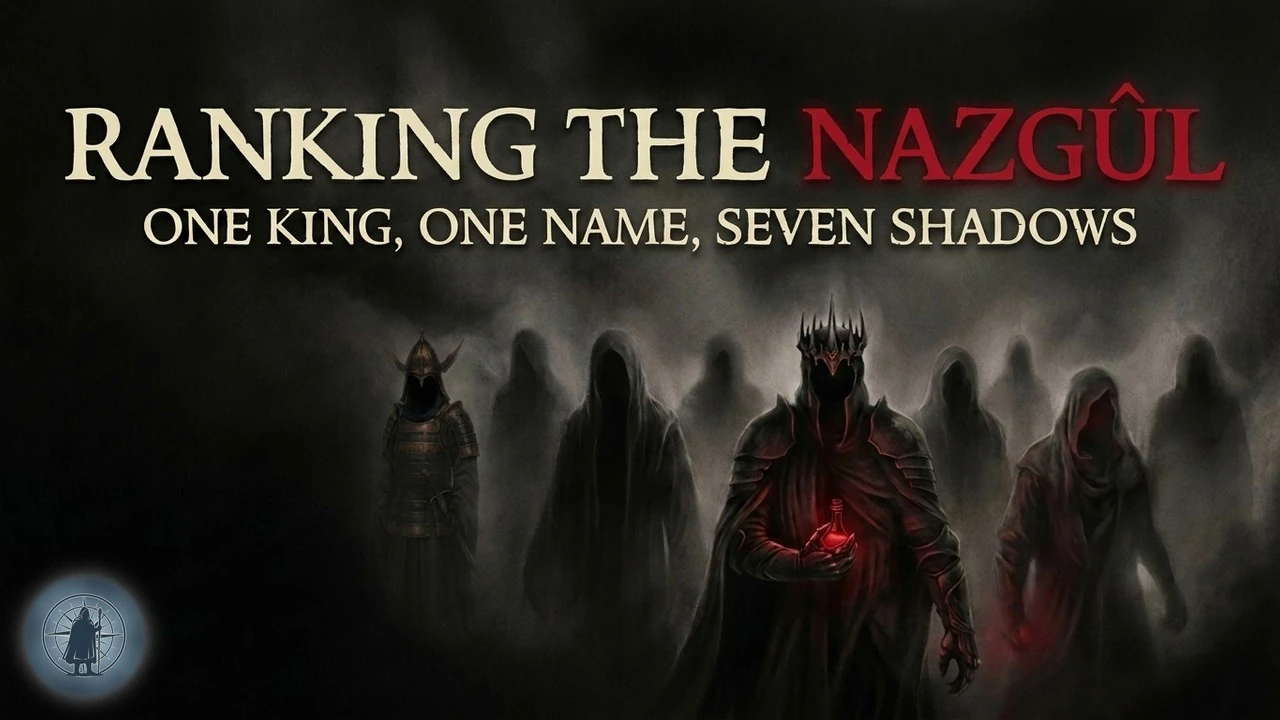 Watch the episode
Who Were the Nine Ringwraiths? | Only One Nazgûl Has a Name
Watch the episode
Who Were the Nine Ringwraiths? | Only One Nazgûl Has a Name
Research Notes: The Nine Nazgûl Ranked — Why Only Two Have Names
Overview
The Nazgûl (Black Speech, "Ring-wraiths") were nine mortal Men who accepted Rings of Power from Sauron in the Second Age and were consumed by them, becoming Sauron's most terrible servants until the destruction of the One Ring. The episode's honest, text-grounded ranking rests on a hard fact that most fans get wrong: Tolkien named only one of the Nine — Khamûl the Easterling. The Witch-king of Angmar is identified throughout, but "Witch-king" and "Lord of the Nazgûl" are titles, not a personal name; his name was never given. Every other circulating "Nazgûl name" (Dwar, Ûvatha, Akhôrahil, Adûnaphel, Ren, Hoarmûrath, Morgomir) is a 1980s–90s invention of Iron Crown Enterprises' Middle-earth Role Playing (MERP) game, with no basis in Tolkien.
So an honest ranking is really three tiers built on evidence density: (1) the Witch-king — richly detailed across LOTR, its Appendices, and Unfinished Tales; (2) Khamûl — the one named lieutenant, with a handful of concrete facts from Unfinished Tales; (3) the seven unnamed — about whom Tolkien said almost nothing beyond their number, three of them being of Númenórean origin, and their collective powers and weaknesses. The thematic core: the Nine Rings didn't just grant power — they consumed identity itself. Namelessness is the answer to what the Rings ate. As Gandalf says, they became wraiths "under the domination of the One," faceless extensions of Sauron's will.
Primary Sources
The Lord of the Rings
Gandalf on the Nine's fate ("The Shadow of the Past," FOTR):
"Nine [Rings] he gave to Mortal Men, proud and great, and so ensnared them. Long ago they fell under the dominion of the One, and they became Ringwraiths, shadows under his great Shadow, his most terrible servants."
"A mortal, Frodo, who keeps one of the Great Rings, does not die, but he does not grow or obtain more life, he merely continues, until at last every minute is a weariness."
Gandalf on their dependence on Sauron ("The Ring Goes South," FOTR):
"The power of their master is in them, and they stand or fall by him."
Aragorn on their senses ("A Knife in the Dark," FOTR):
"They themselves do not see the world of light as we do, but our shapes cast shadows in their minds, which only the noon sun destroys; and in the dark they perceive many signs and forms that are hidden from us... And at all times they smell the blood of living things, desiring and hating it."(This is the crucial passage on their perception and their daylight weakness.)
The Witch-king at the Pelennor ("The Battle of the Pelennor Fields," ROTK):
"Upon it sat a shape, black-mantled, huge and threatening. A crown of steel he bore, but between rim and robe naught was there to see, save only a deadly gleam of eyes: the Lord of the Nazgûl."
The Éowyn confrontation (ROTK):
Witch-king: "Hinder me? Thou fool. No living man may hinder me!"
Éowyn: "But no living man am I! You look upon a woman. Éowyn I am, Éomund's daughter. You stand between me and my lord and kin. Begone, if you be not deathless! For living or dark undead, I will smite you, if you touch him."
The Silmarillion — "Of the Rings of Power and the Third Age"
"Men proved easier to ensnare. Those who used the Nine Rings became mighty in their day, kings, sorcerers, and warriors of old. They obtained glory and great wealth, yet it turned to their undoing. They had, as it seemed, unending life, yet life became unendurable to them... And one by one, sooner or later, according to their native strength and to the good or evil of their wills in the beginning, they fell under the thraldom of the ring that they bore and under the domination of the One... And they became for ever invisible save to him that wore the Ruling Ring, and they entered into the realm of shadows. The Nazgûl were they, the Ringwraiths, the Enemy's most terrible servants; darkness went with them, and they cried with the voices of death."
This is the single most important passage for the theme: the Nine gained everything the world offers a mortal ruler — power, wealth, apparent immortality — and lost themselves entirely. No names survive because there were no selves left to name.
The Akallabêth
The Ringwraiths are referenced as already active in the later Second Age; three of the Nine were "great lords of Númenórean race" who had been seduced by Sauron's rings during the years of Númenor's decline (the source for the "three Númenórean lords" fact repeated in translator's notes and Unfinished Tales).
Unfinished Tales — "The Hunt for the Ring" (Part Three, IV)
The deployment of the Nine (the key Khamûl passage):
"Now at that time the Chieftain of the Ring-wraiths dwelt in Minas Morgul with six companions, while the second to the Chief, Khamûl the Shadow of the East, abode in Dol Guldur as Sauron's lieutenant, with one other as his messenger."
Their weaknesses — the Witch-king's uniqueness (critical for the ranking):
"All except the Witch-king were apt to stray when alone by daylight; and all, again save the Witch-king, feared water, and were unwilling, except in dire need, to enter it or to cross streams unless dryshod by a bridge."
This is the textual basis for the Witch-king's "immunity." Note precisely: it is not stated that sunlight or water could destroy him and not the others — rather, the Witch-king alone did not stray in daylight and did not fear water. Frame it as his singular composure/mastery, not literal invulnerability.
Khamûl's Ring-sense and daylight confusion: Christopher Tolkien's notes record that Khamûl, of all the Nazgûl after the Witch-king, was the most sensitive to the presence of the Ring — but was also the most easily confused and diminished by daylight (paraphrased from the same section's notes on the Nazgûl who searched the Shire and the Anduin vales).
At the Ford of Bruinen: the horses were destroyed and the wraiths unhorsed; the Witch-king returned to Mordor to be re-equipped, and the Nine were re-armed and given the winged fell beasts.
The Letters of J.R.R. Tolkien
Letter 210 (to Forrest J. Ackerman, June 1958 — the rejection of Morton Grady Zimmerman's film treatment):
"Their peril is almost entirely due to the unreasoning fear which they inspire (like ghosts). They have no great physical power against the fearless; but what they have, and the fear that they inspire, is enormously increased in darkness."
Also in Letter 210, Tolkien objected that Zimmerman had the Black Riders scream as they attacked, insisting they should keep a more terrifying near-silence. This is the definitive statement that terror, not physical might, is the Nazgûl's chief weapon.
Letter 246:
"Sauron... still through their nine rings (which he held) had primary control of their wills."(Confirms Sauron physically held the Nine Rings and controlled the wraiths through them — they had no independent will to preserve a name.)
Timeline
Second Age: - c. SA 1500s — The Nine (with the Seven and lesser rings) forged by the Elven-smiths of Eregion under Sauron's tutelage. - c. SA 1600 — Sauron forges the One Ring in Orodruin to rule all the others. - SA 1693–1701 — War of the Elves and Sauron; Sauron seizes the Rings he can (the Nine among them). - c. SA 2251 — "The Nazgûl first appeared" (Tale of Years, Appendix B). The nine Men, corrupted "one by one," have fully become Ringwraiths. - SA 3441 — Sauron overthrown by the Last Alliance; the Nazgûl pass into shadow with him.
Third Age: - c. TA 1300 — The Nazgûl reappear. The Lord of the Nazgûl founds the realm of Angmar in the north, capital at Carn Dûm, to destroy the Dúnedain successor-kingdoms of Arnor (Arthedain, Rhudaur, Cardolan). - TA 1409 — Angmar overruns Rhudaur and Cardolan; the Tower of Amon Sûl (Weathertop) falls. - TA 1974–75 — Angmar destroys Arthedain (fall of Fornost); at the Battle of Fornost (1975) a host from Gondor under Eärnur, with Elves under Glorfindel, routs Angmar. Glorfindel prophesies: "Far off yet is his doom, and not by the hand of man will he fall." (Appendix A). - c. TA 1980 — The Witch-king abandons the north, returns to Mordor, and gathers the Nazgûl. - TA 2000–2002 — The Nazgûl besiege and take Minas Ithil, capturing its palantír; the city is renamed Minas Morgul. The Witch-king becomes the Lord of Morgul. - c. TA 2043 / 2050 — As Witch-king, he challenges King Eärnur of Gondor to single combat; Eärnur eventually rides to Minas Morgul and is lost, ending the line of the Kings of Gondor. - TA 2951 — Sauron declares himself openly; three Nazgûl are sent to reoccupy Dol Guldur (Khamûl among them, as Sauron's lieutenant there). - TA 3018 — the Hunt for the Ring: - June — Sauron assaults Osgiliath; the Nine cross the Anduin in secret (mid-July, re-equipped at Sarn Gebir). - Sept 22 — The Nazgûl drive the Rangers from Sarn Ford and enter the Shire. - Sept 23 — A wraith (traditionally identified with Khamûl, searching the Shire/Anduin vales) questions the Gaffer in Hobbiton. - Sept 29 – Oct 3 — Pursuit through Bree; attack on Crickhollow. - Oct 6 — Weathertop: the Witch-king stabs Frodo with the Morgul-knife. - Oct 11 — Glorfindel drives three Nazgûl from the Last Bridge. - Oct 20 — Ford of Bruinen: all nine are swept away by the flood raised by Elrond (wielded by Gandalf); horses destroyed, wraiths unhorsed and forced back to Mordor. - TA 3019: - Re-armed with winged fell beasts. - March 15 — Battle of the Pelennor Fields: the Witch-king breaks the Gate of Minas Tirith with Grond, slays Théoden, and is destroyed by Éowyn (with Merry's Barrow-blade breaking the spell on his knee) — fulfilling Glorfindel's prophecy: no man, but a woman and a hobbit. - March 25 — the Ring is destroyed at Orodruin; the remaining eight winged Nazgûl, flying to defend Mount Doom, are consumed in the eruption. With the One unmade, the Nine Rings lose all power and the wraiths are ended forever.
Key Characters
The Witch-king of Angmar (Lord of the Nazgûl, the Black Captain, the Morgul-lord). The chief of the Nine; likely (per translator's notes) one of the three great Númenórean lords, though never confirmed. Founder-king of Angmar; conqueror of Arnor; captor of Minas Morgul; besieger of Minas Tirith. Alone among the Nine he did not stray by daylight nor fear water (UT). Destroyed by Éowyn and Merry. He has a title, never a name.
Khamûl the Easterling (the Shadow of the East, the Black Easterling, "second to the Chief"). The only Nazgûl given a personal name by Tolkien. An Easterling lord of Rhûn in life. Sauron's lieutenant at Dol Guldur after its reoccupation. The most Ring-sensitive of the Nine after the Witch-king, but the most confused and weakened by daylight. Led search operations in the Vales of Anduin and the Shire during the Hunt for the Ring.
The seven unnamed Ringwraiths. No names, no individual histories. Tolkien records only: nine in all; three were of Númenórean race; the rest were "kings, sorcerers, and warriors" of various Mannish peoples of the East and South. Six companions dwelt with the Witch-king at Minas Morgul; one served as Khamûl's messenger at Dol Guldur. That is essentially the sum of what is canonically known of the individual seven.
Sauron. Held the Nine Rings physically and controlled the wraiths' wills through them (Letter 246).
Glorfindel. Elf-lord of Rivendell; author of the prophecy of the Witch-king's doom (Appendix A).
Geography
- Angmar / Carn Dûm — the Witch-king's northern realm (TA 1300–1975), built to destroy Arnor. - Minas Morgul (formerly Minas Ithil) — the Nazgûl's fortress in the Ephel Dúath after TA 2002; the Witch-king's seat. - Dol Guldur — Sauron's stronghold in southern Mirkwood; Khamûl's post as lieutenant. - Weathertop (Amon Sûl) — site of the Morgul-wounding of Frodo. - Ford of Bruinen — the flood that unhorsed all nine (the eight lesser wraiths' fear of water is thematically underscored here; the Witch-king alone did not fear the water but was still swept up). - Pelennor Fields / Minas Tirith — the Witch-king's fall. - Mount Doom (Orodruin) / the Morannon — the end of the remaining eight. - Rhûn — Khamûl's homeland as an Easterling.
Themes and Symbolism
1. Namelessness as the wage of the Rings. The Nine promised power, wealth, and unending life; what they took was the self. A name is the last mark of individual identity — and eight of the Nine have none, not because Tolkien forgot but because there was nothing left to name. Even the Witch-king is only a title. The wraiths are literally shadows of what they were.
2. Fear over force (Letter 210). Their weapon is dread, not muscle — "no great physical power against the fearless." The Black Breath is despair weaponized. This inverts the usual fantasy hierarchy: the most feared servants of the Enemy can be undone by courage (Éowyn, the hobbits at Bree, Frodo invoking Elbereth).
3. Immortality as damnation. "Life became unendurable to them" (Silmarillion). Deathlessness without growth is Tolkien's Catholic-inflected horror — the Gift of Men (mortality) refused and perverted into endless weariness.
4. Total subordination. They "stand or fall by" Sauron; their wills were his through the rings he held. They are the ultimate image of domination — free men who traded agency for power and became instruments.
5. Prophecy and the humble instrument. The Witch-king, mightiest of the Nine, is felled not by a great king but by a woman and a halfling — the Tolkien pattern of providence working through the overlooked.
Scholarly Perspectives
- On the "three Númenóreans": Scholars (e.g., discussions drawing on Appendix and Unfinished Tales notes) generally hold the Witch-king was probably one of the three Númenórean lords, but stress Tolkien only speculated this ("I think") — it is not settled. - On Khamûl's rank: Unfinished Tales explicitly calls him "second to the Chief," so "second-in-command" is well supported — though some fans over-read this into a formal military hierarchy the text doesn't fully spell out. - On the MERP names: Tolkien scholars and the Tolkien Gateway are emphatic that Dwar, Ûvatha, Akhôrahil, Adûnaphel, Ren, and Hoarmûrath (and Morgomir, from ICE's later War of the Ring board game) are non-canonical fan/game inventions, frequently mistaken online for Tolkien's own. This is the episode's central "myth-busting" beat. - Perception/vision analysis: Aragorn's "our shapes cast shadows in their minds, which only the noon sun destroys" is widely cited as Tolkien's clearest window into wraith-cognition — they inhabit the wraith-world, seeing spirit rather than light.
Contradictions and Variants
- Witch-king's origin. Not fixed. Sometimes implied Númenórean (translator's notes), never named or confirmed. Flag as open. - Which wraith searched the Shire. Unfinished Tales offers overlapping draft accounts; the wraith who spoke to the Gaffer is commonly identified as Khamûl, but the drafts are not perfectly consistent (Christopher Tolkien flags multiple versions of the Hunt). Treat "Khamûl in the Shire" as the best-supported reading, not an ironclad fact. - "Immunity" to sun/water. The precise text says the Witch-king alone did not stray by daylight and did not fear water — not that sunlight/water harmed the others physically while sparing him. Avoid overstating it as literal invulnerability. - Fell-beast count at the end. Eight winged Nazgûl perished at Orodruin (the Witch-king having already died at the Pelennor). Consistent across the text — but writers sometimes slip and say "nine" at Mount Doom. It is eight. - The name vs. title distinction. "Only two have names" is the hook, but the honest framing is: only one personal name (Khamûl); the Witch-king is a title. Worth stating cleanly so the episode isn't itself imprecise.
Linguistic Notes
- Nazgûl — Black Speech: nazg ("ring") + gûl ("wraith / spirit"). The same nazg appears in the Ring-inscription ("Ash nazg durbatulûk..."). - Khamûl — a name of unclear etymology; not glossed by Tolkien. Fits an Easterling/Mannish tongue, deliberately outside the Elvish naming systems — appropriately "other," a Man of the East. - Angmar — Sindarin, roughly "Iron-home / Iron-land" (ang "iron" + mar "home/dwelling"). - Carn Dûm — the Angmar capital; likely pre-Númenórean/hill-men naming. - Morgul — Sindarin mor ("black/dark") + gûl ("sorcery, wraith-spirit"); "black sorcery." Minas Morgul = "Tower of Black Sorcery." - Dwimmerlaik — Éowyn's insult, from Rohirric/Old English dweomer ("phantom, illusion, necromancy"); a "work of necromancy," a spectre.
Additional Context
The MERP material is worth naming specifically because it is the single biggest source of fandom misinformation on this topic. Iron Crown Enterprises held the Middle-earth Role Playing license from 1982 to 1999 and, needing statted-out antagonists, invented full names, homelands, and backstories for all nine wraiths (e.g., Akhôrahil "the Blind Sorcerer," Adûnaphel "the Quiet Avenger," a female Nazgûl — none of which Tolkien wrote). These names propagated through fan wikis, forums, and later video-game adaptations, so a large share of the audience will arrive believing the seven have Tolkien-given names. The episode's value is in cleanly separating canon (one name: Khamûl) from game-invention (everything else).
Questions for Further Research
- Exact wording of the Unfinished Tales note on Khamûl's superior Ring-sense and daylight-confusion (paraphrased here from secondary sources; verify against the print edition, "The Hunt for the Ring," Christopher Tolkien's notes). - Whether any History of Middle-earth volume (esp. The Peoples of Middle-earth or Sauron Defeated) adds anything to the individual wraiths — appears not, but worth a confirming pass. - The precise Akallabêth phrasing on the three Númenórean lords receiving rings.
Discrete Analytical Themes
Theme 1: The Name Ledger — One Name, One Title, Seven Blanks
Core idea: Tolkien gave exactly one Nazgûl a personal name (Khamûl); the Witch-king has only titles; the other seven have nothing — and every "name" you've heard for them is a game invention. Evidence: - "the second to the Chief, Khamûl the Shadow of the East, abode in Dol Guldur as Sauron's lieutenant" (Unfinished Tales, "The Hunt for the Ring") — the sole canonical name. - "Witch-king" / "Lord of the Nazgûl" / "the Black Captain" are titles, never a name (LOTR passim). - Dwar, Ûvatha, Akhôrahil, Adûnaphel, Ren, Hoarmûrath (and Morgomir) = Iron Crown Enterprises' MERP (1982–1999), NOT Tolkien. Distinction: This is the bibliographic/canonical theme — what the text does and does not contain — as opposed to in-world character analysis.Theme 2: Namelessness as the Rings' True Price
Core idea: The Nine consumed identity itself; the absence of names is the meaning, not an oversight — a name is the last thing a self owns, and the wraiths have none. Evidence: - "life became unendurable to them... they fell under the thraldom of the ring... and entered into the realm of shadows" (Silmarillion, "Of the Rings of Power"). - "shadows under his great Shadow" (Gandalf, FOTR). - Sauron "through their nine rings (which he held) had primary control of their wills" (Letter 246) — no independent self left to bear a name. Distinction: This is the thematic payoff — WHY namelessness matters — separate from Theme 1's factual inventory.Theme 3: The Witch-king as Tier One — Composure the Others Lacked
Core idea: The Witch-king ranks first not just by rank but by a specific textual trait: alone among the Nine he was undiminished by daylight and unafraid of water. Evidence: - "All except the Witch-king were apt to stray when alone by daylight; and all, again save the Witch-king, feared water" (Unfinished Tales). - Founder-king of Angmar (TA ~1300), conqueror of Arnor, captor of Minas Morgul. - At the Ford, the Witch-king alone rides back re-horsed; he leads at Weathertop and the Pelennor. Distinction: This is about the Witch-king's unique capabilities and mastery, not his death or the prophecy (Theme 6).Theme 4: Khamûl as Tier Two — The One Named Lieutenant
Core idea: Khamûl earns the clear #2 slot as the only named wraith, Sauron's lieutenant at Dol Guldur, and the most Ring-sensitive after the Witch-king — but hobbled by a real weakness: daylight. Evidence: - "second to the Chief... Sauron's lieutenant" at Dol Guldur (Unfinished Tales). - An Easterling lord of Rhûn in life; "the Shadow of the East," "the Black Easterling." - Best able to sense the Ring after the Witch-king, yet "most confused and diminished by daylight" (UT notes) — leads the Shire/Anduin search. Distinction: This is a single-character profile of the only other named wraith — distinct from the collective seven (Theme 5) and from the Witch-king (Theme 3).Theme 5: The Seven Shadows — What Tolkien Left in the Dark
Core idea: The bottom tier is a deliberate void — Tolkien tells us the seven's number and a few group facts, and nothing individual, which is exactly the point of a wraith. Evidence: - Three of the Nine were "great lords of Númenórean race" (Akallabêth / translator's notes) — the only sub-grouping given. - "six companions" dwell with the Witch-king at Minas Morgul; "one other" is Khamûl's messenger at Dol Guldur (Unfinished Tales) — positional, never personal. - No names, homelands, or histories for the seven anywhere in the legendarium. Distinction: This covers the collective unnamed and the honest admission of a canonical gap — the anti-Theme-4, and the reason the ranking's third tier is a tier, not seven ranked slots.Theme 6: Fear, Not Force — and the Humble Undoing
Core idea: The Nazgûl's power is terror, not physical might, which is precisely why the mightiest of them is undone by the least likely hands. Evidence: - "Their peril is almost entirely due to the unreasoning fear which they inspire... They have no great physical power against the fearless" (Letter 210). - "our shapes cast shadows in their minds, which only the noon sun destroys" (Aragorn, FOTR) — they fight in the world of dread and shadow. - Glorfindel: "not by the hand of man will he fall" → fulfilled by Éowyn ("no living man am I") and Merry's Barrow-blade (ROTK). Distinction: This is the mechanics of their power and its ironic defeat — how the ranking's #1 dies — separate from the Witch-king's capabilities (Theme 3) and the identity theme (Theme 2).Sources: The Nine Nazgûl Ranked — Why Only Two Have Names
Primary Tolkien Texts (cited, consulted via secondary quote-collections)
- The Lord of the Rings — FOTR "The Shadow of the Past," "The Ring Goes South," "A Knife in the Dark"; ROTK "The Battle of the Pelennor Fields"; Appendix A (Glorfindel's prophecy at Fornost); Appendix B (Tale of Years, Nazgûl dates). Most useful for: the Éowyn duel, the Witch-king's appearance, Gandalf on the Nine, the prophecy. - The Silmarillion — "Of the Rings of Power and the Third Age" (~p.289). Most useful for: the definitive passage on Men ensnared by the Nine and reduced to Ringwraiths ("life became unendurable... entered into the realm of shadows"). - The Akallabêth — the three Nazgûl of Númenórean race. - Unfinished Tales — Part Three, IV, "The Hunt for the Ring." MOST USEFUL SINGLE SOURCE for tier structure: names Khamûl as "second to the Chief" / Sauron's lieutenant at Dol Guldur; the "six companions" at Minas Morgul; the Witch-king's unique freedom from daylight-straying and water-fear; Khamûl's Ring-sense and daylight weakness. Verify exact wording against print. - The Letters of J.R.R. Tolkien — Letter 210 (to Forrest J. Ackerman, 1958, rejecting Zimmerman's film treatment): terror/fear as the Nazgûl's chief weapon, "no great physical power against the fearless." Letter 246: Sauron held the Nine Rings and controlled the wraiths' wills.
Web Sources Consulted
- Nazgûl — Wikipedia — reliable overview; confirms only two named, three Númenóreans, MERP name inventions, powers/weaknesses. - Thain's Book — Nazgûl (minastirith.cz) — VERY USEFUL: detailed timeline with SA/TA dates, the Hunt for the Ring day-by-day, Ford of Bruinen, Pelennor, Mount Doom (eight fell beasts), powers and weaknesses list. - Nazgûl — Tolkien Gateway (WebFetch blocked, 403; used via search snippets) — canonical wiki. - Khamûl — Tolkien Gateway (403; via snippets) — Khamûl profile. - The Nazgûl — Tolkien Essays (tolkienessays.com) — quote collection with citations; the "became rather than were mighty" nuance. - Nazgûl Quotes (circlesofpower.neocities.org) — USEFUL: exact primary quotes with book/page for FOTR, ROTK, Unfinished Tales weakness passage, Letter 210. - Sixth of the Nazgûl — Tolkien Gateway & Misconceptions — Tolkien Gateway — confirm MERP names are non-canonical. - Middle-earth Role Playing — Wikipedia — ICE/MERP license history (1982–1999); source of the invented wraith names. - Nazgûl of Dol Guldur — Master of Lore — the exact "Chieftain... dwelt in Minas Morgul with six companions, while the second to the Chief, Khamûl..." UT quotation. - Letter 210 — Tolkien Gateway & TolkienGuide L210 — context for the Zimmerman rejection and the fear passage. - Identity and Origins of the Nazgûl — A Tolkienist's Perspective — scholarly synthesis on the three Númenóreans and origins uncertainty.
Reliability Notes
- Most useful for the ranking spine: Unfinished Tales "The Hunt for the Ring" (the only text distinguishing the wraiths from one another) + Thain's Book for the timeline. - Handle with care: The specific claim that the Shire-searching wraith was Khamûl rests on overlapping UT drafts — well-supported but not airtight (Christopher Tolkien flags variant accounts). - Myth-bust anchor: Tolkien Gateway + Wikipedia both explicitly attribute the seven "names" to MERP/ICE, not Tolkien. - Print verification still advised for: the exact UT wording on Khamûl's Ring-sense/daylight weakness, and the Silmarillion page reference.