Transcript
The Maiar
Tolkien's Angels Ranked by Power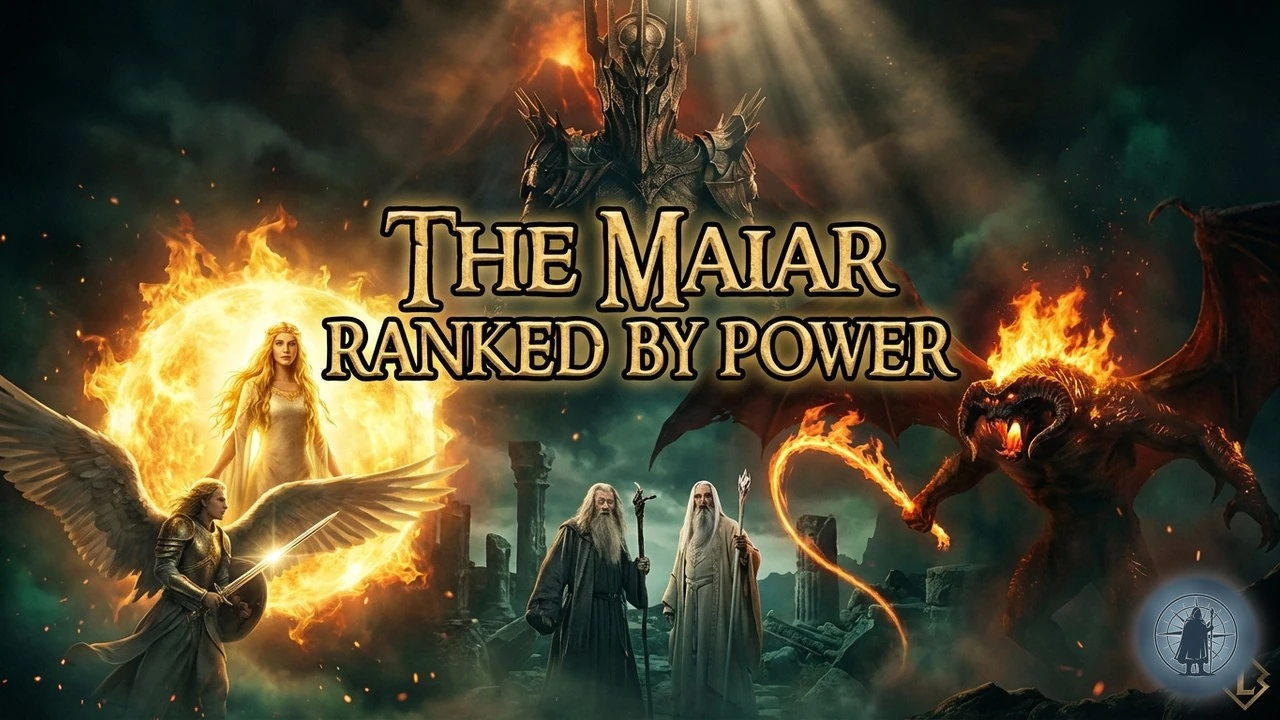 Watch the episode
The Maiar: Tolkien's Angels Ranked by Power | Silmarillion Deep Dive
Watch the episode
The Maiar: Tolkien's Angels Ranked by Power | Silmarillion Deep Dive
Main Narrative: The Maiar Power Tier List
SECTION: The Beautiful Ones -- What Are the Maiar?
How do you rank angels?
Not the sanitized, harp-playing figures of greeting cards -- the real ones. The kind that shake the ground when they walk. The kind whose mere presence can warp the world around them. In Tolkien's legendarium, these are the Maiar: angelic spirits created by Iluvatar before time itself, who descended into the world alongside the great Valar to shape it from raw possibility into living earth.
The Quenya word itself -- Maiar -- comes from the root maya-, meaning "excellent" or "admirable." Literally: the Beautiful Ones. And they were beautiful, at least in the beginning. But beauty and might are not the same thing, and among the Beautiful Ones, the range of ability was staggering.
Here's the problem. Tolkien never gave us a definitive ranking. He never sat down and said, "Sauron is number one, Eonwe is number two, and Gandalf comes in third." What he did give us, scattered across decades of letters, drafts, and published works, are clues. Tantalizing, sometimes contradictory fragments that let us piece together a picture of how these spirits compared to one another.
The single most direct statement comes from Letter 183, where Tolkien describes Sauron as "of the same kind as Gandalf and Saruman, but of a far higher order." That phrase -- "far higher order" -- confirms that the Maiar were not equals. There were gradations. Internal subdivisions. Some of these spirits were immensely more capable than others.
But the more you study those gradations, the more you realize that ranking the Maiar on a single scale is like ranking a sword, a song, a bonfire, and a fortress. They don't operate on the same axis. And that tension -- between the desire to rank and the impossibility of a clean ranking -- is what makes this exploration genuinely fascinating.
So let's try it anyway. Not because we'll arrive at a definitive list, but because the attempt reveals something profound about how Tolkien understood greatness itself.
SECTION: Four Axes of Strength
The first thing you have to accept about Maiar "power" is that the word itself is almost too blunt. Tolkien's legendarium operates on at least four distinct axes of strength, and a Maia can dominate one axis while being surprisingly limited on another.
The first axis is martial prowess -- raw combat capability. Who wins in a fight? This is the most intuitive measure, and the Valaquenta gives us a clear champion: Eonwe, the herald of Manwe, "whose might in arms is surpassed by none in Arda." If we take that at face value, Eonwe is the single greatest warrior in the entire world. Greater than Sauron. Greater than any Balrog. Greater, even, than the Valar in direct combat.
The second axis is wisdom and knowledge. This is where Gandalf -- Olorin, in Valinor -- stands supreme. The Valaquenta calls him "the wisest of the Maiar." Not the strongest, not the mightiest. The wisest. He dwelt in the Gardens of Lorien and learned compassion from Nienna, the Vala of grief. His understanding of the world and its peoples ran deeper than any other spirit of his order.
The third axis is elemental force -- the kind of primal, cosmic energy bound to the fabric of reality itself. Arien, the spirit of fire who guides the Sun, represents this category. She carries the last light of Laurelin through the heavens every day. Tolkien's early drafts ranked her as the second most potent Maia in existence. Even Morgoth -- the literal Dark Lord of the First Age -- feared to approach her. Her fire is so pure, so uncorrupted, that darkness cannot touch it.
And the fourth axis is domination and craft -- the ability to shape, manipulate, control. This is Sauron's domain. His genius was never brute force. He lost to Huan the Hound and Luthien in the First Age. His gift was the ability to bend wills, forge instruments of control, and build systems of surveillance and dominion that could operate across thousands of miles. The Rings of Power are not weapons. They're tools of subjugation -- and they are the most sophisticated artifacts any Maia ever created.
So when someone asks "who is the most powerful Maia?" the honest answer is: it depends on what you mean by powerful. The supreme warrior? Eonwe. The wisest? Gandalf. The most elementally overwhelming? Arien. The most effective at imposing his will on the world? Sauron.
But that doesn't mean we can't make some comparisons. Because certain Maiar clearly outclass others, even across different axes. And the characters who sit at the very top of this ordering are extraordinary.
SECTION: The Supreme and the Cosmic -- Tiers One and Two
Let's start at the summit.
Sauron -- Mairon, "the Admirable," before his corruption -- occupies a category largely by himself. Tolkien's own words in Letter 183 place him "of a far higher order" than the Istari, and the weight of the legendarium supports this. In his uncorrupted state, Sauron was the foremost and most beloved servant of Aule the Smith. His mastery of craft was without peer among the Maiar. His ability to take fair form, to deceive even the wisest Elves, to forge the One Ring and through it command the will of other Ring-bearers -- these represent a concentration of ability that no other known Maia approaches.
But scholars have long debated what "far higher order" actually means. Does it describe Sauron's inherent spiritual magnitude -- that he was simply born greater? Or does it reflect the diminished state of the Istari, who were deliberately handicapped in old men's bodies? The answer is probably both. Sauron was a greater spirit from the beginning, AND the wizards were constrained. The gap between them was real in both directions.
Beside Sauron -- though in a completely different register -- stands Arien. She's the most overlooked figure in any Maiar discussion, and she shouldn't be. Tolkien's drafts explicitly marked her among the most formidable of her order. Her nature is elemental fire, preserved uncorrupted through all the ages of the world. When Melkor sought to assault the Sun in early draft versions of the mythology, he could not bring himself to face her. The Dark Lord who challenged the entire host of the Valar flinched before a single spirit of flame.
Arien and Sauron represent two poles of supreme Maiar capability: one is cosmic and elemental, beyond politics and warfare; the other is strategic and dominative, bent on reshaping the world according to his will. They rarely appear in the same conversation because their domains never overlap. But in sheer spiritual stature, they stand together at the peak.
Dropping down to the next tier, we find four figures of enormous but more specialized prowess.
Eonwe, the herald of Manwe, is the undisputed champion of the battlefield -- with one caveat. The description of his martial supremacy was an editorial addition by Christopher Tolkien, not found in his father's original manuscripts. It was added to prepare readers for Eonwe's role leading the Host of the West in the War of Wrath. Whether J.R.R. Tolkien would have endorsed the claim in precisely those terms is uncertain. But the narrative supports it: Eonwe led the most overwhelming military campaign in the history of Arda, and even Sauron submitted to him in its aftermath. What makes Eonwe genuinely fascinating, though, is what he couldn't do. After Sauron knelt before him and professed repentance, Eonwe commanded him to return to Valinor for judgment. But Eonwe "had not the power to pardon Sauron." He could defeat any foe in combat, but he could not exercise mercy on his own authority. His authority was martial. His jurisdiction was not.
That scene -- Sauron kneeling before Eonwe, confessing his crimes, then being offered a path back to grace and refusing it -- is one of the most quietly devastating moments in the entire Silmarillion. The supreme warrior in Arda stands face to face with the most cunning manipulator in Arda, and neither can fully resolve the encounter. Eonwe's sword can end any foe, but it cannot compel a spirit to repent. Sauron's guile can deceive almost anyone, but it cannot fool a herald of Manwe into lowering his guard. They are, in that moment, a perfect illustration of why force and authority are not the same thing.
Melian stands beside Eonwe, though her abilities could not be more different. She served Vana and Este, was akin to Yavanna, and was the greatest enchantress among the Maiar. Her Girdle of Doriath -- an impenetrable barrier of protective magic -- held for centuries, and even Ungoliant could not breach it. But more than that: Melian did something no other Ainu ever accomplished. She married the Elf-king Thingol and bore Luthien, a half-Maia child who would herself reshape the fate of the world. Melian's capacity extended beyond enchantment into something almost maternal -- she bridged the gap between the angelic and the incarnate in a way Tolkien never repeated.
Gothmog, Lord of Balrogs, rounds out this tier as a figure of pure martial terror. High-captain of Angband, Morgoth's chief lieutenant, he personally slew two High Kings of the Noldor -- Feanor, the greatest of the Elves, and Fingon, one of the most valiant. Gothmog wielded a fiery whip and a black axe, and he fell only when Ecthelion of the Fountain drove him into a pool of water during the Fall of Gondolin, drowning them both. His name may derive from Sindarin elements meaning "Dread Voice" or "Strife of War," and either translation suits the most fearsome warrior Morgoth ever commanded.
SECTION: Fire Corrupted -- The Balrog Question
Speaking of Balrogs -- what exactly were they?
The question sounds simple, but it hides one of the deepest inconsistencies in Tolkien's published work. And the answer changes everything about how we assess their place in the pecking order.
In Quenya, they are the Valaraukar -- "Demons of Might." They were originally spirits of fire drawn to Melkor's service before the shaping of Arda. Not corrupted later, like Sauron. Drawn in from the very beginning, seduced by Melkor's discord in the Great Music. Their hearts, Tolkien writes, were of fire, but they were cloaked in darkness. They carried whips of flame.
And here's a detail that rarely gets discussed: as spirits of fire, the Balrogs share a fundamental kinship with Arien, the guardian of the Sun. She too is a fire-spirit, one of the most potent among all the Maiar. The difference is that Arien's flame remained pure -- uncorrupted, untouched by Melkor -- while the Balrogs' fire was twisted into a weapon of ruin. They are, in a sense, what Arien might have become had she fallen. The same primal elemental nature, bent toward opposite purposes.
Now here's where it gets complicated. In Tolkien's earliest writings -- the Book of Lost Tales -- Balrogs numbered in the hundreds, even thousands. Gothmog commanded legions of them. They were fearsome, certainly, but they were essentially demonic foot soldiers, powerful enough individually but not rare.
Then Tolkien changed his mind. A late marginal note, recorded by Christopher Tolkien, states that there were "at most seven" Balrogs. Possibly as few as three.
That single revision transforms them completely. Seven Balrogs is not an army. It's a council. If only seven spirits in the entire history of the world ever became Balrogs, then each one was an immensely potent individual Maia -- not a soldier, but a general. A force of nature. Something closer to Sauron's own league than to the orcs they commanded.
And the evidence supports this reading. Consider Durin's Bane, the Balrog of Moria. This creature hid beneath the Misty Mountains for more than five thousand years after the War of Wrath, and when it finally emerged, it fought Gandalf the Grey -- a Maia in his own right, one of the Istari -- to absolute mutual destruction. Their battle lasted ten days. From the deepest abyss of Moria to the peak of Zirakzigil, they fought without rest. "From the lowest dungeon to the highest peak," Gandalf tells the Fellowship, "I fought with the Balrog of Morgoth."
That isn't a skirmish with a powerful monster. That is two beings of comparable spiritual weight locked in a contest that neither can clearly win. Gandalf prevailed -- barely -- and it killed him. The fact that Durin's Bane could match an Istar for ten straight days places the Balrogs firmly among the upper echelons of Maiar potency.
There's one more detail worth noting. When Ungoliant -- that vast, primordial spider-entity whose hunger threatened even Morgoth himself -- attacked the Dark Lord after the destruction of the Two Trees, it took multiple Balrogs to drive her away. Not one. Several. Even collectively, they struggled against something whose origins are as mysterious as Tolkien ever wrote. The Balrogs were immensely formidable. But they had limits.
Below the Balrogs in the hierarchy, we find the elemental and maritime Maiar: Osse, spirit of the Inner Seas, who loved storms and coastlines and once raised the very island of Numenor from the ocean floor; his spouse Uinen, Lady of the Seas, whose calming influence over Osse's tempests was itself a form of quiet authority; Tilion, the hunter of Orome who steers the Moon but was singed when he drew too near Arien's fire. And then there is Ilmare, listed alongside Eonwe in the Valaquenta as a chief of the Maiar, handmaid of Varda and associated with starlight -- yet almost nothing survives about her actual capabilities. She is a reminder that our tier list is built on fragments. Of the eighteen or so named Maiar, most remain mysteries. How many unnamed spirits of equal or greater magnitude simply never entered any story we were told?
SECTION: The Istari Handicap -- Strength Wearing Chains
Now we come to one of the most unusual experiments in the history of Tolkien's world: the Istari.
Around the year 1000 of the Third Age, five Maiar were sent to Middle-earth in a form that deliberately constrained them. They appeared as old men -- aged, mortal-seeming, subject to hunger and weariness and pain. They were, as Tolkien describes in Letter 156, "forbidden to match his power with power, or to seek to dominate Elves or Men by force and fear."
Think about what that means. These were angelic spirits of enormous inherent capability, voluntarily shackled. Not weakened exactly -- their native essence remained -- but limited in how they could express it. They could advise. They could inspire. They could guide. But they could not simply overwhelm. They could not command armies by force of will or reshape the landscape with a thought. They were placed on a leash, and the leash was the point.
This creates a truly strange placement problem in any tier list. Where does Gandalf rank? In his unconstrained state -- as Olorin in Valinor, the wisest of the Maiar -- he might stand near the very top. But in Middle-earth, wearing the body of an old man, following rules that forbade him from unleashing his true capabilities? He's operating at a fraction of his potential.
And this is where the story of the Istari becomes a moral drama rather than a simple accounting of force.
Saruman -- Curumo, the Maia of Aule -- was recognized as the head of the order. He was given the highest rank, the most official authority. But when Cirdan the Shipwright met the Istari at the Grey Havens upon their arrival, something remarkable happened. Cirdan looked past Saruman's official status and gave Narya, the Ring of Fire, to Gandalf instead. He had "divined," Tolkien tells us, that Gandalf was "the greatest of the Istari" despite Saruman's nominal leadership.
Cirdan saw something Saruman couldn't: that true greatness among the Istari had nothing to do with brute might or official rank. It had to do with character. With purpose. With the willingness to remain within the boundaries of one's mission.
And the history of the Third Age proved Cirdan right. Saruman grasped for the Ring. Saruman built armies. Saruman tried to match Sauron's methods with Sauron's tools. He exceeded his mandate, and his reach exceeded his grasp, and he fell from the head of the order to a petty tyrant terrorizing hobbits in the Shire.
Gandalf refused the Ring. Gandalf worked through others. Gandalf died fighting the Balrog and was sent back by Iluvatar himself with enhanced authority -- not because he was the strongest, but because he was the most faithful. As Gandalf the White, he filled the role Saruman had abandoned. He could now command rather than merely advise.
But even as the White, even with Iluvatar's direct endorsement, Gandalf did not confront Sauron in a direct contest of wills. The Ring still had to be destroyed. Restraint remained his most potent weapon, even after his restraints were loosened.
The Blue Wizards -- Alatar and Pallando, Maiar of Orome -- add another layer of mystery. They went into the East and were never heard from again. Tolkien's views on their fate shifted over the decades. Early on, he suggested they probably failed, falling into corruption or founding cults of magic. Later, in notes published in The Peoples of Middle-earth, he gave them new names -- Morinehtar, "Darkness-slayer," and Romestamo, "East-helper" -- and speculated that they may have succeeded in weakening Sauron's hold on the eastern lands. We may never know. Their story is one of Tolkien's great unsolved riddles.
And then there is Radagast -- Aiwendil, "Lover of Birds," a Maia of Yavanna brought along at her specific request. Radagast became so absorbed in the natural world that he abandoned his mission against Sauron entirely. Was he weak? Not necessarily. But he was unfocused. His love of beasts and growing things consumed his attention so completely that the war against darkness simply slipped from his awareness. A gentle failing, perhaps. But a failing nonetheless.
SECTION: The Corruption Tax -- Every Grasp Diminishes
Here is the theological engine that drives Tolkien's entire hierarchy: in his world, evil does not create. It corrupts. It twists. And every act of corruption costs the corruptor something that can never be recovered.
This principle -- what we might call the corruption tax -- operates as an iron law across every fallen Maia in the legendarium. The more you reach for domination, the more of yourself you must spend.
Consider the original pattern. Morgoth, the first Dark Lord, dispersed his own native force throughout the physical substance of Arda itself. This is the concept Tolkien calls "Morgoth's Ring" -- the entire material world became his ring of power, saturated with his will. But the cost was catastrophic. By the end of the First Age, Morgoth -- who had once been Melkor, the mightiest of all the Valar -- was diminished below the level of his own chief servants. He could not even leave Angband to fight. The being who once challenged the entire host of the Valar in the War of the Powers had become, in practical terms, weaker than Sauron.
Sauron learned from his master's example. He concentrated his invested essence into a single object -- the One Ring -- rather than dispersing it throughout the world. Smarter, perhaps. More efficient. But the cost was the same in kind, if different in degree.
Trace Sauron's trajectory. In the Years of the Trees, he was Mairon the Admirable -- a being of extraordinary craft, beauty, and spiritual magnitude, capable of taking any form he wished. After forging the Ring around the year 1600 of the Second Age, he became dependent on it. Without the Ring, he could still function, but his full capability was bound to it. After the drowning of Numenor in 3319, he lost his body and -- permanently -- the ability to take fair form. He could never again appear as the beautiful Annatar, the Lord of Gifts, who had deceived the Elven-smiths. After the Last Alliance in 3441, he lost the Ring itself and was reduced to a bodiless spirit, spending millennia rebuilding in shadow.
By the time of the War of the Ring, the being who had once been the Admirable was a fixed will anchored to a fortress, unable to take physical form, dependent on a single golden band for his continued existence. And when that band dissolved in the fire of Mount Doom, he was reduced to nothing -- "a huge shape of shadow, impenetrable, lightning-crowned," that the wind dispersed like smoke.
Saruman's arc is the same pattern compressed into a shorter span. Head of the Istari, the most officially recognized of the five, a Maia of genuine knowledge and subtle thought. By the end, he was Sharkey -- a diminished, spiteful old man lording over terrorized hobbits, stabbed by his own servant. When he died, his spirit rose from his body and looked west toward Valinor, but a wind from the West blew it away. He was refused. The door that had been open to him as a faithful Maia was now closed.
Tolkien put it with devastating clarity: "Those that were corrupted became mockeries of their former selves."
The pattern is universal. Every fallen Maia -- Sauron, the Balrogs, Saruman -- follows the same downward arc. They begin with real gifts. They reach beyond their appointed role. And they diminish. Not because some external force punishes them, but because the act of seizing unauthorized dominion burns through their own substance like fuel.
SECTION: Delegated Authority -- The Angelic Design
If you step back far enough, the Maiar tier list reveals something deeper than individual rankings. It reveals a theology.
Tolkien called The Lord of the Rings "a fundamentally Catholic work" and described the Ainur -- both Valar and Maiar -- as "angelic powers, whose function is to exercise delegated authority in their spheres (of rule and government, not creation, making or re-making)." That word "delegated" is the key that unlocks the entire hierarchy.
The Maiar's strength is not their own. It was granted to them by Iluvatar at their creation. Each Ainu -- as Tolkien writes in the Ainulindale -- "was given understanding only of that part of the mind of Iluvatar from which they came." Their knowledge is partial by design. Their authority is bounded by design. They are stewards, not sovereigns.
Scholars like Ralph C. Wood have drawn the parallel to Catholic angelology, particularly the Pseudo-Dionysian celestial hierarchy. In that tradition, angels differ not in goodness but in the degree of divine knowledge they received -- Seraphim comprehend more than Cherubim, who comprehend more than Thrones, and so on down the celestial order. The Valar and Maiar mirror this structure precisely. Some spirits were granted more understanding, more capability, more responsibility. But none was granted everything. And none was granted autonomy.
This is why the tier list is ultimately a moral question, not just a spectral analysis. The "most powerful" Maiar are not necessarily the ones with the most raw spiritual magnitude. They are the ones who use what they were given within the boundaries of how they were meant to use it.
Gandalf succeeds -- not because he's the mightiest spirit, but because he stays within his role. He advises. He inspires. He refuses the Ring. When he dies fighting the Balrog, Iluvatar sends him back with greater authority because he proved worthy of it. His promotion is earned through faithfulness, not ambition.
Sauron fails -- not because he lacks talent, but because he transgresses his role. He was given the most extraordinary gifts among the Maiar, and he used them to seize lordship over others. Every step beyond his mandate cost him something. The Admirable became the Abhorred -- even his name inverted, from Mairon to Sauron, from "excellent" to "hateful" -- and the arc was inevitable from the moment he chose mastery over service.
Melian offers a third model. She poured her spirit into the Girdle of Doriath, protecting a kingdom for centuries. When Thingol was slain and the purpose of that protection ended, she withdrew -- not in defeat, but in sorrow. She had fulfilled her role. She returned to Valinor having used her gifts exactly as they were meant to be used: in service, in love, in guardianship.
Eonwe cannot pardon. Gandalf will not dominate. Melian protects without possessing. Arien burns without destroying. These are not limitations. They are the shape of faithfulness.
And so the Maiar tier list, in the end, is not about who would win in a fight. It is about who remained what they were created to be. The Beautiful Ones were named for a reason. Beauty, in Tolkien's world, is not a measurement of force. It is a quality of the soul that endures when force has spent itself.
The greatest Maia is not the one who seized the most. It is the one who served the best.