Research & Sources
The Maiar
Tolkien's Angels Ranked by Power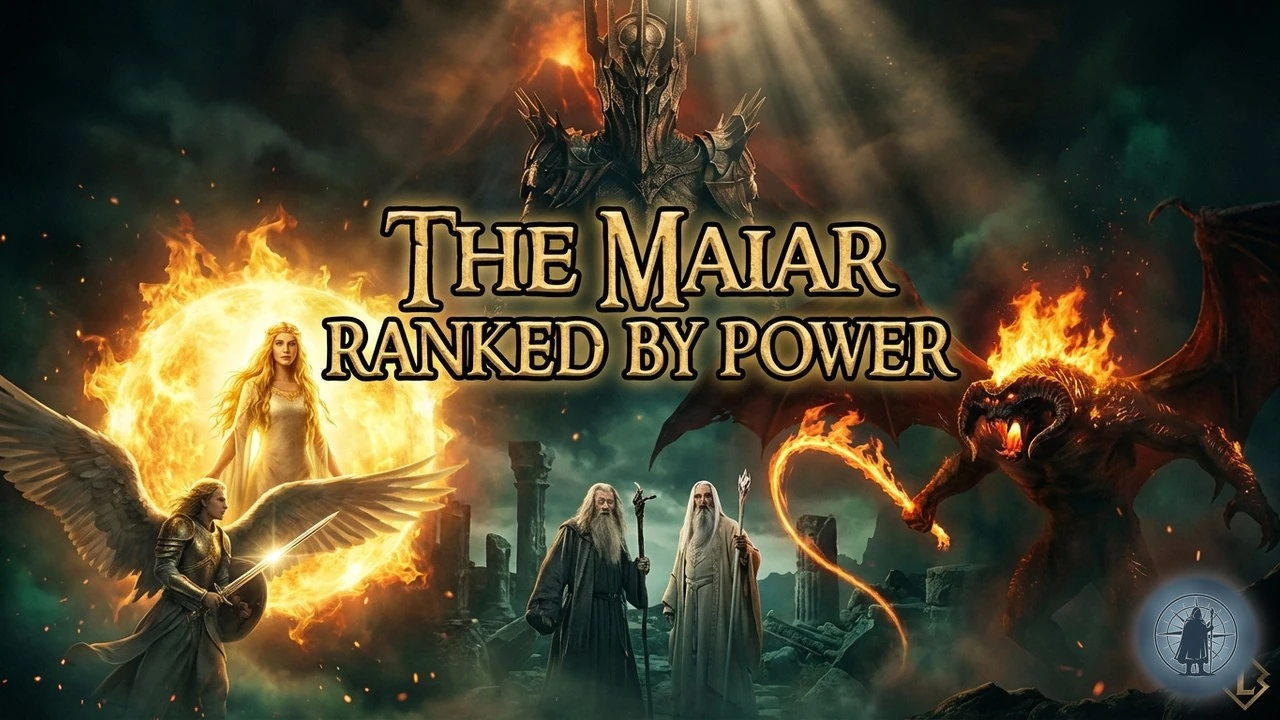 Watch the episode
The Maiar: Tolkien's Angels Ranked by Power | Silmarillion Deep Dive
Watch the episode
The Maiar: Tolkien's Angels Ranked by Power | Silmarillion Deep Dive
Research Notes: The Maiar Power Tier List
Overview
The Maiar are the lesser Ainur -- angelic spirits created by Iluvatar before the world, who descended into Ea to help the Valar shape Arda. Though they are "of the same order as the Valar but of less degree" (Valaquenta, The Silmarillion), enormous variation exists within their ranks. Tolkien himself acknowledged this hierarchy in Letter 183, describing Sauron as "of the same kind as Gandalf and Saruman, but of a far higher order," confirming that the Maiar had internal subdivisions of power. The question of how to rank them is endlessly debated because Tolkien never provided a definitive tier list -- and because "power" in his legendarium is multidimensional: martial prowess, wisdom, authority, elemental force, and spiritual influence all operate as distinct axes of strength.
The Quenya word "Maiar" derives from the root maya- meaning "excellent, admirable" -- literally "the Beautiful Ones." Their number is unknown; only about eighteen are named across all of Tolkien's published works.
Primary Sources
The Silmarillion (Valaquenta)
The Valaquenta is the primary source for understanding the Maiar hierarchy. It introduces the chiefs of the Maiar as Eonwe and Ilmare:
- Eonwe is described as the herald and banner-bearer of Manwe, "whose might in arms is surpassed by none in Arda" (Valaquenta). However, this description was an editorial addition by Christopher Tolkien to prepare for Eonwe's role leading the Host of the West in the War of Wrath; it does not appear in J.R.R. Tolkien's original manuscripts. - Ilmare is the handmaid of Varda and described alongside Eonwe as among the chiefs of the Maiar. She is associated with starlight (her name in Quenya means "Starlight"). - Olorin (Gandalf) is described as the wisest of the Maiar, who dwelt in the Gardens of Lorien and was a servant of both Manwe and Varda, and who learned pity and patience from Nienna. - Melian served Vana and Este, was akin to Yavanna, and was "the most beautiful, wise and skilled in songs of enchantment of all the people of Irmo." - Sauron (Mairon) was a Maia of Aule the Smith, "among the mightiest" of the Maiar before his corruption by Morgoth. - Arien, a spirit of fire and servant of Vana, was chosen to guide the Sun. She was "too bright for the eyes of the Elves" and was a spirit of fire uncorrupted by Melkor. - Tilion, a hunter of Orome, was chosen to guide the Moon and loved Arien. - Osse was a vassal of Ulmo who loved storms and coasts, and was briefly tempted by Melkor. - Uinen, spouse of Osse, was the Lady of the Seas who could calm his storms.
The Lord of the Rings
- Gandalf's battle with Durin's Bane (the Balrog of Moria) is a definitive power-comparison moment: two Maiar of comparable but different strengths fighting to mutual destruction. The entire battle lasted ten days, from the Bridge of Khazad-dum through the depths to the peak of Zirakzigil. "From the lowest dungeon to the highest peak I fought with the Balrog of Morgoth... until at last I threw down my enemy, and he fell from the high place" (The Two Towers, "The White Rider"). - Gandalf the White is described as returning with enhanced power and authority, now filling the role that Saruman had abandoned. He could now command rather than merely advise. - Saruman's power of persuasion and voice is a key Maiar ability: "His knowledge was deep, his thought was subtle, and his hands marvelously skilled; and he had a power over the minds of others. The wise he could persuade, and the smaller folk he could daunt" (Unfinished Tales, "The Istari").
Unfinished Tales (The Istari)
- The Istari were Maiar sent in embodied form around T.A. 1000, deliberately limited in power. Their mission was "to advise but never to attempt to match Sauron's strength" -- they were forbidden from dominating or overwhelming the Free Peoples. - Cirdan gave Narya to Gandalf rather than Saruman because he "divined" that Olorin was "the greatest of the Istari" -- despite Curumo (Saruman) being recognized as the head of the order. - Saruman's jealousy of Gandalf grew from this perceived slight. - The Blue Wizards (Alatar and Pallando, Maiar of Orome) went east and were never seen again. Tolkien's views on whether they failed or succeeded changed over time. - Radagast (Aiwendil), a servant of Yavanna, was brought along at Yavanna's request and focused on the natural world rather than his mission.
The Letters of J.R.R. Tolkien
- Letter 131: "Sauron was of course not 'evil' in origin. He was a 'spirit' of the same order as the 'wizards'... He had been attached to the greatest [Vala], Melkor." Sauron began with "fair motives: the reorganising and rehabilitation of the ruin of Middle-earth" but "very slowly... becomes a reincarnation of Evil, and a thing lusting for Complete Power." - Letter 183: Sauron is described as "of the same kind as Gandalf and Saruman, but of a far higher order." This is the most direct statement from Tolkien about internal hierarchy among the Maiar. Scholars debate whether "far higher order" refers to Sauron's inherent power, or to the diminished state of the Istari in their embodied forms. - Letter 156: Discusses the Istari's restrictions in embodied form. They were "forbidden to match his power with power, or to seek to dominate Elves or Men by force and fear."
Morgoth's Ring (History of Middle-earth Vol. 10)
- The concept of "Morgoth's Ring" -- that Morgoth dispersed his own power throughout the physical substance of Arda itself, analogous to how Sauron invested his power into the One Ring. This establishes the key principle that evil Ainur diminish themselves by pouring power into external vessels. - Maiar can take physical form (fana, "raiment/veil") by choice, unlike the hroa (body) of the Children of Iluvatar. The fana does not belong to their nature. - When a Maia's physical body is destroyed, their spirit wanders "houseless" and their power is diminished until they can take physical form again. - Corruption and evil cause further permanent diminishment: "Those that were corrupted became mockeries of their former selves."
The Silmarillion (Quenta Silmarillion)
- Sauron at Tol-in-Gaurhoth: Sauron was defeated by Luthien and Huan. Luthien enchanted him with weariness while Huan (a hound of Valinor, granted special powers by the Valar) defeated Sauron in his werewolf form. Sauron was forced to yield mastery of the tower and fled as a vampire. - Gothmog, Lord of Balrogs: High-captain of Angband and Morgoth's chief lieutenant. Personally slew Feanor (mortally wounding him at the Dagor-nuin-Giliath) and Fingon (at the Nirnaeth Arnoediad). Slain by Ecthelion during the Fall of Gondolin -- both perished in the Fountain of the King. - The Balrogs drove away Ungoliant when she threatened Morgoth after the destruction of the Two Trees, requiring "at least three or at most seven" Balrogs to accomplish this (Christopher Tolkien's note on their reduced numbers). - Melian created the Girdle of Doriath, an impenetrable magical barrier so potent that "even Ungoliant was unable to breach it." This is among the greatest sustained feats of power by any Maia in the legendarium. - After the War of Wrath, Eonwe summoned Sauron to repent and return to Valinor for judgment. Sauron initially "did obeisance to Eonwe... and abjured all his evil deeds." But Eonwe "had not the power to pardon Sauron" and commanded him to return to Aman. Sauron "was ashamed, and he was unwilling to return in humiliation and to receive from the Valar a sentence, it might be, of long servitude in proof of his good faith." He hid in Middle-earth and fell back into evil.
Key Facts and Timeline
- Before Time: All Ainur (Valar and Maiar) created by Iluvatar; participate in the Ainulindale (Great Music) - Creation of Arda: Maiar enter Ea alongside the Valar to shape the world - Years of the Trees: Melkor corrupts many Maiar -- those who become Balrogs were "spirits of fire" drawn to his service. Sauron (Mairon) is seduced away from Aule - First Age: Gothmog serves as Morgoth's chief captain; Sauron holds Tol-in-Gaurhoth; Melian maintains the Girdle of Doriath; Arien and Tilion guide the Sun and Moon - c. F.A. 456-472: Gothmog slays Fingon at the Nirnaeth Arnoediad - c. F.A. 510: Gothmog killed by Ecthelion at the Fall of Gondolin - F.A. 583-590: War of Wrath; Eonwe leads the Host of the West; most Balrogs destroyed; Morgoth defeated; Sauron summoned to repent but refuses - S.A. c. 1500: Sauron (as Annatar, "Lord of Gifts") begins forging Rings of Power with Celebrimbor - S.A. c. 1600: Sauron forges the One Ring, investing much of his own power - S.A. 3319: Numenor's downfall -- Sauron's body destroyed; he loses the ability to take fair form forever - S.A. 3441: Sauron defeated by Last Alliance; loses the One Ring to Isildur; his spirit flees bodiless - T.A. c. 1000: Istari arrive; Sauron rebuilds as "the Necromancer" at Dol Guldur - T.A. 2941: White Council drives Sauron from Dol Guldur - T.A. 3019: Gandalf defeats Durin's Bane; returns as Gandalf the White; War of the Ring; One Ring destroyed; Sauron permanently diminished
Significant Characters (Named Maiar)
Tier 1: Supreme Maiar
- Sauron (Mairon): Originally the greatest and most beloved Maia of Aule. Master craftsman, shapeshifter, and manipulator. Created the One Ring. Tolkien called him "of a far higher order" than Gandalf and Saruman (Letter 183). His power diminished progressively: investing power in the Ring, losing fair form after Numenor, losing physical form after the Last Alliance. Even weakened, he dominated the Third Age. - Arien: Spirit of fire, guardian of the Sun. Tolkien ranked her "among the most powerful of the Maiar" and initially placed her as the second most powerful. She is essentially untouchable -- Melkor could not corrupt or deceive her, and even he would not challenge her directly. Her power is elemental and cosmic rather than political or martial.
Tier 2: Chiefs and Great Warriors
- Eonwe: Herald of Manwe, "whose might in arms is surpassed by none in Arda." Led the Host of the West in the War of Wrath. Sauron submitted to him. However, he lacked authority to pardon Sauron -- his power is martial, not juridical. The "mightiest in arms" description was Christopher Tolkien's editorial addition. - Melian: Served Vana and Este, akin to Yavanna. Created the Girdle of Doriath. Repelled Ungoliant. Bore a child (Luthien) with an Elf -- unique among all Ainur. Her foresight, enchantment, and sustained protective magic over centuries demonstrate extraordinary power. She voluntarily departed Middle-earth after Thingol's death. - Gothmog: Lord of Balrogs, High-captain of Angband. The greatest of the Balrogs. Slew two High Kings of the Noldor (Feanor and Fingon). Wielded a fiery whip and black axe. Killed by Ecthelion at mutual cost.
Tier 3: The Istari and Other Balrogs
- Curumo (Saruman): Maia of Aule. Head of the Istari order. Great knowledge, subtle thought, skilled hands. His power over minds and voice was his signature ability. Corrupted by ambition and desire for the Ring. Diminished after his fall. - Olorin (Gandalf): Wisest of the Maiar. Served Manwe and Varda, learned from Nienna. As Gandalf the Grey, deliberately restrained. Defeated Durin's Bane at cost of his own life. Sent back by Iluvatar as Gandalf the White with enhanced power and authority. The only Istar who remained faithful to his mission. - Durin's Bane: The Balrog of Moria. One of the last surviving Balrogs. Hid beneath the Misty Mountains for over 5,000 years. Fought Gandalf to mutual destruction over ten days.
Tier 4: Elemental and Specialized Maiar
- Osse: Maia of Ulmo, spirit of the Inner Seas. Raised the island of Numenor. Powerful but limited to his maritime domain. Briefly tempted by Melkor, restrained by Uinen. - Uinen: Lady of the Seas, spouse of Osse. Could calm storms and was beloved by mariners. Her power is protective rather than destructive. - Tilion: Hunter of Orome, guide of the Moon. Less powerful than Arien -- when he approached too close, her heat singed his vessel. - Salmar: Maia of Ulmo who made the Ulumuri (great horns of the sea).
Tier 5: Other Known Maiar
- Ilmare: Chief of the Maiar alongside Eonwe, handmaid of Varda. Associated with starlight. Very little detail about her actual capabilities. - Aiwendil (Radagast): Servant of Yavanna. Focused on nature rather than his mission. Not necessarily weak, but unfocused. - Alatar and Pallando (Blue Wizards): Maiar of Orome. Went east and were never seen again. Their fates are unknown -- Tolkien variously suggested they failed, or that they succeeded in stirring rebellion among Men in the East.
Possibly Maiar / Debated
- Thuringwethil: Sauron's vampire messenger. Referred to as a "bat-shaped fay" in The Etymologies, which may indicate Maiar status since "fay" often became "Maia" in Tolkien's later revisions. Her shapeshifting ability supports this theory. - Draugluin: Sire of all werewolves. His nature is uncertain -- he could be a Maia or a corrupted beast. - Ungoliant: Explicitly NOT listed among the Maiar. Her origins are mysterious -- "from the darkness" around Arda. The Eldar suspected she might have been among the Ainur corrupted by Melkor, but this is unconfirmed. She represents a theological anomaly: evil that may not stem from Melkor. - Tom Bombadil: Tolkien deliberately left his nature enigmatic. The Maia theory is common but has problems (particularly his indifference to the Ring). Tolkien said, "Even in a mythical Age there must be some enigmas."
Geographic Locations
- Valinor: Original dwelling of the Maiar before the shaping of Arda; the Blessed Realm where the Valar and faithful Maiar reside - Angband/Thangorodrim: Morgoth's fortress where corrupted Maiar (Balrogs, Sauron) served as his captains - Tol-in-Gaurhoth (Isle of Werewolves): Sauron's stronghold in the First Age where he was defeated by Luthien and Huan - Doriath: Melian's realm, protected by the Girdle -- the greatest sustained magical feat by any Maia - Moria (Khazad-dum): Where Durin's Bane hid for millennia; site of Gandalf's battle with the Balrog - Dol Guldur: Sauron's base as "the Necromancer" in the Third Age - Barad-dur/Mount Doom: Sauron's fortress and the place where the One Ring was forged
Themes and Symbolism
The Paradox of Invested Power
Both Morgoth and Sauron illustrate a core theological principle: evil that seeks domination must pour its power into external things, thereby diminishing itself. Morgoth dispersed his power throughout Arda ("Morgoth's Ring"); Sauron invested his into the One Ring. The greater your desire for control, the more you must give away of yourself. This is profoundly anti-power -- the pursuit of supreme power is inherently self-defeating.Wisdom vs. Strength
Tolkien consistently distinguishes between raw power and wisdom. Olorin is the "wisest" of the Maiar but not the mightiest. Eonwe is the greatest "in arms" but lacks authority to pardon. Sauron is the most powerful in terms of domination but is repeatedly defeated by wisdom, mercy, and humility. The hierarchy of the Maiar is not a simple linear scale.The Cost of Incarnation
Every Maia who takes permanent physical form pays a price. The Istari accept deliberate limitation. The Balrogs bind themselves to fire and darkness. Sauron progressively loses the ability to shapeshift. Melian can sustain the Girdle only while her spirit is bound to Doriath. Physical form is both a tool and a trap.Corruption as Diminishment
Tolkien's Catholic theology pervades the Maiar: evil does not create, it only corrupts and diminishes. Sauron was the greatest Maia, but by the Third Age he is reduced to a bodiless will. The Balrogs were spirits of fire, now bound to destruction. Saruman falls from the head of the Istari to a petty tyrant in the Shire. The arc of corruption is always downward.Delegated Authority
The Maiar exercise "delegated authority in their spheres (of rule and government, not creation, making or re-making)" (Tolkien, describing the Ainur as angelic powers). Their power is not their own -- it is granted by Iluvatar. When they exceed their mandate (Sauron seeking domination, Saruman seeking the Ring), they fall. The faithful Maiar (Gandalf, Melian, Eonwe) succeed by staying within their roles.Scholarly Perspectives
The "Far Higher Order" Debate
Letter 183's description of Sauron as "of a far higher order" than Gandalf and Saruman is one of the most debated passages in Tolkien scholarship. Some scholars argue this refers to Sauron's inherent spiritual power -- he was simply a greater Maia from the beginning. Others argue it refers to the diminished state of the Istari: Olorin and Curumo might have been peers of Sauron in Valinor, but as embodied old men with deliberate restrictions, they were "of a far lower order." The truth likely involves both factors.Arien's Forgotten Power
Tolkien's drafts show he initially ranked Arien as the second most powerful Maia. This is significant because she is often overlooked in fan discussions. Her power is elemental and cosmic -- she literally carries the last light of Laurelin through the sky. In early drafts, Morgoth lusted after her but feared to approach, and there is a lost plot thread where Melkor was to assault the Sun.The Balrog Number Problem
Tolkien's conception of Balrog numbers changed dramatically. Early versions (Book of Lost Tales) imagined hundreds or thousands. The published Silmarillion treats them plurally. But Christopher Tolkien noted a late marginal note saying "at most 7." This matters for power assessment: if there were only 3-7 Balrogs, each one was a tremendously powerful individual Maia. If there were hundreds, they were more like footsoldiers.Catholic Angelology
Scholars (especially Ralph C. Wood) have noted the strong parallel between Tolkien's Maiar and the Catholic angelic hierarchy. The Valar correspond roughly to archangels, the Maiar to lesser angels. The variety within both -- Seraphim vs. Cherubim vs. Thrones in Catholic theology, and the vast range from Sauron to Tilion in Tolkien -- mirrors the Pseudo-Dionysian celestial hierarchy. The key theological point: angels differ in the degree of divine knowledge they received, just as each Ainu "was given understanding only of that part of the mind of Iluvatar from which they came."Contradictions and Variants
Eonwe's "Mightiest in Arms"
Christopher Tolkien added the description of Eonwe's martial supremacy. J.R.R. Tolkien's original drafts are less definitive. This raises the question: is Eonwe truly the greatest warrior among the Maiar, or is this an editorial artifact?Sauron vs. Eonwe
If Eonwe's "might in arms is surpassed by none in Arda," then is Sauron more powerful overall but weaker in direct combat? Or does the phrasing allow for exceptions? The fact that Sauron submitted to Eonwe after the War of Wrath supports Eonwe's martial superiority, but Sauron may have been choosing diplomacy over force.The Blue Wizards' Fate
Tolkien's later writings (Peoples of Middle-earth) suggest the Blue Wizards may not have failed after all. He gave them new names (Morinehtar and Romestamo, "Darkness-slayer" and "East-helper") and suggested they may have succeeded in weakening Sauron's hold on the East. This contradicts his earlier statements that they probably failed.Gandalf the White's Power Level
Gandalf the White is described as "sent back in the form of an enhanced Istari, one more powerful than any other to have walked Middle-earth." This is ambiguous -- does it mean more powerful than Saruman ever was? More powerful than Sauron? Most scholars interpret it as meaning Gandalf the White was the most powerful Istar, but still not a match for Sauron in direct confrontation, which is why the Ring had to be destroyed rather than wielded.Arien vs. Sauron
If Tolkien ranked Arien as the second most powerful Maia and Sauron as the most powerful, their power was of completely different types. Arien's is elemental fire that even Morgoth feared; Sauron's is craft, domination, and manipulation. They occupy different axes entirely.Linguistic Notes
- Maiar (Q.): From maya- "excellent, admirable" -- literally "the Beautiful/Admirable Ones" - Ainur (Q.): "Holy Ones" -- the collective term for Valar and Maiar - Mairon (Q.): "The Admirable" -- Sauron's original name, emphasizing his excellence - Sauron (Q.): "The Abhorred" -- his name after corruption, a deliberate inversion - Olorin (Q.): Possibly from olos "dream, vision" -- fitting for the Maia who dwelt in Lorien - Curumo (Q.): "Skilled Man" or "Cunning One" - Aiwendil (Q.): "Lover of birds" - Valaraukar (Q.): "Demons of Might" -- the Quenya name for Balrogs - Gothmog (S.): Possibly "Dread Voice" or related to "strife/war" - Fana (Q.): "Veil, raiment" -- the physical form taken by an Ainu, as opposed to the hroa of incarnate beings
Compelling Quotes for Narration
1. "Their number is not known to the Elves, and few have names in any of the tongues of the Children of Iluvatar; for though it is otherwise in Aman, in Middle-earth the Maiar have seldom appeared in form visible to Elves and Men." (Valaquenta) 2. "Sauron was of the same kind as Gandalf and Saruman, but of a far higher order." (Letter 183) 3. "Sauron was of course not 'evil' in origin." (Letter 131) 4. "He was ashamed, and he was unwilling to return in humiliation." (The Silmarillion, on Sauron refusing to return to Valinor) 5. "From the lowest dungeon to the highest peak I fought with the Balrog of Morgoth." (The Two Towers) 6. "Angelic powers, whose function is to exercise delegated authority in their spheres." (Tolkien, describing the Ainur)
Visual Elements to Highlight
1. The Ainulindale -- the Great Music of creation, with spirits of varying brightness and power 2. Sauron in his many forms: beautiful Annatar, the werewolf lord, the dark lord in armor, the Great Eye 3. Arien carrying the Sun -- a spirit of fire blazing through the heavens 4. Eonwe leading the Host of the West against Morgoth in the War of Wrath 5. Melian's Girdle -- an invisible dome of enchantment surrounding the forests of Doriath 6. Gandalf and the Balrog on the Bridge of Khazad-dum and atop Zirakzigil 7. Gothmog and Ecthelion falling together into the Fountain of the King 8. Sauron kneeling before Eonwe, only to later refuse the summons and hide in Middle-earth
Questions and Mysteries
- How powerful was Sauron before he invested his power in the Ring? Was he truly matchless among all Maiar? - Could Gandalf the White have defeated Sauron directly? Tolkien seems to imply not, but the text is ambiguous. - Were the Blue Wizards failures or secret successes? How powerful were they relative to Gandalf? - What was Arien's relationship to other "spirits of fire" -- were the Balrogs her corrupted kin? - If Eonwe is the mightiest in arms, could he have defeated Sauron in combat? - What happened to the spirits of destroyed Balrogs? Are they still wandering houseless? - How much of Sauron's diminishment was from Ring-investment versus successive bodily destructions?
Discrete Analytical Themes
Theme 1: The Multidimensional Nature of Maiar Power
Core idea: Tolkien's Maiar cannot be ranked on a single axis because "power" operates across at least four distinct dimensions: martial prowess, wisdom/knowledge, elemental force, and domination/influence. Evidence: - Eonwe is "mightiest in arms" but lacks authority to pardon Sauron -- supreme warrior, limited judge - Olorin is "wisest of the Maiar" but not the strongest -- wisdom as a separate category from might - Arien is fire incarnate, untouchable even by Morgoth, but exercises no political or military power - Sauron's primary power is domination and craft, not raw combat (he loses to Huan and Luthien) - Melian's power is protective enchantment sustained over centuries -- neither martial nor destructive Distinction: This theme is about the FRAMEWORK for understanding power, not any individual's rank. It establishes why a simple linear tier list is inherently reductive -- and why that tension makes for compelling analysis.Theme 2: Sauron's Arc of Diminishment
Core idea: Sauron begins as the greatest Maia and undergoes a progressive, self-inflicted decline driven by the pursuit of total domination -- each grasp for more control costs him something irreplaceable. Evidence: - Originally "the most powerful and beloved" Maia of Aule, with mastery of craft and fair form - Investing power in the One Ring: gains control over other Ring-bearers but becomes dependent on the Ring to survive - Numenor's downfall: body destroyed, loses ability to take fair form forever -- "he was robbed now of that shape" - Last Alliance: loses Ring, loses physical form entirely, spends millennia as a diminished spirit - Third Age: reduced from a shapeshifting Maia-lord to a bodiless will anchored to Barad-dur - Letter 131: begins with "fair motives" but "very slowly... becomes a reincarnation of Evil" Distinction: This is about SAURON'S SPECIFIC TRAJECTORY over time, not the general principle of how evil diminishes (that is Theme 4).Theme 3: The Istari Handicap -- Power Under Deliberate Restriction
Core idea: The five Istari represent a unique experiment in constrained power: Maiar deliberately diminished and embodied in old men's forms, forbidden from using their full abilities, creating a tension between what they COULD do and what they SHOULD do. Evidence: - Forbidden "to match his power with power, or to seek to dominate Elves or Men by force and fear" (Letter 156) - Their mission was to advise and inspire, not to command -- Gandalf as "the enemy of Sauron" works through others - Saruman's failure is precisely a failure of restraint -- he reaches for the Ring and for direct power - Gandalf's success is precisely a success of restraint -- he guides, inspires, refuses the Ring - Cirdan recognized Gandalf as "the greatest of the Istari" despite Saruman's higher rank - Gandalf the White receives enhanced power from Iluvatar but still does not confront Sauron directly Distinction: This is about the SPECIFIC MECHANISM of the Istari's limited power and the moral drama it creates -- how restriction functions as both handicap and strength. Distinct from the general concept of power types (Theme 1) and from the corruption arc (Theme 4).Theme 4: The Corruption Tax -- How Evil Self-Diminishes
Core idea: Tolkien's theology dictates that evil corrupts and diminishes the one who wields it -- every Maia who turns to darkness pays an escalating price in power and being, mirroring Morgoth's own trajectory. Evidence: - Morgoth dispersed his power throughout Arda itself ("Morgoth's Ring"), diminishing until he was weaker than Sauron - Sauron invests power in the One Ring; cannot survive its destruction - Balrogs bind themselves to fire and destruction; "those that were corrupted became mockeries of their former selves" - Saruman falls from head of the Istari to a petty dictator in the Shire, eventually a pitiful wraith - "When the physical body of a Maia is destroyed, their spirit wanders houseless and their power diminished" - Tolkien's Catholic principle: evil cannot create, only corrupt -- and corruption always costs the corruptor Distinction: This is about the THEOLOGICAL PRINCIPLE of how evil operates -- a universal law in Tolkien's world, not any one character's story. It applies across all corrupted Maiar as a pattern.Theme 5: The Elemental Maiar -- Cosmic Roles Beyond the Wars
Core idea: Several Maiar hold cosmic, elemental functions (guiding the Sun, governing the seas) that place them outside the military/political power struggles but represent enormous underlying power -- they keep the world running. Evidence: - Arien guides the Sun and embodies fire so pure that Morgoth himself feared to approach her - Tilion steers the Moon and was singed when he drew too close to Arien - Osse governs the coastal seas, raised the island of Numenor, was briefly tempted by Melkor - Uinen calms storms and protects mariners -- her restraining influence on Osse is itself a form of power - Melian's Girdle of Doriath is a cosmic-scale protective enchantment sustained for centuries - These Maiar exercise power over fundamental aspects of Arda rather than through combat or politics Distinction: This is about MAIAR WHOSE POWER IS BOUND TO NATURAL FUNCTIONS rather than manifested through conflict. They represent a different category of significance entirely.Theme 6: The Balrog Question -- Fire Corrupted
Core idea: The Balrogs represent the most dramatic case of Maiar corruption: spirits of fire twisted into demons of destruction, whose exact nature, number, and power level are among Tolkien's most debated inconsistencies. Evidence: - Originally "spirits of fire" drawn to Melkor before the shaping of Arda - Number changed from hundreds/thousands (early drafts) to "at most 7" (late marginal note) -- this dramatically affects power assessment - Gothmog slew two High Kings of the Noldor and was High-captain of Angband - Durin's Bane fought Gandalf to mutual destruction over ten days -- a peer-level Maia battle - Multiple Balrogs were needed to drive away Ungoliant -- implying even collectively they had limits - "Their hearts were of fire, but they were cloaked in darkness... they had whips of flame" Distinction: This is specifically about WHAT BALROGS ARE and what they tell us about corrupted Maiar power, not about corruption in general (Theme 4) or about individual character arcs.Theme 7: Eonwe's Paradox -- Supreme Warrior, Limited Authority
Core idea: Eonwe embodies a fascinating tension: he is the greatest warrior among all Maiar but lacks the authority to make consequential decisions, creating a figure of immense power constrained by cosmic hierarchy. Evidence: - "Might in arms surpassed by none in Arda" -- but this was Christopher Tolkien's editorial addition - Led the Host of the West in the War of Wrath, defeating Morgoth's forces - Sauron "did obeisance" to Eonwe after the war -- even the greatest Maia submitted to him - Yet Eonwe "had not the power to pardon Sauron" and could only command him to return for judgment - His inability to simply force Sauron back to Valinor -- the limits of martial power in a moral universe - As herald of Manwe, his authority is always derivative, always delegated Distinction: This is about ONE SPECIFIC CHARACTER who illustrates the gap between martial power and cosmic authority -- a microcosm of Tolkien's broader themes but focused on Eonwe's unique position.Theme 8: The Angelic Template -- Catholic Theology Made Mythic
Core idea: The Maiar hierarchy maps onto Catholic angelology in ways Tolkien acknowledged, providing a theological grammar for understanding why the Maiar are arranged as they are and why their falls follow specific patterns. Evidence: - Tolkien called LOTR "a fundamentally Catholic work" and described the Ainur as "angelic powers" - The Ainur exercise "delegated authority in their spheres (of rule and government, not creation)" - Each Ainu "was given understanding only of that part of the mind of Iluvatar from which they came" -- parallels Thomistic doctrine of angelic knowledge - Ralph C. Wood and others identify Pseudo-Dionysian celestial hierarchy parallels - The Valar/Maiar distinction mirrors archangels vs. lesser angels in Catholic doctrine - Free will and the capacity for rebellion are shared between Tolkien's and Catholic angelology - Sauron's fall mirrors Lucifer's: the greatest servant who seeks to become master Distinction: This is about the REAL-WORLD THEOLOGICAL FRAMEWORK informing Tolkien's design choices, not about in-universe power dynamics. It provides the "why" behind the hierarchy.Sources: The Maiar Power Tier List
Primary Sources (Tolkien's Works)
Most Critical
- The Silmarillion (Valaquenta) -- Primary source for the Maiar hierarchy, naming Eonwe and Ilmare as chiefs, describing individual Maiar's roles and associations with specific Valar - The Letters of J.R.R. Tolkien -- Letters 131, 156, and 183 are essential. Letter 183 contains the crucial "far higher order" statement about Sauron. Letter 131 discusses Sauron's origins and motivations. Letter 156 covers Istari restrictions. - The Lord of the Rings (The Two Towers, "The White Rider") -- Gandalf's account of his battle with the Balrog; his return as Gandalf the White - Unfinished Tales ("The Istari") -- The fullest account of the Wizards' mission, restrictions, and relative rankingsSupporting
- The Silmarillion (Quenta Silmarillion) -- Sauron at Tol-in-Gaurhoth, Gothmog's battles, Melian's Girdle, War of Wrath - Morgoth's Ring (History of Middle-earth Vol. 10) -- Concept of fana, Morgoth's diminishment principle, evil as self-diminishing - The Peoples of Middle-earth (History of Middle-earth Vol. 12) -- Revised Blue Wizards account with new names - The Book of Lost Tales (History of Middle-earth Vols. 1-2) -- Early conceptions of Balrog numbers, proto-MaiarSecondary Sources (Web)
Encyclopedic References
- Tolkien Gateway: Maiar, Sauron, Gandalf, Eonwe, Balrogs, Melian, Arien, Letter 183, Letter 131, Letter 156, Wizards, Tom Bombadil/Nature -- Comprehensive wiki with strong sourcing; attempted but returned 403 errors on direct fetch; information accessed via search result summaries - LOTR Fandom Wiki: Maiar, Sauron, Eonwe, Balrogs, Gothmog), Melian, Gandalf -- Cross-referenced for factual accuracy - Wikipedia: Maiar, Balrog, Gandalf, SauronRanked Lists and Analysis Articles
- Screen Rant: 10 Most Powerful Maiar in The Lord of the Rings, Ranked -- Useful for popular ranking framework; Sauron #1, Arien #2, Eonwe #3 - Screen Rant: All 18 Confirmed Maiar in Lord of the Rings Explained -- Complete named Maiar inventory - Screen Rant: Why Sauron Is So Much Stronger Than Gandalf And Saruman -- Analysis of Letter 183 implications - GameRant: Lord Of The Rings: 14 Most Powerful Maiar, Ranked -- Alternative ranking with broader inclusion - CBR: Why Sauron Was Stronger Than Other Maiar -- Sauron power analysisScholarly and In-Depth Analysis
- Ask Middle-earth (Tumblr): Hierarchy of the Maiar -- Thoughtful analysis of Maiar internal rankings - Barrow-Downs Forum: Mightiest of the Maiar? -- Scholarly fan discussion with textual citations - The Tolkien Forum: Maiar Power Levels? -- Community debate with strong primary source usage - Valar Guild: Eonwe as Maia -- Detailed Eonwe analysis - Valar Guild: Eonwe paper -- Extended scholarly treatment - Silmarillion Writers' Guild: Gandalf (Olorin) -- Character study - Silmarillion Writers' Guild: Thuringwethil -- Character analysis including Maia debate - Middle-earth Xenite Blog: Questions about the Maiar -- Accessible analysis - Middle-earth Xenite Blog: Could Weakened Ainur Regain Their Former Strength? -- Power diminishment analysis - A Tolkienist Perspective: Ungoliant: A Fragment of Melkor's Discord? -- Ungoliant origin analysis - LOTR Scrapbook: Tolkien, Sauron and Evil in Tolkien's Letters -- Compilation of Tolkien's letters on Sauron and evil - rec.arts.books.tolkien: A far higher order -- Scholarly usenet discussion of Letter 183Theological and Thematic Analysis
- Biola University Blog: Angels in Tolkien and the Bible -- Academic treatment of Tolkien's angelology - Fellowship & Fairydust: Angelic Beings: The Ainur and Maiar -- Catholic theological analysis - Catholic Culture: Universe According to Tolkien -- Catholic perspective on Tolkien's cosmology - Dimitra Fimi (Substack): On Tolkien's Letter 131: Incarnate good and evil -- Academic Tolkien scholar analysisLinguistic References
- Parf Edhellen (Elvish Dictionary): Maia -- Etymology of "Maia/Maiar" - Encyclopedia of Arda: Maiar, ThuringwethilSource Quality Assessment
Most Useful: Tolkien Gateway (comprehensive, well-sourced), Tolkien's Letters (direct authorial statements on hierarchy), The Silmarillion Valaquenta (primary text), Screen Rant ranked list (useful popular framework to build from/push against)
Strong Supporting: Barrow-Downs and Tolkien Forum discussions (textual rigor from knowledgeable fans), Silmarillion Writers' Guild character studies, Valar Guild papers
Good Context: Catholic theology analyses (Biola, Fellowship & Fairydust), Dimitra Fimi's academic work, rec.arts.books.tolkien archives
Use With Caution: Quora answers (variable quality but sometimes cite primary sources well), general pop-culture listicles (useful for framing but sometimes inaccurate on details)