
Transcript
The Dead Men of Dunharrow
The Oath That Cursed Them 3,000 Years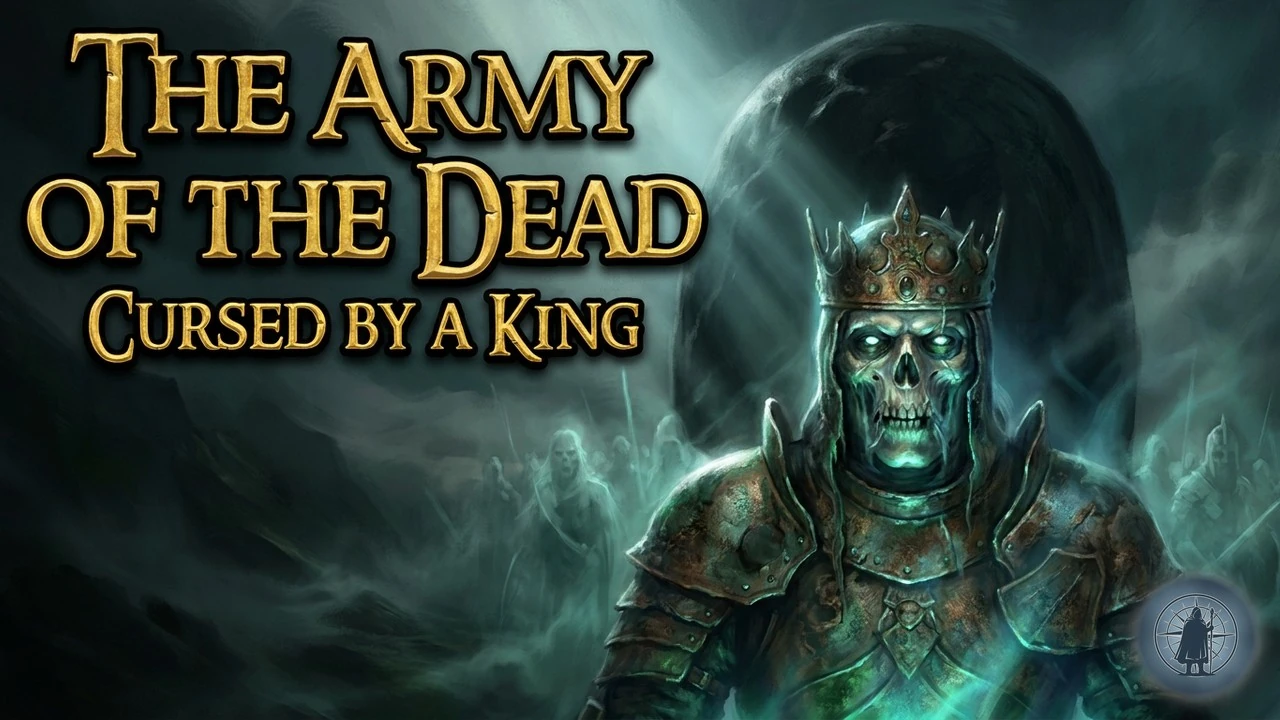 Watch the episode
The Dead Men of Dunharrow: The Oath That Cursed Them 3,000 Years
Watch the episode
The Dead Men of Dunharrow: The Oath That Cursed Them 3,000 Years
SECTION: The Stone and the Sworn Word
"Thou shalt be the last king." That is how it begins — with a sentence pronounced over a kneeling lord at the close of an age, in a tongue most of the people who heard it would not live to see honored. Those four words held that lord beyond the reach of death for three thousand years. And the reason starts with a black stone on a green hill, and the kind of promise that, in Tolkien's world, is never really only words.
The people at the heart of this story have no proper name in the books. They are called the Men of the Mountains — a folk of the White Mountains, the Ered Nimrais, who had lived in those high cold valleys long before the tall sea-kings of Númenor ever came east. They belonged to an older stock of Men, kin to the Dunlendings and the rough country-folk who would one day settle around Bree. And in the long stretch of the Second Age that the histories call the Dark Years, when Sauron's power lay heavy over Middle-earth, these mountain people had done a thing that would damn their descendants. They had worshipped him.
And that word matters. Not feared him — worshipped him. Sauron in the Second Age did not rule by armies alone. He set himself up as a god to the Men who fell under his shadow, took their reverence, took their temples, took their prayers. The Men of the Mountains were among those who bowed. And when Sauron's outward power was at last broken on the field, that old devotion did not simply evaporate. It went underground. It waited.
Then the sea-kings came. Out of the drowning of Númenor, Elendil and his sons Isildur and Anárion escaped the wreck of the world and founded the realms in exile — Gondor in the south, Arnor in the north. And Isildur carried with him out of the ruin a strange relic: a great black stone, round and smooth as if it had once been molten, that he set upon a hill in the southern vales. The Hill of Erech. There, by that stone, the King of the Mountains came down and swore allegiance to Isildur — pledged his folk to the cause of Gondor and the heirs of Elendil. A vow given freely, sealed on the black stone, witnessed by both peoples.
It was a vow these people had no intention of keeping. The old reverence for Sauron still lived in them. And so when the test came, the troth broke like rotten wood.
The test came soon enough. Sauron rose again, and the Last Alliance of Elves and Men marched to war against him — the great war that would end with the Dark Lord thrown down and the Ring cut from his hand. Isildur, true to the pledge, summoned the Men of the Mountains to fight. This was the moment their sworn word was for. This was exactly what they had promised to do.
They refused. They would not lift a blade against the master they had once adored. But neither did they dare openly join him and fight Isildur to his face. So they did the most cowardly thing of all — they came to the aid of neither side, and hid themselves in their mountains while the world decided its fate without them. A people caught between a god they could not betray and a king they would not serve, and so betraying the one promise they had actually made.
And it is here, on this exact failure, that Isildur turned and laid down the words that would outlast his kingdom, his line, and very nearly the world itself.
SECTION: The Words Isildur Laid
To modern ears, a curse is a kind of insult — a wish for bad luck, words flung in anger that the world is free to ignore. That is not what happens at Erech, and missing that is missing the whole story. The sentence Isildur lays is not a wish at all. When he turns to the faithless King of the Mountains, the words he pronounces do not ask the universe to punish these men. They simply describe what the broken pledge has already done to them.
Hear the sentence in full. "Thou shalt be the last king. And if the West prove mightier than thy Black Master, this curse I lay upon thee and thy folk: to rest never until your oath is fulfilled. For this war will last through years uncounted, and you shall be summoned once again ere the end."
To rest never until your oath is fulfilled. Say that part aloud and feel the weight of it. He does not threaten them with suffering, or defeat in battle. He denies them rest — the one thing that, for mortal Men, is owed to every living creature at the end. These men will not be allowed to die. Or rather, they may die in body, but they will not be permitted to go — to pass out of the world into whatever waits beyond it for the kindreds of Men. The pledge they swore and shattered will hold them here, suspended, unfinished, for as long as it takes.
This is the deep machinery of Tolkien's world. In Arda, a sworn word is not a social nicety. It is a real force — something closer to physics than to politics. When you bind yourself this way, especially before witnesses and sealed on a holy thing, you tie a part of yourself to its fulfillment. Keep it, and you are released. Break it, and the binding remains, pulling at you, refusing to let you be whole until the debt is paid. The Men of the Mountains did not merely behave dishonorably. They tore something in the fabric of their own fate, and the tear would not close on its own.
The clearest proof that this is a law of the world, and not just Isildur's personal grudge, is that the very same thing happens elsewhere in the legendarium — to far greater people, bound by far greater names. Long before, in the deeps of the First Age, the mightiest of all the Elves swore a terrible vow of his own. Fëanor and his seven sons swore, calling upon the name of the One himself, to pursue with hatred and vengeance anyone who kept a Silmaril from them. It drove them to kinslaying, to ruin, to the slow destruction of nearly everything they loved — and it could not be unsaid. They could not lay it down even when they wished to. The words had teeth, and the teeth held.
Tolkien, a devout Catholic, knew exactly where this idea came from. In one of his letters he points to the warning in the Epistle of James — "swear not at all" — the ancient counsel that to bind yourself before heaven is to gamble with forces you cannot control. The Oathbreakers and the sons of Fëanor are the two great illustrations of that warning across his whole mythology: rash bindings that destroy the swearer, made lightly and paid for over ages.
So the curse at Erech is not magic words flung by an angry king. It is Isildur naming, out loud, what these men have done to themselves. He simply adds the one mercy hidden inside the sentence — you shall be summoned once again ere the end. There will be a way out. A second chance to do the thing they failed to do. But it will not come for a very, very long time.
SECTION: Three Thousand Years of Dread
Isildur fell not long after, ambushed at the Gladden Fields, the Ring lost in the river. His kingdom passed to his heirs, then dwindled across the centuries. Empires rose and crumbled in the south. And through all of it — through three thousand years of history — the Men of the Mountains kept their grim appointment with Isildur's words. They died, as all Men die. But they did not depart. They lingered.
They became a haunting. The high refuge of Dunharrow lay in those same White Mountains, and above it loomed a peak the Rohirrim came to call the Dwimorberg — in their old tongue, the Haunted Mountain. At the head of the dark valley stood a wood called the Dimholt, and beyond it a black opening in the rock: the Dark Door, the entrance to a road under the mountain. And that road, and that door, belonged to the dead.
There is a piece of old verse the Riders of Rohan passed down, a warning carved into their memory. "The way is shut. It was made by those who are Dead, and the Dead keep it, until the time comes. The way is shut." No living man went through that door and came back. The land around it was a place of cold dread, where the Rohirrim would not go, where even the bravest horses balked and shied. The shades themselves were rarely seen — felt more than seen, a presence, a weight in the air, a host of watchers just beyond the edge of sight. But everyone in that country knew they were there.
And once, the dread claimed a prince. Long before Aragorn's day, in the line of the kings of Rohan, there was a young man named Baldor, son of King Brego. At the great feast to celebrate the building of the golden hall of Meduseld, with the mead flowing and the boasts running high, Baldor rose and swore that he would tread the Paths of the Dead. A boast made in pride and wine, before a hall full of witnesses — the very kind of rash promise this whole story warns against.
He kept it. That was the tragedy. The next year he rode to the Dark Door and went in. And he never came out.
We know what became of him, because three thousand years after Isildur spoke at Erech, when others finally passed that road, they found him. In the dry dead air of the tunnel lay the bones of a mighty man, still in his mail, his harness whole, his belt of gold and garnets, the gilded helm fallen from his skull. He had reached a second door, deep in the mountain — a stone door, sealed shut. And he had died there, alone in the dark, his finger-bones still clawing at the cracks of a door he could not open and could not pass.
Notice how perfectly Baldor mirrors the people who killed him. A foolish boast, made at a feast. A sealed door he was not meant to open. And death in the dark, on the wrong side of something he could not get past. The Men of the Mountains broke a vow and were trapped outside the peace they longed for; Baldor made a vow and was trapped inside the mountain that they kept. The same shape, the same cruelty — a man undone by his own sworn word, clawing at a barrier that would not yield. For three thousand years the Door under the mountain swallowed anyone fool enough to test it, and gave back nothing.
Until one man came who had the right to ask it for more than entry. He came to ask the dead themselves to follow him out.
SECTION: The Heir Walks the Dark Road
Three thousand years after Isildur spoke his malediction, his heir stood at the Dark Door. Aragorn — Elessar, the last in the long line of the kings — had come to do the one thing none of his fathers had done, and none of them could have done. He had come to call in the broken pledge.
This is the hinge of the whole tale, and it turns on a single fact: only Isildur's heir could command the Dead. Not the king of Rohan, in whose land they haunted. Not the ruling Stewards of Gondor, who governed Isildur's old realm in his line's long absence. Not any of the dozens of kings who reigned in the three thousand years between. The troth had been sworn to Isildur, and the sentence laid by Isildur, and so only the blood of Isildur held the key to it. The Dead would answer to that lineage and no other.
And this tells us something Tolkien wants us to understand about what kingship actually is in his world. Aragorn's claim to the throne is not a matter of armies or votes or the strength of his sword-arm. It is something woven into the moral order of the world itself — a rightful authority that the very dead can recognize and obey. When the shades follow Aragorn, they are not being conquered. They are acknowledging a truth: that here, at last, is the lawful lord who can hold their broken promise in his hand. The throne of Gondor was always more than a chair. It carried the power to bind and the power to absolve, and the Oathbreakers knew it the moment he came.
But first he had to reach them, and that meant the road no living man survived. Aragorn led a small grey company — his fellow Rangers of the North, and the sons of Elrond — in through the Dark Door and down into the Paths of the Dead. Even for that hardened company it was a descent into pure terror. We see it most clearly through Gimli the dwarf, who had walked unafraid through the deepest delvings in the world, through Moria itself. Here, in the black tunnels under the Dwimorberg, something broke even him. A blindness of fear came over him. He could feel the unseen host gathering behind, thronging the dark at his back, following, following — and he knew there could be no turning round, for the way behind was already full of the dead.
They passed Baldor's clawing bones in the dark. And they came through, out the far side of the mountains, into the southern vales — and rode by night to the Hill of Erech, where it had all begun. To the black stone. There Aragorn unfurled a banner in the darkness, the standard wrought in secret for the true king, and he stood by the Stone of Erech and cried out into the night.
"Oathbreakers, why have ye come?"
And out of the darkness a voice answered him, as if from very far away. "To fulfil our oath and have peace."
Then Aragorn named the terms. "Now I go to Pelargir upon Anduin, and ye shall come after me. And when all this land is clean of the servants of Sauron, I will hold the oath fulfilled, and ye shall have peace and depart for ever." And then the words that unlocked three thousand years: "For I am Elessar, Isildur's heir of Gondor." The name was the key. The shadow-men heard their lawful lord, and they came.
SECTION: The Grey Tide at Pelargir
A fleet of doom was already bearing down on Gondor at that very hour. Far to the south, the Corsairs of Umbar — sea-raiders, old enemies, allies of Sauron — had launched a great fleet of black-sailed ships up the river Anduin. Fifty of them. They had taken the river-haven of Pelargir, and they were coming north to fall upon Minas Tirith from behind while the main host of Mordor crushed it from the front. Those black sails were, by every reckoning, the doom of Gondor. The reinforcement that would finish the kingdom off.
Aragorn rode for Pelargir with the Shadow Host at his back. And what happened there was hardly a battle at all. As the grey dead came on, the Corsairs' nerve simply shattered. Imagine it — hardened raiders, men who had carved their living from blood and salt water, looking up to see a tide of shades rolling toward them out of the dark, a host that no blade could touch and no wall could stop. At Pelargir Aragorn called them in with the words, "Now come! By the Black Stone I call you!" And the Shadow Host that had hung back at the last swept forward like a grey tide, carrying all before it.
The Corsairs went mad with terror. They flung themselves overboard rather than face the dead. They drowned in the river or fled into the dark, and the great black fleet — fifty ships of doom — was simply abandoned, taken without a true fight, left floating empty and ready for new hands.
And here is the turn that makes this one of the most quietly astonishing moments in all of Tolkien. Isildur's curse was an act of wrath. He spoke it in anger, over men who had failed him, with no thought beyond their punishment. He could not possibly have foreseen what it would become. Three thousand years later, that act of vengeance reached forward through time and saved the very kingdom he had founded. Because the dead emptied those ships, living men of southern Gondor — freed by the rout — could fill them. And those black sails, the very symbol of approaching doom, came up the river to the great battle before Minas Tirith not as death but as rescue. The thing everyone dreaded turned out to be the thing that saved them. A malediction, bent across three thousand years, into a deliverance its maker never dreamed of.
But for the shades themselves, the meaning of Pelargir was something else entirely — something gentler. What they actually asked for, there in the dark at Erech, was startlingly small. Not victory. Not glory. Not revenge on the world that had shunned them. "To fulfil our oath and have peace." All they wanted, after three thousand years, was to be allowed to stop. To rest. To go.
And Aragorn gave it to them. With Pelargir won and the river cleansed, he held their troth fulfilled and released them. The King of the Dead bowed, and broke his staff, and the whole grey host dissolved away into the air and was gone — passing at last out of the world, into the rest that had been denied them since the end of the Second Age. For mortal Men, death is meant to be a gift — the release that lets them leave the weariness of the world behind. These men had been refused that gift for three thousand years. And what looks, from the outside, like a king conscripting an army of ghosts was also, from the inside, the one act of mercy that finally let a cursed people die.
SECTION: The People Swept Aside
Step back now from the single dramatic night, and look at the whole shape of what was lost. Because the Men of the Mountains are not just a ghost story with a satisfying end. They are the most haunting example in the whole legendarium of a particular kind of tragedy — the fate of the peoples who chose the wrong side in the Dark Years, and were quietly erased by history for it.
Remember who these men were. Not Gondorians. Not the tall Dúnedain of Númenor's blood. They were an older people, kin to the Dunlendings whom Rohan despised, kin to the plain country-folk of Bree, kin even to the Drúedain — the Wild Men of the woods. All of them remnants of the same broad stock of Men who had been in Middle-earth from the beginning. And in the great sorting of the Second Age, these were the peoples who, by and large, fell under Sauron's shadow and stayed there, while another branch of Men — the Edain, the fathers of the Númenóreans — turned toward the light of the West and were lifted up to greatness.
That sorting cost almost everything. The faithful line became Númenor, became the sea-kings, became Elendil and Isildur and at last Aragorn himself — the heroes who inherit the earth at the end of the Third Age. And the other line? It dwindled. The Men of the Mountains chose the Shadow, and the Shadow gave them nothing but a slow disappearance. They lost their lands. They lost their name. They were reduced first to a doom, then to a haunting, then to mist on a hillside. By the time the story ends, an entire people exists only as a memory of terror in their neighbors' songs.
And Tolkien left a quiet, devastating monument to this on the road up to Dunharrow itself. The stair that climbs to the high refuge is lined with ancient carved figures — squat, weathered statues the Rohirrim called the Pukel-men. They are eroded almost shapeless now, sad-eyed and silent, sitting cross-legged through the centuries while the riders pass them by. Those statues were carved long ago in the likeness of the Drúedain — and the hands that carved them belonged to these very mountain-folk, in the days of their Sauron-worship. The carvers, the histories say, are forgotten and remembered in no song or legend. A people who left behind only weather-worn idols of another vanishing people, and not even their own names attached.
That is the wider grief underneath the ghost story. This was never about one ruined king. It is a whole branch of humanity that backed the losing power in the war for the soul of the world, and was swept off the board for it — their valleys emptied, their temples sealed in the dark, their memory reduced to dread and rubble. The black stone still stands on its lonely hill. The Door is shut again. And the Pukel-men sit on their stair, watching a world that has entirely forgotten whose hands first shaped them.