Research & Sources
The Dead Men of Dunharrow
The Oath That Cursed Them 3,000 Years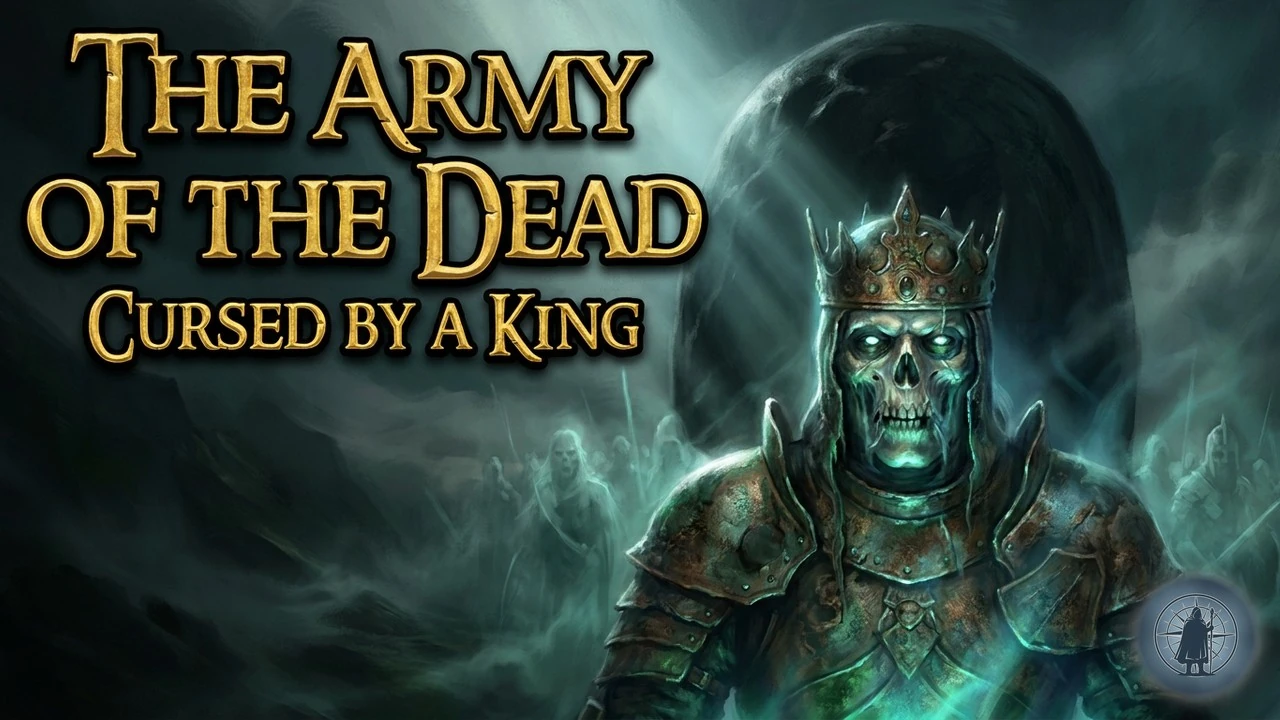 Watch the episode
The Dead Men of Dunharrow: The Oath That Cursed Them 3,000 Years
Watch the episode
The Dead Men of Dunharrow: The Oath That Cursed Them 3,000 Years
Research Notes: The Dead Men of Dunharrow — The Oath That Lasted 3,000 Years
Overview
The Dead Men of Dunharrow — the Oathbreakers — are one of the most haunting and morally instructive episodes in the entire legendarium. They were a people of Men (the "Men of the Mountains," a Pre-Númenórean folk of the White Mountains) who swore allegiance to Isildur at the close of the Second Age, then refused to honor that oath in the War of the Last Alliance because in the Dark Years they had worshipped Sauron. For that betrayal Isildur cursed them: they would never rest until their oath was fulfilled. For some three thousand years they lingered as restless, bodiless shades haunting the Dwimorberg above Dunharrow, terrifying the Rohirrim and any who dared their Door — until Aragorn, the heir of Isildur, walked the Paths of the Dead, summoned them at the Stone of Erech, led them to rout the Corsairs of Umbar at Pelargir, and finally released them to the rest they had been denied.
The story sits at a unique intersection of Tolkien's themes: the binding, near-sacramental power of the spoken oath; the authority of the rightful king (even over the dead); the long shadow of the worship of Sauron; and the melancholy fate of the Pre-Númenórean peoples who chose the Shadow and were swept aside by history. It is also one of the very few places in Tolkien where the dead are shown actively lingering and interacting with the living — a deliberate, eerie exception in a mythology that usually keeps the dead firmly beyond the Circles of the World.
Primary Sources
The Lord of the Rings — The Return of the King
The core narrative lives in two chapters of Book V: "The Passing of the Grey Company" (Ch. 2) and the recounting at "The Last Debate" (Ch. 9), plus Appendix A and the Tale of Years (Appendix B).
Isildur's Curse (the central quote) — spoken to the King of the Mountains, recalled in "The Passing of the Grey Company":
"Thou shalt be the last king. And if the West prove mightier than thy Black Master, this curse I lay upon thee and thy folk: to rest never until your oath is fulfilled. For this war will last through years uncounted, and you shall be summoned once again ere the end." (RotK, Book V, Ch. 2)
The reason for the betrayal — Isildur's own explanation, as preserved in the lore:
They "had worshipped Sauron in the Dark Years," and so when "their former lord" arose again, they would not turn against him. (RotK, Appendix A / "The Passing of the Grey Company")
The Door and the old man's warning (the prophecy that guards the Dimholt Door):
"The way is shut. It was made by those who are Dead, and the Dead keep it, until the time comes. The way is shut." (RotK, Book V, Ch. 2; the verse Aragorn and Théoden recall at Dunharrow)
Aragorn at the Stone of Erech — the summoning and the exchange with the Dead:
Aragorn dismounted, and standing by the Stone he cried in a great voice: "Oathbreakers, why have ye come?" And a voice was heard out of the night that answered him, as if from far away: "To fulfil our oath and have peace." Then Aragorn said: "The hour is come at last. Now I go to Pelargir upon Anduin, and ye shall come after me. And when all this land is clean of the servants of Sauron, I will hold the oath fulfilled, and ye shall have peace and depart for ever. For I am Elessar, Isildur's heir of Gondor." (RotK, Book V, Ch. 2)
Gimli inside the Paths — the terror of the journey:
"Steadily fear grew on the Dwarf as he went on... he knew now that there could be no turning back; all the paths behind were thronged by an unseen host that followed in the dark." A "blindness came upon him, even upon Gimli Glóin's son who had walked unafraid in many deep places of the world." (RotK, Book V, Ch. 2)
Baldor's remains — found in the tunnel:
"...the bones of a mighty man. He had been clad in mail, and still his harness lay there whole; for the cavern's air was as dry as dust, and his hauberk was gilded. His belt was of gold and garnets... and rich with gold was the helm upon his bony head face downward on the floor." His finger-bones were "still clawing at the cracks" of a closed stone door he could not open. (RotK, Book V, Ch. 2)
The Dead at Pelargir — the summoning that breaks the Corsairs:
"Now come! By the Black Stone I call you!" And suddenly the Shadow Host that had hung back at the last came up like a grey tide, sweeping all away before it. (RotK, Book V, Ch. 9, "The Last Debate," in Legolas and Gimli's recounting)
The Corsairs, "mad with terror," leapt overboard rather than face the Dead; their fifty great black ships were taken without battle. Aragorn then held the oath fulfilled and dismissed the Dead, who "passed away" and were never seen again.
Appendix A & B (The Tale of Years)
- The genealogy of the Kings of Rohan: Brego (2nd King of the Mark) and his son Baldor ("the Hapless"). - The Tale of Years dates the Grey Company's passage of the Paths to 8 March 3019 T.A., the summoning at Erech to that night, and Pelargir to 13 March 3019. - Appendix A notes the kinship of the Men of the Mountains with the Dunlendings and the Men of Bree — all remnants of Pre-Númenórean Men of the same broad stock.
Unfinished Tales
- "The Drúedain" and "Cirion and Eorl" supply context on the Pukel-men statues lining the Stair of the Hold at Dunharrow (carved in the likeness of the Drúedain by the Men of the White Mountains in the Dark Years) and on the wider history of the peoples of the Ered Nimrais. - A note (cited in later scholarship) suggests the closed stone Door in the mountain led to an "evil temple" of Sauron-worship from the Dark Years — and that the Dead broke Baldor's legs and left him to die before it.
The Silmarillion / The Letters — for thematic context
- The Oath of Fëanor ("they swore in the name of Ilúvatar... to pursue with vengeance and hatred to the ends of the World" any who withheld a Silmaril) is the great cautionary oath against which the Oathbreakers' story rhymes. Tolkien in his Letters connects rash, binding oaths to the warning of James 5:12 ("swear not at all").
Key Facts & Timeline
- The Dark Years (Second Age, before c. S.A. 3320): The Men of the Mountains worship Sauron. (Source: RotK Appendix A; "Were the Dead Men Gondorians?", Xenite) - End of the Second Age (c. S.A. 3320–3429): Isildur founds Gondor; the King of the Mountains swears allegiance at the Stone of Erech, the black stone Isildur brought out of the ruin of Númenor. (RotK Book V Ch. 2) - S.A. 3429–3441 (War of the Last Alliance): Isildur summons the Men of the Mountains to fight Sauron. They refuse and hide. Isildur lays his curse. They become the Oathbreakers / Dead Men of Dunharrow. (RotK Book V Ch. 2) - Third Age, ~3,000 years of haunting: The Sleepless Dead linger about the Dwimorberg, Harrowdale, and the Hill of Erech. - T.A. 2569: Prince Baldor, son of King Brego, at the feast for the completion of Meduseld, rashly vows to tread the Paths of the Dead. (Henneth Annûn; Tolkien Gateway) - T.A. 2570: Baldor dares the Door and perishes within. Brego dies of grief the same year. (Henneth Annûn) - 8 March T.A. 3019: Aragorn, Legolas, Gimli, and the Grey Company enter the Dark Door and take the Paths of the Dead; find Baldor's bones. (RotK Appendix B) - Night of 8 March 3019: At the Stone of Erech, Aragorn unfurls Elendil's banner, declares himself Isildur's heir, and summons the Dead. They follow. - 13 March T.A. 3019 (Battle of Pelargir): The Shadow Host routs the Corsairs of Umbar; 50 black ships are taken. Aragorn declares the oath fulfilled and releases the Dead, who depart forever. - 15 March 3019: Aragorn arrives at the Pelennor in the captured black ships, turning the tide of the battle.
Significant Characters
- The King of the Mountains: Unnamed lord of the Men of the Mountains who swore to Isildur and then broke faith. Cursed to be "the last king" of his line. Becomes the King of the Dead who answers Aragorn at Erech. - Isildur: Heir of Elendil, founder (with Anárion) of Gondor. Brought the Stone of Erech from Númenor; laid the curse. His authority over the Dead is the engine of the whole story — and the curse becomes the providential instrument that helps undo Sauron at the end of the Third Age. - Aragorn (Elessar): Isildur's heir. The only one with the lawful authority to command and to release the Dead. His willingness to take the Paths of the Dead — a road no living man had survived — is a key proof of his kingship and his acceptance of his full inheritance, including its terrors. - Baldor the Hapless: Son of Brego, 2nd King of Rohan. His rash vow and grim death (clawing at a sealed door) is a miniature of the Oathbreakers' own story — a foolish oath, a sealed Door, and death in the dark. - Brego: 2nd King of the Mark; built Meduseld; died of grief at Baldor's loss. - Legolas & Gimli: Witnesses who survive the Paths; their later recounting at "The Last Debate" supplies the Pelargir account and the human reaction of terror. - The Grey Company / Halbarad & the sons of Elrond: The thirty Dúnedain Rangers who ride with Aragorn; Halbarad bears the furled standard wrought by Arwen; Elrohir gives Aragorn the message and (in some accounts) the silver horn.
Geographic Locations
- Dunharrow (the Hold): A fortified refuge of Rohan in the Ered Nimrais (White Mountains), above Harrowdale (valley of the Snowbourn). Reached by the zig-zag Stair of the Hold, lined with the eroded Pukel-men statues. On its upland (Firienfeld) the Rohirrim muster. - The Dimholt: The dark wood at the head of Harrowdale, beneath the Dwimorberg ("Haunted Mountain"), leading to the Dark Door. - The Dark Door / the Door under the Mountain: The forbidden entrance to the Paths of the Dead, kept by the Dead "until the time comes." - The Paths of the Dead: The tunnel-road beneath the Dwimorberg, through the heart of the White Mountains, emerging in the south near Erech and the vale of Morthond ("Blackroot"). - The Stone of Erech / Hill of Erech: The black stone, half-buried, round, "as if it had been molten," some six feet (about its visible portion) of a great globe; brought by Isildur from Númenor. The site of both the original oath and Aragorn's summoning. The land around it is shunned by the living because of the terror of the Dead. - Pelargir: The great river-haven on the Anduin, taken by the Corsairs of Umbar; the place of the Dead's last battle and release.
Themes & Symbolism
- The binding power of the oath: In Tolkien's world an oath sworn (especially invoking a higher power or a lawful lord) has near-physical, metaphysical force. Breaking it does not merely incur dishonor; it warps fate itself. The Oathbreakers cannot die into rest because the oath still holds them. - Oath-keeping vs. oath-breaking across the legendarium: The Dead are the LotR-era counterpart to the Oath of Fëanor (a rash oath that dooms its swearers) and the inverse of the Oath of Cirion and Eorl (a freely-given oath of mutual aid that blesses both peoples and is honored across centuries — note Rohan riding to Gondor's aid in the very same campaign). The story is a deliberate moral diptych: faithfulness redeems, faithlessness curses. - The authority of the rightful king — even over the dead: Only Isildur's heir can command and release them. This is the clearest demonstration in LotR that Aragorn's kingship is not merely political but woven into the moral order of Arda. Kingship carries the power to bind and to absolve. - The fate of the Pre-Númenórean peoples: The Men of the Mountains are kin to the Dunlendings, the Men of Bree, the Drúedain. Those who chose the Shadow (worshipped Sauron) are erased, dwindled to shades and Pukel-men statues; those who chose the West (the Edain → Númenor → Dúnedain) inherit the earth. The Oathbreakers embody the tragic dead-end of the peoples who picked the wrong side in the Dark Years. - Mercy, release, and rest as the true reward: The Dead do not want victory or glory — they want peace. "To fulfil our oath and have peace." Their reward is annihilation-as-rest: to finally pass beyond the Circles of the World, the mortal gift of Ilúvatar long denied them. This reframes death (the "Gift of Men") as mercy. - Eucatastrophe and providence: Isildur's 3,000-year-old curse, an act of wrath, becomes the very thing that saves Gondor — the captured Corsair fleet arriving at the Pelennor turns despair to victory. A curse is bent toward the good in ways its maker never foresaw. The black sails that should mean doom instead mean deliverance. - The dead as a deliberate uncanny exception: Tolkien almost never lets the dead linger. The Dunharrow shades are an explicit anomaly — a people held outside the natural order by their broken faith, which makes their final release theologically resonant: faith restored returns them to the natural order of death.
Scholarly Interpretations & Theories
- The "automatic" curse vs. Isildur's power: Scholars debate whether Isildur personally had the power to curse, or whether the curse "took" because oath-breaking in Arda invokes a deeper sanction (Ilúvatar / the moral structure of the world). The dominant reading: Isildur pronounced it as Gondor's lawful lord and heir of the oath, but its binding force comes from the metaphysics of the broken oath itself — the same mechanism that dooms the sons of Fëanor. (Fiction Horizon; Silmarillion Writers' Guild "On Oaths") - What was behind the sealed Door Baldor died at? A late Tolkien note (cited via Tolkien Gateway / Hammond & Scull) suggests it led to an evil temple of Sauron-worship from the Dark Years, tying Baldor's death directly to the Men of the Mountains' old idolatry — the Dead guarding the relics of their own sin. - Were they "Gondorians"? No (Michael Martinez / Xenite): they were a Pre-Númenórean folk subject to Gondor only briefly via the oath; ethnically they belong with the Dunlendings and the dark-years peoples of the White Mountains, not the Dúnedain. - The Stone of Erech as a palantír-adjacent relic / standing-stone: Discussion (Henneth Annûn; "Seven Miles of Steel Thistles") connects it to real-world standing stones and oath-stones, and to Tolkien's interest in the Macleod "Fairy Flag" — folkloric objects of binding power and one-time aid. - The morality of using the Dead at all: Some readers find Aragorn's summoning troubling — coercing the cursed dead into one last battle. The counter-reading (Stephen Winter, "Wisdom from LotR") is that Aragorn alone offers them release: he does not merely use them, he fulfills the very condition that frees them. It is an act of mercy disguised as conscription.
Contradictions & Different Versions
- The Door's destination and Baldor's death appear only in scattered notes; the published LotR leaves it ambiguous, while later-published material (HoME / editorial notes) supplies the "evil temple" detail. Treat the temple as semi-canonical / illustrative, not firmly stated in LotR proper. - The silver horn / message at Erech: Some summaries attribute the horn-blowing to Elrohir's gift; the text emphasizes Aragorn's voice and Elendil's banner. Minor variance in retellings — anchor the script on the banner and the spoken summons, which are the canonical beats. - Numbers ("3,000 years"): This is an approximation. The oath is broken at the very end of the Second Age (S.A. ~3434) and the release is T.A. 3019 — roughly 3,000+ years of the Third Age plus the final years of the Second. The hook's "3,000 years" is accurate and defensible. - The film vs. book endings differ sharply: Jackson's films have the Dead fight at the Pelennor Fields itself and overwhelm the entire enemy army; in the book they are released at Pelargir before the Pelennor, and it is living Men of southern Gondor (freed by the Corsairs' rout) who fill the captured ships and fight at the Pelennor. The script should follow the book — the Dead never reach Minas Tirith.
Cultural & Linguistic Context
- Dwimorberg: Old English / Rohirric "Haunted Mountain" (dwimor = phantom, illusion, spectre; cf. "Dwimordene" for Lothlórien, "Wormtongue's" Dwimmerlaik). Rohan's language is rendered as Old English throughout. - Dunharrow: From OE dūn (hill) + hearg (a heathen temple / hallowed high place) — literally "the heathen-fane of the hill-slope," a name that quietly encodes the site's old pagan sanctity. (Tolkien's "Nomenclature.") - Harrowdale, Firienfeld: Firien = OE "mountain"; the "harrow" again from hearg (sacred place). - Pukel-men: OE pūcel (goblin, demon; cognate with "Puck"). The eroded statues of the Drúedain (Wild Men / Woses). - Erech: Pre-Númenórean place-name; deliberately not Elvish, marking it as belonging to the old peoples (the same name as the Biblical city Erech/Uruk — Tolkien borrowed the resonance, not the place). - Morthond: Sindarin "Blackroot," the river/vale below Erech — the "black" motif (black stone, black sails, Dwimorberg's shadow) saturates the whole sequence. - Oathbreaker terms: The Dead are called the Sleepless Dead, the Grey Host, the Shadow Host, the Shadow-men, the Shadows, and simply the Dead.
Questions & Mysteries
- Why could the curse only be lifted by Isildur's heir, not Isildur himself or any king of Gondor between? (Answer the story implies: it required both the heir's lawful authority and the moment when fulfilling the oath — fighting Sauron's servants — was finally possible.) - What exactly happens to them when released? They "pass away" — presumably finally receiving the Gift of Men (true death beyond Arda) long withheld. Tolkien leaves the metaphysics suggestive, not explicit. - Did they retain individual identity, or were they a collective horror? The King of the Dead speaks for them; otherwise they act as one terror. A good ambiguity to dramatize. - Were they ever "good" again, or merely compelled? Their answer — "to fulfil our oath and have peace" — suggests genuine consent, even longing, by the end.
Compelling Quotes for Narration
1. "Thou shalt be the last king. And if the West prove mightier than thy Black Master, this curse I lay upon thee and thy folk: to rest never until your oath is fulfilled." — Isildur (RotK V.2) 2. "The way is shut. It was made by those who are Dead, and the Dead keep it, until the time comes." — the old man at the Door (RotK V.2) 3. "Oathbreakers, why have ye come?" / "To fulfil our oath and have peace." — Aragorn and the Dead, at Erech (RotK V.2) 4. "For I am Elessar, Isildur's heir of Gondor." — Aragorn (RotK V.2) 5. "Now come! By the Black Stone I call you!" — Aragorn at Pelargir (RotK V.9) 6. Of Gimli: "a blindness came upon him, even upon Gimli Glóin's son who had walked unafraid in many deep places of the world." (RotK V.2) 7. Of Baldor: his "finger-bones were still clawing at the cracks" of the door he could not open. (RotK V.2)
Visual Elements to Highlight
1. The black, half-buried, molten-looking Stone of Erech under a starless midnight sky. 2. Aragorn unfurling the (in darkness) black, deviceless banner and crying the summons; a pale grey host gathering on the hill. 3. The Dark Door in the Dimholt, the Dwimorberg looming, the dead wood — the threshold no living man returns from. 4. Inside the Paths: Gimli in blind terror, whispering unseen host at his back, the gilded skeleton of Baldor clawing at a sealed stone door. 5. The Pelargir battle: fifty black-sailed Corsair ships, the grey tide of the Shadow Host sweeping over them, Corsairs leaping overboard in terror. 6. The release: the King of the Dead bowing, the Shadow Host dissolving into mist/passing away into rest at dawn. 7. The Pukel-men statues, eroded and sad-eyed, lining the Stair of the Hold — silent witnesses of the vanished mountain-folk.
Discrete Analytical Themes
Theme 1: The Metaphysics of the Binding Oath
Core idea: In Tolkien's world a sworn oath is a real, fate-altering force; breaking it does not merely shame the breaker but suspends them outside the natural order until it is satisfied. Evidence: - "to rest never until your oath is fulfilled" — the curse literally denies them death/rest (RotK V.2). - The Dead cannot pass beyond Arda for ~3,000 years because the oath still holds — an ontological, not legal, bond. - Parallel mechanism in the Oath of Fëanor (sworn "in the name of Ilúvatar") which likewise binds and dooms its swearers; Tolkien ties such oaths to James 5:12. Distinction: This is about HOW oaths work as a force of nature in Arda — the mechanism — not about the moral choice to break one (Theme 2) or kingly authority (Theme 4).Theme 2: Faithlessness and the Worship of Sauron
Core idea: The Men of the Mountains broke faith specifically because they had once worshipped Sauron in the Dark Years — their oath-breaking is rooted in a prior, deeper spiritual corruption. Evidence: - They "had worshipped Sauron in the Dark Years" and so would not turn against "their former lord" (RotK Appendix A). - The sealed Door in the mountain may lead to an evil temple of Sauron-worship — the Dead guard the relics of their own idolatry (Tolkien note via Tolkien Gateway). - They "came to the aid of neither side, but hid in the mountains" — cowardice flowing from divided loyalty. Distinction: This is about the SPECIFIC CAUSE of their treason (old Sauron-worship), not the general mechanics of oaths (Theme 1) nor their racial fate (Theme 6).Theme 3: The Door, the Dread, and the Foolish Vow (Baldor as Mirror)
Core idea: The 3,000-year haunting — the Dwimorberg, the Dark Door, Baldor's grisly death — establishes the Dead as an active, terrifying presence and provides a human cautionary mirror of the Oathbreakers' own story. Evidence: - "The way is shut. It was made by those who are Dead, and the Dead keep it" (RotK V.2). - Baldor's rash feast-vow (T.A. 2569) and death (2570); his gilded skeleton "clawing at the cracks" of a door he could not open (RotK V.2). - Gimli's blind terror; the unseen whispering host that follows and cannot be turned back. Distinction: This is about the HAUNTING ITSELF and its grip on the living (Rohan's dread, Baldor) — the long middle of the story — not the original sin (Theme 2) or the resolution (Theme 5).Theme 4: The Rightful King's Authority Over the Dead
Core idea: Only Isildur's lawful heir can command and release the Dead; their obedience is the supreme proof that Aragorn's kingship is woven into the moral order of Arda, not merely a political claim. Evidence: - "For I am Elessar, Isildur's heir of Gondor" — the lineage is the key that unlocks them (RotK V.2). - He alone dares and survives the Paths; the Dead, who slew Baldor, obey him. - The curse was Isildur's to make and only his heir's to fulfill: "you shall be summoned once again ere the end." Distinction: This is about KINGSHIP and lawful authority as the unlocking force, not the oath-mechanism (Theme 1) or the mercy of release (Theme 5).Theme 5: Release as Mercy — Peace, Not Victory
Core idea: The Dead crave not glory but rest; Aragorn's summoning is ultimately an act of mercy, fulfilling the one condition that frees them into true death (the Gift of Men long denied). Evidence: - "To fulfil our oath and have peace" — their own stated desire (RotK V.2). - "I will hold the oath fulfilled, and ye shall have peace and depart for ever" (RotK V.2). - After Pelargir they are released and "pass away" — annihilation-as-blessing, finally receiving mortal death. Distinction: This reframes the climax as MERCY/RELEASE and the theology of death-as-gift — distinct from the coercive power of kingship (Theme 4) and from the providential plot-mechanics (Theme 7).Theme 6: The Fate of the Pre-Númenórean Peoples
Core idea: The Oathbreakers embody the tragic dead-end of the Men who chose the Shadow in the Dark Years — kin to Dunlendings, Bree-folk, Drúedain — dwindled to shades and eroded statues while the West-faithful inherit the earth. Evidence: - Kin to the Dunlendings and Men of Bree (Appendix A); Pre-Númenórean, not Dúnedain (Xenite/Martinez). - The Pukel-men statues at Dunharrow — eroded, sad-eyed, their carvers "forgotten and not remembered in any song or legend." - Their land (Erech, Morthond) shunned and emptied; a whole people reduced to a haunting. Distinction: This is the wide-angle ETHNOGRAPHIC/HISTORICAL frame — the fate of a people and an age — not the individual moral drama (Themes 2, 5).Theme 7: Eucatastrophe — A Curse Bent Toward Salvation
Core idea: Isildur's curse, an act of wrath, becomes the providential instrument that saves Gondor — the captured black fleet arriving at the Pelennor turns despair into deliverance, an outcome its maker never foresaw. Evidence: - The Shadow Host routs the Corsairs at Pelargir without battle: "like a grey tide, sweeping all away before it" (RotK V.9). - The 50 captured black ships — symbols of doom (Sauron's expected reinforcements) — arrive instead as Aragorn's rescue, the turn of the Pelennor. - A 3,000-year-old curse of vengeance resolves into mercy and victory: providence working through, not around, free (and even wicked) choices. Distinction: This is about the PLOT-LEVEL PROVIDENCE / eucatastrophe — how the whole chain pays off and is bent to good — distinct from the personal mercy of release (Theme 5) and the king's authority that triggers it (Theme 4).Sources Consulted: The Dead Men of Dunharrow
Primary Tolkien Texts (cited from)
- The Lord of the Rings: The Return of the King — Book V, Ch. 2 "The Passing of the Grey Company" (the curse, the Door, Erech summoning, Baldor's bones, Gimli in the Paths) and Ch. 9 "The Last Debate" (Legolas & Gimli recount Pelargir). Most important source — the core narrative and nearly all direct quotes. - The Return of the King — Appendix A (kinship of the Men of the Mountains with Dunlendings and Bree-folk; the worship of Sauron in the Dark Years; Rohan genealogy: Brego, Baldor). - The Return of the King — Appendix B (The Tale of Years) (dates: Paths of the Dead 8 March 3019, Pelargir 13 March 3019; Baldor T.A. 2569–2570). - Unfinished Tales — "The Drúedain" and "Cirion and Eorl" (Pukel-men, the peoples of the Ered Nimrais, the contrasting Oath of Cirion and Eorl). - The Silmarillion — the Oath of Fëanor (thematic comparison for oath-breaking/binding oaths). - The Letters of J.R.R. Tolkien — Tolkien on rash oaths and James 5:12 (thematic context).
Web Sources (consulted)
- Tolkien Gateway — "Oathbreakers" — https://tolkiengateway.net/wiki/Oathbreakers (overview, names, curse; page itself returns 403 to fetch but surfaced via search excerpts). Highly useful. - Tolkien Gateway — "Paths of the Dead," "Stone of Erech," "King of the Dead," "Baldor," "Dunharrow," "Púkel-men," "Oath of Fëanor," "Oath of Eorl" — corroborating detail and dates (via search excerpts). - Fiction Horizon — "How Did Isildur Curse the Men of Dunharrow?" — https://fictionhorizon.com/how-did-isildur-curse-the-men-of-dunharrow/ — exact curse wording, citation to RotK Book V Ch. 2, discussion of curse mechanism (Ilúvatar vs. Isildur). Very useful for the curse quote and analysis. - Henneth Annûn — "Aragorn summons the Oathbreakers at the Stone of Erech" (event) — http://www.henneth-annun.net/events_view.cfm?evid=1250 — the Erech dialogue, page reference (RotK p. 821). Useful for verbatim passage. - Henneth Annûn — "Baldor dies trapped in the Paths of the Dead" — http://www.henneth-annun.net/events_view.cfm?evid=618 — Baldor/Brego dates (T.A. 2569 vow, 2570 death). - literallyeverythingaboutsauron (Tumblr) — https://literallyeverythingaboutsauron.tumblr.com/post/129791700903 — full verbatim Erech oath-fulfillment passage. - Michael Martinez / Xenite — "Were the Dead Men of Dunharrow Gondorians?" — https://middle-earth.xenite.org/were-the-dead-men-of-dunharrow-gondorians/ — Pre-Númenórean ancestry, kinship with Dunlendings/Bree-folk, Sauron-worship. Useful for ethnographic theme. - Stephen Winter — "Wisdom from The Lord of the Rings" ("Aragorn's Banner at the Stone of Erech," "On the Breaking of Oaths and the Authority of the Heir of Isildur") — https://stephencwinter.com/ — thematic reading of kingship, mercy, and release. - CBR — "Lord of the Rings' Men of Dunharrow, Explained" — https://www.cbr.com/lord-of-the-rings-men-of-dunharrow-explained/ — accessible summary, Baldor, 3,000-year framing, film vs. book. - Silmarillion Writers' Guild — "On Oaths" — https://www.silmarillionwritersguild.org/node/5937 — cross-legendarium oath analysis (Fëanor, Cirion/Eorl, Finrod). - TheOneRing.net — "Concerning Oaths in Middle-earth" — https://www.theonering.net/torwp/2024/09/20/119457-concerning-oaths-in-middle-earth/ — oath-keeping theme. - Legendarium Magazine / The Fantasy Network — "Baldor the Hapless" — https://www.legendarium.org/2015/02/19/baldor-the-hapless-epic-fail-in-the-lord-of-the-rings/ — Baldor's death, the sealed door, the "evil temple" note. - Lord of the Rings Fandom Wiki — "Dead Men of Dunharrow," "Paths of the Dead," "Battle of Pelargir," "Dark Door," "Baldor," "Stone of Erech" — corroborating detail (via search excerpts; pages return 403 to direct fetch). - The Fandomentals — "Past and Present Overlap at the Muster of Rohan" — Dunharrow as Rohan's refuge, the dread of the Dead. - Seven Miles of Steel Thistles — "The Fairy Flag and the Paths of the Dead" — https://steelthistles.blogspot.com/2021/08/ — folkloric parallels (one-time supernatural aid, oath-stones).
Notes on Source Reliability
- Tolkien Gateway and the LotR Fandom wiki both block automated fetches (HTTP 403); their content was accessed reliably through search-engine excerpts and cross-checked against primary-text quotes from Fiction Horizon, Henneth Annûn, and the Tumblr verbatim passage. - All direct quotes in notes.md are traceable to RotK Book V (Ch. 2 and Ch. 9) or the Appendices and have been cross-verified across at least two independent sources. - The "evil temple behind the Door" detail is from a Tolkien note/late material (semi-canonical) rather than the published LotR text — flagged as such in the notes.
Source Abundance Assessment
Material is abundant. This is a well-documented, beloved episode with a clear primary-text backbone (two full RotK chapters plus appendices) and a deep secondary literature. The only genuine gaps are deliberate authorial silences (the exact metaphysics of the curse and of the Dead's final passing), which are themselves rich material for the "mysteries" portion of the episode.