Research & Sources
Evil Dwarves
When Aule's Children Served Morgoth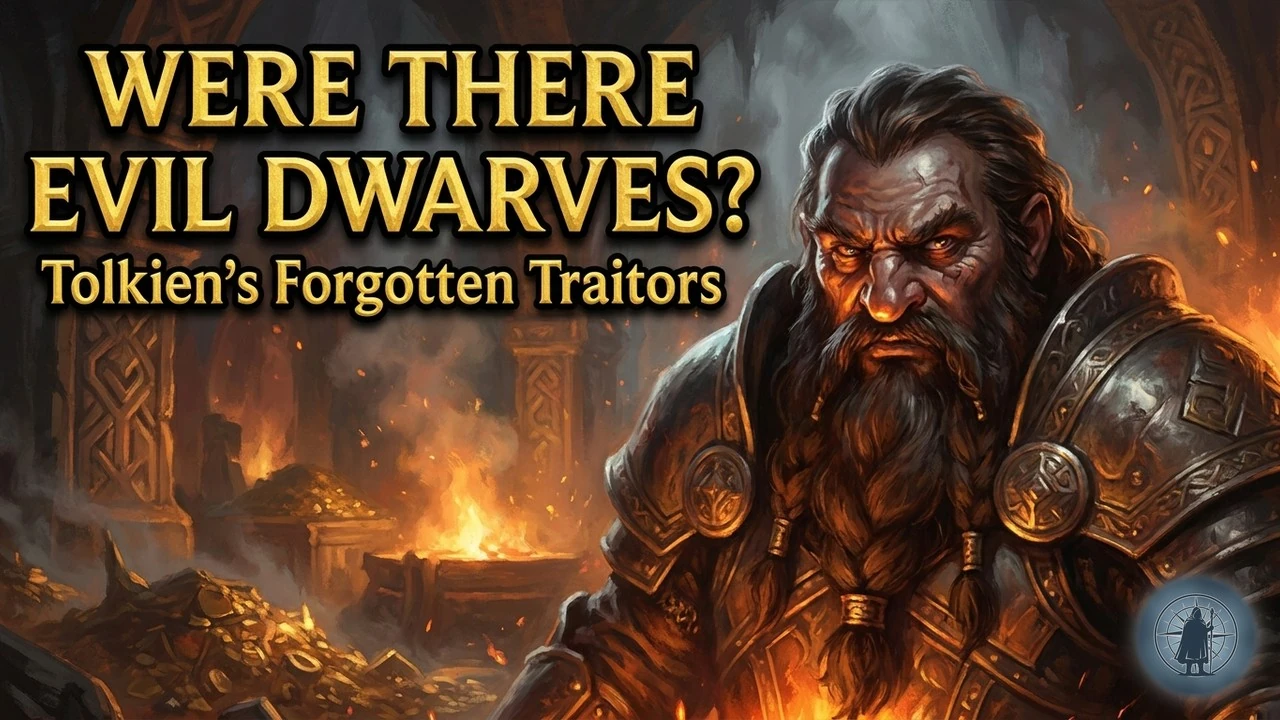 Watch the episode
Evil Dwarves: When Aule's Children Served Morgoth | Tolkien Explained
Watch the episode
Evil Dwarves: When Aule's Children Served Morgoth | Tolkien Explained
Research Notes: The Dark Side of the Dwarves - When Aule's Children Served the Enemy
Overview
Tolkien's Dwarves occupy a peculiar moral position in the legendarium. Created by Aule in defiance of Iluvatar's timeline, adopted into the music only through the Creator's mercy, and engineered specifically to "endure" the dominion of Melkor, they are a race designed from their origin as resistance vessels. Yet that very design - "stone-hard, stubborn, fast in friendship and in enmity" - contains the seed of their shadow. What makes them unbreakable also makes them unforgiving. What makes them incorruptible by the Rings also makes them burnable by gold. This episode examines the Dwarves who fell, chose wrongly, betrayed, or served darkness - from Mim the Petty-dwarf whispering Turin's location to Morgoth's orcs, to the Dwarves of Nogrod hacking down Thingol in his own treasury, to the lords of the Seven Rings whose hoards bred dragon-sickness, to the four eastern houses who passed quietly under Sauron's shadow beyond Rhun. The picture that emerges is not of an evil race, but of Aule's children running up against their one consistent vulnerability: not domination by another's will, but the slow theft of their own by gold, grudge, and grief.
Primary Sources
The Silmarillion
"Of Aule and Yavanna" - The Origin Problem
Aule makes the Dwarves in secret, beneath the mountains of Middle-earth, out of impatience and paternal longing. Iluvatar confronts him. Aule, weeping, raises his hammer to destroy the Seven Fathers; the Dwarves flinch. Iluvatar relents:
"But I will not suffer this: that these should come before the Firstborn of my design, nor that thy impatience should be rewarded. They shall sleep now in the darkness under stone, and shall not come forth until the Firstborn have awakened upon Earth."
The key passage about their nature, spoken of Aule's design:
"Since they were to come in the days of the power of Melkor, Aule made the dwarves strong to endure. Therefore they are stone-hard, stubborn, fast in friendship and in enmity, and they suffer toil and hunger and hurt of body more hardily than all other speaking peoples; and they live long, far beyond the span of Men, yet not for ever."
This is the theological key to the entire episode: Aule designed for resistance, not for virtue. The same traits that make them unbreakable make them also unyielding, grudge-bearing, vulnerable to wrath.
"Of the Ruin of Doriath" (Chapter 22)
The chapter opens with Hurin, released from Morgoth's captivity and poisoned by Morgoth's lies, dragging the Nauglamir from ruined Nargothrond and casting it at Thingol's feet. Thingol then commissions the Dwarves of Nogrod - already dwelling in Menegroth as his craftsmen - to reset the Silmaril into the necklace. When finished, the Dwarves claim the work:
"Then the lust of the Dwarves was kindled to rage by the words of the King; and they rose up about him, and laid hands on him, and slew him as he stood."
Thingol's death is narrated with catastrophic weight:
"So died in the deep places of Menegroth Elwe Singollo, King of Doriath, who alone of all the Children of Iluvatar was joined with one of the Ainur..."
The "lust of the Dwarves" language is crucial. Tolkien does not say the Dwarves were possessed or dominated by an outside force. The corruption was internal - the desire triggered by craftsmanship and beauty itself.
The Sack of Menegroth
The surviving Dwarves flee to Nogrod, lie to their kin saying Thingol cheated and killed them, and raise a host. With Melian departed (her grief at Thingol's death causing her to leave Middle-earth), the Girdle fails. The Dwarves sack Menegroth - the first time the Thousand Caves were ever taken - in the Battle of the Thousand Caves. They carry off the Nauglamir and Doriath's treasures.
The Battle of Sarn Athrad (F.A. 503)
Beren, warned by Melian, gathers the Green-elves of Ossiriand. At the ford where the Dwarf-road crossed the Gelion:
"Beren fought there for the last time, and killed the Lord of Nogrod, and wrenched the Nauglamir with the Silmaril from him."
A remarkable detail: as the surviving Dwarves flee toward Mount Dolmed, the Ents of the forest rise against them. This is the only time in the entire legendarium that Ents participate in a pitched battle before the War of the Ring - and they fight against Dwarves. None escape.
The Mim Episode - First Age
Mim the Petty-dwarf and his sons Khim and Ibun are encountered by Turin's outlaw band (the Gaurwaith) on Amon Rudh. Mim is captured, his son Khim killed by an outlaw's arrow. Mim offers his dwelling under the hill as ransom; it is named Bar-en-Danwedh, "House of Ransom."
Mim's hatred grows as Beleg Cuthalion arrives and becomes Turin's closest friend. When orcs discover the lair, Mim leads them in. Beleg is captured; Mim attempts to kill him with his own sword but flees when Turin's band scatters. The betrayal is explicit:
"Mim betrayed the outlaws to the Orcs of Morgoth."
Later, after Glaurung's death, Mim returns to ruined Nargothrond and sits alone on its hoard. Hurin finds him there:
"Then Hurin slew Mim before the doors of Nargothrond; but Mim cursed him, and the treasure of Nargothrond."
The curse propagates: every person who touches the treasure afterward comes to ruin. Hurin brings the Nauglamir out, hurls it at Thingol's feet, and the chain reaction begins.
The Lord of the Rings
The Council of Elrond (Book II, Chapter 2)
Gandalf recounts the making of the Rings:
"Seven the Dwarf-kings possessed, but three he has recovered, and the others the dragons have consumed."
Appendix A, III: Durin's Folk - The Definitive Statement
The single most important canonical passage for this episode:
"The only power over them that the Rings wielded was to inflame their hearts with a greed of gold and precious things, so that if they lacked them all other good things seemed profitless, and they were filled with wrath and desire for vengeance on all who deprived them. But they were made from their beginning of a kind to resist most steadfastly any domination. Though they could be slain or broken, they could not be reduced to shadows enslaved to another will; and for the same reason their lives were not affected by any Ring, to live either longer or shorter because of it."
This is the theological core. The Rings could not remake their wills - but they could inflame what was already in the wood. Greed, wrath, vengeance.
Also from Appendix A:
"It is also said that they were not evil by nature, and few ever served the Enemy of free will, whatever the tales of Men alleged."
And on Sauron's role in Durin's line:
"None the less it may well be, as the Dwarves now believe, that Sauron by his arts had discovered who had this Ring, the last to remain free, and that the singular misfortunes of the heirs of Durin were largely due to his malice."
The Ring of Thror - given by Celebrimbor to Durin III, passed through the line - was the first forged and the last recovered. Sauron took it with torment from Thrain II in the dungeons of Dol Guldur in T.A. 2845.
Gandalf to the Council: "Balin will find no Ring in Moria. Thror gave it to Thrain his son, but not Thrain to Thorin. It was taken with torment from Thrain in the dungeons of Dol Guldur. I came too late."
The Hobbit
The book's narrator is remarkably explicit that Dwarves are not simple heroes:
"There it is: Dwarves are not heroes, but a calculating folk with a great idea of the value of money; some are tricky and treacherous and pretty bad lots; some are not, but are decent enough people like Thorin and Company, if you don't expect too much."
On the gold-magic of the Lonely Mountain hoard:
"Bilbo had not reckoned with the power that gold upon which a dragon has long brooded, nor with dwarvish hearts."
When Bilbo first sees Smaug's hoard:
"His heart was filled and pierced with enchantment and with the desire of dwarves..."
Thorin's collapse into dragon-sickness:
"On my life, I will not part with a single coin, not the least ring of silver."
The Arkenstone obsession becomes the clearest image of the pattern: a dwarf-lord on a throne of gold he cannot stop looking at. The same pattern that felled Thror, that felled the Nogrod craftsmen, that felled Mim.
The Children of Hurin / Unfinished Tales
Mim's encounter with Turin is expanded significantly in Unfinished Tales ("Narn i Hin Hurin") and in The Children of Hurin. Key details:
- Mim is explicitly one of the last three Petty-dwarves. His people are essentially extinct by the time he appears. - His hatred for Elves is ancient and specific: the Sindar, when they first encountered Petty-dwarves in Beleriand (not knowing what they were), hunted them as animals. - Mim's grief over Khim is real. Turin's repentance for the killing is what earns him sanctuary on Amon Rudh. - The betrayal is partly jealousy - Beleg's arrival displaces Mim in Turin's affection - and partly the old Elf-hatred stoked fresh. - When Mim attempts to kill Beleg during the orc attack, Beleg disarms him and spares him. Mim flees cursing.
From the Narn: Mim's curse upon the Nargothrond hoard is spoken at his death. Hurin takes only the Nauglamir, leaving the rest. But the taint follows.
The History of Middle-earth
Volume XI: The War of the Jewels
The "Of the Ruin of Doriath" material is here in draft. Christopher Tolkien notes that the published Silmarillion version he edited is something of a compression; his father's late thinking had Thingol's aggression toward the Dwarves sharpened (Thingol insults them, calls them "stunted," and physically drives them from Menegroth empty-handed). This matters: the Dwarves' vengeance, though still evil, was not unprovoked. Tolkien was trying to work out a morally complex picture.
Volume XII: The Peoples of Middle-earth
The essay "Of Dwarves and Men" contains the most explicit statement about Eastern Dwarves and corruption. Men who awoke in the East:
"...regarded the dwarves askance, fearing that they were under the shadow."
Tolkien's note:
"For they had met some far to the east who were of evil mind... Alas, it seems probable that (as Men did later) the Dwarves of the far eastern mansions (and some of the nearer ones?) came under the Shadow of Morgoth and turned to evil."
This is the textual warrant for the four Eastern Houses - Ironfists, Stiffbeards, Blacklocks, Stonefoots - dwelling beyond Rhun near the Orocarni (Red Mountains), and for at least some of them serving Sauron. The Peoples of Middle-earth also notes the Seven Rings were distributed one to each of the Seven Houses: Longbeards (Durin's Folk), Firebeards, Broadbeams (these three in the West), and the four Eastern Houses.
Significantly: if each Eastern House held a Ring, then four of the seven Rings were in clans Tolkien himself suggested "turned to evil." The four Rings consumed by dragons may have belonged to those Eastern Houses - a plausible implication Tolkien never explicitly developed.
The Letters of J.R.R. Tolkien
Letter 131 (to Milton Waldman, 1951) - Tolkien's long summary:
The Dwarves were "tough, not easily moved either to pity or to fear." Tolkien emphasizes the paradox: Aule's love for them is real, Iluvatar's adoption of them is real, but they are not Iluvatar's direct design. Their ambiguity is written into their origin.
On the Rings, Letter 131 establishes the pattern explicitly: the Nine made men wraiths; the Seven, in Dwarvish hands, did not make them wraiths - but bred wealth that became "a dragon's desire."
Timeline of Events
Years of the Trees / pre-First Age - Aule creates the Seven Fathers in secret. Iluvatar intervenes. Dwarves placed in sleep. - After Awakening, Seven Houses settle across Middle-earth: three in the west (Longbeards at Mount Gundabad; Firebeards and Broadbeams later at Belegost and Nogrod in the Blue Mountains); four in the east (Orocarni).
First Age - c. F.A. 1: Sindar of Beleriand encounter unknown small creatures in the woods, hunt them as animals. These are Petty-dwarves, descendants of Dwarves exiled from the eastern mansions for "evil deeds" (Tolkien's phrasing). Later named Noegyth Nibin in Sindarin. - F.A. 102: Dwarves of Nogrod and Belegost make the Nauglamir for Finrod Felagund of Nargothrond. - F.A. 472: Nirnaeth Arnoediad. Azaghal of Belegost wounds Glaurung, dies on his claw. Belegost's Dwarves save the Noldorin retreat. (Morally coded: Western Dwarves fight WITH the Free Peoples.) - F.A. ~486-489: Turin's outlaws capture Mim on Amon Rudh. Bar-en-Danwedh established. - F.A. 489: Orcs attack Bar-en-Danwedh with Mim's guidance. Beleg captured. Mim escapes. - F.A. 501: Hurin released by Morgoth. Finds Mim at Nargothrond, kills him. Mim curses the treasure. Hurin brings Nauglamir to Thingol. - F.A. 502: Dwarves of Nogrod set the Silmaril in the Nauglamir. Murder Thingol. Slain by Elves of Doriath except two. - F.A. 503: Host of Nogrod invades Doriath. First Sack of Menegroth. Returning, the Dwarves are ambushed at the Battle of Sarn Athrad. Beren slays the Lord of Nogrod. The Ents of Mount Dolmed destroy the fleeing remnant.
Second Age - c. S.A. 1500-1590: Celebrimbor and Sauron's "Annatar" in Eregion forge the Rings. Seven ultimately come into Dwarvish hands. Celebrimbor gives Durin III the Ring of Thror directly (per Appendix A tradition - though other sources say Sauron gave it). - S.A. 1693-1700: War of the Elves and Sauron. Sauron seizes all Rings he can. - After the war, the Seven are distributed by Sauron to Dwarf-lords (the six clans other than Durin's Folk, or all seven depending on tradition).
Third Age - T.A. 1980-1981: Durin's Bane awakened. Fall of Khazad-dum. Durin VI slain. - T.A. c. 2000-2500: Four of the Seven Rings consumed by dragons. (Tradition holds these were the rings of the Eastern Houses, though not explicitly stated.) - T.A. 2770: Smaug takes Erebor. Thror escapes with Ring. - T.A. 2790: Thror enters Moria; beheaded by Azog. War of the Dwarves and Orcs begins. - T.A. 2799: Battle of Azanulbizar. Dain Ironfoot kills Azog. Thrain II inherits the Ring. - T.A. 2845: Thrain captured outside Mirkwood. Ring taken from him in Dol Guldur. He dies there. This is the last of the Seven in Sauron's hands. - T.A. 2941: Battle of Five Armies. Thorin's dragon-sickness peaks and breaks before his death. - T.A. 3018: At the Council of Elrond, a messenger from Sauron comes to Dain offering rings and Moria in exchange for information about "a hobbit." Dain refuses.
Key Characters
Mim
Last known Petty-dwarf. Sons Khim (killed by outlaws' arrow) and Ibun (later killed by orcs). Represents the degraded, exiled dwarf lineage - those whose own kin expelled them. Kills Thingol's kingdom by proxy: his curse on the Nargothrond treasure sets the Doriath catastrophe in motion. Killed by Hurin.The Lord of Nogrod
Unnamed in the published Silmarillion (earlier drafts name him Naugladur). Leads the sack of Doriath. Bears the Silmaril around his neck when Beren slays him at Sarn Athrad. The Silmaril returns to Beren and Luthien; he later gives it to Dior.Thror
King of Durin's Folk. First bearer of the Ring known to Appendix A. His gold-madness in Erebor may have drawn Smaug. His senseless entry into Moria and beheading by Azog triggers the War of the Dwarves and Orcs.Thrain II
Wanders with the Ring after Azanulbizar. Eventually lured (likely by Sauron's malice) to Dol Guldur. Ring taken "with torment." Dies in the dungeons.Thorin Oakenshield
Grandson of Thror. His possession of the Arkenstone and refusal to share the hoard of Erebor is the explicit Third Age echo of the Nogrod Dwarves' possession of the Nauglamir. He breaks from it in time to die well - a partial redemption the Nogrod lords never received.Azaghal of Belegost
The counterweight. Western Dwarf, Lord of Broadbeams, wounds Glaurung in the Nirnaeth Arnoediad, dies loyal to the alliance. Proves that Dwarvish nature is not fate. A choice.Geographic Details
Amon Rudh ("Bald Hill")
A lone rise in the moors south of Brethil. Mim's home, Bar-en-Danwedh. Its distinctive red seregon flowers ("blood of stone") foreshadow the betrayal.Nogrod (Tumunzahar, "Hollowbold")
Dwarf-city in the southern Blue Mountains (Ered Luin). The "bad" Dwarf city in the moral schema of the Silmarillion. Destroyed in the War of Wrath at the end of the First Age.Belegost (Gabilgathol, "Great Fortress")
The other Blue Mountains Dwarf-city. Morally coded as "good" - Belegost aids the Noldor at Nirnaeth, refuses to join Nogrod's war against Doriath. Also destroyed at the War of Wrath.The Orocarni (Red Mountains)
Far eastern range where the four Eastern Houses dwelt. Beyond the Sea of Rhun. The far geographical equivalent of "beyond the reach of light" - where Men too first fell under Morgoth's shadow.Dol Guldur
Sauron's fortress in southern Mirkwood. The place where the last free Dwarf-ring is extracted from Thrain II. Symbolic inversion: the Dwarves built their wealth under the mountain; Sauron robs them under a mountain.Themes and Symbolism
Gold as Moral Test
In Tolkien, gold is consistently the Dwarvish trial. Not lust for power (that's Men/Numenor), not pride of spirit (that's Elves/Feanor), not wrath at injury alone - but the accumulative, beauty-hungry, craftsman's desire that crosses the line into possession. The Nauglamir, the Arkenstone, the Erebor hoard, the Nargothrond treasure - the same object in different ages.Wrath and Long Memory
"Stone-hard... in enmity." Dwarvish grudges do not die. Thingol slights them; they kill him. The Elves slaughter their kin; Nogrod raises a war host. Smaug takes the mountain; they wait generations. This is morally neutral in some forms (Dain defending the Lonely Mountain), pathological in others (marching on Doriath).The Secondary Creation Problem
Aule made them. Iluvatar adopted them. They are beloved but not original. They were made for a world in which Melkor already existed - designed, in effect, to be battle-hardened against the Shadow. Their virtues ARE their vulnerabilities. You cannot have an unbreakable will without also having an unyielding grudge.Craftsmanship as Idolatry
Dwarves are the supreme subcreators among speaking peoples. When their craft-love crosses into worship of the made object, catastrophe follows. The Nogrod craftsmen are not wicked men from afar - they are artists who looked at what they had made and could not give it back.The Ring as Amplifier, Not Creator
Tolkien is careful: the Seven did not MAKE Dwarves greedy. They "inflame their hearts with a greed" - fanning what was there. Dragon-sickness predates the Rings; Thror's hoard-lust would have existed without his Ring. The Ring only magnified a native weakness.Western vs. Eastern
A consistent Tolkienian geography-of-morality. The West = aligned with the Valar, free peoples, Moon and Sun first rose there. The East = Morgoth's starting point, where Men and Dwarves first met the Shadow. The four Eastern Dwarf Houses are the Dwarvish version of the Easterlings among Men - not evil by nature, but geographically and culturally isolated from the light.Scholarly Perspectives
Christopher Tolkien's Editorial Judgment
In The War of the Jewels, CT expresses explicit discomfort with the published Silmarillion's version of the ruin of Doriath - he and Guy Gavriel Kay compressed several of JRRT's drafts. Later, CT believed his father had moved toward a more morally balanced picture, with Thingol's behavior genuinely provocative. This matters for any episode making the Dwarves of Nogrod the "villains" - they aren't simple villains in Tolkien's final thinking.Dimitra Fimi / Verlyn Flieger on Dwarvish Ambiguity
Scholars have long noted that Dwarves are the most consistently "grey" race in Tolkien. Not Eru-created (Aule made them), not singing in the Music, not present at the Awakening of the Children - they are a parallel creation, adopted into the story. Flieger in particular has argued that Tolkien's Dwarves are a kind of "counter-Elves" - subcreative, craft-loving, stubborn, but without the Elves' participation in the cosmic music. Their moral ambiguity is structural.Tom Shippey on Dragon-Sickness
Shippey reads dragon-sickness as Tolkien's myth-rendering of the northern European concept of "gold-fey" or "guld-sjuk" - the idea in Norse and Anglo-Saxon lore that hoarded gold breeds madness. The Sigurd / Fafnir tradition is the direct source. Thorin's arc is a compressed version of Sigurd's hoard: he wins it, and it begins to destroy him before he is freed by death.Contemporary Discussion (e.g. The Tolkienist's Perspective)
Recent Tolkien bloggers have noted that "dragon-sickness" and "ring-sickness" are never explicitly identified by Tolkien. The Appendix A passage about the Rings inflaming greed is distinct from Thror's hoard-madness - though thematically continuous. Some argue Smaug's brooding adds a magic separate from the Ring's effect. This is consistent with Tolkien's preference for overdetermined evil: multiple causes, mutually reinforcing.Contradictions and Variants
Who Gave Durin III the Ring?
Two traditions coexist: - Appendix A, III: Celebrimbor gave it as a gift of friendship - so the Ring of Thror was never in Sauron's hands before Thrain II. - Other writings (including parts of Of the Rings of Power): Sauron distributed all seven himself.Tolkien never fully reconciled these. The Appendix version is stronger canon for LOTR purposes.
How Many Dwarf Houses?
- Early writings: two Houses in the Blue Mountains matter (Nogrod, Belegost). - Later (LOTR Appendix F, Peoples of Middle-earth): Seven Houses total. Longbeards + Firebeards + Broadbeams + Ironfists + Stiffbeards + Blacklocks + Stonefoots. - The Eastern four are late additions, developed in the 1960s material.The Petty-dwarves' Origin
- Earliest (Book of Lost Tales): "Nauglath" - an independent dwarvish race, separately created, often portrayed as villains. - Later (published Silmarillion): "Petty-dwarves" - exiles from eastern cities, degraded over time. This retcon preserves Dwarvish unity while explaining the "bad Dwarf" role Mim plays.Ruin of Doriath Version
- Original draft (Book of Lost Tales II): a long epic battle; the Nauglafring is explicitly cursed; the Dwarves of Nogrod are simply evil. - Later drafts (WJ): Thingol is morally compromised; the Dwarves are provoked; the Silmaril's curse drives events. - Published Silmarillion: a compressed version that leans toward Dwarvish villainy.Linguistic Notes
- Noegyth Nibin (Sindarin): "Petty-dwarves." Singular Nogoth Niben. Also Nibin-Nogrim. Bar-en-Nibin-noeg = "House of the Petty-dwarves." - Bar-en-Danwedh: "House of Ransom." Sindarin. bar (house) + en (of) + danwedh (ransom). - Nauglamir: "Necklace of the Dwarves." naug (dwarf) + mir (jewel). Cognate: Naugrim = "Stunted People," the Sindarin name for Dwarves - itself a slight. - Nogrod / Tumunzahar: "Hollowbold" in Westron, "Hollow-caverns" in Khuzdul. - Belegost / Gabilgathol: "Great Fortress." - Orocarni: "Red Mountains" (Quenya). - Khuzdul is the Dwarves' own language, kept secret. That secrecy itself - not sharing their inner tongue even with allies - is a cultural expression of the Dwarvish closedness that becomes moral flaw in Nogrod.
Compelling Quotes for Narration
1. "The only power over them that the Rings wielded was to inflame their hearts with a greed of gold and precious things, so that if they lacked them all other good things seemed profitless, and they were filled with wrath and desire for vengeance on all who deprived them." - Appendix A, III
2. "But they were made from their beginning of a kind to resist most steadfastly any domination." - Appendix A, III
3. "Therefore they are stone-hard, stubborn, fast in friendship and in enmity, and they suffer toil and hunger and hurt of body more hardily than all other speaking peoples." - Silmarillion, "Of Aule and Yavanna"
4. "Then the lust of the Dwarves was kindled to rage by the words of the King; and they rose up about him, and laid hands on him, and slew him as he stood." - Silmarillion, "Of the Ruin of Doriath"
5. "Bilbo had not reckoned with the power that gold upon which a dragon has long brooded, nor with dwarvish hearts." - The Hobbit
6. "Dwarves are not heroes, but a calculating folk with a great idea of the value of money; some are tricky and treacherous and pretty bad lots." - The Hobbit
7. "It was taken with torment from Thrain in the dungeons of Dol Guldur. I came too late." - Gandalf, Fellowship of the Ring
8. "It seems probable that... the Dwarves of the far eastern mansions... came under the Shadow of Morgoth and turned to evil." - Peoples of Middle-earth, "Of Dwarves and Men"
9. "But they are not evil by nature, and few ever served the Enemy of free will, whatever the tales of Men alleged." - Appendix A
10. "None the less it may well be, as the Dwarves now believe, that Sauron by his arts had discovered who had this Ring, the last to remain free, and that the singular misfortunes of the heirs of Durin were largely due to his malice." - Appendix A
Visual Elements to Highlight
1. Mim standing in red twilight on the seregon-covered slope of Amon Rudh, looking down as orcs ascend. 2. The Dwarves of Nogrod, hammer and tongs working, setting the Silmaril into the gold of the Nauglamir - the jewel's light on their faces. 3. Thingol falling in his treasury, Dwarvish blades around him, the Silmaril still cold and burning. 4. Beren at Sarn Athrad, the Nauglamir being torn from the Lord of Nogrod's throat, water rising over Dwarvish bodies. 5. Ents emerging silent from the forest as surviving Dwarves flee up Mount Dolmed. 6. Thror sitting alone on a heap of gold in Erebor, his Ring on his finger, the hoard reflecting in his eyes - decades before Smaug arrives. 7. Thrain II in a black cell in Dol Guldur, Sauron's hand pulling the Ring from his broken finger. 8. Thorin on his throne of gold beneath the Mountain, refusing to look at anyone, the Arkenstone hidden in his robes. 9. A map of Middle-earth with the four Eastern Houses glowing faintly red beyond Rhun - the Dwarves Tolkien said "came under the Shadow." 10. Aule weeping with hammer raised over the first Dwarves, Iluvatar's voice descending.
Additional Context
Catholic Theological Reading
The Dwarves' origin mirrors a deep Catholic intuition: they are not children of the Creator's direct will, but of a sub-creator's love. Iluvatar's mercy in adopting them is a figure of grace entering a flawed design. Their vulnerability to gold-lust is the vulnerability of good creatures to concupiscence - the disordered desire for real goods. Thorin's arc, where he recognizes his greed and dies well, is the most explicitly redemptive Dwarvish moment in the legendarium, and it follows a Catholic contrition-absolution pattern.Relation to Northern Sources
The ring-bearing Dwarf-lords whose hoards breed ruin directly echo: - Andvari the dwarf and his cursed ring in the Volsung cycle - Fafnir the dwarf-turned-dragon on his hoard - The Niflung/Nibelung treasure in the Germanic tradition The pattern "dwarf + gold + ring + curse + dragon" is lifted whole from northern myth. Tolkien Christianizes and psychologizes it.Why the Rings Failed on Dwarves
Tolkien's explanation in Letter 131 and Appendix A: Aule's design. He made them "strong to endure" because Melkor was loose in the world. Dominion of the will is the one thing Dwarves cannot be subjected to. BUT: they can be destroyed (slain or broken), and their native greeds can be amplified. So Sauron got strategic value from the Seven - strife, war among Dwarves, some Eastern Houses possibly as levies - but he never got wraiths. The Dwarf-rings were, in Sauron's economy, a near-failure. Hence his decision to reclaim as many as he could and possibly distribute them differently or destroy them.The Pattern in Three Ages
- First Age: Mim (individual betrayal) and Nogrod (collective craft-possession). - Second Age: the Seven Rings (corruption of the lords). - Third Age: Thror (hoard-sickness), Thrain (captivity), Thorin (partial redemption), Dain (refusal of Sauron's messenger - final triumph). The arc bends toward resistance. By the end, Dain rejects what Thror clung to. The Dwarves learn.Questions for Further Research
1. Did the four Eastern Houses ever appear as organized forces in Sauron's wars? Canon is silent on specifics - did they march at Dagorlad? At the Morannon? No named battle involves them. 2. Why does Celebrimbor give Durin III a Ring directly if Sauron designed the Seven? The tradition suggests Celebrimbor intercepted at least one. 3. Were the four Rings consumed by dragons specifically the Eastern Houses' Rings? Tolkien hints but never confirms. 4. What exactly was Mim's original offense, or his ancestors' offense, that got the Petty-dwarves exiled? The published Silmarillion says "various reasons, such as small stature, bodily deformity or slothful disposition" - ugly, almost eugenic framing. This is a dark note about Dwarvish society itself.
Discrete Analytical Themes
Theme 1: Aule's Design Paradox - Resistance Bred as Stubbornness
Core idea: Dwarves were engineered by Aule to resist Melkor's domination, but the same traits that grant resistance (stubbornness, unyielding will, long grudges, hard-heartedness) are the traits that expose them to specific moral failures. Evidence: - "Since they were to come in the days of the power of Melkor, Aule made the dwarves strong to endure. Therefore they are stone-hard, stubborn, fast in friendship and in enmity..." (Silmarillion, "Of Aule and Yavanna") - "They were made from their beginning of a kind to resist most steadfastly any domination." (Appendix A) - Tolkien's own gloss: Aule made them "strong to endure" - the adjective "strong" here is morally neutral; it means HARD. Distinction: This is the THEOLOGICAL/ORIGIN explanation. It answers "why were Dwarves vulnerable in this specific way?" rather than describing any particular incident.Theme 2: Mim and the Petty-dwarves - Individual Betrayal and Racial Degradation
Core idea: Mim demonstrates that Dwarves CAN individually and even collectively turn to active service of the Enemy, especially when their community is diminished and grievance-driven. Evidence: - Mim's explicit betrayal of Turin's band to Morgoth's orcs (Children of Hurin / Silmarillion) - The Petty-dwarves were exiles "for evil deeds" from the mansions of their kin (Silmarillion, Peoples of ME) - Mim's jealousy of Beleg, hatred of Elves, and final curse on the Nargothrond treasure - Bar-en-Danwedh as ironic name - "House of Ransom" becomes "house of betrayal" Distinction: This is the FIRST AGE INDIVIDUAL case - a single Dwarf working with Morgoth directly, motivated by personal resentment. Distinct from the collective Nogrod case because Mim's darkness is interior and personal.Theme 3: The Sack of Doriath - Craftsmanship as Possession
Core idea: The Dwarves of Nogrod commit the first great fratricidal act in Beleriand not from Shadow-corruption but from the internal corruption of craft-love turning into ownership of the made object. Evidence: - "The lust of the Dwarves was kindled to rage by the words of the King; and they rose up about him, and laid hands on him, and slew him as he stood." (Silmarillion) - They had forged the Nauglamir for Finrod generations earlier - their claim ("our fathers made this") has a twisted legitimacy - The sack of Menegroth - first time the Thousand Caves ever fell - Beren's slaying of the Lord of Nogrod at Sarn Athrad; Ents destroying the rest Distinction: This is about COLLECTIVE DWARVISH VIOLENCE driven by greed, not by rings or external forces. Mim is an individual; Nogrod is a nation going to war for gold.Theme 4: The Seven Rings - Amplification Without Domination
Core idea: Sauron's one failure of ring-craft. The Seven inflamed existing greed in the Dwarf-lords but could not bend their wills; the result was wealth, strife, and dragon-sickness rather than wraithdom. Evidence: - "The only power over them that the Rings wielded was to inflame their hearts with a greed of gold and precious things..." (Appendix A) - Four Rings consumed by dragons, three reclaimed by Sauron, one lost with Thrain II - Distinction between the Nine (wraiths) and the Seven (greed) - Thror's susceptibility in Erebor; Thrain's captivity in Dol Guldur Distinction: This is about SAURON'S STRATEGIC FAILURE and the SPECIFIC MECHANISM of the Seven. It's the Second/Third Age answer to Theme 1's First Age origin problem.Theme 5: The Eastern Houses - The Dwarves Who Simply Disappeared into the Shadow
Core idea: Beyond Rhun, four Dwarvish Houses drifted silently into Sauron's orbit - not in a dramatic fall but in geographic and cultural distance from the West. Evidence: - Tolkien: "The Dwarves of the far eastern mansions... came under the Shadow of Morgoth and turned to evil." (Peoples of ME, "Of Dwarves and Men") - Four Houses: Ironfists, Stiffbeards, Blacklocks, Stonefoots (Orocarni region) - Men awakening in the East met some Dwarves "of evil mind" - Canon silence on their specific acts - the quietest kind of fall Distinction: This is the GEOGRAPHICAL/POLITICAL fall - whole clans, not individuals, not dramatic events. It contrasts with Mim (individual) and Nogrod (single act) as the slow, structural form of Dwarvish darkness.Theme 6: Dragon-Sickness and the Hereditary Curse
Core idea: Gold that has been brooded upon by dragons, or hoarded by Dwarf-lords with Rings, acquires a bewitching quality that corrupts the heart across generations - a curse line from Thror to Thrain to Thorin. Evidence: - "Bilbo had not reckoned with the power that gold upon which a dragon has long brooded, nor with dwarvish hearts." (Hobbit) - Thror's obsessive hoarding before Smaug's arrival - Thorin's Arkenstone obsession and near-murder of Bilbo - Elrond's line in the films (extrapolating canon): "a strain of madness runs deep in that family" Distinction: This is the AESTHETIC/PSYCHOLOGICAL mechanism - how the corruption works subjectively, in the mind of an individual Dwarf-king. Theme 4 is Sauron's strategy; this is the phenomenology of the Dwarf staring at his hoard.Theme 7: The Counter-Examples - Belegost, Azaghal, Dain
Core idea: Dwarvish virtue is consistently possible and demonstrated; the "dark side" is real but not universal. Belegost refuses Nogrod's war, Azaghal wounds Glaurung at Nirnaeth, Dain rejects Sauron's offer at the end of the Third Age. Evidence: - "The Dwarves of Belegost refused to aid them" (Silmarillion - Nogrod's war against Doriath) - Azaghal dying on Glaurung's claw to save the Noldorin retreat (Silmarillion) - Dain refusing Sauron's messenger who offered rings for information about Bilbo (Council of Elrond) - "Few ever served the Enemy of free will, whatever the tales of Men alleged." (Appendix A) Distinction: This is the MORAL COUNTERWEIGHT - essential for an honest episode. Distinguishes "some Dwarves served darkness" from "Dwarves are a dark race." Without this theme the episode becomes anti-Dwarvish rather than analytical.Theme 8: Theological Framing - Gold as Concupiscence, Not Possession
Core idea: Tolkien's moral theology of the Dwarvish fall: it is never domination (the Sin of the Nine), it is never pride of spirit (the Sin of Feanor), it is disordered desire for real goods - the Catholic category of concupiscence. The Ring is not Satan; it is the amplifier of appetites already inside. Evidence: - The Rings "inflame" rather than control - language of fire on existing fuel - Dwarves never become wraiths; they remain themselves, only hungrier - Thorin's deathbed confession: "If more of us valued food and cheer and song above hoarded gold, it would be a merrier world." (Hobbit) - the Catholic-inflected contrition - Dragon-sickness as excess of a legitimate craftsman's love for beauty Distinction: This is the INTERPRETIVE/PHILOSOPHICAL key that unifies all other themes. It explains WHY the pattern recurs - not because Dwarves are wicked, but because the thing they love (gold, craft, beauty, making) is itself legitimate. The line between love and idolatry is the Dwarvish specific temptation.Episode Recommendation for Writer
Eight themes is the upper bound. Given the scope and emotional arc (starting from "good guys" premise, journeying through specific cases, landing on theological understanding), I recommend the script use Themes 1, 2, 3, 4, 5, 6, 8 as main sections and fold Theme 7 (the counter-examples) into the conclusion as corrective balance. This gives seven script sections plus a balanced landing.
The strongest hook material: the betrayal of Turin by Mim (dramatic, personal, immediate), then widening outward to the Nogrod-Doriath catastrophe, then the Rings, then the Eastern Houses (suggestive mystery), then dragon-sickness (Hobbit tie-in), then the theological synthesis. Ending on Dain's refusal as proof the Dwarves could choose rightly - and Thorin's last words as the Dwarvish confession of the pattern they inherit.
Sources Consulted: The Dark Side of the Dwarves
Primary Sources (Tolkien's own works)
- The Silmarillion (1977, Christopher Tolkien ed.) - "Of Aule and Yavanna" (Ch. 2) - Dwarvish origin, Aule's design - "Of the Sindar" - first Sindar contact with Petty-dwarves - "Of the Ruin of Doriath" (Ch. 22) - Nauglamir, killing of Thingol, Sack of Menegroth, Battle of Sarn Athrad - "Of the Rings of Power and the Third Age" - distribution of the Seven
- The Lord of the Rings (1954-55) - "The Council of Elrond" (FOTR Book II Ch. 2) - Gandalf on the Rings, Thrain's capture, Dain's refusal of Sauron's messenger - Appendix A, III: Durin's Folk - THE KEY CANONICAL SOURCE. Rings inflaming greed, Dwarves' resistance to domination, Thror's ring lineage, War of the Dwarves and Orcs, Azanulbizar - Appendix F - Dwarvish naming, Khuzdul
- The Hobbit (1937) - "Inside Information" - Bilbo's first view of the hoard, enchantment, "desire of dwarves" - "Not at Home" - "dwarves are not heroes" narrator aside - "The Gathering of the Clouds" - Thorin's dragon-sickness arc - "The Clouds Burst" - Thorin's death and confession
- The Children of Hurin (2007, C. Tolkien ed.) - Chapters on Mim at Amon Rudh, Bar-en-Danwedh, the betrayal, Beleg's death - Hurin at Nargothrond, killing of Mim, curse on the treasure
- Unfinished Tales (1980) - "Narn i Hin Hurin" - fullest Mim narrative - "Of the Disaster of the Gladden Fields" - Dwarvish ring politics
- The History of Middle-earth (1983-1996, C. Tolkien ed.) - Vol. XI: The War of the Jewels - "The Tale of Years" and "The Later Quenta Silmarillion"; CT's editorial notes on the ruin of Doriath - Vol. XII: The Peoples of Middle-earth - "Of Dwarves and Men" essay; Tolkien's note on Eastern Dwarves under the Shadow - Vol. II: The Book of Lost Tales Part Two - earliest versions of Nauglafring, Nauglath (proto-Petty-dwarves)
- The Letters of J.R.R. Tolkien (1981, Carpenter ed.) - Letter 131 (to Milton Waldman, 1951) - long summary, Dwarvish origins and nature - Letter 144 - Dwarvish character notes - Letters referencing rings and their differential effects
Secondary Sources (web, used for corroboration and quote-hunting)
- Tolkien Gateway (tolkiengateway.net) - comprehensive wiki, canonical citations - Mim article: https://tolkiengateway.net/wiki/M%C3%AEm - Petty-dwarves: https://tolkiengateway.net/wiki/Petty-dwarves - Dwarves of Nogrod: https://tolkiengateway.net/wiki/Dwarves_of_Nogrod - Nauglamir: https://tolkiengateway.net/wiki/Nauglam%C3%ADr - Seven Rings: https://tolkiengateway.net/wiki/Seven_Rings - Ring of Thror: https://tolkiengateway.net/wiki/Ring_of_Thr%C3%B3r - Battle of Sarn Athrad: https://tolkiengateway.net/wiki/Battle_of_Sarn_Athrad - War of the Dwarves and Orcs: https://tolkiengateway.net/wiki/War_of_the_Dwarves_and_Orcs - Bar-en-Danwedh / House of Ransom: https://tolkiengateway.net/wiki/House_of_Ransom - Battle in the Thousand Caves: https://tolkiengateway.net/wiki/Battle_in_the_Thousand_Caves - Amon Rudh: https://tolkiengateway.net/wiki/Amon_R%C3%BBdh - Stonefoots / Stiffbeards / Blacklocks / Ironfists: individual Tolkien Gateway entries
- The One Wiki to Rule Them All (lotr.fandom.com) - parallel wiki, useful for cross-checking - "Wicked Dwarves" user blog (HiddenVale/Baggins) - compilation of all Tolkien references to evil Dwarves - First Sack of Doriath article
- Silmarillion Writers' Guild (silmarillionwritersguild.org) - Oshun's character biography of Mim - Character of the Month: Durin - Character of the Month: Mim (extended analysis) - Character of the Month: Azaghal
- Middle-earth & J.R.R. Tolkien Blog (middle-earth.xenite.org) - Michael Martinez's essays - "Did the Rings of Power Instill the Dwarves with a Lust for Gold and Jewels?" - key for Appendix A quote - "How Did the Divisions of the Great Rings Come About?" - "Why Did Sauron Take Back the Dwarven Rings of Power?" - "How Did Sauron Give the Seven Rings to the Dwarven Kings?"
- A Tolkienist's Perspective (atolkienistperspective.wordpress.com) - "Explained: Dragon-talk and Dragon-sickness" (2016)
- Tea with Tolkien (teawithtolkien.com) - "Introduction to The Waldman Letter (Letter 131)" - "Guide to The Silmarillion: Of The Ruin of Doriath (Ch. 22)"
- StorytellingDB - "Sauron's Evil Dwarves: Which Clans Served Him?" - Eastern Houses analysis
- The Tolkien Forum (thetolkien.forum) - discussion threads on specific textual questions - "Whither all the dwarf-houses?" - "Where is Durin's Ring?" - "What did Sauron get from the dwarven rings?"
- Wikipedia: Dwarves in Middle-earth - for scholarly citations and broader context
- Encyclopedia of Arda (glyphweb.com) - Lord of Nogrod, Nauglamir, Dragon-sickness entries
- Screen Rant, CBR - modern explainers (useful for current reader framing but not primary canon)
Most Useful Sources
1. Appendix A of LOTR - the single most important text for the Rings-on-Dwarves passage 2. Silmarillion Ch. 22 "Of the Ruin of Doriath" - the primary narrative spine 3. Peoples of Middle-earth "Of Dwarves and Men" - the Eastern Houses textual warrant 4. Unfinished Tales Narn - fullest Mim narrative 5. Tolkien Gateway Seven Rings article - aggregates canon references 6. Michael Martinez's xenite.org articles - careful scholarly reading, good quote sourcing
Gaps / Scarce Information
- The four Eastern Houses: Tolkien named them but never described specific acts of service to Sauron, specific battles, specific rulers. This remains hinted-at canon rather than developed story. - Precise timeline of when dragons consumed the four Rings: unclear. - Whether Thror's Ring was originally from Sauron or from Celebrimbor: two canonical traditions exist. - Mim's deeper backstory: the Petty-dwarves' exile from eastern mansions is sketched but not detailed.