Transcript
The Awakening of the Elves
How Middle-earth Began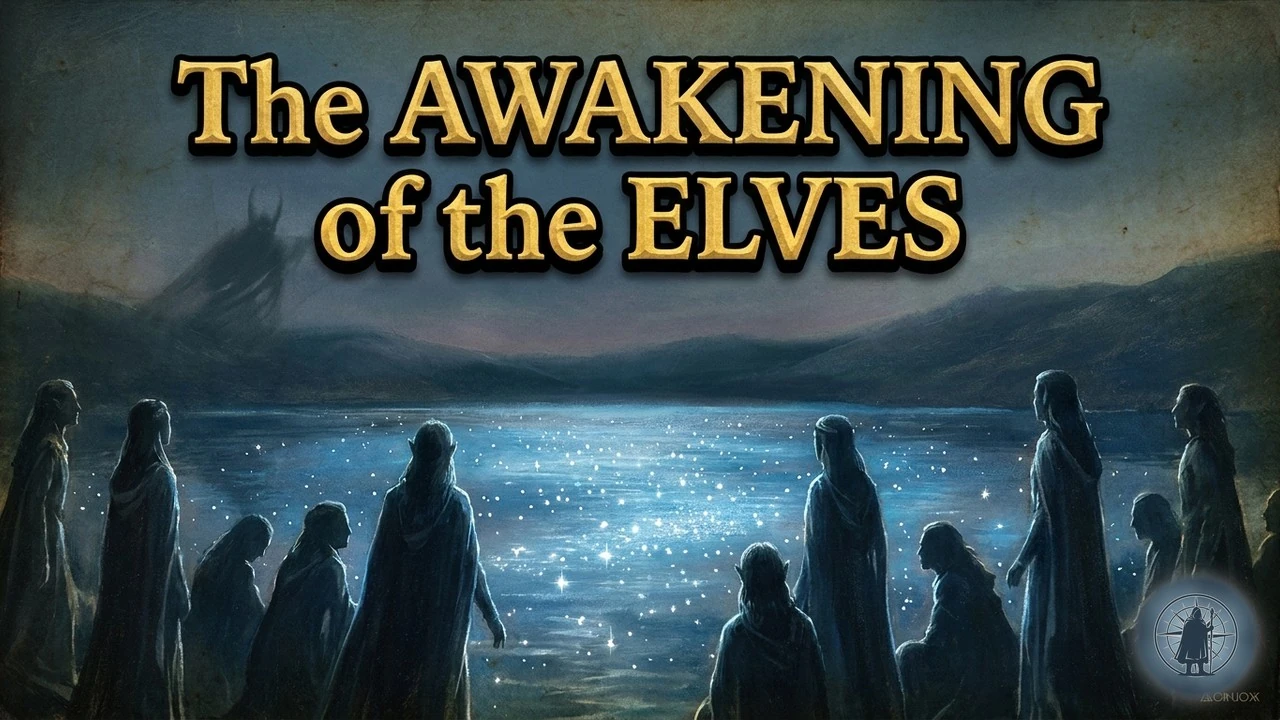 Watch the episode
The Awakening of the Elves: How Middle-earth Began | Silmarillion Lore
Watch the episode
The Awakening of the Elves: How Middle-earth Began | Silmarillion Lore
Main Narrative: The Awakening of the Elves
SECTION: The Star That Rose Before Us
In the Year of the Trees ten-fifty, by the count of the Annals of Aman, a single new thing entered the world.
Not a city. Not a kingdom. Not a war.
A pair of eyes opened by the shore of a starlit water in the uttermost east of Middle-earth, and saw, for the first time in the history of creation, the stars of heaven.
That is the awakening.
It is the most important moment in the entire legendarium, and almost nothing happens in it. There is no battle. No oath. No throne. There is only a body rising from the sleep of Ilúvatar, in a forest beside a great mere, looking up at a sky that has been hung above it for ages, and seeing it.
Tolkien dates the moment with the precision of an astronomer. The Silmarillion tells us that even as Varda ended her labors, and they were long, when first Menelmacar strode up the sky and the blue fire of Helluin flickered in the mists above the borders of the world, in that hour the Children of the Earth awoke, the Firstborn of Ilúvatar.
Menelmacar is the constellation we call Orion. Helluin is the star we call Sirius. So at the moment the Quendi opened their eyes, Orion was climbing the eastern sky, and Sirius — the brightest star of the heavens — was burning blue in low mist above the rim of the world.
That is the first image they ever saw. That is the picture stamped on every Elvish soul that would ever exist.
And because of it, the text says, they have ever loved the starlight, and have revered Varda Elentári above all the Valar.
Now consider what that first moment was not. There was no sun. There was no moon. The Two Trees of Valinor burned far away in the West, but their light did not reach the eastern lands. The Lamps that had once stood at the world's north and south had fallen ages before. So the Firstborn opened their eyes into a darkness lit only by the cold lamps of heaven — and the first sensation of conscious life in the history of Arda was wonder.
We know this because we know the first word.
The Cuivienyarna, an Elvish folk-tale preserved as an appendix to one of Tolkien's late linguistic essays, records that the first word ever spoken by any Elf was a single syllable. Ele. Behold. Lo. Look.
Not "I am." Not "I hunger." Not "where am I." Behold.
And from that one cry came the whole language of the stars. Ele gave the root elen, which means "star." From elen came Elda, "one of the people of the stars" — the very name Oromë would later give them when at last he found them in the eastern woods. The Eldar are, literally, the people of behold.
So the foundation of Elvish identity is not power, not craft, not wisdom, not lineage. It is the act of looking up and being amazed. Everything else the Elves would ever do — every smithcraft of Fëanor, every song of Lúthien, every road walked by Galadriel — grew out of that first wordless astonishment under unfamiliar stars.
SECTION: A Hundred and Forty-Four, Two by Two
But this kindling was not the rising of one mind. And it was not the rising of a mass.
The Cuivienyarna preserves a structure for the event that the published Silmarillion only hints at — a structure so deliberate, so geometric, that it has shaped everything Elvish ever since.
The Firstborn awoke in pairs. One male, one female, side by side, beneath the trees of the wood that grew about the mere. Twelve such pairs, gathered into groups of twelve. A hundred and forty-four Elves in total, scattered through the forest of Cuiviénen on the night the stars first met conscious eyes.
Twelve squared. The smallest founding population the legendarium will ever name.
Notice how the Cuivienyarna describes it. The very first three Elves to wake were called the Elf-fathers — Imin, whose name means "One." Tata, whose name means "Two." Enel, whose name means "Three." Each of them woke a little before his appointed spouse. So the first sight of Imin, the first sight of any conscious being in the history of Arda, was the stars. And his second sight, when he turned his head, was the sleeping face of Iminyë beside him.
That is the pattern. Each Elf-father wakes first to stars, and second to love.
Tata woke and beheld the stars, and then beheld Tatië. Enel woke and beheld the stars, and then beheld Enelyë. And in pairs, scattered through the woods, the same thing was happening a hundred and forty-four times.
When Imin and Tata and Enel had woken their wives, they walked together through the trees, gathering the others as they went. By the rule of seniority, each new pair they came upon belonged to whichever of the three Elf-fathers had found them first. Imin, the eldest, found his group quickly — twelve companions. Tata, second in seniority, found the next group — fifty-four. Enel, third, walked farthest and found the rest — seventy-two.
So at the end of the gathering there were three companies. The Minyar, the First-folk under Imin. The Tatyar, the Second-folk under Tata. The Nelyar, the Third-folk under Enel.
Those three companies are the seed of every Elvish people that will ever exist. The Minyar become the Vanyar, the fair-haired Elves who dwell forever in the light of the Trees. The Tatyar become the Noldor — Fëanor's people, the deep-delvers, the makers of the Silmarils. The Nelyar become the Teleri, the sea-singers, the most numerous of the kindreds, the source of the Sindar and the Falmari and the Nandor and a half-dozen other branches of the family tree.
Every Elvish king who ever ruled — Ingwë, Finwë, Elwë, Thingol, Galadriel's grandfather, Eärendil's grandfather, every one of them — descends from one of the founders gathered into one of those three companies in the woods beside Cuiviénen.
And the night fixed more than lineage. It fixed mathematics.
Because the Quendi had risen in twelve pairs of twelves, twelve became their sacred number. Their counting was duodecimal — base-twelve, the way British shillings used to count. And a hundred and forty-four, the total of that first night, became their gross — the largest number that the earliest Elvish languages had a single word for. For ages, no Elvish tongue could name a larger figure with one syllable. They counted everything that mattered against the number of those first ones in the wood.
It also fixed marriage. The Elves are, from the first moment of their existence, a paired species. The text gives no Elf who awakens alone. There is no founding Adam without his Eve. Wakening and partnership are written into the act of creation itself. Tolkien is making a point about Elvish nature here that he never spells out — that for the Firstborn, solitude is not original. Solitude is a wound that comes later.
SECTION: The Shadow That Was Already Watching
Now turn the picture. Hold the same hundred and forty-four Elves in the woods beside the mere. Hold the same stars in the sky above. And look, this time, at what they could not see.
Melkor was watching.
The Silmarillion is brutally explicit about this. Melkor, ever watchful, was first aware of the rising of the Quendi, and sent shadows and evil spirits to spy upon them and waylay them.
Note the word first. Before Oromë knew. Before Varda knew. Before any of the Valar in the West so much as turned their faces eastward, the Dark Lord of Arda had already seen the new lights in the eastern wood, and he had already sent his servants to walk the hills above Cuiviénen.
The Firstborn opened their eyes to wonder. But evil had opened its eyes to them first.
The oldest Elvish songs, the Silmarillion says, remember this. They tell of shadow-shapes that walked in the hills above the mere, or would pass suddenly over the stars, dimming them. They tell of a dark Rider upon his wild horse who pursued lone Elves who wandered far from the others, taking them and devouring them.
The Quendi gave that figure a name. They called him the Hunter. And when one of their own went out alone into the wood and did not return, they would say to one another, in the very first words Elvish had ever shaped, that the Hunter had caught him.
So fear entered Elvish consciousness almost as soon as wonder did. The first generation of Elves did not have a long stretch of innocence before the world turned dark. They had, perhaps, a few nights of pure starlight before the shadow-shapes began.
The identity of the Dark Rider is one of the legendarium's enduring mysteries. Tolkien never resolves it. Some scholars argue it was Sauron, who was certainly active under Melkor by this time. Others say it was a Balrog, or perhaps Melkor himself in some assumed form. A third possibility — the one Tolkien's own text seems most to lean toward — is that there was no single Rider at all. Only a rumor. A whispered shape made of fear and dimmed stars and the silence after a missing voice.
Because that is Melkor's chief weapon at Cuiviénen. Not violence. Uncertainty.
And here we have to reach for a deeper text. In the later writings collected in Morgoth's Ring, Tolkien gives a name to the cosmological reality that the Elves were waking into. He calls Arda itself Morgoth's Ring — meaning that Melkor, in his long rebellion, had dispersed so much of his own being into the matter of the world that the world itself was partly his substance. The mountains, the seas, the very atoms of Arda carried a trace of his marring.
So when the Firstborn opened their eyes to stars, they were not opening their eyes into a pristine creation. They were opening their eyes into a wounded one. Their first breath drew in air that had already been touched by the discord of the Music. Their first wonder rose in a world where the Fall, in Tolkien's Catholic framing, had in some sense already begun — before they had made any choice of their own.
This is a heavy thing to absorb. It means the Elves never knew an unfallen world. It means their famous sorrow, the grief that runs through every Elvish song and every elvish departure across the sea, is not a sorrow they earned. It is a sorrow they inherited. They woke into it.
SECTION: The Huntsman and the Lateness of the Powers
So where were the Valar?
The cosmological prep work had been done. Varda had spent ages of the world kindling new and brighter stars specifically against the coming of the Firstborn. The text says her labors were long, and that she gathered together all her ancient light that remained from the wells of Telperion, and from it kindled fresh stars and constellations. She made the great signs of the northern sky for the very purpose that the Firstborn, when they should wake, should not wake in unrelieved darkness.
That preparation worked. The Elves opened their eyes to Menelmacar climbing the heavens, to Helluin flickering blue, to a canopy of kindled lights that had been arranged for their benefit.
But preparation is not protection.
Varda lit the lamps of heaven. She did not light a guard around Cuiviénen. And while she was completing her labor, Melkor was already moving through the eastern woods.
The Valar — the guardians of Arda, the keepers of its order, the ones charged by Eru with the care of his Children — were operating in cosmic time. They thought in ages. Melkor was operating in local time. He was on the ground.
And so the discovery, when at last it came, came not by patrol or by plan but by accident. Or rather, by what the text very carefully calls accident. Thus it was that the Valar found at last, as it were by chance, those whom they had so long awaited.
Don't take the phrase too literally — Tolkien has loaded it with theological weight. As it were by chance. That little phrase contains the entire argument about providence and accident that runs through the legendarium. The Valar were not patrolling the eastern lands. Oromë the Huntsman, the only one of the Powers who regularly rode in Middle-earth, was out chasing the monsters that Melkor had bred — and one night, hunting in the woods near the inland Sea of Helcar, he came over a rise, and there before him was a starlit bay and figures moving along its shore.
Oromë looking upon the Elves was filled with wonder, the Silmarillion says, as though they were beings sudden and marvellous and unforeseen.
He should have foreseen them. He had been hunting in these lands for ages. He must have ridden within a few leagues of Cuiviénen more than once. But the text repeats: he saw them as though they were new. Providence framed as accident. The right meeting, but later than it should have been.
And the Elves, when they saw him?
Many of them fled.
The Silmarillion is unflinching here. Many of the Quendi were filled with dread at his coming; and this was the doing of Melkor. By the time Oromë arrived, Melkor had already taught the Elves to be afraid of riders. Dark shapes on dark horses had been stealing away their kin for years. So when the bright Vala came riding out of the trees on Nahar, his great white horse with hooves shod in gold, sounding the horn Valaróma — many of the Firstborn saw not a rescuer. They saw the Hunter come at last for all of them.
This is the operational cost of the Valar's lateness. Their well-intentioned arrival had to fight through a fog of fear that should never have been allowed to gather. The Powers thought they were bringing rescue. The Quendi, half of them, thought they were being hunted.
It is the first instance of a pattern that will repeat across the entire legendarium — the rescuers who arrive after the wound has already been made.
SECTION: The Vilest Deed
The Elves who fled from Oromë were the lucky ones. Some had already been caught — not by him, but by what came before him.
The lone wanderers who had vanished from Cuiviénen. The ones the Quendi said the Hunter had taken. They had not been devoured. They had been carried, alive, north and east, across the bitter lands, to the iron gates of Utumno, Melkor's first and greatest fortress in the uttermost north. And there, in pits beneath those gates, something was being done to them.
Listen to the Silmarillion's account. All those of the Quendi who came into the hands of Melkor, ere Utumno was broken, were put there in prison, and by slow arts of cruelty were corrupted and enslaved; and thus did Melkor breed the hideous race of the Orcs in envy and mockery of the Elves, of whom they were afterwards the bitterest foes.
Slow arts of cruelty.
That phrase deserves its own weight. Slow arts of cruelty. Not a single blow. Not a quick death. A method. A craft. Practiced patiently, over generations, on captive beings who had been made for wonder and for partnership and for the love of stars.
The Orc is what was left at the end of that process.
This is what Tolkien names, in the very next breath, as possibly the vilest deed of Melkor, and the most hateful to Ilúvatar. He does not award that title to the destruction of the Two Trees. He does not award it to the slaying of Finwë, or the theft of the Silmarils, or the burning of Doriath, or the drowning of Beleriand. He awards it to this. The remaking of the Firstborn into Orcs.
And he is careful to tell us why.
Naught that had life of its own, nor the semblance of life, could ever Melkor make since his rebellion in the Ainulindalë. Melkor cannot create. That is the iron rule of Tolkien's theology of evil. Only Eru can give life. The fallen Vala, for all his vast power, can only take what Eru has made and twist it. He can mar. He can imitate. He can pervert. He cannot originate.
So if Melkor wants an army, he cannot grow one from nothing. He must steal living beings already made by Eru, and over slow centuries break what they are into the shape he needs.
The Orcs are that theft made flesh.
And here is the detail that gives the act its full horror. The text says that deep in their dark hearts the Orcs loathed the Master whom they served in fear, the maker only of their misery. The Orcs are not happy slaves. They are ontologically tortured. Some echo of what they had been before — Quendi who once woke under stars beside a sleeping partner — survives buried in them, hating the thing they have become and hating the master who unmade them, but bound to serve him anyway through pain.
This is why Tolkien wrestled with the orc-origin problem for the rest of his life. In his later writings, in Morgoth's Ring, he proposes alternative origins — corrupted Men, fallen Maiar, animals given speech, a mixed source. He worried that if Orcs really were corrupted Elves, then Elvish immortality meant orcish immortality, which meant souls trapped beyond rescue forever. That outcome did not sit well with his Catholic conscience.
But Christopher Tolkien, assembling the published Silmarillion from his father's drafts, kept the original answer. Orcs come from corrupted Elves. The kindling of the Quendi produces, almost immediately, its own dark mirror.
And it is hard to imagine a more terrible mirror. Because the act of rising, in Eru's hand, was the opening of eyes to wonder. The act of corruption, in Melkor's pits, was the closing of those same eyes upon themselves forever.
SECTION: The Summons and the Sundering
So now the Valar know. Oromë has ridden back to the West with the news that the Firstborn have awakened, that Melkor has already been at work among them, that some have been taken and some are afraid even of rescuers.
Manwë sits long in thought upon the peak of Taniquetil. He seeks the counsel of Ilúvatar himself. And the Powers come to a decision.
They will make war. The Battle of the Powers, sometimes called the War of the Wrath of the Valar, is launched expressly to deliver the Quendi from the shadow of Melkor. It is a long and terrible war. The hills and rivers and mountains of Middle-earth are broken in its course. Whole regions are reshaped. The Sea of Helcar, which had been a vast inland water at the foot of the Orocarni, would be partly drained in the convulsions of these years and the centuries that followed — only fragments remaining as the lakes we later know as the Sea of Rhûn and the Sea of Núrnen.
Eventually, after long siege, the gates of Utumno are broken. Tulkas the wrestler runs Melkor down, throws him to the ground, and binds him with the great chain Angainor that Aulë had forged for the purpose. The Dark Lord is brought before Manwë's feet and sentenced to three ages — three thousand Valian years — in the Halls of Mandos.
But it is not a clean victory. Sauron escapes the breaking of Utumno. Angband, Utumno's western outpost, is not destroyed. Many of Melkor's fell creatures hide in pits the Valar do not search. And the Elves who had already been corrupted into Orcs are not freed. They cannot be. They are no longer what they were.
Then the Valar make their second great decision. They will summon the Quendi to come west, away from Middle-earth, to dwell in Valinor in the light of the Two Trees, safely under the eye of the Powers.
And at this moment, Mandos breaks his silence. He almost never speaks, this Vala — the Doomsman of the Valar, the keeper of the Halls of the Dead. He sees what is coming before it comes. And when the decision is reached to summon the Firstborn west, he opens his mouth and says four words.
So it is doomed.
We will come back to those four words at the end. For now, hold them in your ear, and watch what they do.
The call goes out. And the Quendi, when it reaches them, are split nearly in half.
Many distrust the Valar still — partly because of Melkor's old lies, partly because they love the lands where they first opened their eyes, partly out of simple suspicion of any power that calls them away from home. So ambassadors are needed. Ingwë of the Minyar, Finwë of the Tatyar, and Elwë of the Nelyar are chosen and sent west across Middle-earth and across the sea to behold Valinor for themselves and report back. They go. They see the light of the Two Trees. They return as believers.
But not everyone is convinced. The Great Debate at Cuiviénen splits the Firstborn into two groups whose names tell the whole story. Those who agree to make the journey are called from this moment the Eldar, in the strict sense — the People of the Stars who follow the call. Those who refuse are called the Avari, the Unwilling. The Refusers.
And the Avari are not a footnote. They may be as many as half of all the Elves who ever lived. They simply stayed. They kept the lands where they had first risen. Their descendants drift west over the long ages and merge with other peoples — many of the Silvan Elves of Mirkwood and Lothlórien in the Third Age have Avari blood. But they never make the journey. They never see the Trees. They are, in the legendarium's own taxonomy, the Moriquendi — the Elves of the Darkness — not because they are evil, but because they never saw the Light.
This is the first sundering. It happens at Cuiviénen itself, before a single Elf has taken a step westward.
The fractures continue at every stage of the road.
The Great Journey is one of the most extraordinary marches in Tolkien's writing. The three host of the Eldar — Vanyar in the lead under Ingwë, then Noldor under Finwë, then Teleri under Elwë and his brother Olwë — walk out of the eastern lands across what would one day be Rhovanion, through the Wild Wood that men would later call Mirkwood, down to the great river Anduin.
There at the river's edge, the second sundering. A host of the Teleri under a lord named Lenwë looks up at the Misty Mountains rising ahead of them — vast, snow-crowned, terrible — and refuses. They turn aside and follow the river south. The Eldar name them the Nandor. Those Who Turn Back.
The remaining hosts cross the Misty Mountains, march through Eriador, cross the Blue Mountains, and at last enter Beleriand. There, the third sundering. Elwë of the Teleri, the king of the third clan, wanders alone in the woods of Nan Elmoth, and meets Melian, a Maia of Lórien, and is so enchanted by her that he stands still in the starlight for years without moving. His people will not depart without him. They stay. When at last Elwë wakes from his enchantment, he is changed — silver-haired, mighty beyond all his kin — and he becomes Elu Thingol of Doriath, and his people become the Sindar, the Grey-elves of Beleriand.
The fourth sundering. A faction of the Teleri under Círdan the Shipwright loves the sea so much that they will not leave its coasts. They become the Falathrim.
Finally, Ulmo, the Vala of waters, comes to ferry across to Aman those Eldar who have completed the road. The Vanyar go first. The Noldor follow. The remainder of the Teleri — Olwë's people, called the Falmari, the wave-folk — go last.
Look at what has happened.
Three clans went into the journey. By its end, the Elvish people are fractured into at least eight named groups: Vanyar, Noldor, Falmari in Aman; Sindar, Falathrim, Nandor in Beleriand and on the coasts; Avari left at Cuiviénen; and, descended from later Nandor migrations, the Silvan Elves who will populate Mirkwood and Lothlórien in the ages to come. From this point on, no king will ever rule all the Quendi together. The species has been broken into peoples.
The Valar called the Elves west to keep them safe. And the calling itself sundered them.
SECTION: So It Is Doomed
Now come back to Mandos's four words.
So it is doomed.
He spoke them at the moment of the summoning. Not at the moment of the kindling. Not at the moment of Melkor's first shadow. Not at the breaking of Utumno. He stayed silent through all of that. He broke his silence at the precise instant the Valar decided to call the Quendi west.
Listen to what the text says right after: From this summons came many woes that afterwards befell.
Many woes. Hold those words against the legendarium. The Kinslaying at Alqualondë, when Fëanor's Noldor slaughter their own Telerin kin for their ships, was a woe that came from this calling. The Crossing of the Helcaraxë, the grinding ice that killed who knows how many of Fingolfin's host. The slaying of Finwë at Formenos, the theft of the Silmarils, the Doom of the Noldor pronounced on the shores of Aman, the long defeats of Beleriand, the fall of Gondolin, the sack of Doriath, the drowning of the land itself in the War of Wrath — every one of those catastrophes traces back to the journey that began at Cuiviénen.
Mandos saw it coming. That is what so it is doomed means. He was not deciding anything. He was acknowledging a consequence that was already locked in. The Valar's well-intentioned call had already become a hinge on which the entire future of Arda would turn.
And here is the thing that makes this the central image of the whole legendarium.
The calling that produced all those woes also produced everything beautiful that came after.
Lúthien Tinúviel, the most beautiful being who ever walked in Arda, would not exist without it. Her father Thingol was an Elf who heard the call and answered. Eärendil the Mariner, who carried the light of the last Silmaril across the sky as the star of hope, descends from that same summoned people. Elrond, who held Rivendell against three Ages of darkness, comes through that same line. Arwen, who chose mortality for the love of Aragorn, is the last flower of that same long stem.
Take away the summons and you take away the Doom of the Noldor — but you also take away every Elvish glory that Middle-earth ever knew.
This is why the awakening at Cuiviénen is the hinge moment of the entire legendarium. Not because the moment itself is dramatic. It is not. It is quiet. It is two eyes opening in starlight. But every later event — every Silmaril forged, every kinsman slain, every ring poured into a mold, every Hobbit standing at the crack of Mount Doom — is downstream of that single quiet moment by the mere.
Tolkien himself, in his last years, wrestled with whether the Valar had done right. There are passages in his late writings where he wonders whether Ulmo had been correct all along — that the Elves should have been left in Middle-earth, to mature in the lands where they had awakened, rather than summoned away into a Valinor that was not, in the end, theirs.
He never resolved the question. He could not. The summons made the tragedy. The same summons made the glory. There is no version of the story where you keep one without the other.
What he leaves us, instead, is the image he started with. A hundred and forty-four Elves opening their eyes by a starlit water, in the uttermost east of a world that had already been wounded, and looking up at a sky that had been kindled for them by a Vala they had not yet met. And one of them, before he knew his own name or the name of the one sleeping beside him, lifted his face to the stars and said the first word ever spoken in Arda.
Ele.
Behold.
Everything that the Children of Ilúvatar would ever be — every song, every sundering, every sorrow, every grace — was in that one word.