Research & Sources
The Awakening of the Elves
How Middle-earth Began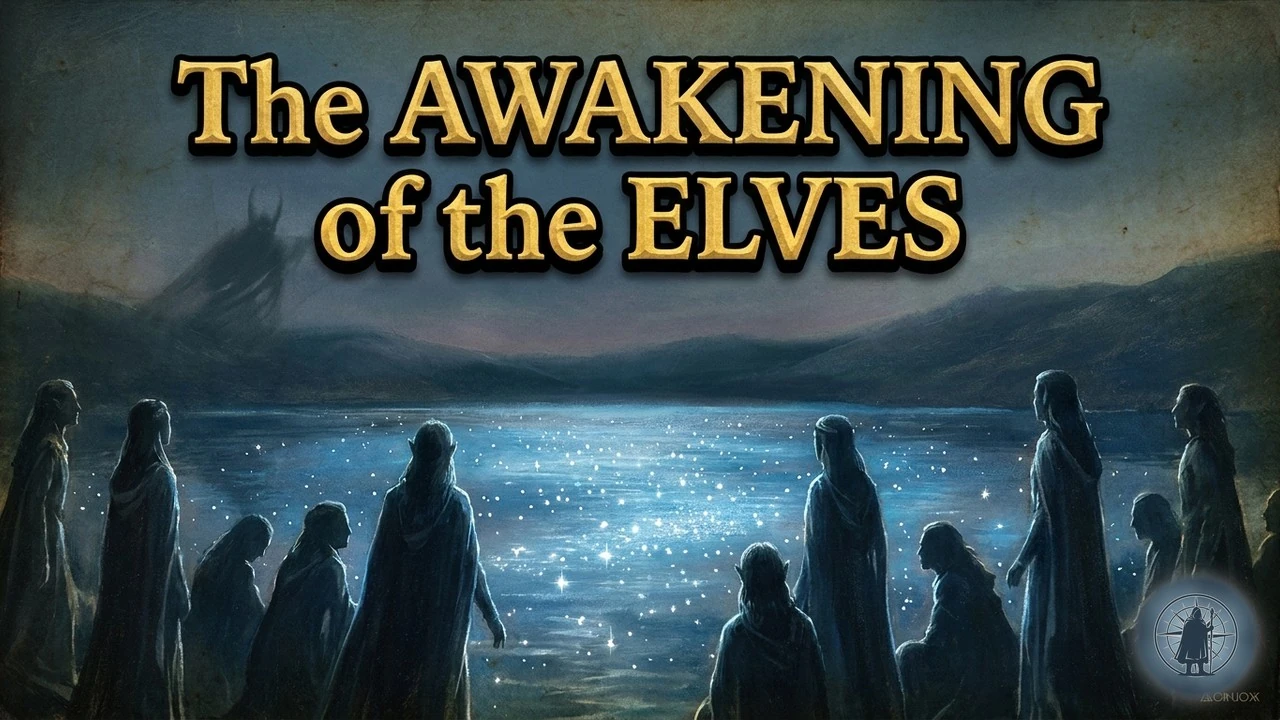 Watch the episode
The Awakening of the Elves: How Middle-earth Began | Silmarillion Lore
Watch the episode
The Awakening of the Elves: How Middle-earth Began | Silmarillion Lore
Research Notes: The Awakening of the Elves
Overview
The Awakening of the Elves at Cuiviénen is the foundational event of the history of the Children of Ilúvatar — the moment when the Firstborn opened their eyes for the first time, in starlight, beside a great water in the uttermost east of Middle-earth. Dated by the Annals to Year of the Trees 1050 (Y.T. 1050), it marks the beginning of all that follows: the Great Journey westward, the Sundering of the Elves into kindreds, the discovery by Oromë, the abduction and corruption of captured Elves into the first Orcs, the Battle of the Powers and the chaining of Melkor. It is the hinge moment of the legendarium — the first consciousness of mortal speech in Arda, made under shadow and seen first by stars rather than by sun.
The episode draws principally from The Silmarillion (Quenta Silmarillion, Chapter 3, "Of the Coming of the Elves and the Captivity of Melkor"), the Cuivienyarna — an Elvish folk-tale preserved as an appendix to Tolkien's late essay "Quendi and Eldar" in The War of the Jewels (HoME XI) — supplementary material in Morgoth's Ring (HoME X) and The Nature of Middle-earth, and Tolkien's Letters.
Primary Sources
The Silmarillion — Quenta Silmarillion Ch. 3
The chapter opens with Varda's labors completing just before the awakening:
"It is told that even as Varda ended her labours, and they were long, when first Menelmacar strode up the sky and the blue fire of Helluin flickered in the mists above the borders of the world, in that hour the Children of the Earth awoke, the Firstborn of Ilúvatar. By the starlit mere of Cuiviénen, Water of Awakening, they rose from the sleep of Ilúvatar; and while they dwelt yet silent by Cuiviénen their eyes beheld first of all things the stars of heaven."(Silmarillion, Ch. 3)
"Therefore they have ever loved the starlight, and have revered Varda Elentári above all the Valar."
"In the beginning the Elder Children of Ilúvatar were stronger and greater than they have since become; but not more fair, for though the beauty of the Quendi in the days of their youth was beyond all other beauty that Ilúvatar has caused to be, it has not perished, but lives in the West, and sorrow and wisdom have enriched it."
On the early language and naming:
"Themselves they named the Quendi, signifying those that speak with voices; for as yet they had met no other living things that spoke or sang."
On the early fear and Melkor's shadow:
"Melkor, ever watchful, was first aware of the awakening of the Quendi, and sent shadows and evil spirits to spy upon them and waylay them."
"And indeed the most ancient songs of the Elves, of which echoes are remembered still in the West, tell of the shadow-shapes that walked in the hills above Cuiviénen, or would pass suddenly over the stars; and of the dark Rider upon his wild horse that pursued those that wandered to take them and devour them."
"When the newly-awakened Elves strayed far abroad, alone or few together, they would often vanish and never return; and the Quendi said that the Hunter had caught them, and they were afraid."
On Oromë's discovery:
"Thus it was that the Valar found at last, as it were by chance, those whom they had so long awaited. And Oromë looking upon the Elves was filled with wonder, as though they were beings sudden and marvellous and unforeseen…"
"But many of the Quendi were filled with dread at his coming; and this was the doing of Melkor. For by after-knowledge the wise declare that Melkor, ever watchful, was first aware of the awakening of the Quendi… he sent indeed his dark servants as riders, or he set lying whispers abroad, for the purpose that the Quendi should shun Oromë, if ever they should meet."
On the origin of Orcs:
"All those of the Quendi who came into the hands of Melkor, ere Utumno was broken, were put there in prison, and by slow arts of cruelty were corrupted and enslaved; and thus did Melkor breed the hideous race of the Orcs in envy and mockery of the Elves, of whom they were afterwards the bitterest foes."
"For the Orcs had life and multiplied after the manner of the Children of Ilúvatar; and naught that had life of its own, nor the semblance of life, could ever Melkor make since his rebellion in the Ainulindalë… and deep in their dark hearts the Orcs loathed the Master whom they served in fear, the maker only of their misery. This it may be was the vilest deed of Melkor, and the most hateful to Ilúvatar."
On the Valar's resolve:
"Then Manwë sat long in thought upon Taniquetil, and he sought the counsel of Ilúvatar… and the Valar prepared for war."
"Take up again the mastery of Arda, at whatsoever cost, and deliver the Quendi from the shadow of Melkor."
On the summoning:
"At the last, therefore, the Valar summoned the Quendi to Valinor, there to be gathered at the knees of the Powers in the light of the Trees for ever; and Mandos broke his silence, saying: 'So it is doomed.' From this summons came many woes that afterwards befell."
The Lord of the Rings
LOTR refers obliquely to this earliest age — the Elves' reverence of Elbereth (Varda) springs directly from her stars at Cuiviénen. Gildor and Frodo invoke her ("A Elbereth Gilthoniel"); Sam later cries her name in Cirith Ungol. These references all root back to the awakening moment when the stars were the first thing the Elves ever saw, making star-worship — Varda-worship — the oldest devotion in Arda.
Unfinished Tales
Unfinished Tales mentions Cuiviénen and the journey only in passing (e.g., in "The History of Galadriel and Celeborn"), but reinforces the canonical picture: that the Sindar are kin to the Teleri who tarried east of the Blue Mountains, and that the Avari are scattered remnants in the wilds of Rhovanion who never made the journey.
The History of Middle-earth — Especially HoME X (Morgoth's Ring) and HoME XI (The War of the Jewels)
The Cuivienyarna (appendix to "Quendi and Eldar," The War of the Jewels, HoME XI, c. 1959–60) — the most important supplementary text. It is presented as an Elvish "fairytale" mingled with counting-lore, preserved in nearly identical form among the Eldar of Aman and the Sindar of Beleriand.
Key contents of the Cuivienyarna:
- The first three Elves to awaken were the Elf-fathers: Imin ("One"), Tata ("Two"), and Enel ("Three"). - Each awoke before his appointed spouse, and his first sight was the stars at twilight before dawn. His second sight was his sleeping wife beside him: Iminyë, Tatië, Enelyë. - The Elves did not all awaken together; they awoke in pairs (one male, one female), in batches of twelve, scattered through the forest near Cuiviénen. - Imin, Tata, and Enel woke their wives, then walked together through the woods, finding more Elves. By the rule of seniority, each new pair encountered "belonged" to whichever of the three found them first. - Imin (the eldest) chose first and got the fewest companions (12). Tata got the next group (54). Enel, third in seniority, found the rest (72). - Total awakened: 144 (12² — twelve pairs of twelves). Hence twelve became the Elvish base of counting, and 144 the largest number any later Elvish language had a single word for. - The three companies became the three original clans: Minyar ("Firsts"), Tatyar ("Seconds"), Nelyar ("Thirds") — ancestors of the Vanyar, Noldor, and Teleri respectively.
The Cuivienyarna also gives the famous etymology of "Elda":
- The first word spoken by any Elf was "Ele!" — a primitive exclamation meaning "behold! lo!" — uttered when they first beheld the stars. - From this root came el / elen ("star"), and Elda / Eldar ("People of the Stars"), the name Oromë later gave them.
Morgoth's Ring (HoME X) provides the cosmological/philosophical framing: Arda is "Morgoth's Ring" because Melkor dispersed his being into the very matter of the world. Hence the Elves awoke into a world already marred — their first conscious experience was of a creation in which shadow was already present. Morgoth's Ring also contains Tolkien's later philosophical wrestling with the orc-origin problem and with the question of how the Elves' awakening fit Eru's design.
The Nature of Middle-earth preserves a manuscript variant of the Cuivienyarna (Part One §VIII), with slight differences in numbers and order — Christopher Tolkien chose the typescript version for HoME XI.
Letters of J.R.R. Tolkien
In Letter 131 (to Milton Waldman, c. 1951) and Letter 144 (to Naomi Mitchison, 1954), Tolkien describes his "elves" as a distinct order of being: long-lived ("immortal" only in the sense of being bound to Arda's lifespan), bound to the world, and embodying what is best in unfallen human nature — beauty, art, longevity, and the pain of memory. Letter 153 expands on this. The awakening at Cuiviénen is the cosmic moment when this race enters history — beings made expressly to be the "Firstborn" whose long memory carries Arda's grief.
In Letter 212 and the later "Athrabeth Finrod ah Andreth" (printed in Morgoth's Ring), Tolkien wrestles with the philosophical implications of awakening into a marred world: the Elves are aware that their birth into Arda was itself a wound, that consciousness in Arda is consciousness in a fallen creation.
Key Facts & Timeline
- Y.T. 1000 (approx.): Varda begins her great labor of star-making (collecting dews of Telperion), foreseeing the Firstborn's coming. - Y.T. 1050: The Awakening at Cuiviénen. Stars are the first sight; the constellation Menelmacar (Orion) is rising; Helluin (Sirius) flickers blue in the mist. 144 Elves awake in pairs. - Y.T. 1050 onward: The first ages at Cuiviénen — the Elves dwell silently, learn speech, name themselves Quendi ("speakers"). Melkor sends shadows and the Dark Rider. Lone Elves vanish; the Hunter legend grows. - Y.T. 1085: Oromë discovers the Quendi while hunting in the east. He names them Eldar ("People of the Stars") and rides to Valinor to bring word. - Y.T. 1086–1090: The Valar deliberate. Manwë seeks Ilúvatar's counsel. The decision is made to wage war on Melkor. - Y.T. 1090–1100: The Battle of the Powers (War of the Powers). Valar march east in force; siege of Utumno is long and grievous. Many rivers and mountains of Middle-earth are broken in this war. - Y.T. 1099: Utumno's gates broken; Melkor flees to the uttermost pit; Tulkas wrestles him to the ground and binds him with the chain Angainor forged by Aulë. - Y.T. 1100: Melkor brought before Manwë's feet, condemned to three ages (3,000 Valian years) in the Halls of Mandos. Sauron escapes; Angband remains; many fell creatures hide. Some captured Elves are not freed — already corrupted into Orcs. - Y.T. 1102: The Valar summon the Quendi to Valinor. Many distrust the summons; ambassadors are needed. - Y.T. 1104–1105: Ingwë (Minya), Finwë (Tatya), Elwë (Nelya) journey to Valinor as ambassadors. They behold the Light of the Trees. - Y.T. 1105: Return of the ambassadors. The Great Debate. Many Elves refuse the journey — these become the Avari ("Unwilling"). Those who accept the summons are the Eldar in the strict sense. - Y.T. 1105 onward: The Great Journey begins westward. Order: Vanyar (led by Ingwë), Noldor (led by Finwë), Teleri (led by Elwë and Olwë). - The Sunderings of the Eldar along the way: - The Nandor: At the Anduin valley, a host of Teleri under Lenwë refuse to cross the Misty Mountains and turn back ("Those Who Turn Back"). - The Sindar: West of the Blue Mountains in Beleriand, Elwë wanders and is lost in Nan Elmoth (enchanted by Melian). His people will not depart without him; they stay in Beleriand and become the Sindar (Grey-elves) under Elwë (now Thingol) when he wakes. - The Falathrim: A faction under Círdan loves the sea and stays on the coasts of Belegaer. - Olwë leads the remaining Teleri (the Falmari) on; they cross to Aman. - Y.T. 1125: Vanyar and Noldor arrive in Beleriand. - Y.T. 1128: Teleri arrive in Beleriand; sundering of Sindar/Falathrim from Falmari. - Y.T. 1132: Ulmo bears the Vanyar and Noldor across the sea on Tol Eressëa. - Later: Olwë's Falmari reach Aman; Tol Eressëa is anchored off the coast. Elves of Aman (Calaquendi) live in the Light of the Trees. The Avari, Sindar, Nandor, Falathrim remain in Middle-earth (Moriquendi / Úmanyar).
Significant Characters
- The Three Elf-fathers (Cuivienyarna): - Imin ("One") & Iminyë — first to awaken; fathers/mothers of the Minyar → Vanyar. - Tata ("Two") & Tatië — fathers/mothers of the Tatyar → Noldor. - Enel ("Three") & Enelyë — fathers/mothers of the Nelyar → Teleri. - Ingwë — Minya, first High King of the Vanyar, eventual High King of all Elves. Loves Varda above all. - Finwë — leader of the Noldor; later slain by Morgoth at Formenos. Father of Fëanor. - Elwë (Singollo / Thingol) — leader of the Teleri ambassadors; lost in Nan Elmoth to Melian, becomes King of Doriath. - Olwë — Elwë's brother; leads the remaining Teleri (Falmari) to Aman after Elwë's disappearance. - Lenwë — Telerin lord who turns aside at Anduin; father of the Nandor. - Círdan the Shipwright — Telerin lord of the coasts; founds the Falathrim. (The only one of these early Elves still in Middle-earth at the end of the Third Age.) - Varda Elentári — kindler of the stars; her labor of star-making is timed to the awakening. - Oromë (Aldaron, Tauron) — the Huntsman; first Vala to meet the Elves; names them Eldar; rides Nahar; sounds Valaróma. - Manwë — High King of the Valar; deliberates on Taniquetil; decrees the war on Melkor. - Melkor / Morgoth — sends shadows, the Dark Rider/Hunter; captures Elves and breeds Orcs; defeated and chained. - Tulkas — the Valar's strongest; physically wrestles Melkor down and chains him with Angainor. - Mandos (Námo) — keeper of the chained Melkor; breaks his usual silence to say "So it is doomed" of the summoning — implying foreknowledge of the woes to come (Kinslaying, Exile, etc.).
Geographic Locations
- Cuiviénen ("Water of Awakening," from Q. cuivië "awakening" + nen "water"). A bay on the eastern shore of the inland Sea of Helcar, at the feet of the Orocarni (Red Mountains), in the uttermost east of Middle-earth, near the Wild Wood. The Sea of Helcar was a vast inland sea filling part of the basin where the original lamp Illuin had fallen. - Orocarni (the Red Mountains) — mountain chain east of Cuiviénen; the rising sun would later first appear above them. - Sea of Helcar — drained or shattered in the cataclysms of the First Age's end / War of Wrath; only its remnants survive as the Sea of Rhûn and (much later) Sea of Núrnen. - Utumno — Melkor's first and greatest fortress in the far north of Middle-earth; site of the captivity and corruption of Elves; broken in the Battle of the Powers. - Angband ("Iron Prison") — Utumno's western outpost; not destroyed in the Battle of the Powers; later rebuilt by Morgoth. - The Great Journey route — westward from Cuiviénen, through the future Rhovanion and the Wild Wood (later Greenwood / Mirkwood), to the Anduin (where the Nandor turn back), across the Hithaeglir (Misty Mountains), through Eriador, over the Ered Luin (Blue Mountains), into Beleriand, and finally — for those who completed the journey — across the sea on Tol Eressëa to Aman.
Themes & Symbolism
- First Consciousness in Starlight: The defining image of the awakening is consciousness arriving under stars, before any sun. Elves are creatures of starlight; their first relation to creation is wonder ("Ele!"), not labor or fear. The starlight is itself a prepared gift — Varda specifically created brighter stars so the Firstborn would not awake in unrelieved darkness. - Light vs. Darkness as Foundational Polarity: The awakening sets up the cosmic structure of Arda. Light (Varda's stars, later the Trees, later the Silmarils) versus Darkness (Melkor's shadows, the Hunter, Utumno) is established at the moment of Elvish consciousness. Every later conflict — Silmarils, Sun and Moon, Ring — is a continuation of this first polarity. - Fear vs. Trust: Faced with Oromë, some Elves recognized him as good and were drawn; others fled. The text frames this not as moral failure but as the work of Melkor's lies — yet it is still a choice of trust, and that choice maps directly onto the later decision to accept or refuse the Great Journey. Trust extended to the Valar produces the Eldar; refusal produces the Avari. Tolkien presents both as authentic choices with real costs. - Fate vs. Choice in Joining the Journey: The summons to Valinor was meant for the Elves' protection, but Mandos's "So it is doomed" hints that the very act of summoning would chain-produce the great tragedies (Kinslayings, Exile, Doom of the Noldor). The Awakening is the point at which Elvish history becomes irreversibly entangled with the Valar's intentions — neither pure providence nor pure free will, but a kind of woven necessity. - The Cost of Sundering: From a single awakening of 144 Elves, the kindreds proliferate — Vanyar, Noldor, Teleri, Avari, Nandor, Sindar, Falathrim, Falmari, Laiquendi, Silvan, etc. Every step westward produces a new sundering; every separation is also a loss. The episode of awakening contains, in seed, the entire later geography of Elvish exile. - Marred Creation: The Elves awake into Arda Marred — a world already shaped by Melkor's discord (the Music) and his physical dispersion (Morgoth's Ring). They are, from the first moment, conscious beings in a wounded creation. Tolkien's Catholic framing surfaces here: the Firstborn are not pre-lapsarian; they wake into a world where the Fall has already begun, even before any choice of theirs. - The Vilest Deed: The corruption of captured Elves into Orcs is named the "vilest deed of Melkor, and the most hateful to Ilúvatar." This is Tolkien's theology of evil: evil cannot create (Melkor cannot make life), it can only corrupt and mock. The Orc is, in this conception, an ontological perversion — a creature that loathes the master it must serve. - Eucatastrophe in Reverse: Where the LOTR ends in eucatastrophe, the Awakening is a kind of inverse — a beginning so beautiful (starlight, first wonder, first speech) that everything afterwards bears the imprint of that grace, even through the long sorrow of the Sundering.
Scholarly Interpretations & Theories
- The Orc-origin Problem: Tolkien wrestled with this until the end of his life. The published Silmarillion presents corrupted Elves as the origin (chosen by Christopher Tolkien from his father's drafts). In later writings (Morgoth's Ring), Tolkien proposed alternatives: corrupted Men, fallen Maiar (especially as orc-captains and lieutenants), animals given speech, or a mixed origin. The objection to the "corrupted Elves" theory is theological — Elves are immortal, so Orcs would have to be immortal too (which seems wrong), and Eru would not permit their souls to be irrevocably lost. The Maiar-origin theory addresses these but creates other problems (orc breeding). Most scholars treat the "mixed origin" as Tolkien's last best answer. - The Numerology of 144: Twelve pairs of twelves — 12² = 144 — has been variously read as (a) reflecting Tolkien's love of duodecimal counting (which the British shilling system used), (b) echoing the 144,000 of Revelation, (c) emphasizing the smallness and intimacy of the founding population, (d) underlining the importance of paired awakening (Elves are made for marriage and partnership). - The "Dark Rider" Identity: Never definitively resolved. Possibilities: Sauron (active under Melkor by this time), a Balrog or other Maia, Melkor himself in disguise, or no real Rider at all — only a Melkor-generated rumor that produced the legend. The ambiguity is itself the point: fear distorts perception, and Melkor's chief weapon at Cuiviénen is uncertainty. - Mandos's "So it is doomed": Scholars (Verlyn Flieger, Tom Shippey, Marjorie Burns) read this as one of the most pregnant lines in the legendarium. It is not Mandos deciding, but acknowledging an already-determined consequence: that the summoning, however well-intentioned, will produce woes. This sets up Tolkien's larger problem of well-intentioned interventions producing tragedy (compare the making of the Sun, the making of the Rings, the summoning of the Númenóreans). - Awakening Under Starlight as Liturgical Image: Tolkien scholars (Stratford Caldecott, Joseph Pearce) note the strongly Marian/liturgical resonance — Varda as a star-crowned figure, the Elves' first act being wonder and praise, and Elbereth invoked in moments of need much as the Virgin is invoked. The Awakening is, in this reading, a kind of cosmic Annunciation. - The Avari as the Underclass of the Legendarium: Verlyn Flieger and others note that the Eldar's narrative dominance has obscured the Avari, who in many ways represent the alternative path — Elves who stayed with the land of their awakening rather than chasing Valinor. The unsettled cousins in Mirkwood and the wilds of Rhovanion are partly Avari-descended, and Tolkien hinted that some of the wisest and oldest Elves were Avari who never sought the Trees.
Contradictions & Different Versions
- Pre-published vs. published versions: Earlier drafts (in HoME I, The Book of Lost Tales) have very different details — the original tale "The Coming of the Elves and the Making of Kôr" includes only generic awakening at "Koivië-néni" with no Cuivienyarna framework. The Imin/Tata/Enel structure is a late conception (1959–60), and Christopher Tolkien chose not to include it in the published Silmarillion even though it post-dates much of the published text. - Manuscript vs. typescript Cuivienyarna: Slightly different numbers and details exist between the manuscript version (in The Nature of Middle-earth) and the typescript (in War of the Jewels). - Date variations: Different Annals give slightly different Valian Years for the awakening (Y.T. 1050 is the canonical figure from the later Annals of Aman, but earlier annals used different chronologies). - Orc origin: As discussed above, never settled. Silmarillion says corrupted Elves; Morgoth's Ring gives multiple alternatives. - Did the Valar do right in summoning?: Tolkien himself, in late writings, expressed doubts about whether the summoning to Valinor was the right course. Some passages suggest Manwë and Ulmo disagreed, and that Ulmo always argued the Elves should have been left in Middle-earth. The published Silmarillion preserves both positions ambivalently. - Who first met whom: One thread has Oromë coming upon the Elves quite by chance; another has him actively sent by the Valar to look. The published text leans toward "as it were by chance," preserving the providence-or-accident ambiguity.
Cultural & Linguistic Context
- Cuiviénen — Quenya: cuivië ("awakening") + nen ("water"). Sindarin equivalent would be Nen Echui. - Quendi — from primitive Quendian kwendī, "speakers" (those who speak with voices), root KWENED-, ultimately related to KWE- "vocal speech." - Eldar — from the exclamation Ele! ("Behold!"), the very first Elvish word, spoken at the sight of stars. From this same root: el / elen ("star"), Elda (singular). Oromë's name "Eldar" thus means "People of the Stars" — literally, "people of the behold!" - Minyar, Tatyar, Nelyar — "Firsts, Seconds, Thirds" — the original clan-names, simple ordinals. - Vanyar — "Fair Ones" (golden-haired). - Noldor — "Wise / Knowing Ones" (from root NGOL- "wisdom"). - Teleri — "Hindmost / Last-comers" — a name given to them by the other kindreds because they arrived in Beleriand last (they themselves called themselves Lindar, "Singers"). - Avari — "Unwilling, Refusers." - Nandor — "Those Who Turn Back." - Calaquendi / Moriquendi — "Elves of Light" / "Elves of Darkness" — i.e., those who saw the Trees vs. those who did not. - Counting in twelves: The 144 of the awakening fixed Elvish numeration as duodecimal. The Elvish word for "twelve" is essentially basal; their word for 144 (the "gross") was, for ages, their highest single-word number.
Questions & Mysteries
- Why did Eru let them awake in darkness, in a marred world? The Music had already happened; Arda was already wounded. Tolkien's answer (in Athrabeth Finrod ah Andreth and elsewhere) is that even the Elves' suffering is taken up into a healing only Eru foresees. - Was Mandos's "So it is doomed" a prophecy or a curse? The grammar is ambiguous in the original. It could be read as fatalistic acknowledgment, or as a fiat that, once spoken, made the doom real. - Who or what was the Dark Rider? Never resolved. - How "real" is the Cuivienyarna? Tolkien frames it as Elvish folk-tale, not as straight history — the numerical neatness (144, 12 pairs of 12) suggests counting-lore rather than memory. Yet it was preserved identically in Aman and Beleriand, which the Eldar took as proof of its truth. - What happened to the Avari? Mostly lost to history. Some merged with the Nandor in Rhovanion and may be ancestors of some Silvan Elves of Mirkwood and Lothlórien. - Did any Elves remain at Cuiviénen until the end? Implied yes — but the Sea of Helcar drained, and the location became unreachable.
Compelling Quotes for Narration
1. "By the starlit mere of Cuiviénen, Water of Awakening, they rose from the sleep of Ilúvatar; and while they dwelt yet silent by Cuiviénen their eyes beheld first of all things the stars of heaven." — Silmarillion, Ch. 3. 2. "Therefore they have ever loved the starlight, and have revered Varda Elentári above all the Valar." — Silmarillion, Ch. 3. 3. "The most ancient songs of the Elves… tell of the shadow-shapes that walked in the hills above Cuiviénen, or would pass suddenly over the stars; and of the dark Rider upon his wild horse that pursued those that wandered to take them and devour them." — Silmarillion, Ch. 3. 4. "Themselves they named the Quendi, signifying those that speak with voices; for as yet they had met no other living things that spoke or sang." — Silmarillion, Ch. 3. 5. "Thus it was that the Valar found at last, as it were by chance, those whom they had so long awaited." — Silmarillion, Ch. 3. 6. "By slow arts of cruelty were [they] corrupted and enslaved; and thus did Melkor breed the hideous race of the Orcs in envy and mockery of the Elves… This it may be was the vilest deed of Melkor, and the most hateful to Ilúvatar." — Silmarillion, Ch. 3. 7. "From this summons came many woes that afterwards befell." — Silmarillion, Ch. 3. 8. "Ele!" — "Behold!" — the first Elvish word, spoken at the first sight of stars. (Cuivienyarna / Quendi and Eldar, HoME XI.) 9. "So it is doomed." — Mandos, breaking his silence at the summoning of the Quendi (Silmarillion, Ch. 3). 10. "When first Menelmacar strode up the sky and the blue fire of Helluin flickered in the mists above the borders of the world, in that hour the Children of the Earth awoke." — Silmarillion, Ch. 3.
Visual Elements to Highlight
1. The first opening of eyes — close on a single Elvish face under a sky of cold stars, water reflecting the sky beside them. 2. The mere of Cuiviénen — a wide starlit bay against the dark wall of the Orocarni, no moon, no sun, only constellations. 3. Menelmacar rising / Helluin flickering — the precise stellar moment of awakening — Orion striding up; Sirius blue in the mist. 4. 144 paired Elves scattered in twilit forest — twelve pairs of twelves stirring under the trees beside their sleeping spouses. 5. Imin, Tata, Enel walking together through the woods, gathering their kin — the first community. 6. The Dark Rider — a half-glimpsed shape, a black horse silhouetted against stars, vanishing. 7. The Hunter taking a lone Elf — only a cry, a vanishing, the empty place where someone stood. 8. Oromë and Nahar emerging from the eastern wood — golden Vala on white-shod horse, sounding the Valaróma, terrifying and beautiful at once. 9. The siege of Utumno — Valar arrayed in light against black towers; mountains broken; the earth heaving. 10. Tulkas wrestling Melkor down — the chain Angainor being clasped on him. 11. Captured Elves in Utumno's pits — slowly being unmade; the moment of becoming Orc. 12. The Great Debate at Cuiviénen — Ingwë, Finwë, Elwë urging the journey; the Three Elf-fathers and many others resisting. 13. The Great Journey columns — long lines of Elves walking westward under stars, through forest and across the Anduin. 14. The Nandor turning aside at the Anduin — Lenwë leading his people south down the river while the Vanyar and Noldor continue west. 15. Ulmo's island (Tol Eressëa) bearing the Elves across the sea — torn from the seabed and floated to Aman.
Sources Consulted
- The Silmarillion (J.R.R. Tolkien, ed. Christopher Tolkien, 1977) — esp. Quenta Silmarillion Ch. 3 "Of the Coming of the Elves and the Captivity of Melkor." - The History of Middle-earth, Vol. X: Morgoth's Ring (1993) — Tolkien's late cosmological/philosophical writings; the "Athrabeth Finrod ah Andreth"; later orc-origin essays. - The History of Middle-earth, Vol. XI: The War of the Jewels (1994) — esp. "Quendi and Eldar" and its appendix the Cuivienyarna. - The Nature of Middle-earth (ed. Carl Hostetter, 2021) — manuscript version of the Cuivienyarna; late writings on Elvish numerology and time. - Unfinished Tales (1980) — peripheral references in "The History of Galadriel and Celeborn." - The Letters of J.R.R. Tolkien (eds. Carpenter & Tolkien, 1981) — esp. Letters 131, 144, 153, 212. - Tolkien Gateway — Awakening of the Elves - Tolkien Gateway — Cuiviénen - Tolkien Gateway — Cuivienyarna - Tolkien Gateway — Quendi - Tolkien Gateway — Great Journey - Tolkien Gateway — Hunter and Rider - Tolkien Gateway — Battle of the Powers - Tolkien Gateway — Oromë - Tolkien Gateway — Quendi and Eldar - Wikipedia — Sundering of the Elves - LitCharts — Silmarillion Ch. 3 summary - Silmarillion Writers' Guild — Of the Coming of the Elves summary - Tolkien Road Podcast — SilmGuide Pt 6 - Roar Cat Reads — Silmarillion Ch. 3 commentary - Lurker in the Mirk — Silmarillion Ch. 3 reader notes - Middle-earth & J.R.R. Tolkien Blog — Elves by the Numbers - The Stars That Varda Made — Silmarillion Writers' Guild
Discrete Analytical Themes
Theme 1: Consciousness Under Starlight (The First Sight)
Core idea: The defining moment of Elvish existence is that they opened their eyes to stars, not to sun — and the first word ever spoken was a cry of wonder, not of fear or need. Evidence: - "while they dwelt yet silent by Cuiviénen their eyes beheld first of all things the stars of heaven" (Silmarillion Ch. 3) - The first Elvish word was Ele! — "Behold!" — uttered at the sight of stars (Cuivienyarna, HoME XI) - From Ele derived elen ("star") and Elda ("People of the Stars") — the entire language of star-naming flows from that first exclamation - Varda specifically timed her star-making so the Firstborn would not awake in unrelieved dark: "she made new stars and brighter against the coming of the Firstborn" Distinction: This theme is about the phenomenology of awakening — what it was like to be conscious for the first time. Not about Varda's labor (Theme 4) and not about Melkor's shadow (Theme 3). It is the pure positive event: wonder before fear.Theme 2: The Cuivienyarna — A Pair-Bonded, Numbered Beginning
Core idea: The Elves did not awake alone or as a mass, but in matched pairs of twelves — a structured, intimate, communal beginning that fixed Elvish culture forever (paired marriage, base-12 counting, three founding clans). Evidence: - 144 Elves total, in twelve pairs of twelve, scattered through the forest (Cuivienyarna, HoME XI) - Each Elf-father (Imin, Tata, Enel) awoke before his spouse and his second sight was her sleeping face beside him - Imin/Iminyë → Minyar (Vanyar); Tata/Tatië → Tatyar (Noldor); Enel/Enelyë → Nelyar (Teleri) - Twelve became the Elvish base of counting; 144 was their highest named number for ages Distinction: This is the structural origin story — how Elvish society, kinship, and even mathematics were set at the awakening. Not the cosmic moment of consciousness (Theme 1), not the threat (Theme 3), but the social architecture.Theme 3: The Shadow That Was Already There (Melkor's Stalking)
Core idea: The Firstborn awoke into a creation already marred — before the Valar found them, Melkor's shadows had found them, and fear entered Elvish consciousness as early as wonder. Evidence: - "Melkor, ever watchful, was first aware of the awakening of the Quendi, and sent shadows and evil spirits to spy upon them" (Silmarillion Ch. 3) - Lone Elves who wandered "would often vanish and never return; and the Quendi said that the Hunter had caught them, and they were afraid" - The Dark Rider legend in the most ancient Elvish songs — whether real Melkor-servant or rumor sown by Melkor, the fear was the weapon - Morgoth's Ring framing: Arda itself was Melkor's Ring; the Elves awoke into matter that was already partially Melkor's Distinction: This is about the world the Elves awoke into — already wounded. Not about Melkor's later corruption of captured Elves into Orcs (Theme 6). This is the diffuse, ambient evil; that one is the active, surgical evil.Theme 4: The Valar's Long Watch and Late Arrival
Core idea: The Valar prepared for the Elves for ages (Varda's stars, Oromë's hunting through the eastern lands), but were beaten to them by Melkor — and that lateness has consequences. Evidence: - Varda's labors to make brighter stars were "long" and timed precisely to the awakening (Silmarillion Ch. 3) - Oromë found them "as it were by chance" while hunting — providence framed as accident - Many Elves dreaded Oromë's coming because Melkor's lies had already inoculated them against trust - The Valar then launched the Battle of the Powers — but only after losses to Melkor had already happened Distinction: This is about the protective intent and operational lateness of the Valar — how guardians who plan in cosmic time can still be outmaneuvered by an enemy operating in local time. Not Melkor's evil (Theme 3) or the rescue itself (Theme 5).Theme 5: Trust, Fear, and the Choice to Journey (The First Sundering)
Core idea: From the very first encounter with Oromë, Elves divided themselves by whether they trusted or feared — and the same fault line ran through the later Great Debate, producing the Eldar (trusting) and Avari (refusing). Evidence: - "But many of the Quendi were filled with dread at his coming; and this was the doing of Melkor" (Silmarillion Ch. 3) - The ambassadors (Ingwë, Finwë, Elwë) were needed precisely because so many Elves distrusted the summons - The Great Debate at Cuiviénen split the Quendi roughly in half: Eldar (those who accepted) vs. Avari (the "Unwilling") - Even among the Eldar, fear later turned them back: the Nandor at the Anduin, the Sindar at Nan Elmoth, the Falathrim on the coasts Distinction: This is about the choice point — how trust vs. fear shaped destinies. Not the Valar's invitation (Theme 4), not the journey route (Theme 7). The internal psychological event of decision.Theme 6: The Vilest Deed — Awakening's Dark Mirror
Core idea: Melkor's corruption of captured Elves into Orcs is presented as the antithesis of Eru's awakening — life that should have been free turned to bondage, beauty turned to mockery — and named explicitly the worst of all Melkor's crimes. Evidence: - "By slow arts of cruelty were [they] corrupted and enslaved; and thus did Melkor breed the hideous race of the Orcs in envy and mockery of the Elves" (Silmarillion Ch. 3) - "Naught that had life of its own, nor the semblance of life, could ever Melkor make since his rebellion in the Ainulindalë" — therefore he could only corrupt, never create - "This it may be was the vilest deed of Melkor, and the most hateful to Ilúvatar" - The Orcs "deep in their dark hearts… loathed the Master whom they served in fear" — they remained ontologically tortured Distinction: This is the surgical, targeted corruption — Melkor's active inversion of the Awakening — as distinct from the ambient shadow of Theme 3. It is also the seed of the entire later orc-origin problem.Theme 7: The Great Journey as Cascading Sundering
Core idea: From a single moment of unity at Cuiviénen, every step westward fractured the Elvish people — Avari, Nandor, Sindar, Falathrim, Falmari, Vanyar, Noldor — and the very rescue meant to save them sundered them. Evidence: - The Avari refused the journey at Cuiviénen itself - Lenwë's host turned aside at the Anduin (Nandor) - Elwë was lost in Nan Elmoth; his people stayed for him (Sindar) - Círdan's folk stayed on the coasts (Falathrim) - Only the Vanyar, the Noldor, and Olwë's Falmari completed the journey to Aman - Three original clans, by the end of the journey, had become at least eight named groups Distinction: This is about the cost of the rescue — how the Valar's good intent produced fragmentation. Not the trust/fear choice itself (Theme 5), but its downstream cascade.Theme 8: "So It Is Doomed" — Awakening as the Hinge of Tragedy
Core idea: The awakening at Cuiviénen is the precise narrative hinge at which Arda's tragedy becomes possible — Mandos's "So it is doomed" at the summoning hints that even this rescue carries the seeds of the Kinslayings, the Exile, the Doom of the Noldor, and all later sorrows. Evidence: - Mandos broke his silence to say "So it is doomed" at the Valar's decision to summon (Silmarillion Ch. 3) - "From this summons came many woes that afterwards befell" - Tolkien himself, in later writings, expressed doubt about whether the summoning was right - Every later catastrophe (Fëanor's oath, the Kinslaying, the Crossing of the Helcaraxë, the loss of the Silmarils) traces back to the journey begun at Cuiviénen - Yet the Awakening is also the source of every later glory — Lúthien, Eärendil, the line that leads through Elrond to Arwen Distinction: This is the meta-theme — the awakening as the structural hinge of the legendarium. It synthesizes the others: wonder (1) and pair-bond (2) made what was lost, shadow (3) and lateness (4) and choice (5) made the form of the loss, corruption (6) and sundering (7) made the substance of the loss. This theme is what it all means.Sources: The Awakening of the Elves
Primary Tolkien Texts
Most Essential
- The Silmarillion (1977), Quenta Silmarillion Chapter 3: "Of the Coming of the Elves and the Captivity of Melkor" — THE central narrative text. - The History of Middle-earth Vol. XI: The War of the Jewels (1994), "Quendi and Eldar" essay (c. 1959–60) and its appendix the Cuivienyarna — the Imin/Tata/Enel tale, the 144 paired awakening, the Ele! etymology. Essential for any depth. - The History of Middle-earth Vol. X: Morgoth's Ring (1993) — cosmological framing (Arda Marred, Morgoth's dispersed power); late orc-origin essays; Athrabeth Finrod ah Andreth.Supporting
- The Nature of Middle-earth (ed. Carl Hostetter, 2021) — Part One §VIII, manuscript variant of the Cuivienyarna; late writings on Elvish numerology. - Unfinished Tales (1980) — peripheral context in "The History of Galadriel and Celeborn." - The Letters of J.R.R. Tolkien (eds. Carpenter & Tolkien, 1981) — esp. Letters 131, 144, 153, 212 on Elvish nature, immortality, and the Awakening's place in the mythos.Web Sources Consulted
High value
- Tolkien Gateway — Awakening of the Elves - Tolkien Gateway — Cuiviénen - Tolkien Gateway — Cuivienyarna - Tolkien Gateway — Great Journey - Tolkien Gateway — Hunter and Rider - Tolkien Gateway — Battle of the Powers - Tolkien Gateway — Quendi - Tolkien Gateway — Quendi and Eldar - Tolkien Gateway — Oromë - Wikipedia — Sundering of the Elves - Wikipedia — Morgoth's RingChapter summaries / scholarly commentary
- LitCharts — Silmarillion Ch. 3 - Silmarillion Writers' Guild — Of the Coming of the Elves summary - Tolkien Road Podcast — SilmGuide Pt 6 - Roar Cat Reads — Silmarillion Feels Ch. 3 - Lurker in the Mirk — Silmarillion Ch. 3 reader notes - Sean McBride — Blind Read Through, Silmarillion Ch. 3Linguistic / etymological
- Eldamo — Primitive Elvish: EL - Tolkien Gateway — Primitive Quendian - RealElvish Academy — Select Primitive Elvish Roots: EK-ETERNumerology / chronology
- Middle-earth & J.R.R. Tolkien Blog — Elves by the Numbers - The Stars That Varda Made — SWG - askmiddlearth — Timeline of the Great JourneyOrc origin problem
- Tolkien Gateway — Orcs/Origin - Tolkien Essays — Orcs - CBR — LOTR: Are the Orcs Corrupted Elves?Theological / philosophical
- Letter 186 — Tolkien Gateway - Letter to Rhona Beare (Oct 1958) — Tolkien EstateMost Useful for Scripting
For the script writer's purposes, the highest-value sources are:
1. The Silmarillion Ch. 3 — for direct narration quotes; the language is already cinematic. 2. The Cuivienyarna (HoME XI) — for the intimate, human-scale opening (Imin awakening, seeing the stars, then his wife). This is the scene that grounds the cosmic event in a single face. 3. Tolkien Gateway entries on Cuiviénen, Awakening, Cuivienyarna, Great Journey — for clean chronology and cross-referencing. 4. The "Quendi and Eldar" essay (HoME XI) — for the etymology of Ele! → Elda, the most evocative single linguistic moment in the legendarium.
Notes on Source Reliability
- Tolkien Gateway is generally accurate but should be cross-checked against primary texts on contested points (especially orc origin and exact dates). - Fandom wiki sometimes conflates published Silmarillion with later HoME variants; flag any unusual claim. - The Cuivienyarna is not in the published Silmarillion; it is in HoME XI. Anything from it should be cited as "Elvish tradition" / "according to the Cuivienyarna" rather than as flat fact, to maintain Tolkien's own framing of it as folk-tale. - Tolkien Estate website (tolkienestate.com) is the authoritative source for direct letter texts.