
Transcript
Saruman's Fall
Why the Greatest Wizard Betrayed His Order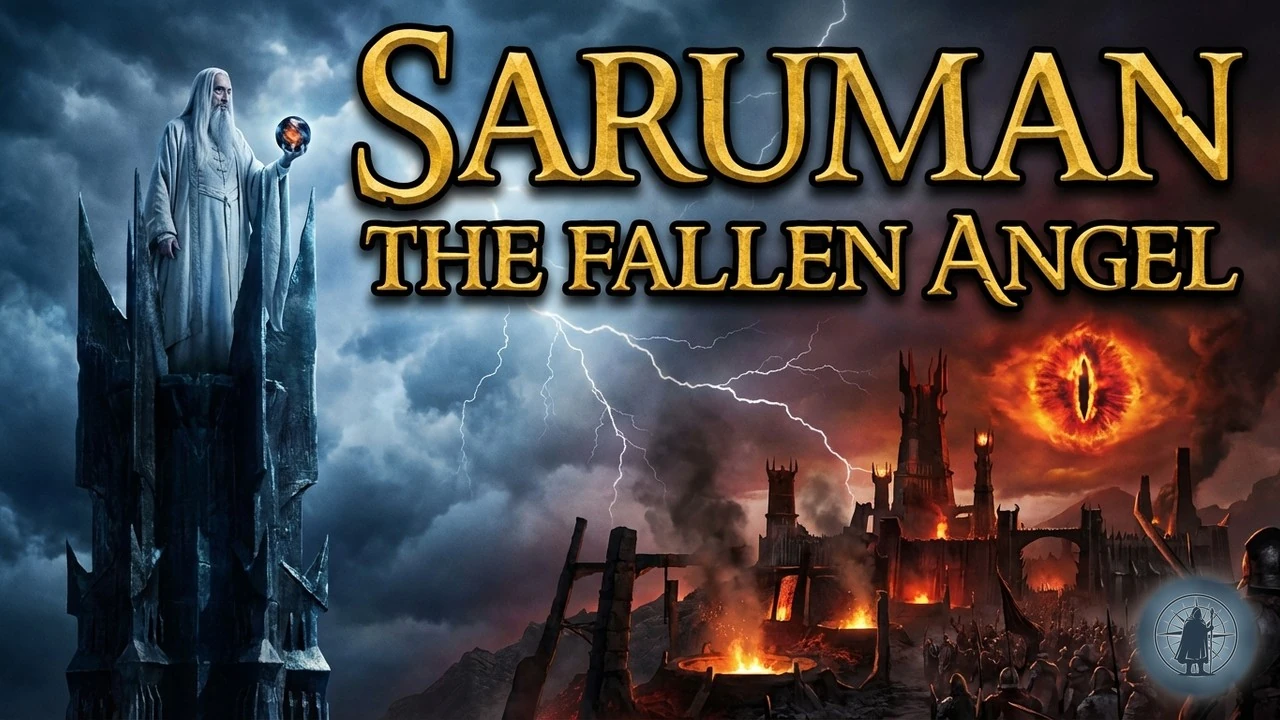 Watch the episode
Saruman's Fall: Why the Greatest Wizard Betrayed His Order | Tolkien Explained
Watch the episode
Saruman's Fall: Why the Greatest Wizard Betrayed His Order | Tolkien Explained
Saruman the White
SECTION: The Craftsman of Valinor -- Curumo Before the Fall
In a letter to Milton Waldman in 1951, Tolkien described the Istari -- the five wizards sent to Middle-earth -- as "the near equivalent in the mode of these tales of Angels, guardian Angels." That phrase reframes the entire story of Saruman. We are not watching a mortal sorcerer dabble in forbidden arts. We are watching a divine being, sent on a sacred mission of protection, who became the very evil he was consecrated to oppose.
His name was Curumo. In Quenya, it means "skilled one," drawn from the root word for craft and handiwork. The Sindar called him Curunir -- "man of skill" or "one of cunning device." And when men of Rohan spoke of him, they used the name Saruman, from the Old English searu, meaning contrivance, art, and cunning. Every language that named him reached for the same idea: here was a being defined by his mastery of making.
This is Ranger of the Realms. And Saruman's story is one I've wanted to tell for a long time -- because it may be the most tragic in all of Tolkien's mythology. Not the tragedy of a hero struck down, but something worse. The tragedy of an angel who chose to fall.
Before the world was made, before even the Music of the Ainur, Curumo existed as a Maia of Aule -- the Vala of making, smithwork, and the substances of the earth. Aule's realm encompassed everything that could be shaped, forged, or built. His Maiar learned to love the materials of creation: metal and stone, crystal and gem. They learned to admire skill, to revere the maker who could impose beautiful order on raw material.
There is a particular danger in this. Aule himself stumbled when, out of impatience for the coming of the Children of Iluvatar, he fashioned the Dwarves in secret -- creating life without authority, because his desire to make and to teach could not wait for Iluvatar's plan. Aule repented. He raised his hammer to destroy what he had made, and Iluvatar, seeing the sincerity of his grief, adopted the Dwarves as his own.
But the lesson of that near-catastrophe echoed through the ages. The craftsman's temptation is to believe that superior skill confers the right to impose order on the world. Sauron, the mightiest of Aule's Maiar, succumbed to it completely. And Curumo -- the second among those servants of making -- carried the same vulnerability in his nature like a flaw in steel.
When the Valar resolved to send emissaries to Middle-earth to contest Sauron's rising shadow, these envoys were required to "forgo might, and clothe themselves in flesh so as to treat on equality and win the trust of Elves and Men." They would be incarnated in human-like bodies, subject to weariness, hunger, and pain. They could be killed. They could -- and this was the crux of it -- be corrupted.
Curumo volunteered. Aule selected him. He was appointed the first Istar, the chief of the Order. And he arrived at the Grey Havens around the year 1000 of the Third Age, bearing the highest title and the greatest authority of any wizard ever to walk Middle-earth.
He carried it for two thousand years before the weight became indistinguishable from chains.
SECTION: The Jealousy That Crossed the Sea
The seeds of Saruman's undoing were sown before he ever set foot in Middle-earth. Perhaps even before he left Valinor.
When the council of the Valar assembled to choose the Istari, another Maia was present -- one called Olorin. Quiet, unassuming, reluctant. Where Curumo volunteered with confidence, Olorin protested that he was too weak for such a task and that he feared Sauron. But Manwe said this was all the more reason he should go. And then Varda -- the Queen of the Stars, the most revered of the Valier -- said something that would fester in Curumo's heart for millennia.
She said that Olorin was "not the third."
The implication cut deep. The Istari were five, and Olorin was assigned the third position in their hierarchy. But Varda's words meant his true stature exceeded his nominal rank. The queen of heaven herself was saying that Curumo's subordinate was, in some essential way, his equal or better.
When the wizards arrived at the Grey Havens, Cirdan the Shipwright -- oldest and wisest of the Elves remaining in Middle-earth -- perceived something in Olorin that he did not see in Curumo. He gave Olorin the Elven ring Narya, the Ring of Fire, saying: "Take this ring, for your labours will be heavy; but it will support you in the weariness that you have taken upon yourself. For this is the Ring of Fire, and with it you may rekindle hearts in a world that grows chill."
Saruman learned of this gift. And the knowledge poisoned something that might otherwise have remained manageable vanity.
Centuries passed. The White Council was formed in the year 2463 of the Third Age to coordinate resistance against Sauron. Galadriel -- piercing, ancient, formidable Galadriel -- wished Gandalf to lead it. Gandalf refused. Saruman was chosen instead. But the very fact that the suggestion had been made, that someone of Galadriel's stature preferred his subordinate over him, deepened the wound that Varda's words had opened.
This is the architecture of Saruman's resentment: not a single devastating blow, but an accumulation of slights -- real and perceived -- that transformed legitimate confidence into something brittle and defensive. He did not begin as a villain. He began as a proud and capable leader who could not stop measuring himself against someone he believed should have remained beneath him.
By the time genuine temptation arrived, the emotional scaffolding for his descent was already built. The jealousy had done its quiet preparatory work. All that remained was a catalyst.
And in this we can see Tolkien's deep Catholic understanding of sin. The spectacular transgression -- the betrayal, the ring-forging, the army-breeding -- is never where the real damage begins. The real damage begins in the small, internal turning: the refusal to accept that someone else might be more gifted, the quiet decision to resent rather than admire. Saruman's ruin began not with a grand Faustian bargain but with something as ordinary and corrosive as professional jealousy. Tolkien knew that the path to the abyss is usually paved with wounded ego.
SECTION: The Abyss Gazes Back -- From Scholar to Imitator
The Silmarillion delivers Saruman's central tragedy in a single devastating sentence: "Too long he had studied the ways of Sauron in hope to defeat him, and now he envied him as a rival rather than hated his works."
Read that again carefully. Tolkien doesn't say Saruman was seduced by Sauron. He doesn't say he was overpowered or deceived. He says he studied. The corruption came through knowledge -- through the sustained, patient, scholarly examination of the Enemy's methods.
There is a terrible logic to this. Saruman's mission required understanding the enemy. To counter Sauron's ring-lore, he needed to learn ring-lore. To anticipate Sauron's strategies, he needed to think like Sauron. The work was necessary. And the work destroyed him.
Gandalf would later crystallize this in a rebuke that functions as one of Tolkien's most important philosophical statements: "He that breaks a thing to find out what it is has left the path of wisdom."
That line distinguishes two kinds of knowledge. There is understanding that participates in the nature of what it studies -- that seeks to know a thing on its own terms. And there is analysis that dismantles, reduces, fragments. Saruman broke things to know them. He treated creation as raw material for his investigation. And in doing so, he lost the capacity to see the whole.
The timeline of his slide is traceable through his decisions on the White Council. In the year 2759, Saruman settled at Isengard with permission from the Steward of Gondor. Orthanc was an ideal base for a wizard tasked with studying and opposing Sauron -- remote, defensible, positioned to watch the southern approaches. But within that tower he discovered something the Council had not been told about: the palantir of Orthanc, one of the seven seeing-stones of the Numenoreans. He concealed this discovery and began using the stone for his own purposes.
That concealment is the first unambiguous act of treachery. Everything before it -- the jealousy, the wounded vanity -- could be explained as personality flaws. But hiding a palantir from the White Council while occupying a position of trust was a deliberate choice to place private ambition above collective responsibility.
In the year 2850, Gandalf entered Dol Guldur and confirmed that the mysterious Necromancer was Sauron returned. He urged the Council to attack immediately. Saruman overruled him -- not out of caution, but because he had already begun searching for the One Ring near the Gladden Fields, where Isildur had lost it. He wanted Sauron to remain in Dol Guldur, drawing attention away from the area where the Ring might surface.
A scholar tasked with defeating the Dark Lord was now manipulating a council of the wise to serve his own secret ambitions. The study had become the thing studied.
And then he began to imitate. Saruman declared himself "Saruman the Wise, Saruman Ring-maker, Saruman of Many Colours" -- and in that self-christening, we can hear the echo of Sauron's own titles. He forged a ring for his own finger. He bred Uruk-hai, engineering a new race of soldiers as Sauron had done with Orcs. He transformed Isengard from a green fortress of watchtowers and gardens into a pit of furnaces, smoke, and iron -- a miniature Mordor.
He placed agents in foreign courts, just as the Dark Lord did. Wormtongue in Rohan, whispering poison into King Theoden's ear, was Saruman's own version of Sauron's network of spies and corruptors.
And most fatally, he used the palantir of Orthanc to communicate directly with the Enemy. The seeing-stone, designed by the Numenoreans for legitimate governance, became a pipeline through which Sauron's superior will could reach into Saruman's already-compromised mind. Scholar after scholar has noted the irony: the instrument of seeing became the instrument of blindness.
By the time Gandalf visited Isengard in July of 3018, expecting counsel, what he found instead was a figure who had become an "imitative and lesser" double of the Dark Lord himself. Saruman's robes, which had seemed white, now shimmered with many colors when he moved.
Scholar Verlyn Flieger, in her landmark study Splintered Light, explores this image at length. White light contains all colors in unity. Break it through a prism and you produce a spectrum -- brilliant, perhaps, but shattered. The unified truth of white is exchanged for the dazzling fragmentation of many colours. When Saruman proudly announced his new title -- "Saruman of Many Colours" -- Gandalf's response was devastating in its simplicity. He preferred white.
That exchange is not merely about robes. It is about epistemology. Saruman's analytical mind had broken knowledge apart, dissected wisdom into constituent fragments, and mistaken the dazzle of multiplied perspectives for superiority over unified truth. Gandalf saw that the many colours, for all their shimmer, were diminished. They had lost the wholeness that made white meaningful. It is one of Tolkien's most compressed and elegant metaphors for the difference between genuine understanding and clever reductionism.
SECTION: The Voice and the Machine -- Two Instruments of Control
Saruman's power manifested through two channels, and both reveal the same perversion of legitimate gifts turned toward subjugation.
The first was his voice. Tolkien describes it as "low and melodious, its very sound an enchantment." But Tolkien was precise about the nature of that enchantment. In Letter 210, he clarified that Saruman's voice was not hypnotic. Those who heard it did not fall into a trance. They found themselves agreeing. The danger was not magical compulsion but genuine persuasion wielded for manipulative ends.
Tom Shippey identifies something distinctly modern in Saruman's rhetoric. His speech is full of "balanced phrases," of words like "deploring" and "ultimate" and "real" -- the vocabulary of 20th-century politics. When Saruman addresses the Riders of Rohan after the destruction of Isengard, his voice nearly sways hardened warriors who have just finished burying their dead. Theoden, already freed from Wormtongue's long poison, almost succumbs again. Only the strongest wills in Middle-earth -- Gandalf, Galadriel, Elrond -- could fully resist the pull.
What makes this terrifying is its familiarity. We have all heard voices like this. Political leaders, demagogues, charismatic figures who make the unreasonable sound perfectly sensible. Tolkien, writing during and after the Second World War, understood that the most dangerous form of power is not the one that forces compliance but the one that manufactures consent.
The second instrument was the machine.
Treebeard's description of Saruman is one of the most quoted passages in the entire legendarium: "He has a mind of metal and wheels; and he does not care for growing things, except as far as they serve him for the moment."
Under Saruman's hand, Isengard was gutted. The gardens were torn up. The orchards were felled. The ring-wall, once enclosing a green bowl of ordered beauty, now surrounded pits and forges that belched smoke and flame into the sky. He needed fuel for his furnaces, so he felled the trees of Fangorn Forest -- ancient, slow, patient trees that had stood since before the Elves awoke. He bred his Uruk-hai in the pits of Isengard as industrial products, treating living beings as raw material.
Tolkien, who spent his childhood in the village of Sarehole before watching it consumed by the expanding industry of Birmingham, poured a lifetime of environmental grief into this imagery. Saruman is not merely a villain who happens to cut down trees. He represents an entire philosophy -- the reduction of all living things to their instrumental value, the treatment of the natural world as nothing more than a resource to be processed.
Voice and machine. Persuasion and force. The silver tongue and the iron wheel. Both are perversions of gifts that Curumo brought from Valinor -- the Maia's natural authority twisted into rhetoric, the artisan's skill warped into industrial destruction. The wizard whose mission was to "encourage and bring out the native powers of the Enemies of Sauron" had become a being who did the exact opposite: suppressing native powers, replacing organic growth with mechanical production, substituting coercion for counsel.
The Ents' march on Isengard -- ancient trees tearing down iron walls, the river Isen itself redirected to flood the pits and quench the furnaces -- is not simply a battle sequence. It is nature's answer to the mind of metal and wheels.
And it is total. Saruman's army of ten thousand Uruk-hai had already been destroyed at Helm's Deep. Now his fortress was drowned, his forges extinguished, his stores ruined. The tower of Orthanc, built by Numenorean hands using methods older and deeper than anything Saruman commanded, stood untouched amid the wreckage. As Merry would observe, the tower's rock seemed to resist the Ents themselves -- "some wizardry is in it, perhaps, older and stronger than Saruman's." The things Saruman built were swept away. The things the Numenoreans built endured.
That contrast is not accidental. Tolkien draws a line between artisanship that works with the grain of creation and industry that works against it. One endures. The other drowns.
SECTION: The Refused Hand -- Mercy at Orthanc and in the Shire
After the Ents destroyed Isengard and Saruman was trapped in the unbreakable tower of Orthanc, Gandalf climbed the steps and offered him something no one in the story expected.
A way back.
Not unconditional pardon. Not a return to authority. But the chance to leave the tower freely, to aid the war against Sauron, to begin the long road of restoration. The terms were conditional, but they were genuine. Gandalf -- now Gandalf the White, having replaced Saruman as head of the Order -- extended the hand of mercy to the being who had imprisoned and betrayed him.
And Saruman almost took it.
This is the moment that separates Tolkien's treatment of villainy from nearly every other fantasy author. Saruman stands at the window of Orthanc, looking down at Gandalf, and for a breath he hesitates. Tolkien writes that a shadow of his former self flickered across his face -- the old wisdom, the old authority, the memory of what he had been. For one instant, the reader can see the path not taken. The wizard who might have repented.
But he could not bring himself to descend those stairs. To walk out of Orthanc as a supplicant before the colleague he despised. His arrogance would not permit him to accept redemption from the hands of one he still considered his inferior. The terms, Tolkien writes, only became "more bitter and filled with the rage of failure" -- not because the terms were harsh, but because accepting them would have required humility.
Gandalf broke Saruman's staff and cast him from the Order. The moment was over. And the manner of the breaking tells us something important. Gandalf did not defeat Saruman in combat. He did not overpower him with superior magic. He spoke, and the staff shattered. This is authority exercised through spiritual legitimacy, not force -- the precise inversion of everything Saruman had become. The wizard who relied on persuasion and machinery was undone by a single act of genuine authority that required neither.
And yet the offer of grace came again.
In the Shire, months later, after Saruman -- now going by "Sharkey" -- had spent his diminished days terrorizing hobbits, Frodo stood before him and forbade his companions from killing the fallen wizard. "He is fallen," Frodo said, "and his cure is beyond us; but I would still spare him, in the hope that he may find it."
Mercy, from a hobbit. A creature Saruman had always dismissed as insignificant.
Saruman's response was to draw a hidden knife and stab at Frodo. The mithril coat saved the hobbit's life. And in that act -- attempting to murder the one person still willing to show him grace -- Saruman sealed his own fate. Not because Frodo withdrew the offer. Frodo didn't. Even after the attempted murder, Frodo still ordered that Saruman be allowed to leave unharmed.
The theological resonance here is unmistakable. Tolkien, a devout Catholic, understood the concept of the unforgivable sin -- not as a sin too great for God to forgive, but as the soul's refusal to accept forgiveness. Saruman is not damned because his crimes are beyond redemption. He is damned because he will not permit himself to be redeemed. Every hand extended to him, he slaps away. Every door opened, he slams shut.
The tragedy is not that mercy failed. The tragedy is that mercy was there all along, and he chose the knife instead.
SECTION: From the Chief of the Istari to Sharkey -- The Arc of Diminishment
The trajectory from Curumo, chief of the divine messengers, to Sharkey, a petty tyrant harassing halflings, is one of the longest falls in all of literature. And Tolkien insists that we witness every stage of it.
After his expulsion from the Order, Saruman could not remain imprisoned in Orthanc. He talked his way past Treebeard -- even diminished, that silver tongue retained some of its old potency -- and made his way north. But he did not seek a new fortress. He did not attempt to rebuild an army. He went to the Shire.
The choice reveals everything about what he had become. He did not go to the Shire to conquer a strategic position. He went because he could. Because the hobbits were small and defenseless and he still possessed enough residual power to bully them. His ambitions had shrunk from world mastery to vandalism. From challenging Sauron for the ordering of Middle-earth to knocking down hobbit-holes and cutting down trees.
It is worth noting that Saruman's interest in the Shire predated even the War of the Ring. Barrels of Longbottom Leaf -- the finest pipe-weed in the Shire -- were found in Isengard's stores after the flooding, evidence that Saruman had been trading with and sending agents into the Shire for years. He had visited it in disguise. He knew its roads and its people. This detail, easily overlooked, reveals that Saruman's later despoiling of the Shire was not mere impulse. It was the fulfillment of a long fascination twisted into malice.
Tom Shippey identifies Saruman as "the best example of wraithing in The Lord of the Rings." Wraithing -- a term Shippey uses for the process by which a person is "eaten up inside" by devotion to some abstraction. The Ringwraiths are the obvious case: men who wore rings of power until their bodies faded into invisibility. But Saruman wraiths without a ring. His devotion to control, to the imposition of his will on every surrounding thing, consumed him from within until the mighty Maia was barely recognizable.
His agents in the Shire imposed a regime of what they called "fair distribution" -- a system in which everything was gathered, catalogued, and redistributed according to rules that benefited no one except the rulers. Beer was rationed. Inns were shuttered. The New Mill belched smoke and fouled the Water. Trees were cut wholesale along the Bywater Road. Hobbit-holes were demolished and replaced with ugly barracks of cheap construction. It was Isengard in miniature, shorn of even the pretense of grand purpose. Where the original had at least aspired to military conquest, this imitation aimed at nothing higher than the systematic destruction of beauty for its own sake.
Stephen C. Winter, in his analysis of the Scouring of the Shire, draws a powerful contrast between two kinds of breaking. Frodo breaks -- physically, psychologically, spiritually -- but his breaking is a self-offering for a transcendent cause, and what is broken in him is eventually reconstructed, even if that reconstruction requires the Undying Lands. Saruman breaks too, but his breaking is the opposite: self-assertion through imposed control, a progressive narrowing of purpose until nothing remains but the compulsion to ruin what others love.
"In his overweening pride," Winter writes, "Saruman has broken himself."
The name Sharkey tells the whole story. It comes from the Orkish word sharku, meaning "old man." His orc followers used it with what Saruman apparently regarded as "a sign of affection." The chief of the Istari, sent by the Lords of the West to protect the peoples of Middle-earth, had become an old man condescended to by orcs. The being who once rivaled Sauron for the mastery of Middle-earth was now scrounging for authority over root vegetables and chimney regulations.
SECTION: The Cold Wind from the West -- Saruman's Death and Evil's Destiny
Wormtongue killed him. Grima, the wretched spy who had served Saruman faithfully, was provoked beyond endurance when Saruman publicly revealed that Grima had murdered Lotho Sackville-Baggins. The knife came fast. Hobbit archers killed Grima in turn. And then something happened that even the hobbits, who had little understanding of such things, recognized as significant.
Tolkien describes the moment with the precision of a theologian:
"A grey mist gathered, and rising slowly to a great height like smoke from a fire, as a pale shrouded figure it loomed over the Hill. For a moment it wavered, looking to the West; but out of the West came a cold wind, and it bent away, and with a sigh dissolved into nothing."
That passage compresses an entire theology into four sentences. The grey mist is Saruman's Maiar spirit, released from its physical form. It rises and looks to the West -- toward Valinor, toward the Blessed Realm, toward the home from which he came and to which the faithful Istari would one day return. For a single wavering moment, the possibility of return exists.
And the West refuses him. A cold wind blows, and the spirit that was Curumo dissolves into nothingness.
Compare this with what Tolkien tells us about Gandalf's eventual departure -- sailing West on the white ship from the Grey Havens, returning to the Blessed Realm having fulfilled his mission. Two Maiar. Two destinies. One received home. The other scattered like ash.
Shippey argues that this death scene encapsulates Tolkien's entire understanding of wickedness and its destiny. Tolkien held two complementary views of evil in tension throughout his work: the Boethian view, in which evil is an absence -- a privation of good, a nothingness that merely pretends to substance -- and the Manichaean view, in which evil is an active, aggressive, terrifyingly real force. Saruman begins as a Manichaean threat. He commands armies. He bends wills. He reshapes landscapes. But he ends in Boethian nothingness. His body shrivels. His spirit dissolves. The active force becomes the absence.
This is not accidental. It is, for Tolkien, the fundamental truth about the kind of power Saruman sought. Mastery over others looks strong. It marshals armies and builds towers and makes the ground shake. But it is borrowing against a future of emptiness. Every act of imposed control costs something, and what it costs is the substance of the one who imposes it.
Saruman is Tolkien's most complete illustration of this principle because we see the entire arc. He begins as a divine being of genuine authority and real capability. He ends as grey smoke blown away by a breeze. Between those two points lies every stage of the progression: the wounded vanity, the scholarly curiosity that curdled into obsession, the imitation of darkness that became indistinguishable from the original, the instruments of domination, the refused grace, the petty cruelty, and finally the dissolution.
He serves as a triple foil in the story's architecture. Against Gandalf, he shows what a wizard becomes when he abandons his mission -- where Gandalf empowers others, Saruman subjugates them. Against Sauron, he reveals a lesser echo of the same decay -- the same spiritual origin in Aule's service, the same love of craft turned to tyranny, but played out on a smaller and more pathetic scale. And against Frodo, he demonstrates the strength that Saruman lacked. Frodo, who bore the Ring to the Crack of Doom and offered compassion to his enemies, embodies everything Saruman refused: humility, self-sacrifice, the willingness to break for a cause greater than oneself.
The cold wind from the West is the final word. Not a thunderbolt. Not a great battle. Just a wind, and then nothing. As if the universe itself had concluded that there was nothing left worth holding onto. As if Curumo, the skilled one, had crafted himself out of existence.