
Research & Sources
Saruman's Fall
Why the Greatest Wizard Betrayed His Order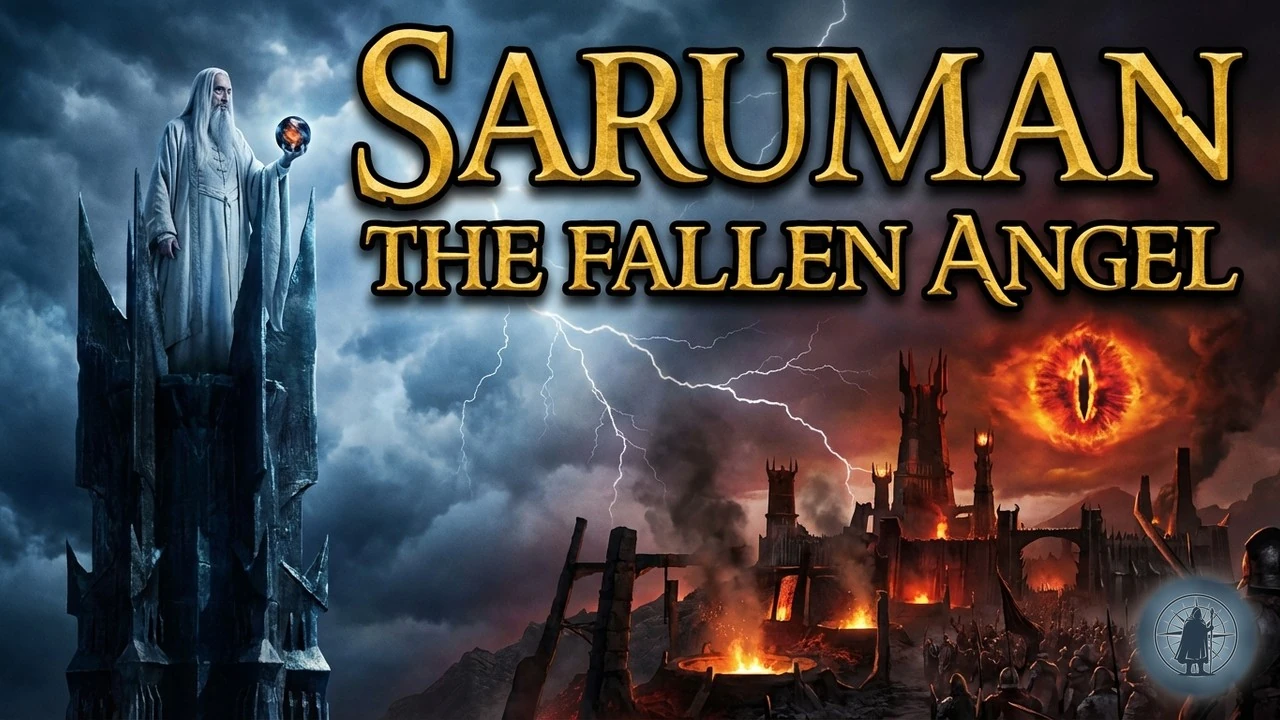 Watch the episode
Saruman's Fall: Why the Greatest Wizard Betrayed His Order | Tolkien Explained
Watch the episode
Saruman's Fall: Why the Greatest Wizard Betrayed His Order | Tolkien Explained
Research Notes: Saruman the White
Overview
Saruman the White is one of Tolkien's most richly developed antagonists -- a divine being sent to protect Middle-earth who instead becomes the very thing he was meant to oppose. Originally a Maia of Aule named Curumo, he was chosen as chief of the Istari, the wizards dispatched by the Valar to contest Sauron's rising power. His fall from wisdom through pride, envy, and the corruption that comes from studying evil too closely makes him a profoundly tragic figure. Saruman's story embodies core Tolkien themes: the danger of seeking power through domination, the corrosion of good intentions by pride, the inadequacy of technical knowledge without moral wisdom, and the merciful possibility of redemption that is offered but refused.
Primary Sources
The Silmarillion ("Of the Rings of Power and the Third Age")
- "Too long he had studied the ways of Sauron in hope to defeat him, and now he envied him as a rival rather than hated his works." (The Silmarillion, "Of the Rings of Power and the Third Age") - Saruman "desired that he and no other should find the Great Ring, so that he might wield it himself and order all the world to his will." (The Silmarillion) - The proper function of the Wizards was described as encouraging and bringing out the native powers of the Enemies of Sauron -- a function maintained by Gandalf and perverted by Saruman.
The Lord of the Rings
The Fellowship of the Ring -- "The Council of Elrond": - Gandalf recounts his visit to Isengard and Saruman's revelation of treachery. - Saruman declares: "For I am Saruman the Wise, Saruman Ring-maker, Saruman of Many Colours!" - Gandalf observes that Saruman's robes "which had seemed white, were not so, but were woven of all colours, and if he moved they shimmered and changed hue so that the eye was bewildered." - Saruman proposes an alliance with Sauron or seizing the Ring for themselves. - Gandalf's response: "He that breaks a thing to find out what it is has left the path of wisdom." - Saruman wears a ring on his finger -- an early attempt at ringcraft.
The Two Towers -- "Treebeard": - Treebeard's description: "He has a mind of metal and wheels; and he does not care for growing things, except as far as they serve him for the moment."
The Two Towers -- "The Voice of Saruman": - Tolkien describes Saruman's voice as "low and melodious, its very sound an enchantment." Those who listened unwarily could seldom report the words they heard; they mostly remembered only that it was a delight to hear, and all that was said seemed wise and reasonable. When others spoke they seemed harsh and uncouth by contrast. - Saruman attempts to negotiate after the destruction of Isengard; his voice nearly sways the Riders of Rohan. - Gandalf offers Saruman a conditional chance at freedom and redemption. - Saruman almost considers repenting but cannot bring himself to do so -- his pride will not permit him to accept terms from Gandalf. - Gandalf breaks Saruman's staff and casts him from the Order of Wizards and the White Council.
The Return of the King -- "The Scouring of the Shire": - Saruman, operating under the alias "Sharkey," has industrialized and despoiled the Shire. - Frodo shows mercy, forbidding the hobbits from killing Saruman. - Saruman reveals that Wormtongue killed Lotho Sackville-Baggins. - Wormtongue, provoked, cuts Saruman's throat and is killed by hobbit archers. - "A grey mist gathered, and rising slowly to a great height like smoke from a fire, as a pale shrouded figure it loomed over the Hill. For a moment it wavered, looking to the West; but out of the West came a cold wind, and it bent away, and with a sigh dissolved into nothing." (Return of the King, "The Scouring of the Shire")
Unfinished Tales ("The Istari")
- A council of the Valar was summoned by Manwe, at which it was resolved to send emissaries to Middle-earth. These emissaries were to be "mighty, peers of Sauron, yet forgo might, and clothe themselves in flesh so as to treat on equality and win the trust of Elves and Men." - Curumo was chosen by Aule and volunteered to travel to Middle-earth. He was appointed the first Istar and became chief of their Order. - Saruman's jealousy of Gandalf began before they even departed Valinor, when Varda said of Olorin (Gandalf) that he was "not the third" -- implying Gandalf's true stature exceeded his nominal rank. - Saruman knew that Cirdan had given Gandalf the Elven ring Narya (the Ring of Fire), which further nurtured his jealousy.
The Letters of J.R.R. Tolkien
Letter 131 (to Milton Waldman, 1951): - Tolkien describes the Wizards as "the near equivalent in the mode of these tales of Angels, guardian Angels." - The proper function of the Wizards, maintained by Gandalf and perverted by Saruman, was to encourage and bring out the native powers of the Enemies of Sauron.
Letter 181 (January 1956): - The wizards were sent by the Valar to assist the peoples of Middle-earth against Sauron. They were incarnated in human-like forms to experience the world and its limitations, making them vulnerable to the same temptations and potential for corruption. - Saruman's fall stemmed from inherent vulnerability: the wizards faced "the possibility of 'fall', of sin." Saruman succumbed to "impatience, leading to the desire to force others to their own good ends."
Letter 210: - Saruman's voice was not hypnotic but genuinely persuasive. The real danger was not falling into a trance but finding oneself agreeing with what was said.
Key Facts & Timeline
- Before Time: Curumo created as a Maia of Aule by Iluvatar before the Music of the Ainur - c. T.A. 1000: The Istari arrive in Middle-earth at Mithlond (the Grey Havens). Saruman is chief among them. Cirdan gives Narya to Gandalf, not Saruman, sensing Gandalf's greater spirit. - T.A. 2463: The White Council is formed. Galadriel wishes Gandalf to lead it, but Gandalf refuses. Saruman is chosen as head, though this fuels his resentment. - T.A. 2759: Saruman settles at Isengard (Orthanc) with permission from Steward Beren of Gondor and King Freaelaf of Rohan. He discovers the Orthanc palantir and conceals this from the White Council. - T.A. 2850: Gandalf enters Dol Guldur and confirms the Necromancer is Sauron. He urges the White Council to attack. Saruman overrules this, secretly wanting Sauron to remain so the Ring might reveal itself near the Gladden Fields. - T.A. 2939: Saruman discovers Sauron's servants are searching the Gladden Fields for the Ring. He grows alarmed. - T.A. 2941: Saruman finally agrees to attack Dol Guldur. Sauron is driven out but resurfaces in Mordor. - T.A. 2951: Sauron declares himself openly in Mordor. - T.A. 2953: Last meeting of the White Council. Saruman lies that the Ring was swept out to sea. He begins fortifying Isengard and making it his own domain. - c. T.A. 2953-3000: Saruman uses the palantir and comes into contact with Sauron through the Ithil-stone. His integrity already weakened, he is further ensnared by Sauron's superior will. He begins breeding Uruk-hai and half-orcs. - c. T.A. 2990: Saruman begins using and possibly breeding Orcs in Isengard openly. - T.A. 3000: Saruman is ensnared by Sauron through the palantir (approximate date from Appendices). - July 10, T.A. 3018: Gandalf arrives at Isengard seeking counsel. Saruman reveals his treachery and imprisons Gandalf atop Orthanc. - September 18, T.A. 3018: Gwaihir rescues Gandalf from Orthanc. - March 3, T.A. 3019: Battle of Helm's Deep; Saruman's army of 10,000 Uruk-hai is destroyed. - March 3, T.A. 3019: The Ents attack and flood Isengard, reducing the fortress to ruins (though Orthanc tower stands). - March 5, T.A. 3019: Gandalf confronts Saruman at Orthanc. Breaks his staff, expels him from the Order. Grima throws the palantir from the tower. - November 3, T.A. 3019: Saruman is killed by Grima Wormtongue in the Shire. His spirit is refused by the West and dissolves into nothing.
Significant Characters
- Saruman / Curumo / Curunir / Sharkey: The chief wizard, originally a Maia of Aule. His names all relate to skill/cunning/craft. Falls through pride, envy, and the study of the enemy's methods. - Gandalf / Olorin / Mithrandir: Saruman's chief rival and eventual judge. The wizard who maintains the proper function of the Istari. Replaces Saruman as "the White." - Sauron / Mairon: The Dark Lord, also a former Maia of Aule. Saruman's intended master/rival. Ensnares Saruman through the palantir. - Grima Wormtongue: Saruman's spy and agent in Rohan. Promised Eowyn as payment. Eventually kills Saruman in the Shire. - Theoden: King of Rohan, nearly destroyed by Saruman's influence through Wormtongue's poisonous counsel. - Treebeard / Fangorn: Oldest of the Ents. Leads the assault on Isengard in response to Saruman's destruction of the forest. - Radagast the Brown: Fellow Istari, unwittingly used by Saruman to lure Gandalf to Isengard. - Aule: Vala of craft and making. The spiritual patron of both Saruman and Sauron -- a significant thematic connection.
Geographic Locations
- Isengard / Angrenost: The fortress containing Orthanc, given to Saruman by Gondor and Rohan. Once a green, fertile ring-wall enclosing gardens and orchards, Saruman transforms it into an industrial wasteland of pits, forges, and furnaces. Its destruction by the Ents is one of the great reversals in the story. - Orthanc: The ancient tower of unbreakable black stone at the center of Isengard. Houses the palantir. Saruman is imprisoned here after the Ents' attack. The name means both "cunning mind" in Sindarin and "Mount Fang" in Rohirric. - Fangorn Forest: The ancient forest bordering Isengard. Saruman's tree-cutting for his furnaces provokes the Ents to march against him. - The Shire: Saruman's final domain, which he despoils in petty revenge. He operates there as "Sharkey." His agents have been involved in the Shire for some time, trading in Longbottom Leaf pipe-weed. - Dol Guldur: Sauron's stronghold in Mirkwood, which Saruman initially opposed attacking to keep Sauron in place while searching for the Ring.
Themes & Symbolism
White to Many Colours: The Splintering of Wisdom
Saruman's transformation from Saruman the White to "Saruman of Many Colours" symbolizes the fragmentation of unified truth. White light contains all colors in unity; breaking it through a prism produces many colors but destroys the wholeness. Gandalf's preference for "white" over "the breaking of white" represents the superiority of integrated wisdom over analytical reductionism. Scholar Verlyn Flieger's Splintered Light explores this metaphor extensively.The Mind of Metal and Wheels: Industrialization vs. Nature
Treebeard's description encapsulates Saruman's transformation into a force of industrial destruction. Tolkien, who witnessed the destruction of the English countryside by industrialization (particularly around his childhood home in Sarehole, Birmingham), channels his environmental concerns through this imagery. Isengard becomes an "industrial hell" of furnaces, iron wheels, and smoke. The Ents' destruction of Isengard represents nature's counterattack against unchecked industrialism.Studying the Enemy: Becoming What You Oppose
Saruman's central tragedy is that prolonged study of Sauron's methods corrupted his own purposes. He began studying ring-lore to defeat Sauron but ended by envying him as a rival. This theme reflects Tolkien's awareness of how those who fight evil can become corrupted by adopting the enemy's methods -- a theme with clear resonance to wartime and post-war politics.The Refusal of Redemption
At multiple points Saruman is offered mercy and the chance to repent: by Gandalf at Orthanc, and by Frodo in the Shire. Each time his pride prevents him from accepting. This parallels the theological concept of the unforgivable sin not as a sin too great for forgiveness, but as the refusal to accept forgiveness.The Voice as Power: Rhetoric and Manipulation
Saruman's voice -- persuasive rather than hypnotic -- represents the danger of sophisticated rhetoric used for domination. Tolkien, writing during and after WWII, was acutely aware of how demagogic speech could sway populations. Shippey notes that Saruman's rhetoric of "balanced phrases" and empty words like "deploring," "ultimate," and "real" marks him as a consummate politician and sophist.Wraithing and Diminishment
Tom Shippey identifies Saruman as the best example of "wraithing" in The Lord of the Rings -- the process by which individuals are "eaten up inside" by devotion to some abstraction. Saruman's physical diminishment (from a powerful wizard to a shabby old man called "Sharkey") mirrors his spiritual collapse. His final fate -- a spirit dissolving into nothing, refused by the West -- represents evil's ultimate destiny of nothingness.Scholarly Perspectives
Tom Shippey (The Road to Middle-earth, J.R.R. Tolkien: Author of the Century)
Shippey identifies Saruman as exemplifying two complementary views of evil that Tolkien holds in tension: the Boethian (evil as absence of good) and the Manichaean (evil as active force). Saruman begins as a Manichaean threat -- a powerful figure doing real harm -- but ends in Boethian nothingness, his spirit dissolving to nothing. Shippey also notes Saruman's distinctly modern speech patterns, connecting him to 20th-century political rhetoric.Verlyn Flieger (Splintered Light)
Flieger's analysis of the white/many colours dichotomy connects it to Tolkien's broader use of light imagery derived from Owen Barfield's theory of the "ancient semantic unity." Saruman's breaking of white light parallels the fragmentation of original unified meaning throughout the mythology.Stephen C. Winter (Wisdom from The Lord of the Rings blog)
Winter contrasts two types of "breaking" in Tolkien: Frodo's breaking (self-offering for a transcendent cause, resulting in spiritual reconstruction) versus Saruman's breaking (self-assertion through imposed control). "In his overweening pride, Saruman has broken himself."Political/Historical Parallels
Scholars note that Saruman's rhetoric draws from the language of 20th-century totalitarianism. His "fair distribution" regime in the Shire has been compared to Communist collectivization. His industrialization of Isengard echoes the environmental devastation Tolkien witnessed. However, Tolkien himself resisted one-to-one allegorical readings.Theological Interpretation
Gandalf has been compared to a "good pope" and Saruman (along with Denethor) to "bad popes" -- figures who abuse spiritual authority. Both Saruman and Sauron are Maiar of Aule, and their shared susceptibility to corruption through craft, possession, and the desire to order the world reflects Tolkien's Catholic understanding of how good intentions can be perverted by pride and the will to dominate.Contradictions & Different Versions
The Istari's Arrival
In some versions, the Istari arrive together at the Grey Havens circa T.A. 1000. In other texts, Tolkien suggests they may have arrived at different times and not necessarily together. The "Istari" essay in Unfinished Tales represents a relatively late conception.Saruman's Ring
The nature and power of Saruman's ring is never clearly defined. Whether it held genuine power or was merely a conceit reflecting his ambition is debated. Tolkien describes him as "Saruman Ring-maker" and shows him wearing a ring, but never specifies its capabilities.The Development of "Sharkey"
In early drafts of "The Scouring of the Shire," Sharkey was simply a ruffian encountered by the hobbits, then the unseen boss of the ruffians. Only in the second draft did Tolkien realize that Sharkey was actually Saruman -- a discovery that profoundly deepened the chapter's thematic resonance.Saruman's Early History
Christopher Tolkien notes that his father's conception of the Istari evolved considerably. The essay in Unfinished Tales was never finished, and details about the selection council in Valinor exist in multiple incomplete versions with varying details about who volunteered and who was commanded.The Name "Tarindor"
In some versions, Saruman also went by the name "Tarindor" in Valinor. This appears in later writings and is not universally attested across all versions of the mythology.Cultural & Linguistic Context
Etymology of Names
- Curumo (Quenya): "Skilled-one" or "Cunning One." Root: curu = "skill." The Quenya noun curwe meaning "craft" or "skill of the hand" appears primarily in names of characters who turn corrupt. - Curunir (Sindarin): "Man of Skill" or "Man of Craft" or "one of cunning device." - Saruman (Mannish/Anglo-Saxon): From Old English searu = "device, design, contrivance, art, skill, cunning" + man. Tolkien used the Mercian dialect of Anglo-Saxon for Rohirric names. - Sharkey: From Orkish sharku = "old man." Modified with English diminutive suffix "-ey." Used by his orc followers as what Saruman regarded as a "sign of affection."The Significance of Craft and Cunning
The dual meaning of Saruman's names -- encompassing both legitimate skill and deceptive cunning -- mirrors his character arc. The same root that denotes admirable craft also connotes wile and guile. This is not accidental; Tolkien consistently used etymology to encode character destiny.Connection to Aule
Both Saruman and Sauron were Maiar of Aule, the Vala of craft and making. Aule's dominion over creation tempted his Maiar to become proud and possessive. Aule himself nearly fell when he created the Dwarves out of impatience, but he repented. His servants were not always so wise.Questions & Mysteries
- When exactly did Saruman's corruption begin? Was he already compromised when he settled at Isengard in T.A. 2759, or did the palantir discovery begin his slide? Some argue his jealousy of Gandalf was already a moral deficiency present from Valinor. - Did Saruman's ring have actual power? Tolkien never clarifies this. Was it a genuine lesser ring of power, or merely a symbol of his pretensions? - Could Saruman have wielded the One Ring effectively? As a Maia, he had significant native power. Would the Ring have amplified this enough to challenge Sauron, or would he have been dominated as Tolkien implies all Ring-wielders ultimately would be? - What was the nature of Saruman's relationship with Sauron? Was he genuinely serving Sauron, or always scheming to supplant him? The text suggests a double game -- appearing to serve while secretly plotting to seize the Ring. - How much of Saruman's original wisdom survived his corruption? Even in the Shire, his ability to organize and control suggests residual capability, though directed toward petty cruelty rather than grand ambition.
Compelling Quotes for Narration
1. "Too long he had studied the ways of Sauron in hope to defeat him, and now he envied him as a rival rather than hated his works." -- The Silmarillion 2. "He that breaks a thing to find out what it is has left the path of wisdom." -- Gandalf, The Fellowship of the Ring 3. "For I am Saruman the Wise, Saruman Ring-maker, Saruman of Many Colours!" -- Saruman, The Fellowship of the Ring 4. "He has a mind of metal and wheels; and he does not care for growing things, except as far as they serve him for the moment." -- Treebeard, The Two Towers 5. Saruman's voice: "low and melodious, its very sound an enchantment" -- The Two Towers, "The Voice of Saruman" 6. "A grey mist gathered, and rising slowly to a great height like smoke from a fire, as a pale shrouded figure it loomed over the Hill. For a moment it wavered, looking to the West; but out of the West came a cold wind, and it bent away, and with a sigh dissolved into nothing." -- The Return of the King 7. Gandalf on Wormtongue's influence: "Ever Wormtongue's whispering was in your ears, poisoning your thought, chilling your heart, weakening your limbs." -- The Two Towers 8. Tolkien in Letter 131: The Wizards are "the near equivalent in the mode of these tales of Angels, guardian Angels." 9. Tolkien in Letter 181: Saruman succumbed to "impatience, leading to the desire to force others to their own good ends."
Visual Elements to Highlight
1. Saruman in white robes that shimmer and shift to many colours as he moves -- the visual reveal of his corruption 2. The industrialized valley of Isengard: pits, forges, furnaces belching smoke, the once-green ring-wall now a wasteland of iron and stone 3. Gandalf imprisoned atop the black pinnacle of Orthanc, Gwaihir the eagle swooping down for rescue 4. The Ents' march on Isengard -- ancient tree-like beings tearing down walls and diverting rivers to flood the fortress 5. The breaking of Saruman's staff -- a moment of authority exercised through spiritual power 6. The Scouring of the Shire -- the pastoral homeland scarred by Saruman's petty industrialization 7. Saruman's death: the grey mist rising from his shrunken body, wavering toward the West, then blown away into nothing by the cold wind 8. Saruman before the palantir -- the Orthanc-stone's dark light reflecting in his eyes as Sauron's influence reaches through
Discrete Analytical Themes
Theme 1: The Corruption of Craft -- From Skill to Domination
Core idea: Saruman's fundamental nature as a Maia of Aule (the smith-god) predisposes him toward the same corruption that claimed Sauron -- the belief that superior skill entitles one to impose order on the world. Evidence: - Both Saruman and Sauron were Maiar of Aule, sharing a spiritual affinity for craft and making - Curumo/Saruman's very name means "skilled one" or "cunning one" -- the root curwe appears primarily in names of characters who turn corrupt - Aule himself nearly fell when he created the Dwarves out of impatience; his servants repeated this pattern at greater cost - Saruman's ring-making attempts mirror Sauron's own craft-based path to domination - Tolkien in Letter 181: Saruman succumbed to "impatience, leading to the desire to force others to their own good ends" Distinction: This theme addresses Saruman's ORIGIN and PREDISPOSITION -- the spiritual DNA that made his specific type of fall possible. It is about what he was, not what he chose.Theme 2: The Envy of the Second-Best -- Saruman's Jealousy of Gandalf
Core idea: Saruman's pride as the appointed chief of the Istari made him unable to accept that Gandalf, his nominal subordinate, might be his superior in wisdom and the Valar's esteem. Evidence: - Varda's declaration that Gandalf was "not the third" -- implying his true stature exceeded his rank -- began the jealousy before they even left Valinor - Cirdan gave Narya (the Ring of Fire) to Gandalf rather than Saruman, recognizing the greater spirit - Galadriel wished Gandalf to lead the White Council; though Gandalf refused, the suggestion stoked Saruman's resentment - Saruman eventually convinced himself Gandalf was scheming against him, justifying his own treachery - Gandalf's eventual elevation to "the White" represents the fulfillment of what Saruman feared: being supplanted Distinction: This theme isolates the PERSONAL RELATIONSHIP and emotional dynamic between two specific characters. It is about rivalry and wounded pride, not the nature of evil broadly.Theme 3: Studying the Abyss -- How Knowledge of Evil Becomes Evil Knowledge
Core idea: Saruman's prolonged study of Sauron's methods and ring-lore gradually transformed him from an opponent of the Dark Lord into his imitator, illustrating the danger of believing one can study evil without being changed by it. Evidence: - "Too long he had studied the ways of Sauron in hope to defeat him, and now he envied him as a rival rather than hated his works" (The Silmarillion) - His study of ring-lore was initially justified as preparation against Sauron's return, but it kindled desire for the Ring itself - He concealed his discovery of the palantir from the White Council, using it for private purposes that led to contact with Sauron - He opposed the attack on Dol Guldur not to protect the Free Peoples but to keep Sauron in place while searching for the Ring - "He that breaks a thing to find out what it is has left the path of wisdom" -- Gandalf's direct critique of Saruman's analytical approach Distinction: This theme addresses the MECHANISM of corruption -- the specific process by which good intentions are gradually subverted. It is about methodology and epistemology, not personality or predisposition.Theme 4: The Voice and the Machine -- Saruman's Two Instruments of Power
Core idea: Saruman wields two distinct forms of domination -- rhetorical persuasion (the Voice) and industrial force (the Machine) -- both of which represent perversions of legitimate gifts turned to the purpose of control. Evidence: - His voice was "low and melodious, its very sound an enchantment" -- not hypnotic but genuinely persuasive (Letter 210) - Only the strongest wills (Gandalf, Elrond, Galadriel) could fully resist it - Treebeard's description: "a mind of metal and wheels" -- the reduction of all things to instrumental value - The industrialization of Isengard: furnaces, pits, forges, the breeding of Uruk-hai as industrial products - His agents in the Shire imposed a regime of "fair distribution" and systematic environmental destruction - Both voice and machine serve the same end: imposing Saruman's will on others rather than encouraging their own native powers Distinction: This theme covers Saruman's METHODS and TOOLS -- how he exercises power in the world. It is distinct from why he fell (Themes 1-3) and what happened as a result (Themes 5-6).Theme 5: The Refused Hand -- Mercy Offered and Pride Rejected
Core idea: At every critical juncture, Saruman is offered the chance to repent and return to his proper purpose, but his pride prevents him from accepting help from those he considers beneath him -- making his damnation a matter of choice, not fate. Evidence: - At Orthanc, Gandalf offers Saruman conditional freedom and the chance to aid the Free Peoples; Saruman almost considers repenting but cannot go through with it - Gandalf's terms only became "more bitter and filled with the rage of failure" for Saruman, who blamed Gandalf for his downfall - In the Shire, Frodo forbids the hobbits from killing Saruman and offers mercy; Saruman repays this with attempted murder - The theological parallel: the unforgivable sin as the refusal to accept forgiveness rather than a sin too great to be forgiven - His fate mirrors Sauron's: a spirit rejected by the Valar, blown away from the West, dissolving into nothingness Distinction: This theme addresses REDEMPTION and FREE WILL -- the moral choices available to Saruman and his responses to them. It is about theological dynamics, not the process of corruption.Theme 6: From Orthanc to Bag End -- The Diminishment of Evil
Core idea: Saruman's trajectory from the chief of the Istari to "Sharkey," a petty tyrant bullying hobbits, illustrates Tolkien's understanding of evil as ultimately self-diminishing -- a force that consumes itself and reduces to nothingness. Evidence: - Tom Shippey identifies Saruman as "the best example of 'wraithing' in The Lord of the Rings" -- being "eaten up inside" by devotion to an abstraction - The name "Sharkey" (from Orkish sharku, "old man") reflects his reduction from a title of honor to a diminutive nickname - His spirit at death rises as grey mist, wavers toward the West, is refused by a cold wind, and dissolves into nothing - His physical body shrinks and shrivels at death, revealing how much of his visible form was sustained by his Maiar spirit - The Scouring of the Shire reduces his ambitions from world domination to petty vandalism and cruelty - Shippey: evil's consistent fate in Tolkien is "nothingness" Distinction: This theme addresses the TRAJECTORY and ULTIMATE FATE of Saruman's evil -- the endpoint and its meaning. It is about what evil becomes, not how it originates or operates.Theme 7: The Shadow of Sauron -- Mimicry and the Imitative Double
Core idea: Saruman does not simply fall into independent evil but specifically imitates Sauron -- building his own ring, his own army, his own fortress-realm -- making him an "imitative and lesser" double who demonstrates how evil reproduces itself through flattering imitation. Evidence: - Saruman declares himself "Saruman Ring-maker" and forges his own ring, aping Sauron's signature act - He breeds Uruk-hai and half-orcs, creating his own army in imitation of Sauron's forces - He transforms Isengard into a fortress-industrial complex modeled on Mordor's organizational principles - He places Wormtongue in Rohan as his agent, paralleling Sauron's use of agents and spies - His use of the palantir establishes a direct pipeline for Sauron's influence -- through which he becomes not just an imitator but a servant - Wikipedia's characterization: Saruman is an "imitative and lesser" double of Sauron while also serving as a contrasting double of Gandalf Distinction: This theme addresses the RELATIONSHIP BETWEEN SARUMAN AND SAURON specifically -- how one evil mirrors and serves another. It differs from Theme 3 (which is about studying evil generally) by focusing on the specific dynamic of imitation and subordination.Additional Context
Saruman and Real-World Politics
Tolkien consistently resisted allegorical readings, but scholars note unavoidable resonances: Saruman's rhetoric of "high and ultimate purpose" echoes totalitarian language; his "fair distribution" in the Shire suggests collectivist economics imposed by force; his industrialization of Isengard parallels the environmental destruction of the English Midlands that Tolkien witnessed firsthand. These are "applicabilities" rather than allegories -- Tolkien's preferred term.The Pipe-weed Connection
Saruman's secret trade in Shire pipe-weed (Longbottom Leaf found in Isengard's stores) reveals that his interest in the Shire predated the Ring quest. He had visited the Shire in disguise and sent agents there for years. This detail, easily overlooked, reveals the depth of Saruman's long-term scheming and his particular interest in hobbits and their land.Saruman as Foil
Saruman serves as a triple foil: to Gandalf (showing what a wizard becomes when he abandons his mission), to Sauron (showing a lesser version of the same corruption), and to Frodo (whose mercy toward Saruman demonstrates the strength that Saruman lacked). This structural richness makes him one of the most thematically dense characters in the legendarium.The Ents' Justice
The destruction of Isengard by the Ents represents a form of natural justice -- the environment itself rising against its despoiler. This is not merely allegorical but fits within Tolkien's mythology where the natural world possesses agency and responds to moral alignment. The Ents' effortless victory over Saruman's industrial fortress demonstrates the ultimate inadequacy of "the mind of metal and wheels" against the deep powers of the natural world.Sources: Saruman the White
Primary Sources (Tolkien's Works)
The Silmarillion
- "Of the Rings of Power and the Third Age" -- primary source for Saruman's corruption narrative and the key quote about studying Sauron's ways - Essential for understanding the Istari's mission and Saruman's desire for the RingThe Lord of the Rings
- The Fellowship of the Ring, "The Council of Elrond" -- Gandalf's account of Saruman's betrayal, the "many colours" scene, the "breaks a thing" quote, Saruman's ring - The Two Towers, "Treebeard" -- "mind of metal and wheels" description, environmental destruction theme - The Two Towers, "The Voice of Saruman" -- the persuasive voice, the offer of redemption refused, breaking of the staff - The Return of the King, "The Scouring of the Shire" -- Sharkey's regime, Frodo's mercy, Saruman's death and the dissolving spirit - Appendix B: The Tale of Years -- chronological dates for Saruman's movements and key eventsUnfinished Tales
- "The Istari" -- the council of the Valar, Curumo's selection, the "not the third" declaration about Gandalf, Cirdan's gift of Narya, Saruman's visits to the ShireThe Letters of J.R.R. Tolkien
- Letter 131 (to Milton Waldman, 1951) -- Wizards as "guardian Angels," the proper function of the Istari - Letter 181 (January 1956) -- the possibility of "fall" for incarnate Maiar, Saruman's "impatience" - Letter 210 -- Saruman's voice as persuasive rather than hypnoticSecondary Sources (Scholarly Works)
Tom Shippey
- The Road to Middle-earth -- Boethian vs. Manichaean evil, "wraithing" concept, Saruman's modern speech patterns - J.R.R. Tolkien: Author of the Century -- Saruman as best example of wraithing, political rhetoric analysis - Source: Referenced via Wikipedia Saruman article and secondary analysisVerlyn Flieger
- Splintered Light -- Analysis of white/many colours symbolism, the breaking of light metaphor, connection to Owen Barfield's semantic unity theory - Source: Referenced via Stephen C. Winter's blog analysisWeb Sources
Tolkien Gateway (tolkiengateway.net)
- Saruman article: https://tolkiengateway.net/wiki/Saruman (accessed via search results; direct access blocked) - Istari/Wizards article: https://tolkiengateway.net/wiki/Wizards - The Voice of Saruman: https://tolkiengateway.net/wiki/The_Voice_of_Saruman - The Scouring of the Shire: https://tolkiengateway.net/wiki/The_Scouring_of_the_Shire - Letter 131: https://tolkiengateway.net/wiki/Letter_131 - Letter 181: https://tolkiengateway.net/wiki/Letter_181 - Usefulness: Comprehensive, well-cited, primary reference for chronology and factual detailsLOTR Fandom Wiki (lotr.fandom.com)
- Saruman: https://lotr.fandom.com/wiki/Saruman - White Council: https://lotr.fandom.com/wiki/White_Council - Uruk-hai: https://lotr.fandom.com/wiki/Uruk-hai - Grima Wormtongue: https://lotr.fandom.com/wiki/Gr%C3%ADma - Usefulness: Good for cross-referencing facts, broader character connectionsWikipedia
- Saruman: https://en.wikipedia.org/wiki/Saruman - The Scouring of the Shire: https://en.wikipedia.org/wiki/The_Scouring_of_the_Shire - Christianity in Middle-earth: https://en.wikipedia.org/wiki/Christianity_in_Middle-earth - Environmentalism in The Lord of the Rings: https://en.wikipedia.org/wiki/Environmentalism_in_The_Lord_of_the_Rings - Usefulness: Excellent for scholarly citations (Shippey, Flieger), critical reception, and real-world contextScholarly Blog: Wisdom from The Lord of the Rings (stephencwinter.com)
- "He That Breaks a Thing To Find Out What It Is Has Left The Path of Wisdom": https://stephencwinter.com/2021/06/04/he-that-breaks-a-thing-to-find-out-what-it-is-has-left-the-path-of-wisdom-gandalf-speaks-of-the-fall-of-saruman/ - "You Have Become a Fool, Saruman, and Yet Pitiable": https://stephencwinter.com/2023/10/28/you-have-become-a-fool-saruman-and-yet-pitiable-gandalf-breaks-the-staff-of-saruman-and-casts-him-from-the-order-of-wizards/ - Treebeard and the Treason of Saruman: https://stephencwinter.com/2023/02/11/he-has-a-mind-of-metal-and-wheels-and-he-does-not-care-for-growing-things-treebeard-speaks-of-the-treason-of-saruman/ - Usefulness: High quality analysis with strong textual grounding. Particularly valuable for the Flieger/breaking metaphor analysis.Middle-earth & J.R.R. Tolkien Blog (middle-earth.xenite.org)
- How did the One Ring Corrupt Saruman?: https://middle-earth.xenite.org/how-did-the-one-ring-corrupt-saruman/ - Usefulness: Good summary of corruption mechanism, cites Letters effectivelyReactor Magazine (reactormag.com)
- LotR Re-read: "The Voice of Saruman": https://reactormag.com/lotr-re-read-two-towers-iii10-the-voice-of-saruman/ - Usefulness: Detailed chapter analysis with good contextual observationsScreen Rant
- Gandalf & Saruman's History & Rivalry Explained: https://screenrant.com/lord-rings-gandalf-saruman-history-relationship-explained/ - When Saruman Really Became A Villain: https://screenrant.com/when-saruman-became-a-villain-in-lord-of-the-rings/ - Usefulness: Accessible overviews, useful for confirming key factsGame Rant
- Why Was Saruman Jealous of Gandalf: https://gamerant.com/lotr-why-was-saruman-jealous-of-gandalf/ - Usefulness: Clear summary of the jealousy dynamic with primary source referencesA Collection of Unmitigated Pedantry (acoup.blog)
- How Gandalf Proved Mightiest: Spiritual Power in Tolkien: https://acoup.blog/2025/04/25/collections-how-gandalf-proved-mightiest-spiritual-power-in-tolkien/ - Usefulness: Academic-level analysis of power dynamics between the wizardsEldamo (eldamo.org)
- Curunir etymology: https://eldamo.org/content/words/word-2938968655.html - Usefulness: Authoritative linguistic source for Tolkien's invented languagesSouthwestern Oklahoma State University (dc.swosu.edu)
- "Saruman, 'Sharkey,' and Suruman" (Mythlore): https://dc.swosu.edu/cgi/viewcontent.cgi?article=1644&context=mythlore - Usefulness: Academic paper on Saruman's naming and etymologyTea with Tolkien (teawithtolkien.com)
- Introduction to The Waldman Letter (Letter 131): https://www.teawithtolkien.com/blog/Letter131 - Usefulness: Good contextualization of Tolkien's lettersSource Assessment
Most valuable sources for this topic: 1. The Silmarillion and Unfinished Tales -- for Saruman's origins and the Istari framework 2. The Lord of the Rings (especially Council of Elrond, Voice of Saruman, Scouring of the Shire) -- for the narrative arc 3. Tolkien's Letters (131, 181, 210) -- for authorial intent and theological/philosophical framing 4. Tom Shippey's scholarship -- for critical analysis (wraithing, political rhetoric, Boethian evil) 5. Stephen C. Winter's blog -- for the "breaking" metaphor and Flieger's analysis
Information abundance: Saruman is one of the most analyzed characters in Tolkien scholarship. Sources are abundant across primary texts, letters, and secondary analysis. There are no significant gaps in the available research material.
Key areas with less definitive information: - The exact nature and power of Saruman's ring (never clarified by Tolkien) - The precise timeline of his corruption (scholarly debate continues) - Details of his early life as Curumo in Valinor (fragmentary texts)