
Transcript
Queen Beruthiel and Her Cats
A Strange Tolkien Mystery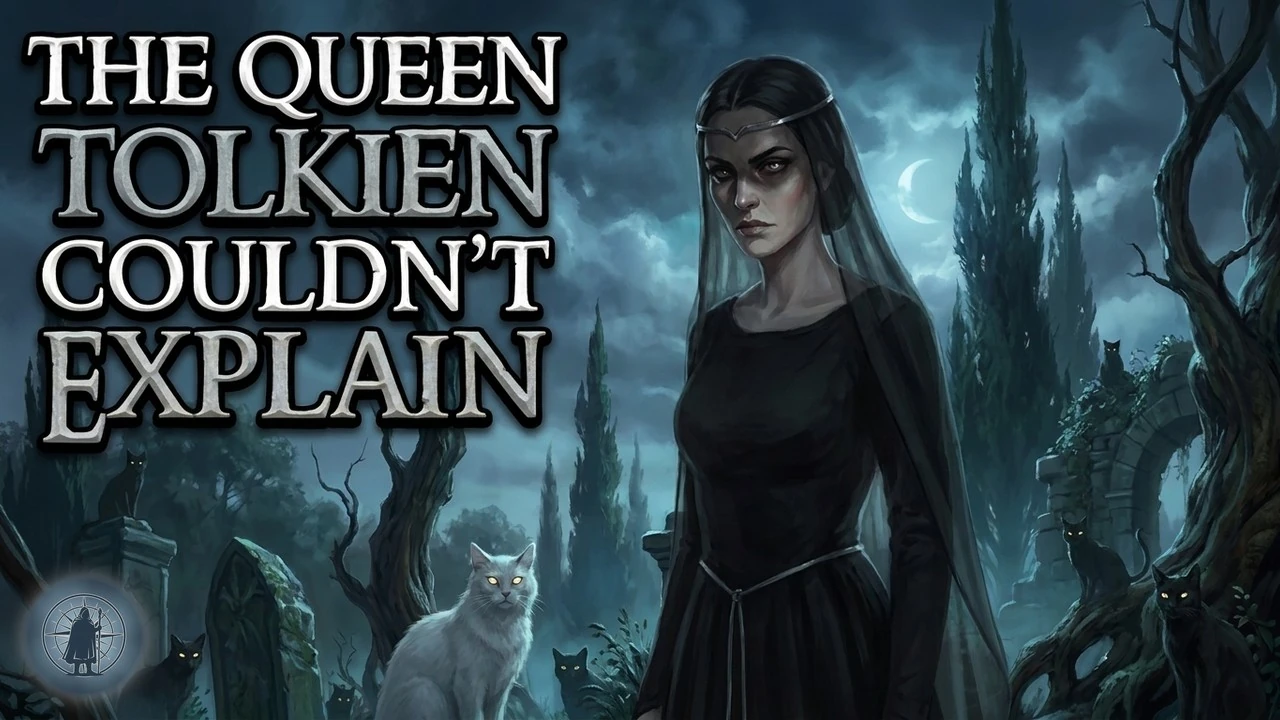 Watch the episode
Queen Beruthiel and Her Cats: A Strange Tolkien Mystery
Watch the episode
Queen Beruthiel and Her Cats: A Strange Tolkien Mystery
Main Narrative: Queen Berúthiel and Her Cats — Tolkien's Strangest Mystery
SECTION: The Throwaway Line in the Dark
Deep beneath the Misty Mountains, in the lightless tunnels of Moria, the Fellowship has come to a fork in the road. Three passages branch into the dark. Gandalf cannot remember which one to take.
And Aragorn, defending him to the others, says something strange.
"He is surer of finding the way home in a blind night than the cats of Queen Berúthiel."
It is a single sentence. It passes in a breath. Frodo hears it, the company hears it, and the story moves on. None of them ask who Queen Berúthiel was. None of them ask what she had to do with cats, or why her cats had become a Gondorian byword for finding one's way in the dark. The line is dropped and forgotten.
But for one reader of The Lord of the Rings, that line could not be forgotten. And that reader was J.R.R. Tolkien himself.
Because Tolkien — the man who claimed to know everything about every name in his book, who had written languages and genealogies and lineages stretching back to the dawn of the world — Tolkien did not know who she was either.
This is the strangest mystery in The Lord of the Rings. Not a riddle inside the story, but a riddle the author left for himself. A name he wrote without meaning to. A queen he could not stop thinking about. And, eventually, a gothic horror tale about cats, surveillance, exile, and the official forgetting of an entire human being — assembled by Tolkien more than a decade after he had first, half-accidentally, summoned her into being.
What follows is the story of Queen Berúthiel — and of the man who spent a decade trying to remember someone he had never invented.
SECTION: The Letter to Auden
In June of 1955 — eight months after The Fellowship of the Ring was published — Tolkien sat down to answer a letter from the poet W. H. Auden.
Auden had been an early and serious reader of The Lord of the Rings. His questions were the kind a scholar asks: what was the inner consistency of this world, what stood behind the names, what sources lay underneath the surface? Tolkien, who loved this kind of correspondence, wrote back at length. He explained, with characteristic precision, that almost every reference in his enormous book sat inside a deeper mythology. Behind every passing name there was a history. Behind every place there was a chronology. The book was the visible tip of an iceberg, and the iceberg, he insisted, was real.
Almost.
In that same letter — Letter 163, dated the seventh of June, 1955 — Tolkien made a confession that scholars have been picking over ever since.
There was, he said, one reference in his book that did not sit inside any deeper reality. One name that pointed to nothing.
"I have yet to discover anything," he wrote, "about the cats of Queen Berúthiel."
The strangeness of that sentence is easy to miss. Not "I haven't worked out yet who she was." Not "I made her up as a piece of texture." But — I have yet to discover. As if the queen and her cats existed somewhere, in some unvisited corner of his world, and he simply hadn't reached them yet. As if her story were a real thing he had not been told.
This was Tolkien's lifelong creative posture. He did not consider himself the inventor of Middle-earth. He considered himself its translator — a scribe who reported what was already there, who occasionally encountered fragments he could not yet make sense of. Berúthiel was the most conspicuous of those fragments. In another letter that same year, to his American publishers, he listed her among only two references in the entire trilogy that did not "actually exist on its own plane of secondary reality." The other was the Blue Wizards. Two gaps in a million-word legendarium.
The drafts confirm how accidental she was. In the manuscripts of the Moria chapter, Aragorn's line went through several false starts. The queen was at first called Tamar. Then Margoliente. The cats were originally "the Cat of Benish Armón" — a singular, still more obscure reference. Berúthiel, with her ten cats, only emerged in the final pass. She was a name Tolkien improvised to fill a rhetorical hole in a single sentence.
And then he could not let her go.
For more than ten years he carried her, unanswered, in the back of his mind. And in 1966, when an interviewer for the magazine New Worlds pressed him about her, something gave way — and he began, at last, to tell her story.
SECTION: The Queen Who Hated the Sea
Her name, in Sindarin, means Angry Queen.
That detail matters more than it first appears. Bereth, queen. Rúth, wrath. -iel, the feminine ending. Berúthiel — the Wrathful, the Furious, the Queen of Anger. But there is a problem with this name, and the problem opens the whole story.
Berúthiel was not Sindarin. By every account Tolkien gave, she was a Black Númenórean — a daughter of those Men of Westernesse who had sided with Sauron in the long agony of the Second Age, who had settled the southern coasts and built their stronghold at Umbar. Black Númenóreans did not speak Sindarin. They spoke Adûnaic, the tongue of fallen Númenor. So her real name — her birth name, the name her mother used — is lost.
What we have is the name Gondor gave her. A name imposed upon her by the people who came to hate her. A Sindarin epithet meaning Angry Queen. We do not even know her by her own word. We know her by the curse her enemies translated her into.
She was probably born around the year 800 of the Third Age, somewhere south of Umbar. In 830 — almost certainly through a diplomatic marriage tied to Gondor's southward naval expansion — she became the wife of Tarannon, twelfth King of Gondor.
Tarannon is a figure most Tolkien readers have never heard of, but his reign mattered. He was the first of what came to be called the Ship-kings — the great maritime expansionists who built navies, claimed coastlines, and pushed Gondor's reach far down the southern shore. He took the regnal name Falastur, which in Sindarin means Lord of the Coasts. And below the river-port of Pelargir, he built himself a new royal house — a palace standing, in Tolkien's phrase, "upon arches whose feet stood deep in the wide waters of Ethir Anduin." A house in the sea. A house of salt and gulls and tide.
Berúthiel refused to live in it.
She hated the sea. She hated the smell of the sea, the sound of the sea, the colour of the sea. She refused Pelargir entirely and remained inland, in the older capital at Osgiliath, in the King's House on the river but not the coast. Notice what that refusal means. Falastur, Lord of the Coasts. His wife, who would not so much as visit a coast. Her aesthetic was an attack — etymologically aimed straight at her husband's title. The King ruled the shore; the Queen ruled in defiance of it.
We have no record of love between them. Unfinished Tales gives us only six pitiless words.
"The nefarious, solitary, and loveless wife of Tarannon."
That is how the chronicles remember her. Nefarious — wicked. Solitary — alone. Loveless — without love given or received. Three adjectives, no marriage at all. And around her, in the silent halls of Osgiliath, ten cats began to gather.
SECTION: Black, Silver, Cypress, Yew
To understand Berúthiel, you have to understand the rooms she lived in.
Tolkien rarely lingers on interior decoration. The chambers of his characters are usually sketched in a phrase or two — a fire on the hearth, a table laid with bread. But in the Unfinished Tales fragment about Berúthiel, he stops and paints. And what he paints is unlike anything else in the published Gondorian record.
"She hated all making, all colours and elaborate adornment," the text reads, "wearing only black and silver and living in bare chambers."
Picture the King's House at Osgiliath in those years. The Stewards have not yet risen; the throne stands occupied. Down corridors of white stone the court of Gondor moves in its accustomed colours — the deep blue and silver of the Sea-kings, the gold of harvest, the warm reds of feast and festival. Tapestries on the walls, songs in the great hall, fountains in the courtyards. And then, in one wing of the palace, a different country.
A chamber stripped of ornament. Walls of bare stone. No tapestry, no carving, no painted beam. A single high window, perhaps. A chair. A queen who wears no colour but black, and at her wrist or her throat a thin line of silver — the only metal she will permit. No gold. No jewel. No hue.
And then her gardens.
This is the detail in the passage that lingers longest. Most royal gardens in Tolkien are places of healing — Imladris in flower, Lothlórien in mallorn-light, the courts of Minas Tirith with the White Tree at their heart. Berúthiel's garden was none of these things.
"The gardens of the house in Osgiliath," Tolkien writes, "were filled with tormented sculptures beneath cypresses and yews."
Cypress and yew. Hold those two words a moment. In every Western tradition Tolkien knew, cypress and yew are graveyard trees. They mark cemeteries. They flank tombs. To plant a private garden with cypress and yew is, deliberately, to plant a graveyard. And to fill that graveyard with tormented sculptures — figures of stone twisted in pain, half-glimpsed beneath the dark foliage — is to make of one's home an open mortuary.
There is no other passage like this in published Tolkien. Tolkien wrote in many registers — heroic, elegiac, comic, pastoral, prophetic — but only here, in a single index footnote in a posthumous volume, does he write in the register of Edgar Allan Poe. The cypress and the yew, the bare chamber, the woman in black and silver, the suffering statuary, the watching cats — none of this belongs to the Middle-earth we know from the great hall of Meduseld or the golden wood of Lothlórien. It is a haunted house in the heart of Gondor. A funereal court inside the King's own walls.
It is also the only sustained passage of Gothic horror Tolkien published in this mode. Some scholars argue that this single fragment is enough to prove that horror was a real, if rare, register in his repertoire. Whatever else Berúthiel is, she is the proof that the man who wrote the Shire could also, when he chose, write the crypt.
SECTION: The Nine and the One
And now, at last, the cats.
In the modern imagination, a witch-queen with ten cats reads as comfortable folklore. The black cat at the hearth, the wise old crone, the familiar curled by the fire. We have a thousand fairy tales of this kind. But Tolkien, who knew exactly how that trope worked, did not write it. He wrote its inversion.
Berúthiel did not love her cats. She loathed them.
"She had nine black cats and one white, her slaves, with whom she conversed, or read their memories, setting them to discover all the dark secrets of Gondor, so that she knew those things that men wish most to keep hidden, setting the white cat to spy upon the black, and tormenting them."
Slaves — not familiars. Tools — not companions. The cats came to her, by Tolkien's own account in the 1966 interview, because she hated them. Cats, he observed in that interview, sometimes follow people who hate them. They jump on the laps of those who flinch. They settle by the feet of those who turn away. And Berúthiel, hated by no one more than herself, found her chambers steadily filling with the very animals she could not bear.
A weaker mind would have suffered this. Berúthiel weaponized it.
The cats became her network. She read them — conversed with them, the text says, read their memories — and she sent them out into the city. They walked the night streets of Osgiliath. They sat on the windowsills of merchants and councillors and priests. They listened. And whatever they saw, whatever they heard, came back to her in the bare chamber under the yews.
This is not a familiar's bond. This is an intelligence apparatus. Berúthiel was not a witch in the folkloric sense; she was something more modern and considerably worse. She was running a surveillance state in miniature, inside her own husband's kingdom, using ten silent watchers no man would dare to touch. "No man in Gondor dared touch them," the text says plainly. "All were afraid of them, and cursed when they saw them pass."
Notice the structure she imposed on the cats themselves. Nine black, and one white. The white one — singular, set apart — was her counter-spy. Its job was to watch the other nine. The watchers were watched. The informants had informants. Internal counter-surveillance, embedded in the network. And on top of all of this, she tormented them. Her cruelty toward them was not incidental. It was operational. The white cat tormented the black ones; she tormented the white. Hierarchies of fear, all the way down.
Pause for a moment on the numerology. Nine black agents, plus one set apart from the nine. In Tolkien's symbolic vocabulary, that arithmetic is unsettlingly familiar. Nine wraiths, plus one ring set apart from theirs. Berúthiel's cats are the Nazgûl in shadow form — not weapons of force terrorising enemies on the open road, but weapons of sight gliding through the streets of an unsuspecting city. The Ringwraiths terrorise; the cats inform. Same number, inverted function.
There is one more layer here, easy to miss. Cats, in Tolkien's wider symbolic system, are almost always coded badly. In The Book of Lost Tales — his earliest legendarium — the original villain of Beren and Lúthien is not Sauron but Tevildo, Prince of Cats: a giant evil cat-fay with an army of cats at his command. Tolkien eventually replaced Tevildo with Sauron, but the cat-coded malice never quite left his work. In a 1959 letter to a publisher, he joked that to him "Siamese cats belong to the fauna of Mordor." The Eye of Sauron has a slit pupil. Berúthiel's cats are not an isolated oddity. They are the Third Age's surviving thread of a much older suspicion — Tolkien's lifelong, slightly cranky conviction that the cat is the spy among the animals.
And yet — and this is what makes Berúthiel's whole apparatus so quietly modern — none of it is magic. It is information. It is the power to know what people are saying when they think no one is listening. Two thousand years before any palantír is set into a tower, this is power-as-observation, power without conquest, exercised by an unaccountable foreign queen against the citizens of the realm she has married into.
She is the first Palantír. She is the first surveillance state. And she is using cats.
SECTION: The Sickle Moon
We do not know what finally undid her.
There is no recorded charge. No trial that has come down to us. No moment in the chronicles when Tarannon, in council, accused his queen of crimes against the realm. The mechanism is left blank. We know only that, at some point in his long reign, the King had had enough.
He did not have her killed.
He did something stranger. He had her placed alone upon a ship, with her cats, and pushed out from shore before a north wind.
Tolkien wrote on Beowulf his entire professional life. He lectured on it for decades. And in Beowulf there is a famous passage — the funeral of Scyld Scefing, the founding king of the Danes, whose body is laid in a treasure-laden ship and pushed out to sea, vanishing forever beyond the horizon. Men cannot say truly, the poet says, who received that load. It is one of the most haunting moments in early English poetry, and Tolkien knew it by heart.
What Tarannon did to Berúthiel was a Scyld Scefing funeral with the corpse alive.
This is the most extraordinary single act in early Gondorian history. Not an execution. Not a banishment to a foreign court. A staged sea-burial of a woman who had not yet died. He gave her the ritual departure of a dead king, while she still drew breath, and trusted the sea to finish the work. It was at once a punishment and an erasure. Her death would not be Gondor's act; it would be the sea's.
The chronicle gives us one more image, and then it ends.
"The ship was last seen flying past Umbar under a sickle moon, with a cat at the masthead and another as a figure-head on the prow."
Hold that picture. A small ship, sails taut, driven by a wind from the north. Ahead of it, the silhouetted towers of Umbar — the Black Númenórean stronghold she had probably been born in. Above, a thin sickle moon. On the masthead, a black cat — alive, watching. At the prow, where a carved figurehead would normally be, another cat — but is it carved, or is it living? Tolkien never says. The ambiguity is itself the horror.
And then nothing. The ship passes Umbar. The chronicle stops. No landfall. No wreck. No grave. Tolkien deliberately refuses closure, exactly as the Beowulf poet refuses closure for Scyld. We do not get to know what happened to her. The story sails out of recorded history under that thin moon and is not heard from again.
This is the inverse of an image we know well. At the end of The Lord of the Rings, a white ship sails west out of the Grey Havens, carrying Frodo into grace and healing. Same picture — a single ship, a single passenger, a horizon. But Berúthiel's ship sails south, not west. Toward Umbar, not Aman. Under a sickle moon, not the Evening Star. With cats on the masts, not Elves on the deck. The white ship of the West is grace. The black ship of the South is curse. Tolkien wrote both, and meant the one to remember the other.
Tarannon outlived her. He reigned, alone, for the rest of his long life, and in T.A. 913 he died — childless. The first King of Gondor in the line of Anárion to die without an heir of his body. The throne passed to his nephew Eärnil, who twenty years later would conquer Umbar itself — the very stronghold past which Berúthiel's ship had vanished. The dynasty corrected itself by force where the marriage had failed.
But the King's House at Osgiliath stayed dark. And in the Book of the Kings, the scribes turned to a particular page.
SECTION: The Memory of Men
The scribe takes a small knife. He bends over the vellum. He scrapes the queen's name out of the parchment, letter by letter, until only a faint roughness remains where ink had been. Then he closes the book.
This is the act Tolkien names, with quiet precision, in the Unfinished Tales fragment.
"Her name was erased from the Book of the Kings."
There is a Latin term for this practice — damnatio memoriae, the damnation of memory. The Roman Senate used it to punish disgraced emperors and traitorous officials after their deaths. Their names were chiselled from monuments. Their faces were hammered off coins. Their portraits were painted out of frescoes. The state's verdict was not merely that they had failed; it was that they had never been. To suffer damnatio memoriae was, officially, to be unmade.
Tolkien was a classicist by training. He knew exactly what he was invoking. And in Berúthiel, he gave us the only confirmed instance of damnatio memoriae in the chronicles of Gondor.
But here is the moment that lifts this whole story out of antiquarian curiosity and turns it into something quietly radical. In the very next breath, after recording the erasure, Tolkien adds — almost in passing — the line that is the thesis of the entire episode.
"But the memory of men is not wholly shut in books, and the cats of Queen Berúthiel never passed wholly out of men's speech."
That is historiography, written in a single sentence. Tolkien is making a claim about how the past actually survives. The official record can be scraped clean. The institutional memory of a kingdom can be edited. The state's chronicle can pretend a person never lived. But there is another kind of memory underneath the chronicle — folk memory, common speech, the things grandmothers tell grandchildren in the long northern evenings — and that memory is not under the state's control. It cannot be scraped from a parchment. It cannot be hammered off a coin. It survives in the way people speak.
Tolkien actually performs the erasure on the page. Open Appendix A of The Return of the King and read the entry on Tarannon Falastur. He is named. His regnal title is given. His maritime expansion is summarised. His childlessness is recorded. And of his queen — nothing. Not a word. The official record of Gondor, as Tolkien published it in the appendices, contains no mention of Berúthiel anywhere. The damnatio memoriae succeeded. On the books, she does not exist.
Then turn back to The Fellowship of the Ring, Book Two, Chapter Four. A man and his companions are lost in the dark beneath a mountain. The wizard who leads them cannot remember the way. And the man, defending his friend, says — without thinking about it, the way you mention any old proverb — that the wizard is surer of his bearings than the cats of Queen Berúthiel.
Two thousand and one hundred years after a scribe scraped her name from a vellum page in Osgiliath, a Ranger of the North repeats her name in casual conversation in a tunnel under the Misty Mountains. The Book of the Kings forgot her. The people did not. The cats of Queen Berúthiel had become a proverb — a thing you say when you mean very lost — and proverbs are how cultures remember the things their kings tried to make them forget.
That is the story. That is the whole shape of it.
A Black Númenórean queen, given a name she did not own, in a court she despised, surrounded by cats she hated, ruling a private surveillance state from a chamber the colour of mourning. A King who could not bear her, and who buried her at sea while she still lived. A scribe in Osgiliath, scraping her name out of a chronicle. And then, twenty-one centuries later, a man in a tunnel saying the name out loud, because the people of Gondor had simply gone on saying it, because the memory of men is not wholly shut in books.
And behind all of it — quieter than any of it — a writer in Oxford, in 1955, sitting at his desk with a letter from W. H. Auden, admitting that he had no idea who she was, and then taking the next ten years to find out.