
Research & Sources
Queen Beruthiel and Her Cats
A Strange Tolkien Mystery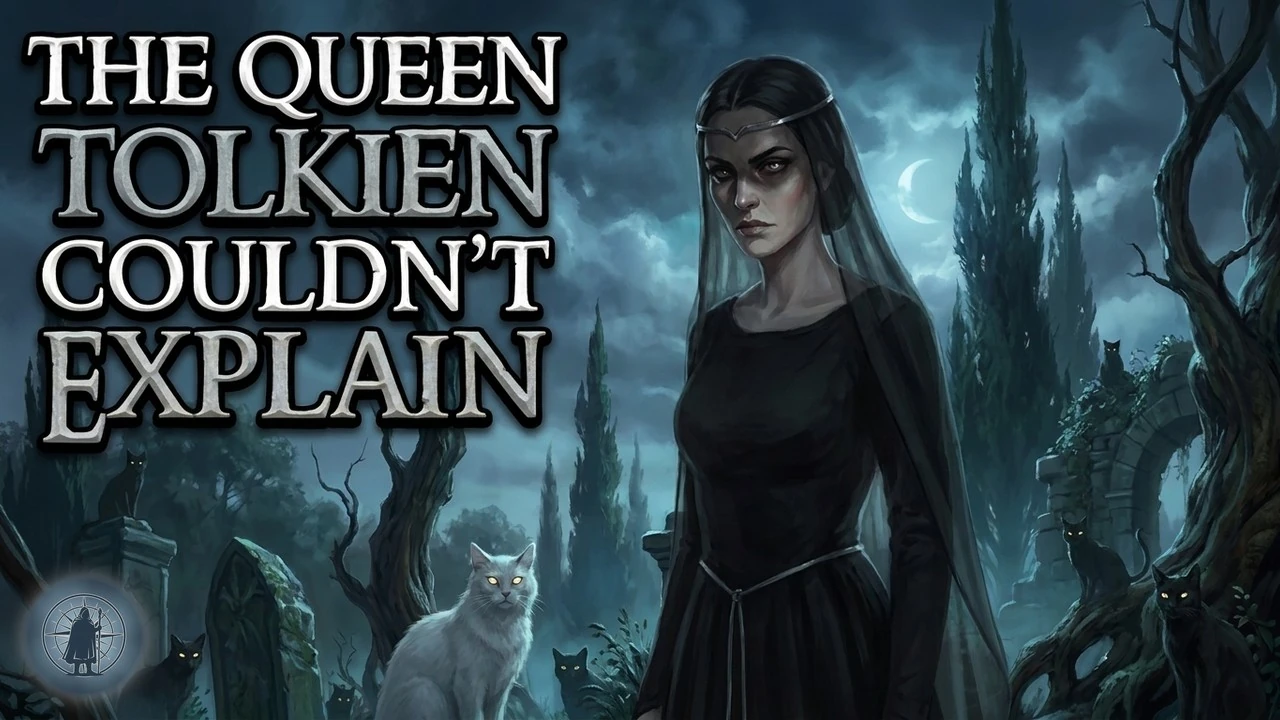 Watch the episode
Queen Beruthiel and Her Cats: A Strange Tolkien Mystery
Watch the episode
Queen Beruthiel and Her Cats: A Strange Tolkien Mystery
Research Notes: Queen Berúthiel and Her Cats — Tolkien's Strangest Mystery
Overview
Queen Berúthiel is the most famous "throwaway line" in The Lord of the Rings — a single offhand remark by Aragorn in Moria ("surer of finding the way home in a blind night than the cats of Queen Berúthiel") that, even to Tolkien himself, had no story behind it when he wrote it. She is unique in the entire legendarium: Tolkien openly admitted to W. H. Auden in 1955 that he had "yet to discover anything about the cats of Queen Berúthiel," and called her one of only two references in The Lord of the Rings (along with the names of the Blue Wizards) that did not "actually exist on its own plane of secondary or sub-creational reality." She was a hole in his own mythology.
Over a decade later, prompted by an interviewer in 1966, Tolkien finally produced an outline. The result — preserved by Christopher Tolkien in the index/footnote material of Unfinished Tales — is one of the strangest, most gothic vignettes in all of Middle-earth: a Black Númenórean queen of Gondor who hated the sea, hated colour, hated cats, and yet kept ten of them as spies; whose name was struck from the official Book of the Kings; and whose ship was last seen flying past Umbar under a sickle moon, with a cat at the masthead and another as a figurehead on the prow.
She is significant for three intersecting reasons: (1) she is the textual case study of Tolkien's "I report what is" worldbuilding philosophy, (2) she is the closest thing Tolkien wrote to a Gothic horror tale set in Gondor, and (3) she is the only confirmed instance in canon of damnatio memoriae — official historical erasure — within Gondorian historiography.
Primary Sources
The Lord of the Rings
The only mention of Berúthiel in the published Lord of the Rings is a single sentence by Aragorn in Moria, defending Gandalf's sense of direction:
"He is surer of finding the way home in a blind night than the cats of Queen Berúthiel."
— The Fellowship of the Ring, Book II, Chapter 4 ("A Journey in the Dark")
In Appendix A ("Annals of the Kings and Rulers"), the corresponding entry on Tarannon — her husband — is conspicuously bare. It records only that with Tarannon "the twelfth King, began the line of the Ship-kings, who built navies and extended the sway of Gondor along the coasts west and south of the Mouths of Anduin," that he took the regnal title Falastur ("Lord of the Coasts"), and — pointedly — that he died childless in T.A. 913 and was succeeded by his nephew Eärnil I. The Appendix says nothing of a queen at all. Berúthiel is not named anywhere in the published text of LOTR or its appendices. Her absence from Appendix A is itself the textual evidence of her erasure.
Unfinished Tales
The fuller account is preserved by Christopher Tolkien in Unfinished Tales of Númenor and Middle-earth (1980), in the Index entry/footnote attached to "The Istari" section (commonly cited as p. 401, footnote 7 of the standard edition). It is not a finished narrative; it is Christopher's reconstruction from a single very rough manuscript, parts of which he describes as "almost wholly illegible." The legible portion gives this canonical account:
Berúthiel was the wife of Tarannon Falastur, twelfth King of Gondor and first of the Ship-kings (T.A. 830–913). She is described as:
"the nefarious, solitary, and loveless wife of Tarannon."
— Unfinished Tales, Index entry on Berúthiel
She lived in the King's House in Osgiliath, hating the sounds and smells of the sea — and, by extension, the great house Tarannon had built below Pelargir "upon arches whose feet stood deep in the wide waters of Ethir Anduin." Her aesthetic is one of austere, hostile negation:
"She hated all making, all colours and elaborate adornment, wearing only black and silver and living in bare chambers, and the gardens of the house in Osgiliath were filled with tormented sculptures beneath cypresses and yews."
— Unfinished Tales, Index entry on Berúthiel
The cats are the heart of the legend:
"She had nine black cats and one white, her slaves, with whom she conversed, or read their memories, setting them to discover all the dark secrets of Gondor, so that she knew those things 'that men wish most to keep hidden,' setting the white cat to spy upon the black, and tormenting them. No man in Gondor dared touch them; all were afraid of them, and cursed when they saw them pass."
— Unfinished Tales, Index entry on Berúthiel
Her end:
"Tarannon had her set on a ship alone with her cats and set adrift on the sea before a north wind. The ship was last seen flying past Umbar under a sickle moon, with a cat at the masthead and another as a figure-head on the prow."
— Unfinished Tales, Index entry on Berúthiel
And the crucial historiographical note:
"Her name was erased from the Book of the Kings ('but the memory of men is not wholly shut in books, and the cats of Queen Berúthiel never passed wholly out of men's speech')."
— Unfinished Tales, Index entry on Berúthiel
Christopher Tolkien explicitly flags the textual fragility of all this in his editorial framing: the underlying manuscript that survives is incomplete and largely unreadable; what we have is essentially a sketch he salvaged.
The History of Middle-earth
The Berúthiel reference receives some attention in HoME's drafts of the Moria chapter (in The Treason of Isengard, vol. VI/VII material on the Mines of Moria). Earlier drafts of Aragorn's line show Tolkien casting about for a name: "Queen Tamar" and "Margoliente" appear before he settled on "Berúthiel." Earlier wordings of the comparison itself include "that to any Cat that ever existed" and "the Cat of Benish Armón" before he arrived at the published phrasing. This is direct evidence that the name was invented on the fly with no story attached — exactly as Tolkien later admitted.
The Letters of J.R.R. Tolkien
- Letter 144 (to Naomi Mitchison, 25 April 1954): the substantive letter discussing his worldbuilding, languages, etc. Often cited in Berúthiel scholarship as the broader context for his "I report rather than invent" stance. - Letter 163 (to W. H. Auden, 7 June 1955): Tolkien's most famous direct statement on Berúthiel. He says, in effect, that nearly every reference in LOTR connects to a deeper legendarium he has worked out — with the explicit exception of "the cats of Queen Berúthiel." He writes: "I have yet to discover anything about the cats of Queen Berúthiel." - Letter 165 (autumn 1955, to the Houghton Mifflin Co.): Reiterates that virtually everything in The Lord of the Rings sits inside an internally consistent secondary world — "except only the cats of Queen Beruthiel." - Letters to Lord Halsbury (10 November 1955) and to a Mr. Thompson (14 January 1956) also reference his ongoing puzzlement about her. - Letter 219 (to Allen & Unwin, 14 October 1959), regarding a Siamese-cat breeder asking to use Tolkien names: "I fear that to me Siamese cats belong to the fauna of Mordor, but you need not tell the cat breeder that." Establishes Tolkien's general distaste for cats — directly relevant to the moral coding of Berúthiel's animals.
The 1966 Daphne Castell Interview (New Worlds magazine)
Tolkien's most expansive surviving statement on Berúthiel is from this interview. He says he "really doesn't know anything of her" — "she just popped up, and obviously called for attention, but I don't really know anything certain about her." But pressed, he produces the substance that Christopher would later anchor in Unfinished Tales: that she was likely a Black Númenórean, that she was "one of these people who loathe cats, but cats will jump on them and follow them about — you know how sometimes they pursue people who hate them," that she "took to torturing them for amusement," used them as spies, and was eventually put on a ship and set adrift. Scholars Hammond & Scull (in their Reader's Companion) treat the Unfinished Tales outline as essentially a literary record of this 1966 conversation, written down by Tolkien shortly afterward.
Key Facts & Timeline
- c. T.A. 800: Berúthiel born, probably in a Black Númenórean settlement south of Umbar (per the Unfinished Tales outline; her exact origin is given as "probably"). - T.A. 830: Tarannon Falastur succeeds his father Siriondil as the twelfth King of Gondor. He is the first of the Ship-kings and assumes the regnal name Falastur ("Lord of the Coasts"). - Probably c. T.A. 830–840: Tarannon and Berúthiel marry — possibly a diplomatic match tied to Tarannon's southward naval expansion. (No wars with Umbar or Harad are recorded during his reign, which scholars take as circumstantial evidence the marriage worked diplomatically.) - Reign of Tarannon (T.A. 830–913): Berúthiel resides not at the new royal seat at Pelargir but in the King's House in Osgiliath; trains her ten cats; spreads fear through Gondor. - Date unknown, within Tarannon's reign: Tarannon exiles her. She is set adrift alone with the cats on a ship before a north wind. Last seen passing Umbar under a sickle moon. Her name is struck from the Book of the Kings. - T.A. 913: Tarannon dies childless. He is succeeded by his nephew Eärnil I (son of his brother Tarciryan) — making Tarannon the first King of Gondor to require an external heir, and a structural break in the bloodline of Anárion. - T.A. 933: Eärnil I conquers Umbar from the Black Númenóreans — the same political milieu Berúthiel almost certainly came from. - T.A. 3019 (~2,100 years after her exile): Aragorn, in Moria, casually invokes "the cats of Queen Berúthiel." The line confirms that her erasure from official record never erased her from popular memory.
Significant Characters
- Berúthiel: Queen of Gondor; Black Númenórean; "nefarious, solitary, and loveless"; mistress of the ten cats. Functionally, a Gothic queen — the closest figure Tolkien wrote to a malevolent witch-queen residing inside Gondor itself rather than beyond its borders. - Tarannon Falastur (T.A. 830–913): Twelfth King of Gondor. First of the Ship-kings. The maritime expansionist whose realm she despises. Builds a palace on arches over the Anduin at Pelargir; she refuses to live in it. Childless, the bloodline breaks under him. - Eärnil I: Tarannon's nephew, son of Tarciryan; succeeds in T.A. 913. Conquers Umbar in T.A. 933. The "correction" of the dynasty after Berúthiel. - The Cats (ten — nine black, one white): Functionally agents of espionage; objects of supernatural communication ("conversed with, or read their memories"); also victims (the white one is set against the black ones; she "torments them"). They are slaves and tools, not familiars in the Western witchcraft sense.
Geographic Locations
- Osgiliath: Then capital of Gondor and royal residence. Berúthiel's chosen base — because it is inland and away from the sea. Her stark chambers and the cypress-and-yew gardens with "tormented sculptures" are her counter-aesthetic to maritime Gondor. - Pelargir: The new river-port favoured by Tarannon. He builds a house there "upon arches whose feet stood deep in the wide waters of Ethir Anduin." Berúthiel refuses to live there. Pelargir's identity is bound up with the Ship-kings; her rejection of Pelargir is a rejection of her husband's whole reign. - Mouths of Anduin (Ethir Anduin): The maritime threshold of Gondor. The water she hates. - Umbar: Her likely point of origin; the Black Númenórean stronghold. Crucially, the place her ghost-ship is last seen passing — sailing back, in some sense, toward home, before vanishing. - The Sea south of Umbar: A trackless legendary space. Tolkien specifically does not say she dies; the ship simply vanishes "under a sickle moon."
Themes & Symbolism
- Surveillance and the inversion of trust: The cats are not weapons of force; they are instruments of sight. They invert the political contract. In a healthy realm, the king sees his people through stewards and law; here, an unaccountable foreign queen sees them through animals at night. Scholarship (laurelindorenan, blueprintexplorations) reads this as a folk-tale precursor to the Palantíri — power as observation without reciprocity. - Damnatio memoriae: Tolkien's most direct treatment of official historical erasure. The Book of the Kings strikes her name; popular memory does not. The thematic statement is explicit: "the memory of men is not wholly shut in books." This is a quietly radical point about historiography — Tolkien dramatising the gap between official record and folk memory. - Anti-fecundity / sterile authority: She is "loveless," "childless," and surrounded by "tormented sculptures" — a queen who produces nothing. Her marriage breaks the bloodline of Anárion. The aesthetic of negation (no colour, no adornment, bare chambers) extends into a political negation: she generates no heirs, no traditions, no warmth. - Gothic / horror register: Cypress and yew (graveyard trees), tormented sculpture, black-and-silver dress, mute slave-cats moving through Osgiliath at night, a ghost-ship under a sickle moon with cats at mast and prow — this is the only sustained Gothic passage in published Tolkien (theonering.net frames this episode as evidence that "Tolkien wrote horror stories"). It reads more like Poe or Hawthorne than like the rest of the Gondorian annals. - The foreigner inside: Berúthiel is the inverse of Aragorn. Aragorn is a Northern outsider who legitimately becomes king of Gondor; Berúthiel is a Southern outsider who illegitimately becomes queen and corrupts from within. Both stories require Black Númenórean Umbar as a foil. In the long arc of Gondor, she is the first proof that the southern coastline is also a moral threat, not just a political one. - Cats as moral signifiers in Tolkien: From Tevildo, Prince of Cats (the proto-Sauron of The Book of Lost Tales), through Sauron's cat-pupil Eye, through Letter 219's joke about Siamese cats as the "fauna of Mordor," cats in Tolkien's symbolic system are coded as duplicitous, surveillance-minded, and morally suspect. Berúthiel is the Third Age's representative of that long, slightly cranky thread.
Scholarly Interpretations & Theories
- Tolkien's "sub-creational discovery" philosophy: The Berúthiel case is the locus classicus in Tolkien studies for his stated method of "reporting what really happened" rather than inventing. He confessed to Auden that he didn't know what her cats were, but he treated this not as a free invention opportunity but as a gap to be filled by patient discovery. The fact that he eventually produced the canonical account in 1966 — a decade after the LOTR mention — is taken as evidence that he genuinely believed his world had answers waiting to be found. (Hammond & Scull, Reader's Companion; Clarendon House analysis.) - Damnatio memoriae parallel: The structure exactly matches Roman damnatio memoriae — the Senate's formal striking of a disgraced figure's name from monuments and records. Tolkien (a Latin-trained philologist) almost certainly had this in mind. The line "the memory of men is not wholly shut in books" is virtually a thesis sentence on the limits of state-sanctioned forgetting. (laurelindorenan.com.) - Berúthiel as political typology rather than personal projection (blueprintexplorations.substack): unlike C.S. Lewis's White Witch (rooted in personal psychology), Tolkien's witch-queen is a political figure — her evil is institutional surveillance, not personal sorcery. She is a parable about authority that watches, records, and disciplines while refusing to generate heirs or shared culture. - Gothic-horror register (theonering.net, "Yes, Tolkien Wrote Horror Stories"): the Berúthiel passage is read as one of the strongest cases that horror was a real, if rare, mode in Tolkien's repertoire — citing the cypress/yew gardens, the tormented sculptures, and the ghost-ship image as straight Gothic. - Folkloric reading of the cats: nine black + one white reads as a deliberate folktale numerology (the odd one out, the betrayer-figure spying on the nine). The cats mirror the Nazgûl in number and function inverted: nine wraiths to terrify enemies; nine cats + one to spy on enemies. - Symbolic precursor to the Palantíri: control through long-distance sight, exercised by an unaccountable elite, anticipating the corruptibility of the seeing-stones in Denethor and Saruman.
Contradictions & Different Versions
- Tolkien's own published vs. private framing. Publicly (Letter 163, Letter 165) he insisted in 1955 that the cats had no story; privately, by 1966, he had produced an elaborate one. Whether the 1966 account is "real" canon or post-hoc rationalisation is itself a debated point — Tolkien always treated his own discoveries as canonical, but the Unfinished Tales outline never received a finished narrative form. - The illegible manuscript. Christopher Tolkien explicitly notes that the unique surviving manuscript on Berúthiel is partly illegible. The connection between Tarannon's childlessness and the cats — i.e., the causal link the whole story implies — survives only as Christopher's editorial inference, not as Tolkien's written text. We do not, strictly, have Tolkien's own statement that the marriage's failure was caused by Berúthiel; we have Christopher's note that the two were "associated" in the manuscript. - Cats and Berúthiel: she hated them, or she loved them? The 1966 interview and the Unfinished Tales outline say she loathed cats, and they came to her because she loathed them. Earlier readings (and many fan summaries) treat her as a witchy cat-mistress with a familiar-bond. Tolkien's actual position is the inverse and more horrible: she is harassed by an animal she hates, and turns the harassment into a tool of state surveillance and personal cruelty. - Drafts of the Moria line: "Queen Tamar" → "Margoliente" → "Berúthiel"; "the Cat of Benish Armón" → "any Cat that ever existed" → "the cats of Queen Berúthiel." The name and number of the cats were unstable in drafting — direct manuscript evidence that the canonical specifics were not in Tolkien's mind in 1939. - Date of her exile: never specified. We know only that it occurred during Tarannon's reign (T.A. 830–913) and that it left him without an heir. Her birth year (~T.A. 800) is itself a back-projected estimate. - Where she went: never resolved. The ship "flying past Umbar" is the last image. Whether the ship landed, sank, or sailed off the edge of the map is left open. This is Tolkien deliberately invoking the older legendary register — like the ship-burial of Scyld Scefing in Beowulf (one of his lifelong literary touchstones), which he almost certainly had in mind.
Cultural & Linguistic Context
- Etymology of Berúthiel (Sindarin): commonly glossed as "Angry Queen" — from bereth ("queen, spouse"; root sense "supreme, sublime") + rúth ("wrath, anger") + -iel (feminine suffix, "daughter of"). Paul Strack (Eldamo) lists this as the most plausible reading though Tolkien never glossed it himself. - Crucial implication: Black Númenóreans did not use Sindarin. So "Berúthiel" is almost certainly not her birth name — it is the Gondorian name for her, a hostile epithet given by the people who hated her. Her actual Adûnaic or Black Númenórean name is lost. The name we know her by is itself an act of foreign imposition, mirroring her own foreignness in Gondor. - Falastur (Sindarin): "Lord of the Coasts," from falas ("coast, shore") + -tur ("lord, master"). Tarannon's regnal name; her aesthetic counter-claim (anti-sea, anti-coast) is etymologically aimed straight at her husband's title. - Real-world parallels: - Scyld Scefing's ship-burial in Beowulf (a poem Tolkien lectured on his entire career) — a ruler set adrift, vanishing into legend, "men cannot say truly … who received that load." The parallel is exact. Berúthiel's exile is Scyld Scefing inverted: a banishment costumed as a funeral. - Roman damnatio memoriae — formal erasure of disgraced figures from public records and inscriptions. Tolkien, a classicist, would have known the practice intimately. - Folkloric witch-queens with animal familiars — but Tolkien's twist (she hates the cats) inverts the trope. - Tevildo, Prince of Cats (Book of Lost Tales I, "The Tale of Tinúviel"): the original villain of Beren and Lúthien's story — a giant evil cat-fay, lord of an army of cats, eventually replaced in the legendarium by Thû/Sauron. Berúthiel is the only major surviving inheritance of Tolkien's early "evil cat" stratum.
Questions & Mysteries
- Why did Tolkien insert a meaningless name in Moria at all? His admission to Auden suggests it was instinctive worldbuilding texture — the kind of detail a fictional culture would casually mention. The mystery is that he then took it seriously enough to spend a decade not knowing the answer. - What were the cats actually? "Slaves," "spies," capable of being conversed with and read. Are they ordinary cats whose memories an evil mind can scry? Or are they touched by something darker — Tevildo-blood, a Black Númenórean working of Sauron-derived lore? Tolkien never clarifies. The horror works because it is unspecified. - Did the ship sink? Tolkien refuses closure. Comparable to Frodo sailing west — the narrative deliberately loses sight of the figure rather than narrating their fate. - What did Tarannon actually charge her with? No explicit "trial" or charge is recorded. The spying and torture seem to be implicit grounds, but the political mechanism by which a king of Gondor exiled and erased his own queen is left blank. (Compare: Denethor as Steward cannot do this to Faramir — Berúthiel's case implies a near-absolute royal authority in early Gondor.) - What did her erasure mean institutionally? "The Book of the Kings" is mentioned only here in this context. Was it a single physical chronicle in Osgiliath? Did the librarians physically scrape parchment? Tolkien gives us a single line and leaves the institution silent. - Is there any connection between Berúthiel's cats and the later fauna of Mordor / Sauron's Eye iconography? Tolkien himself joked that Siamese cats "belong to the fauna of Mordor" (Letter 219). The throughline from Tevildo → Berúthiel's cats → Sauron's Eye is not explicit in canon but is striking.
Compelling Quotes for Narration
1. "He is surer of finding the way home in a blind night than the cats of Queen Berúthiel." — Aragorn, The Fellowship of the Ring, Bk II, Ch 4 ("A Journey in the Dark") 2. "The nefarious, solitary, and loveless wife of Tarannon." — Unfinished Tales, Index entry on Berúthiel 3. "She hated all making, all colours and elaborate adornment, wearing only black and silver and living in bare chambers, and the gardens of the house in Osgiliath were filled with tormented sculptures beneath cypresses and yews." — Unfinished Tales 4. "She had nine black cats and one white, her slaves, with whom she conversed, or read their memories, setting them to discover all the dark secrets of Gondor." — Unfinished Tales 5. "No man in Gondor dared touch them; all were afraid of them, and cursed when they saw them pass." — Unfinished Tales 6. "The ship was last seen flying past Umbar under a sickle moon, with a cat at the masthead and another as a figure-head on the prow." — Unfinished Tales 7. "Her name was erased from the Book of the Kings, but the memory of men is not wholly shut in books, and the cats of Queen Berúthiel never passed wholly out of men's speech." — Unfinished Tales 8. "I have yet to discover anything about the cats of Queen Berúthiel." — Tolkien to W. H. Auden, Letter 163, 7 June 1955 9. "She just popped up, and obviously called for attention, but I don't really know anything certain about her." — Tolkien, Daphne Castell interview, 1966 10. "I fear that to me Siamese cats belong to the fauna of Mordor." — Tolkien, Letter 219, 14 October 1959
Visual Elements to Highlight
1. The bare black-and-silver chamber in the King's House at Osgiliath — austere, deliberately unbeautiful, candlelit. 2. The cypress-and-yew garden of "tormented sculptures" — gothic stone figures twisted in pain, half-glimpsed through dark foliage. 3. Tarannon's arched palace at Pelargir, standing in the river — light, salt, gulls — explicitly the world she rejects. 4. Nine black cats moving silently through the streets of night-time Osgiliath; Gondorians flinching aside, making warding signs. 5. The white cat alone, watching the others — the betrayer set against the group. 6. The throne room at Osgiliath: Tarannon and his queen, her cats coiled at her feet, Tarannon turned toward the south windows and the sea he can no longer reach in her presence. 7. The signature image: a single ship driven before a north wind, sails taut, a black cat at the masthead and another carved (or alive?) at the prow, passing the silhouetted towers of Umbar under a thin sickle moon. 8. A scribe at a desk in Osgiliath, scraping a name from a vellum page — damnatio memoriae in a single quiet gesture. 9. Aragorn in Moria, two thousand years later, casually speaking the name in the dark — visual punchline: she was erased, but the cats outlived the empire.
Discrete Analytical Themes
Theme 1: The Author Who Didn't Know
Core idea: Berúthiel is Tolkien's most public confession that his own legendarium contained a hole he could not fill — and how that hole became the case study of his entire creative method. Evidence: - "I have yet to discover anything about the cats of Queen Berúthiel." (Letter 163, to W. H. Auden, 7 June 1955) - In Letter 165 (1955), he listed her as one of only two references in LOTR (with the Blue Wizards) that did not exist on its own plane of secondary reality. - Manuscript drafts in HoME show the name itself was unstable: "Tamar" → "Margoliente" → "Berúthiel"; "the Cat of Benish Armón" → final form. - A decade later, in the 1966 Daphne Castell interview, he produces an outline anyway — "she just popped up, and obviously called for attention." Distinction: This theme is about TOLKIEN'S CREATIVE METHOD and the specific paradox of an author admitting he doesn't know his own creation. Not about Berúthiel's character or political role.Theme 2: The Gothic Queen of Gondor
Core idea: Berúthiel is the only sustained Gothic-horror set-piece in Tolkien's published Gondorian material — a deliberate aesthetic of negation, decay, and dread. Evidence: - "Wearing only black and silver and living in bare chambers" (Unfinished Tales). - Gardens of "tormented sculptures beneath cypresses and yews" — graveyard trees, suffering statuary. - "All were afraid of them, and cursed when they saw them pass." - The ghost-ship image: cat at the masthead, cat at the prow, sickle moon. Distinction: This is about the LITERARY REGISTER — the only time Tolkien writes Gothic. Distinct from the political-surveillance theme (different kind of analysis, different evidence).Theme 3: Surveillance State in Miniature
Core idea: The cats are not a witch's familiars; they are an early-modern intelligence apparatus, exercising power through invisible observation rather than force. Evidence: - "Nine black cats and one white, her slaves, with whom she conversed, or read their memories, setting them to discover all the dark secrets of Gondor." - "Setting the white cat to spy upon the black, and tormenting them" — internal counter-surveillance, the spies spying on the spies. - "No man in Gondor dared touch them" — fear self-enforcing without formal sanction. - Scholarly reading (laurelindorenan, blueprintexplorations): a folkloric precursor to the Palantíri; "control without conquest." Distinction: This is about the POLITICAL MECHANISM — what kind of power she actually exercised. Distinct from her aesthetics (Theme 2) and her foreignness (Theme 5).Theme 4: The Erasure That Failed
Core idea: Tolkien stages an explicit case of damnatio memoriae — official forgetting — and uses it to argue, quietly, that institutional memory cannot fully erase popular memory. Evidence: - "Her name was erased from the Book of the Kings." - "But the memory of men is not wholly shut in books, and the cats of Queen Berúthiel never passed wholly out of men's speech." - Berúthiel is not named in Appendix A's entry on Tarannon — Tolkien actually executed the erasure on the page. - Aragorn casually invokes her cats ~2,100 years later in T.A. 3019: the proof that the suppression failed. - Roman parallel: damnatio memoriae, formal Senate-level erasure. Distinction: This is about HISTORIOGRAPHY — the gap between official record and folk memory, dramatised. Distinct from her crimes (Theme 3) and her exile (Theme 6).Theme 5: The Foreigner Inside
Core idea: Berúthiel is the first canonical example of Black Númenórean / Umbar influence corrupting Gondor not through war but through marriage — and the structural inverse of Aragorn's later legitimating outsider-marriage to Arwen. Evidence: - Black Númenórean origin, "probably from an inland city south of Umbar" (Unfinished Tales). - Likely diplomatic marriage tied to Tarannon's southward naval expansion (no wars with Umbar/Harad recorded during his reign — circumstantial evidence of an alliance). - Her ship is last seen "flying past Umbar" — sailing back, in some sense, to her origin. - T.A. 933: her great-nephew-in-law Eärnil I conquers Umbar — the political "correction" of her marriage. - The name "Berúthiel" is Sindarin, not Adûnaic — almost certainly a hostile epithet imposed by Gondorians; her true name is lost. Distinction: This is about IDENTITY AND ORIGIN — who she was before Gondor. Distinct from what she did inside Gondor (Theme 3) and from how she was erased afterward (Theme 4).Theme 6: The Vanishing Ship
Core idea: Tarannon does not execute her — he stages a banishment as a funeral, a literary motif Tolkien drew from Beowulf's Scyld Scefing, and refuses any closure on what happened next. Evidence: - "Set on a ship alone with her cats and set adrift on the sea before a north wind." - "Last seen flying past Umbar under a sickle moon, with a cat at the masthead and another as a figure-head on the prow." - No death is recorded. No grave. No certainty. - Beowulf parallel — Scyld Scefing's ship-burial: "men cannot say truly … who received that load." Tolkien lectured on Beowulf his entire career. - Inversion of Frodo's sailing west: same image, opposite moral charge — the white ship of grace becomes a black ship of curse. Distinction: This is about HER ENDING and its literary precedent. Distinct from her crimes (3) and her erasure from records (4) — those are about what was done to her name; this is about what was done to her body.Theme 7: Cats as Tolkien's Moral Litmus
Core idea: Cats consistently appear in Tolkien as figures of duplicity, surveillance, and evil — from Tevildo through Berúthiel through Sauron's Eye — making her cats a node in a much older Tolkienian symbolic system, not an isolated oddity. Evidence: - Tevildo, Prince of Cats — proto-Sauron in Book of Lost Tales, the original villain of Beren and Lúthien before being replaced by Thû/Sauron. - Letter 219: "Siamese cats belong to the fauna of Mordor." - Berúthiel: she hates cats, and they come to her precisely because she hates them — a darker inversion of the witch's familiar trope. - The Eye of Sauron's slit pupil — cat-like. - The cat-versus-dog motif: Tevildo (cat) vs. Huan (Hound of Valinor); Berúthiel's cats vs. (no canonical hound, but the contrast is implicit in the moral landscape). Distinction: This is the META-THEME tying Berúthiel's cats to Tolkien's broader symbolic vocabulary. Distinct from her political surveillance (Theme 3, which is about what the cats do) — this is about what cats mean to Tolkien.Sources Consulted
(See sources.md for the full annotated list with URLs.)
Additional Notes
- Pacing for the script: the strongest narrative spine is the frame story of Tolkien himself discovering the character. Open in Moria with Aragorn's line; cut to Tolkien at his desk in 1955, writing to Auden, "I have yet to discover anything about the cats of Queen Berúthiel"; then drop into the legend itself; close on the ghost-ship and the surviving folk memory. This frame is unusually well-evidenced for a Tolkien topic — we have his own letters openly admitting the gap. - Tone: this is one of the few episodes where Gothic horror is the right register, not heroic high-fantasy. Lean into cypress-and-yew, into the sickle moon, into the silence of Osgiliath at night. - Hook delivery: the "queen so wicked Gondor erased her from history" hook is canonically supported — the Unfinished Tales line about the Book of the Kings is the literal source. - Low-competition advantage: most Berúthiel coverage online is short summary content. Almost nobody has done the Tolkien-letters frame story or the damnatio memoriae / Scyld Scefing literary parallels in a single piece. That is the differentiated angle. - Cards/cross-link candidates: any episode on Black Númenóreans, Umbar, Pelargir, the Ship-kings, Tevildo / Book of Lost Tales, or Tolkien's letters to Auden.
Sources Consulted: Queen Berúthiel and Her Cats
Primary Sources (Tolkien)
Books
- J.R.R. Tolkien, The Fellowship of the Ring — Book II, Chapter 4 ("A Journey in the Dark"). The single canonical mention of the cats of Queen Berúthiel in published LOTR. Aragorn's line in Moria. - J.R.R. Tolkien, The Lord of the Rings, Appendix A ("Annals of the Kings and Rulers"), entry on Tarannon Falastur. Conspicuously omits Berúthiel — she is erased from the appendix, which is itself the textual evidence of the damnatio memoriae. - J.R.R. Tolkien (ed. Christopher Tolkien), Unfinished Tales of Númenor and Middle-earth (1980). Index entry / footnote on Berúthiel — commonly cited at p. 401, footnote 7 in the standard hardback. The single canonical fuller account. Christopher's editorial framing notes the source manuscript is "almost wholly illegible." THIS IS THE PRIMARY SOURCE FOR THE EPISODE. - J.R.R. Tolkien (ed. Christopher Tolkien), The History of Middle-earth, vols VI–VII (The Return of the Shadow / The Treason of Isengard). Drafts of the Moria chapter showing earlier wordings: "Queen Tamar," "Margoliente," "the Cat of Benish Armón." - J.R.R. Tolkien (ed. Christopher Tolkien), The Book of Lost Tales I, "The Tale of Tinúviel." Tevildo, Prince of Cats — the proto-Sauron and the origin of Tolkien's "evil cat" stratum that Berúthiel inherits.
Letters of J.R.R. Tolkien (Carpenter & C. Tolkien, eds.)
- Letter 144 to Naomi Mitchison (25 April 1954) — broader context on his "I report rather than invent" worldbuilding stance. - Letter 163 to W. H. Auden (7 June 1955) — the key letter. "I have yet to discover anything about the cats of Queen Berúthiel." - Letter 165 to the Houghton Mifflin Co. (autumn 1955) — names her cats as one of only two LOTR references that did not exist on their own plane of sub-creational reality. - Letter to Lord Halsbury (10 November 1955) and letter to Mr. Thompson (14 January 1956) — both reference his ongoing puzzlement. - Letter 219 to Allen & Unwin (14 October 1959) — "Siamese cats belong to the fauna of Mordor." Establishes Tolkien's general distaste for cats.
Interview
- Daphne Castell, interview with J.R.R. Tolkien, New Worlds magazine, 1966. The longest surviving spoken statement on Berúthiel; the basis for the Unfinished Tales outline.
Secondary Sources (online, consulted via WebSearch / WebFetch)
Most useful (heavily mined)
- Middle-earth & J.R.R. Tolkien Blog (Michael Martinez), "Who was Queen Berúthiel?" — https://middle-earth.xenite.org/who-was-beruthiel/ Comprehensive biographical synthesis with primary-text quotations (the cypress-and-yew passage, the ghost-ship image, the Aragorn line). One of the better single-page treatments online.
- Sweating to Mordor, "The True Stories Behind Queen Beruthiel and Her Cats" — https://sweatingtomordor.wordpress.com/2014/09/05/the-true-stories-behind-queen-beruthiel-and-her-cats/ Strong textual / chronological analysis of the drafts: traces "Queen Tamar" → "Margoliente" → "Berúthiel" through the Moria-chapter drafts. Cites the relevant letters and the 1966 Castell interview directly. Most useful source for Tolkien's creative process angle.
- The Tolkienist (Marcel Aubron-Bülles), "What happened to the cats of Queen Berúthiel?" (13 June 2023) — https://thetolkienist.com/2023/06/13/what-happened-to-the-cats-of-queen-beruthiel/ Lists the specific letter numbers (#163, #180) and references Hammond & Scull's Reader's Companion as the source for dating the Unfinished Tales outline to ~1966.
- Clarendon House Books, "Tolkien and the Cats of Queen Berúthiel" (23 November 2016) — https://www.clarendonhousebooks.com/single-post/2016/11/23/tolkien-and-the-cats-of-queen-beruthiel Strong on Tolkien's "sub-creational discovery" methodology — the philosophical framing of why he treated her as a real fact awaiting discovery rather than a free-invention opportunity.
- TheOneRing.net, "Yes, Tolkien Wrote Horror Stories" (30 October 2022) — https://www.theonering.net/torwp/2022/10/30/115539-yes-tolkien-wrote-horror-stories/ Reads the Berúthiel passage as Tolkien's clearest sustained Gothic-horror set-piece. Useful for the literary-register / tonal argument.
- Laurelindorenan, "Who Was Queen Beruthiel and Why Her Cats Terrified Gondor" — https://laurelindorenan.com/who-was-queen-beruthiel-and-why-her-cats-terrified-gondor/ Best single source for the damnatio memoriae angle and the surveillance-state reading. Articulates the "control without conquest" framing.
- Blueprint Explorations / WILL TELL, "Lady Berúthiel: The First Cat Lady" — https://blueprintexplorations.substack.com/p/lady-beruthiel-the-first-cat-lady Argues she is a political typology (not a personal-psychology projection) and connects the cats to the later Palantíri as a folkloric precursor of long-distance surveillance. Useful for scholarly-interpretation section.
- CBR, "How LOTR's Black Numenorean Queen Beruthiel Was an Evil Cat Lady" — https://www.cbr.com/lord-of-the-rings-black-numenorean-beruthiel-cat-lady-lotr/ Solid summary of the Black Númenórean origins and diplomatic-marriage hypothesis. Confirms no wars with Umbar/Harad during Tarannon's reign.
Reference / wiki
- Tolkien Gateway, "Berúthiel" — https://tolkiengateway.net/wiki/Ber%C3%BAthiel (returned 403 to WebFetch in this session, but indexed via WebSearch). The most complete online reference page. - Tolkien Gateway, "Cats of Queen Berúthiel" — https://tolkiengateway.net/wiki/Cats_of_Queen_Ber%C3%BAthiel - Tolkien Gateway, "Tarannon Falastur" — https://tolkiengateway.net/wiki/Tarannon_Falastur - Tolkien Gateway, "Letter 163" / "Letter 219" — https://tolkiengateway.net/wiki/Letter_163 / https://tolkiengateway.net/wiki/Letter_219 - Tolkien Gateway, "Tevildo" — https://tolkiengateway.net/wiki/Tevildo (background on Tolkien's "evil cat" stratum) - One Wiki to Rule Them All (Fandom), "Berúthiel" — https://lotr.fandom.com/wiki/Ber%C3%BAthiel - One Wiki to Rule Them All (Fandom), "Tarannon Falastur" — https://lotr.fandom.com/wiki/Tarannon_Falastur - One Wiki to Rule Them All (Fandom), "Eärnil I" — https://lotr.fandom.com/wiki/E%C3%A4rnil_I (succession after Tarannon's childless death) - Fenopaedia (Elfenomeno), "Berúthiel" — https://www.elfenomeno.com/en/info/ver/16820/beruthiel — Spanish Tolkien encyclopedia with detailed dates and citations. - Fenopaedia, "Cats of Queen Berúthiel" — https://www.elfenomeno.com/en/info/ver/16819/cats-of-queen-beruthiel - Eldamo (Paul Strack), Sindarin name index — https://eldamo.org/content/name-indexes/names-s.html — etymology of "Berúthiel" as "Angry Queen." - Parf Edhellen — https://www.elfdict.com/w/beruuthiel/s — name analysis (bereth + rúth + -iel).
Scholarly reference (cited indirectly)
- Hammond, Wayne G. & Scull, Christina, The Lord of the Rings: A Reader's Companion (HarperCollins, 2005). Cited by The Tolkienist and Sweating to Mordor for dating the Unfinished Tales outline to ~1966 and for the connection to the Castell interview. Not directly accessed in this session but is the standard scholarly reference for any line in the published LOTR. - Carpenter, Humphrey (ed.), The Letters of J.R.R. Tolkien — original publication 1981, expanded edition 2023. The source for all Letter citations.
Page references for the script
When citing in the script, the cleanest canonical references are:
- "Aragorn, FOTR II.4" (the original throwaway line) - "Unfinished Tales, Index entry on Berúthiel" (the legend itself) - "Tolkien, Letters, no. 163" (the famous admission to Auden) - "Tolkien, Letters, no. 219" (the Mordor-cats joke) - "Appendix A to LOTR, on Tarannon Falastur" (which crucially omits her — the erasure)
Coverage assessment
Abundant: secondary commentary, thematic analysis, etymology, draft history, the letters context.
Scarce / illegible: the actual primary manuscript on Berúthiel is, by Christopher Tolkien's own account, partly unreadable. Everything we have about her substance comes from a single index footnote in Unfinished Tales derived from a damaged sketch. There is no finished narrative. The script should not pretend otherwise — that gap is itself the subject.
Gaps in canon worth flagging in the script: - her real (Adûnaic / Black Númenórean) name - the date and political circumstances of her exile - the legal mechanism by which a Gondorian king could erase a queen - whether the cats were ordinary animals or something more - the fate of the ship after Umbar