Transcript
Nirnaeth Arnoediad
The Battle of Unnumbered Tears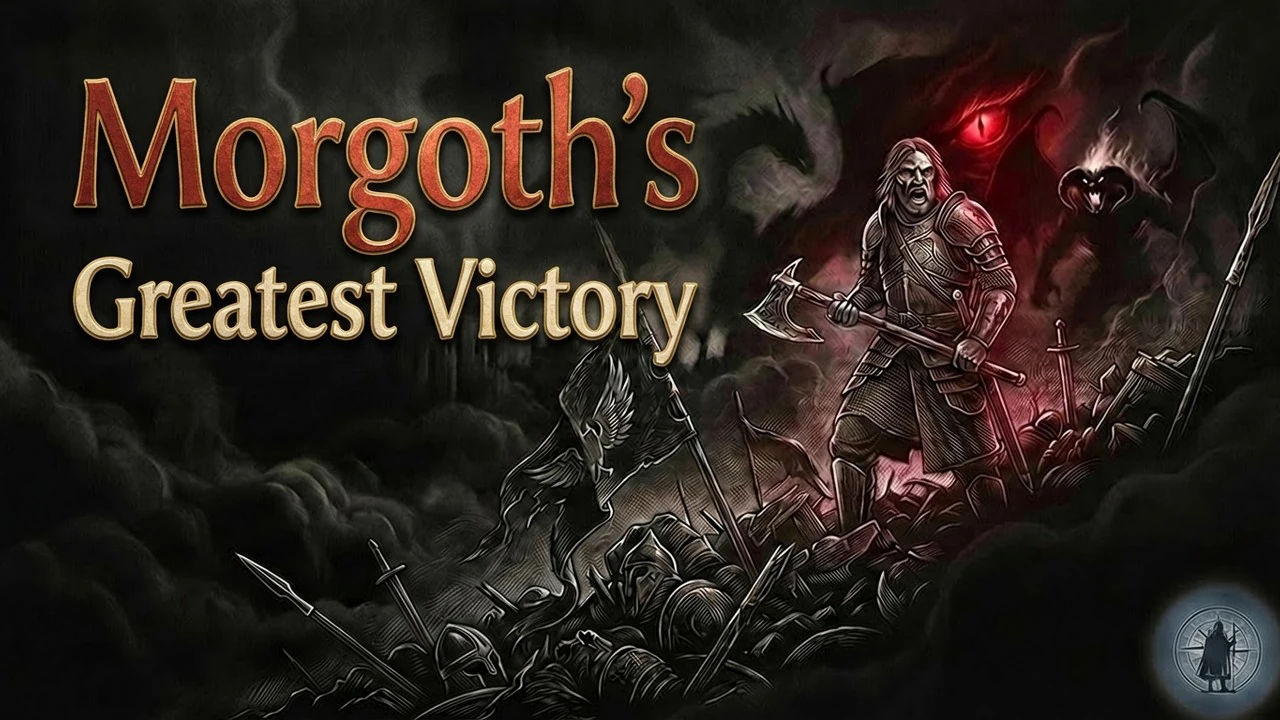 Watch the episode
Nirnaeth Arnoediad: The Battle of Unnumbered Tears | Morgoth's Greatest Victory
Watch the episode
Nirnaeth Arnoediad: The Battle of Unnumbered Tears | Morgoth's Greatest Victory
SECTION: The Debt Comes Due
Long before the trumpets sounded, the outcome was already written. It was written in words — words spoken on a cold shore in Aman, generations before the first spear was raised.
"Tears unnumbered ye shall shed." That was the sentence Mandos pronounced upon the Noldor as they fled Valinor in rebellion, their hands still red from the kinslaying at Alqualondë. The full prophecy went further: their Oath would drive them and betray them; treachery of kin against kin would bring them low; and to evil end would turn all things they began well. When Tolkien came to name the Fifth Battle of Beleriand, he reached back and lifted the phrase directly from that curse. Nirnaeth Arnoediad — the Battle of Unnumbered Tears. The title is a citation. It tells you the ending before the story begins.
The free peoples were attempting something audacious in the year 472 of the First Age. Maedhros, eldest son of Fëanor, had spent years assembling what the histories call the Union of Maedhros — the broadest alliance the exiled Elves would ever raise. Noldor and Sindar, the Men of the Three Houses of the Edain, Easterlings newly come over the Blue Mountains, and the Dwarves of the Ered Luin. On paper it was overwhelming. And Maedhros had a reason to believe it could work that was not foolish at all.
That reason had a name: Beren and Lúthien. A mortal man and an Elf-maiden had walked into Angband itself, laid the great enemy asleep, and cut a Silmaril from the iron crown on his head. If two lovers with no army could rob Morgoth of a jewel from his own brow, then surely a coalition of kings, backed by dragon-slaying Dwarves and the mail-clad host of a hidden city, could break the Dark Lord for good. The logic was sound. That is the first tragedy of the Nirnaeth: the plan was reasonable, and Maedhros had every reason to believe it would work.
But the foundation was rotten, and the rot was old. When Maedhros sent to Thingol of Doriath, the greatest of the Grey-elf kings, Thingol refused him — because the sons of Fëanor still claimed the Silmaril that Beren and Lúthien had died to win, and because Celegorm and Curufin had once held Lúthien captive and schemed against her. A wrong done decades earlier now withheld the strength of the most defensible realm in Beleriand. Orodreth of Nargothrond refused for the same reason; only a single company marched from that kingdom, and its captain, Gwindor, came out of private grief, not policy. And among the Easterlings that Maedhros welcomed as allies, one chieftain — Ulfang the Black — had already been bought by Morgoth before he ever crossed the mountains. The traitor was inside the tent before the war council convened.
This is what the Doom of Mandos actually was — moral cause and effect, compounding across a hundred years like a debt gathering interest. The armies moved by their own choices. Betrayal, proud refusal, oaths sworn in haste — all of it came due on a single midsummer morning. The Union's undoing was written into its own history, and that history was about to be paid in full.
SECTION: The Hammer and the Anvil
Strip away the doom for a moment and look at the battle plan itself, because it deserves respect. It was a good plan. It was, in fact, a classic hammer-and-anvil.
Maedhros would lead the eastern host openly across Anfauglith, the great scorched plain before Angband, and provoke Morgoth into sending his army out to meet him. Meanwhile Fingon, High King of the Noldor, would keep his western host hidden in the eastern foothills of the Ered Wethrin, the Mountains of Shadow. When Morgoth's forces were drawn out onto the open sand, a beacon would flare on the heights of Dorthonion, and Fingon would sweep down onto the enemy's exposed rear. Morgoth's army, caught between the anvil of Maedhros in the east and the hammer of Fingon in the west, would be crushed on the plain of its own making.
The plan required almost nothing except one thing — trust. Trust that the eastern host would arrive on time. Trust that the signal would come. Trust that every contingent, Elf and Man and Dwarf, would hold its discipline until the appointed hour. And Morgoth, who understood his enemies far better than they understood him, aimed his entire counter-strategy at exactly that single point of failure — the Union's patience and its trust. He set out to out-wait the one and poison the other, and let the fighting take care of itself.
He struck at both the east and the west, and he struck with information rather than iron. In the east, his agent Uldor — son of the bought traitor Ulfang — brought Maedhros false reports of an assault issuing from Angband against his flank. The reports were fabrications, designed to make the eastern host hesitate, wheel, and delay. And delay it did. The hammer was late before the anvil was even in place.
In the west, Morgoth reached for cruelty of a more personal kind. Years earlier, at the Battle of Sudden Flame, his forces had captured an Elf of Nargothrond named Gelmir. Now his captains brought Gelmir out within full sight of Fingon's hidden army — and there, deliberately, in the open, they hewed off his hands and his feet, and last of all his head. It was theater. It was bait. And it was aimed at one man: Gwindor of Nargothrond, Gelmir's brother, who had marched to this war for the sole purpose of avenging him.
Gwindor broke. Mad with grief, he and his small company charged out of hiding, alone, straight for the enemy line — and Fingon, watching his own soldiers hurl themselves forward and unwilling to abandon them to die uncovered, gave the order. The entire western host attacked. The hammer swung early, out of sequence, before the anvil was ready and before the signal had come.
Sit with how small the levers were. A single whispered lie in the east, and a single act of engineered grief in the west — that was the whole of it. Two men, a spy and a mourner, undid a plan that thousands of the mightiest warriors in Middle-earth had spent years preparing. The full strength of Angband had not yet been unsheathed, and the Union was already fighting the wrong battle at the wrong hour.
SECTION: The Day Has Come
And yet — for one shining stretch of that morning — it seemed to be working anyway.
Fingon's charge, premature though it was, hit the orc-host before the fortress of Eithel Sirion like a hammer-fall after all. The western host smashed through the enemy line, drove it out onto Anfauglith, and swept it back across the burning sand. The Noldor cavalry outran the retreat. Fingon's vanguard reached the very walls of Thangorodrim — the triple-peaked stronghold of Morgoth himself — and beat upon the gates of Angband while the guards of the fortress trembled behind them. For a few hours, an Elven army stood hammering on the door of the Dark Lord's house — and for those hours it was really happening.
Then, from the south, came the sight that lifted the whole field. A new host appeared, ten thousand strong, mail-clad and ordered and shining — and at its head marched Turgon, King of Gondolin. Turgon, whose city was so secret that even his own allies did not know where it lay. Turgon, who had sealed himself away from the war for years and was believed by many to be beyond reach. He had come. The hidden king had broken cover and brought his whole army to his brother's side, and the very fact that Gondolin would risk exposure measured how much hung on this one day.
When Fingon saw his brother's banners on the field, when he heard the great trumpet of Turgon echo in the hills, the shadow lifted from his heart and he shouted aloud in the High Speech: "Utúlie'n aurë! Aiya Eldalië ar Atanatári, utúlie'n aurë!" The day has come. Behold, people of the Eldar and Fathers of Men, the day has come. And across the whole army, in the hills and on the sand, every warrior who heard that great voice roll and echo answered him, crying back: "Auta i lómë!" The night is passing.
That word — aurë — carries the whole battle inside it. Day. Daylight. Sunrise. Fingon's cry was the noblest single moment of speech the Noldor ever uttered on the fields of Middle-earth, and it was true when he said it. Maedhros's eastern host was now closing from the far side. The two wings of the Union were drawing together toward Morgoth's forces exactly as the plan had drawn them on the map. For one held breath, the hammer and the anvil were both in place, and the day really had come.
Everything that follows is the descent from this sentence.
SECTION: The Pits Unsealed
Morgoth had been watching. He had been waiting for precisely this — for both wings of the Union to commit, for the whole strength of his enemies to gather in one place where he could destroy it in one blow. And now he opened his pits and let out everything he had kept in reserve.
The last strength of Angband came forth, and it barely deserved the word army. Wolves and wolfriders. A wave of Balrogs, demons of shadow and flame. And ahead of all of them, breaking from the gates at full growth, came Glaurung — the Father of Dragons, the first of the great worms to walk the earth on his own power. Behind him came his brood. The counter-stroke that Morgoth unleashed was larger than the entire host that Fingon had driven back that morning, and it had been kept back the whole time, waiting underground for the enemy to walk into the open where nothing could shelter him.
Glaurung did the one thing that decided the battle at a stroke. He drove himself between the host of Fingon in the west and the host of Maedhros in the east — a living wall of fire and armored hide — and split the Union in two. The hammer and the anvil, so nearly closed, were now wedged apart by a dragon, and they would never join again. Each half of the great alliance was now cut off, surrounded, and left to be destroyed on its own.
And here, in the center, on the worst day, the Dwarves did something no one else on the field could do. The host of Belegost stood against the dragon and did not break. They wore great masks of steel over their faces, hideous and grim, and by that craft alone they could endure the blast of Glaurung's fire that sent Elves and Men reeling. They ringed the dragon. They hewed at him with their long war-axes. And when Glaurung in his fury knocked down their king, Azaghâl, and crawled over him to crush him, Azaghâl with the last strength in his body drove a knife up into the dragon's soft belly.
It was enough. Glaurung, wounded — the first wound of real consequence any creature of the Union struck that entire day — screamed and fled the field, and all his brood fled after him, back toward Angband. A dying Dwarf-king, pinned beneath a dragon, bought the field a few hours of relief with a single knife. The Dwarves of Belegost lifted Azaghâl's broken body onto their shoulders and bore him away from the battle, and as they carried their king home they sang a deep dirge in their own tongue, walking slowly, and no enemy dared come near them. Of every image the Nirnaeth leaves behind, that one — the masked Dwarves singing their king out of the ruin — is among the hardest to forget.
SECTION: The Accursed
The dragon had split the Union. Now the treason inside it finished the eastern half.
Uldor the Accursed — the same agent whose false report had delayed Maedhros to begin with — turned openly at last. He and the hidden kin of his father Ulfang, who had marched all this way as sworn allies of the sons of Fëanor, fell upon Maedhros's host from the rear at the very moment it was hardest pressed. And more Easterlings, concealed in the eastern hills for exactly this purpose, came pouring down onto the flank. The eastern wing of the Union, already cut off by Glaurung, was now being knifed in the back by the very men who had eaten at its fires. This was the Doom of Mandos spoken plainly — treason of kin, or near-kin, the fear of betrayal made real at the worst possible hour.
But Tolkien does something here that is easy to miss and important not to. He refuses to let "Easterling" become a synonym for "traitor." Because on that same field, at that same moment, other Easterlings died keeping their word.
Ulfang's house had come over the mountains alongside another chieftain — Bór the Faithful, whose three sons were named Borlad, Borlach, and Borthand. When the treachery broke open, Bór's people did not waver. They turned on the traitors. Bór's sons cut down two of Ulfang's sons, Ulfast and Ulwarth, before they themselves were killed in the press. And Maglor, son of Fëanor, hunted down Uldor the Accursed and slew him in single combat. The traitors accomplished their mission — the eastern host disintegrated, and Maedhros was driven, broken, into the mountains toward Dolmed, saved only because the Dwarves covered his retreat. But the loyal Men died loyal. They paid for their honor with their lives, and they paid it gladly, and their names are written down.
That care is deliberate. In the earliest drafts of this story, the human allies who broke the Union were simply a faithless mass, Men-as-a-category proving false. Across decades of revision, Christopher Tolkien tells us, his father went back and built Bór the Faithful into the account specifically so the chapter would not condemn a whole people for the crime of a single bought chieftain. Faithlessness in this story is a choice made by particular souls — Ulfang chose it, Bór refused it. It is a matter of individual will, and blood has nothing to do with it. Even at the absolute bottom of the disaster, Tolkien would not let the moral bookkeeping go slack.
SECTION: The Trodden Banner
In the west, the end came for the High King.
With Maedhros shattered in the east and the dragon-brood driven off, Morgoth turned the full weight of his western assault onto Fingon. Balrog after Balrog pressed forward, and at their head came Gothmog, Lord of Balrogs, the high captain of Angband — the same demon who had dealt Fëanor his death-wound long before. Fingon's guard was cut down around him until he stood almost alone. And there, on the burning plain, the High King of the Noldor faced the Lord of Balrogs in single combat.
It did not last. As Fingon fought Gothmog before him, a second Balrog swept in from behind and caught him about with a whip of fire. Held fast, unable to turn, Fingon was cloven through the helm by Gothmog's black axe. And the histories record one small, devastating detail — his white banner, sown with gold, was trodden into the mud and blood beneath the feet of his enemies. With the trampling of that banner, the open kingship of the Noldor in Middle-earth ended. No Elven realm would ever again march out to give Morgoth open battle in the field. Every war after this one would be a war of hiding.
But there was still a retreat to protect, and a future hidden inside it. Turgon's host of Gondolin was not destroyed — and it could not be allowed to be, for reasons no one on the field could yet have named. To cover the King of Gondolin's escape back toward the mountains, two brothers of the House of Hador took up a position at the Fens of Serech, where the river Sirion runs down into Beleriand through a narrow pass. Húrin and Huor, lords of Dor-lómin, walled that pass with the last Men of their people and held it against everything Morgoth could throw at them, so that Turgon could slip away south and vanish once more into the secret of his city.
And there, in the middle of that hopeless rearguard, Huor said something strange to his king. He told Turgon to go, and to keep Gondolin standing even a little while longer — because, he said, out of Turgon's house and Huor's own, together, a new star would arise. Then Huor fell, a venomed arrow through his eye, and the last Men of Dor-lómin died around him one by one. Huor did not live to see what he meant. But he had just named the single thread by which the entire world would eventually be saved, and we will follow that thread to its end.
SECTION: Seventy Times
When Huor fell, one man was left standing in the pass. His brother. Húrin Thalion of Dor-lómin.
Everything about what Húrin did next is a refusal of self-protection. He cast aside his shield — the one thing keeping him alive — and took up an axe in both hands. And the songs say the axe smoked in the black blood of Gothmog's troll-guard until the blade withered from the heat of the slaughter. Each time Húrin killed, he cried out two words in the High Speech: "Aurë entuluva!" Day shall come again. He said it once. He said it again. The histories record that he cried it seventy times, standing alone in a marsh at the end of the worst defeat his people would ever suffer, hewing at the servants of the enemy and shouting into their faces that the daylight would return.
That cry is stranger than it sounds. Húrin knows perfectly well that he will lose — his king is dead, his brother is dead, his people lie around his feet, and the enemy's numbers never end. So the words carry no boast about the battle in front of him. Aurë entuluva. Day — the thing itself, sunlight, the turning of the dark toward morning — day shall come again. It is not a military prediction. It is a metaphysical one. His defiance has left the battlefield entirely and become a claim about creation itself.
This is the purest expression in all of Tolkien of what scholars call the northern theory of courage — the old belief, drawn from Norse and Old English legend, that valor is at its highest and cleanest precisely when it knows it is going to lose. It is the courage that expects death and stands anyway, because standing is the right thing and the outcome does not change what is right. Théoden has a share of it. Éowyn has a share of it. But no one in the legendarium holds it as nakedly as Húrin does in that marsh, with no hope of survival and no shield and seventy cries of a returning sun.
They did not kill him. That is the terrible part. The orcs took him alive, by Morgoth's own command — grappling him with their hands, which clung to him still even after he had hewn the arms from their bodies, until at last he went down buried under their weight. Morgoth wanted him alive. And the reason Morgoth wanted him alive is the reason the darkness of the Nirnaeth did not end when the swords fell silent.
SECTION: The Green Hill in the Dust
By the command of Morgoth, the orcs went out across the plain after the battle and gathered every body of the fallen — every Elf and Man and horse and broken weapon of the Union — and piled them into a single enormous mound in the midst of Anfauglith. It rose like a hill, and it could be seen from far off across the dead sand. The Elves gave it two names: Haudh-en-Ndengin, the Hill of Slain, and Haudh-en-Nirnaeth, the Hill of Tears. Morgoth raised it as a monument to his victory and a mockery of the dead.
And then something happened that Morgoth did not intend and could not prevent. Grass grew on it. Long, green grass, up the whole slope of that mound of the dead — and it was the only green thing in all the burnt desert that Morgoth had made. Nothing else grew in Anfauglith. But on the hill of corpses, life came back, thick and green, and no creature of Morgoth's would ever set foot on it again. He built the ugliest thing on the field, and it became the one place in that whole wasteland where beauty refused to die.
The cost was total and it kept climbing for decades. Hithlum and Dor-lómin were handed to the Easterlings as plunder, and the House of Hador was enslaved in its own homeland. Húrin was chained to a stone seat high on Thangorodrim and made, by Morgoth's sorcery, to watch — for twenty-eight years — as the curse the Dark Lord laid on him hunted down and destroyed his children, his son Túrin and his daughter Nienor, one ruin at a time. That was why Morgoth had wanted him alive: not to kill him, but to make him a spectator to the slow murder of everyone he loved. It is the cruelest thing in the whole legendarium, and it is the seed from which the entire tragedy of the Children of Húrin grows.
And after the Nirnaeth, no field army stood between Morgoth and the hidden realms. He no longer had to win battles. He only had to hunt, one refuge at a time. Nargothrond fell in the year 495, to the same dragon a Dwarf-king had once driven bleeding from the field. Doriath fell a few years after, torn apart from within over the same Silmaril that Beren and Lúthien had won. Gondolin, the last and most secret, held until the year 510 — and then it too was found and burned. The hidden kingdoms could buy time, and nothing more. Hiding could delay the end; it could not overturn it.
It comes down, at the very end, to a single word — because the whole battle is bracketed by it. At sunrise, when the day seemed won, Fingon lifted his voice and cried Utúlie'n aurë — the day has come. At nightfall, when everything was lost and one man stood alone in the reddened water, Húrin cried Aurë entuluva — day shall come again. Say the two cries aloud, back to back, and you can hear the entire chapter compressed into a single Quenya root. Aurë. Daylight. The same word opens the battle in triumph and closes it in defeat — the day has come, and then, when the day has plainly gone, day shall come again.
That is not a contradiction. That is Tolkien's whole theology folded into one syllable. The Noldor had a word — estel — for the kind of trust that does not rest on optimism or evidence, that holds even when every visible sign says the cause is lost. Fingon's cry was the ordinary sort: it read the battlefield and saw a chance. Húrin's cry was estel — spoken with the battlefield entirely against him, resting on the conviction that daylight is woven into the world and cannot finally be shut out, whatever the odds. And Húrin was right. Huor's new star did rise: his son Tuor found hidden Gondolin, married Turgon's daughter, and fathered Eärendil — who would sail west with a Silmaril on his brow and bring the wrath of the Valar down on Morgoth at last. Every strand of that rescue was spun here, on the worst day, in the dust and the tears. The day did come again. It simply took an age of the world to dawn.