Research & Sources
Nirnaeth Arnoediad
The Battle of Unnumbered Tears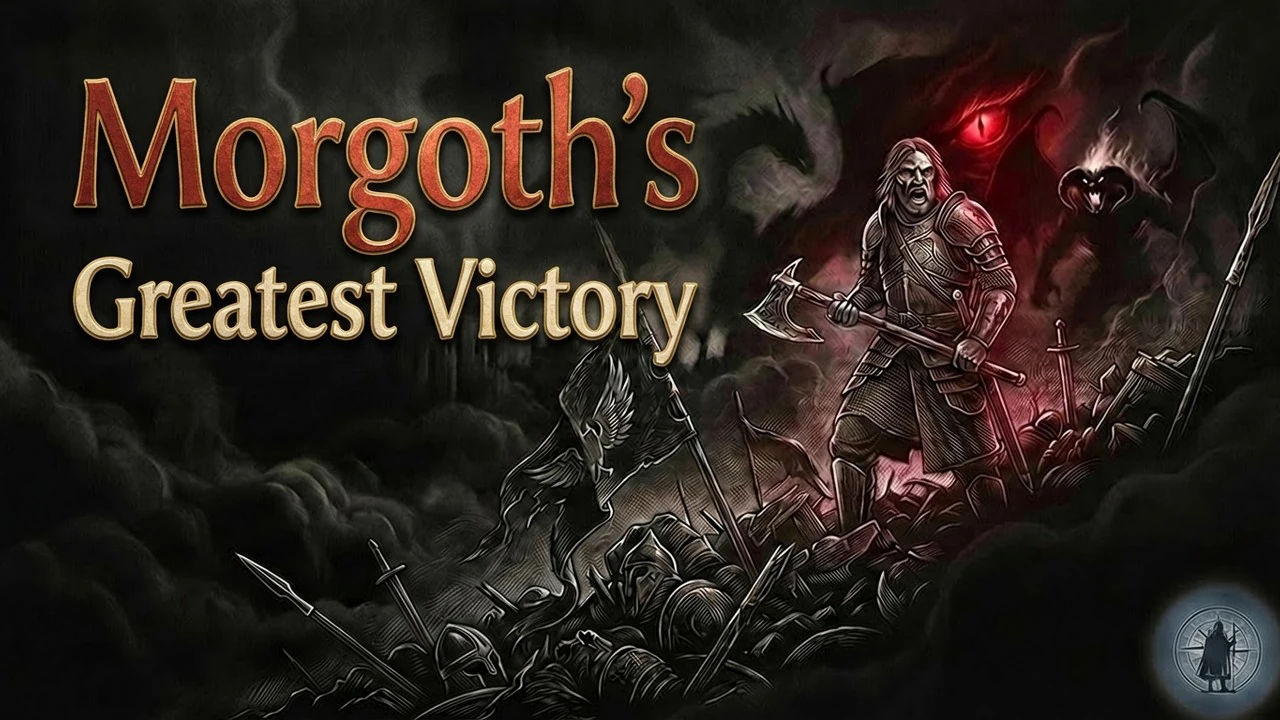 Watch the episode
Nirnaeth Arnoediad: The Battle of Unnumbered Tears | Morgoth's Greatest Victory
Watch the episode
Nirnaeth Arnoediad: The Battle of Unnumbered Tears | Morgoth's Greatest Victory
Research Notes: Nirnaeth Arnoediad — The Battle of Unnumbered Tears
Overview
The Nirnaeth Arnoediad — Sindarin for "Battle of Unnumbered Tears" — was the Fifth Battle of Beleriand, fought in midsummer of Year 472 of the First Age (specifically dated 21–26 June 472 FA in some chronologies). It was the climactic, catastrophic defeat of the free peoples in the Wars of Beleriand: the moment when the Union of Maedhros, an alliance of Noldor, Sindar, Edain, Easterlings, and Dwarves assembled to overthrow Morgoth, was shattered by treachery, ambush, and the unleashed full strength of Angband.
The battle's name is itself a citation. It echoes the opening words of the Doom of Mandos pronounced upon the rebel Noldor: "Tears unnumbered ye shall shed." In choosing this name for the Fifth Battle, Tolkien explicitly framed the disaster as the long-prophesied fulfilment of the curse laid upon Fëanor and his followers. Every theme in the chapter — pride, oath, betrayal, valor, hope-against-hope — turns upon that pre-recorded doom.
Three things end at the Nirnaeth: the open military resistance of the Noldor against Morgoth, the political unity of Elves and Edain in Beleriand, and the possibility that the First Age might end in any way other than ruin. After this battle, no Elven kingdom will ever again take the field offensively against Angband. The remaining narrative of the First Age is a story of hidden realms falling one by one — Nargothrond, Doriath, Gondolin — until only the sea-wanderer Eärendil can plead with the Valar in the West.
Primary Sources
The Silmarillion, Chapter 20: "Of the Fifth Battle: Nirnaeth Arnoediad"
This is the central text. Key passages and their narrative function:
The hopeful trumpet-cry of Fingon:
"Then when Fingon heard afar the great trumpet of Turgon his brother, the shadows passed and his heart was uplifted, and he shouted aloud: 'Utúlie'n aurë! Aiya Eldalië ar Atanatári, utúlie'n aurë! The day has come! Behold, people of the Eldar and Fathers of Men, the day has come!' And all those who heard his great voice echo in the hills answered crying: 'Auta i lómë! The night is passing!'" (The Silmarillion, Ch. 20)
This cry — Quenya for "The day has come" — is the rhetorical high-water mark of the Noldor in Middle-earth. Everything from this point descends.
Húrin's last stand:
"Last of all Húrin stood alone. Then he cast aside his shield, and wielded an axe two-handed; and it is sung that the axe smoked in the black blood of the troll-guard of Gothmog until it withered, and each time that he slew Húrin cried: 'Aurë entuluva! Day shall come again!' Seventy times he uttered that cry; but they took him at last alive, by the command of Morgoth, for the Orcs grappled him with their hands, which clung to him still though he hewed off their arms; and ever their numbers were renewed, until at last he fell buried beneath them. Then Gothmog bound him and dragged him to Angband with mockery." (The Silmarillion, Ch. 20)
Note the deliberate echo: Fingon cried Utúlie'n aurë ("The day has come") at the battle's start; Húrin answers, defeated but unbroken, Aurë entuluva ("Day shall come again"). The same Quenya root word aurë (day, sunlight) frames the whole battle — promise at sunrise, defiance at nightfall.
The Hill of Slain:
"By the command of Morgoth the Orcs with great labour gathered all the bodies of those who had fallen in the great battle, and all their harness and weapons, and piled them in a great mound in the midst of Anfauglith; and it was like a hill that could be seen from afar. Haudh-en-Ndengin the Elves named it, the Hill of Slain, and Haudh-en-Nirnaeth, the Hill of Tears. But grass came there and grew again long and green upon that hill, alone in all the desert that Morgoth made; and no creature of Morgoth trod thereafter upon the earth beneath which the swords of the Eldar and the Edain crumbled into rust." (The Silmarillion, Ch. 20)
Huor's prophecy:
"Yet if [Gondolin] stands but a little while, then out of your house shall come the hope of Elves and Men. This I say to you, lord, with the eyes of death: though we part here for ever, and I shall not look on your white walls again, from you and from me a new star shall arise." (The Silmarillion, Ch. 20, Huor to Turgon)
The "new star" is Eärendil, son of Tuor (Huor's unborn son) and Idril (Turgon's daughter). At the moment of utter defeat, the seed of eucatastrophe is planted.
The Children of Húrin / Narn i Chîn Húrin (Unfinished Tales)
Provides the most detailed account of the Easterling betrayal, the rearguard at Serech, and Morgoth's curse upon Húrin:
"But upon all whom you love my thought shall weigh as a cloud of Doom, and it shall bring them down into darkness and despair. Wherever they go, evil shall arise. Whenever they speak, their words shall bring ill counsel. Whatsoever they do shall turn against them. They shall die without hope, cursing both life and death." (The Children of Húrin, "The Words of Húrin and Morgoth")
The Doom of Mandos (Silmarillion, Ch. 9 "Of the Flight of the Noldor")
"Tears unnumbered ye shall shed; and the Valar will fence Valinor against you, and shut you out, so that not even the echo of your lamentation shall pass over the mountains... Their Oath shall drive them, and yet betray them, and ever snatch away the very treasures that they have sworn to pursue. To evil end shall all things turn that they begin well; and by treason of kin unto kin, and the fear of treason, shall this come to pass."
The Fifth Battle is the most precise fulfilment of every clause in this Doom: tears unnumbered, treason of kin, the Oath driving and betraying, beginnings-well-turning-ill.
The History of Middle-earth, Vol. XI ("The War of the Jewels")
Contains the Grey Annals version of the battle, with significant variations and Christopher Tolkien's editorial notes on how the legend evolved. Earlier drafts give different casualty figures and slightly different sequences for Fingon's death and the arrival of Turgon.
Timeline
Long-term context (all dates First Age):
- F.A. 455 — Dagor Bragollach (Battle of Sudden Flame). Morgoth breaks the Siege of Angband; Fingolfin dies in single combat with Morgoth; many Noldor are slain or scattered. Gwindor's brother Gelmir is captured here. - F.A. 460–465 — Beren and Lúthien retrieve a Silmaril from Morgoth's crown. News of this deed inspires Maedhros to attempt the Union. - F.A. 463 — Easterlings under Bór and Ulfang cross the Blue Mountains into Beleriand. Bór's people swear loyalty to Maedhros and Maglor; Ulfang and his three sons (Uldor, Ulfast, Ulwarth) swear fealty to Caranthir. Unbeknownst to the Sons of Fëanor, Ulfang is already in Morgoth's pay. - F.A. 468–471 — Maedhros sends emissaries: he writes to King Thingol of Doriath demanding the Silmaril, who refuses (on top of refusing the alliance — Thingol still grieves the killings of Celegorm and Curufin's actions toward Lúthien). Orodreth of Nargothrond also refuses, citing the deeds of Celegorm and Curufin; only one company under Gwindor son of Guilin marches from Nargothrond, and Gwindor goes for personal reasons (avenging Gelmir).
The battle itself — Midsummer F.A. 472:
- Morning of Midsummer's Day — Trumpets of the Eldar greet the rising sun. Fingon's western host is hidden in the eastern foothills of the Ered Wethrin. Maedhros's eastern host is to march across Anfauglith, drawing Morgoth's army out, then a beacon in Dorthonion will signal Fingon to charge the rear. Hammer-and-anvil. - The plan miscarries: Maedhros is delayed by Uldor the Accursed bringing false reports of an attack from Angband. The beacon is not lit on schedule. - Provocation: Morgoth's captains have foreknowledge from spies. They send out a small force with the captive Gelmir of Nargothrond, brother of Gwindor (taken at Bragollach). They mutilate Gelmir — cutting off hands, feet, and finally beheading him — in plain sight of Fingon's hidden army. - Gwindor's charge: Mad with grief, Gwindor and his Nargothrond company charge alone. Fingon, unable to abandon them and seeing the moment slip, orders the entire western host to attack. - Initial success: Fingon's host smashes the orc-host before Eithel Sirion. They drive the enemy across Anfauglith and reach the very gates of Angband; Fingon's vanguard beats upon the doors of Thangorodrim. - Counter-stroke: From hidden tunnels Morgoth releases his prepared trap. A previously concealed army issues from Angband and surrounds Fingon's forces on the open sands. Fingon is driven back over Anfauglith with terrible loss. Haldir of Brethil and most of the men of Haleth fall in the rearguard. - Turgon's arrival: On the fourth day, Turgon of Gondolin emerges unexpectedly from the south with a host of ten thousand mail-clad warriors, joining his brother. Fingon's heart is lifted; he cries Utúlie'n aurë! - Maedhros arrives: The eastern host finally reaches the field. The two wings of the Union come close to closing on Morgoth's forces. - The full strength of Angband unleashed: Morgoth empties his pits — wolves, wolfriders, Balrogs, dragons led by Glaurung the Father of Dragons. Glaurung wedges himself between the hosts of Maedhros and Fingon, separating them. - The Dwarves stand: The Dwarves of Belegost, with steel masks and great war-axes, withstand the dragon-fire. Glaurung knocks down their lord Azaghâl, but Azaghâl with his last strength drives a knife into the dragon's belly. Glaurung flees back to Angband; the dragon-brood follows. The Dwarves bear Azaghâl's body from the field, singing dirges. - Treachery — east: Uldor and his hidden kinsmen attack Maedhros from the rear. More Easterlings, hidden in the hills, descend upon his eastern flank. Maglor slays Uldor in single combat; the loyal sons of Bór kill Ulfast and Ulwarth before being slain themselves. The Sons of Fëanor are scattered eastward toward Mount Dolmed and survive only because of the Dwarves' rearguard. - The death of Fingon: Gothmog, Lord of Balrogs, drives forward in the west. Fingon's escort is killed; he faces Gothmog alone. A second Balrog wraps Fingon with a fiery whip from behind. Gothmog cleaves Fingon's head with his black axe, and "his white banner, sown with gold, was trodden under foot." - The retreat at Serech: Húrin and Huor, with the remnant of the men of Dor-lómin, form a wall across the Pass of Sirion at the Fens of Serech. They cover Turgon's retreat back to Gondolin. Huor speaks his prophecy of the "new star," then falls with a poisoned arrow through his eye. The men of Dor-lómin are slain to the last. Húrin alone remains, wielding a two-handed axe and crying Aurë entuluva! seventy times. He is taken alive at Morgoth's command. - End of the battle: "Thus ended Nirnaeth Arnoediad, as the sun went down behind the sea. Night fell in Hithlum, and there came a great storm of wind out of the West."
Aftermath (F.A. 473 and after):
- The Hill of Slain (Haudh-en-Nirnaeth / Haudh-en-Ndengin) is raised in Anfauglith. - Morgoth grants Hithlum and Dor-lómin to the Easterlings as a reward, but penned in — they cannot enter southern Beleriand. - The remnant of the House of Hador is enslaved. Lorgan becomes chief of the Easterlings of Hithlum; Brodda takes Aerin to wife by force; Morwen, Húrin's wife, holds Dor-lómin only because the Easterlings are afraid of her. - Húrin is chained to a stone seat on Thangorodrim and made to watch his family destroyed under Morgoth's curse for 28 years. - Rían, mother of Tuor, dies of grief on the Hill of Slain after learning of Huor's death. - Tuor is born into captivity and raised by the Grey-elf Annael. - Turgon becomes High King of the Noldor in Middle-earth and seals Gondolin completely.
Key Characters
Maedhros son of Fëanor
Eldest of the Sons of Fëanor and architect of the Union. Maimed (right hand cut off when rescued from Thangorodrim by Fingon long before), he had become the most measured of his brothers — but the Oath still binds him. He is delayed by Uldor's deceit on the fatal day; survives the battle but is broken by it. His subsequent attacks on Doriath and on the Havens of Sirion are the long shadow of this defeat: the Oath, denied its hammer-blow against Morgoth, turns inward and devours its own kin.Fingon, High King of the Noldor
Son of Fingolfin, brother of Turgon, the rescuer of Maedhros from Thangorodrim. Commander of the western host. His cry Utúlie'n aurë is the noblest battlefield rhetoric in all of Tolkien. He dies cleft by Gothmog's axe, his banner trodden in the dust. With him dies the High Kingship of the Noldor in any meaningful military sense.Turgon, King of Gondolin
Brother of Fingon. Emerges from his hidden city only this once. His arrival momentarily turns the tide; his retreat preserves Gondolin for nearly four more decades, allowing Eärendil to be born. Becomes High King after Fingon. The fact that he comes at all — that secret Gondolin breaks cover — measures how desperate the situation seemed.Húrin Thalion of Dor-lómin
Lord of the House of Hador and the moral center of the entire chapter. Friend of Turgon (in his youth he and his brother Huor had been guests in Gondolin). His seventy-time defiance of darkness is the antithesis of the entire battle's despair. Captured because Morgoth wants the secret of Gondolin from him. Refuses. Cursed, chained, forced to watch his children destroyed. The seed of The Children of Húrin.Huor of Dor-lómin
Húrin's brother. Speaker of the "new star" prophecy. Dies at Serech with a poisoned arrow through the eye. Father of Tuor (born after his death), grandfather of Eärendil — the actual fulfilment of his prophecy.Gwindor of Nargothrond
Prince of Nargothrond. His brother Gelmir was captured at Bragollach. His grief-charge ignites the battle prematurely. Captured rather than killed; later escapes Angband and returns to Nargothrond, where he becomes entangled in the tragedy of Túrin.Azaghâl, Lord of Belegost
The Dwarf-king who wounds Glaurung. Killed by the dragon, but with his last knife-thrust drives Glaurung from the field. The only commander on the Union's side to inflict a meaningful blow on Morgoth's forces. The Dwarves of Belegost bear his body away singing — one of the most striking small images in the chapter.Gothmog, Lord of Balrogs
Morgoth's high captain. Slayer of Fëanor (long before this battle), of Fingon here, and captor of Húrin. The single most effective servant of Morgoth in the First Age until his eventual death at the Fall of Gondolin.Glaurung, Father of Dragons
The first great dragon to walk on land. Wedges between the two hosts. His withdrawal after Azaghâl's wound is one of the few partial victories on the Union's side, but it is a personal humiliation that he later avenges at Nargothrond and against Túrin.Ulfang the Black and his sons (Uldor, Ulfast, Ulwarth)
The Easterling chieftain in Caranthir's service who is secretly Morgoth's agent. The mechanism of the disaster's "ground-truth": even when the strategy is sound and the host is gathered, a planted lie inside the alliance brings everything down. Uldor delays Maedhros, then turns on him in the rear. All three sons are killed, but they accomplish their mission: the eastern host disintegrates.Bór the Faithful
Lesser-remembered counterpart to Ulfang. Easterling chieftain whose people remain loyal to the Sons of Fëanor. Bór's three sons (Borlad, Borlach, Borthand) kill Ulfast and Ulwarth and are themselves killed — a small redemptive note: not all Easterlings betray, and "Easterling" is not a moral category.Haldir of Brethil
Son of Halmir, leader of the Haladin contingent. Falls in the rearguard with most of his men. The House of Haleth never recovers its fighting strength.Thingol of Doriath (by absence)
The most consequential non-participant. Refuses to join the Union because the Sons of Fëanor still claim the Silmaril retrieved by Beren and Lúthien. Doriath's military strength — the Girdle of Melian and her warriors — is therefore absent. This is one of Tolkien's most pointed demonstrations of how prior wrongs (the Kinslaying, Celegorm and Curufin's treatment of Lúthien) propagate forward into future disasters.Geography
- Anfauglith ("Gasping Dust"): The plain north of the Ered Wethrin, formerly the green plain of Ard-galen, scorched to desert by Morgoth in the Dagor Bragollach. The main battlefield. After the Nirnaeth, the Hill of Slain rises here as the only green spot. - Ered Wethrin (Mountains of Shadow): The ridge sheltering Hithlum to the south. Fingon's host lies hidden in their eastern flanks before the battle. - Hithlum / Dor-lómin: Húrin's homeland. After the battle, given to Easterlings as plunder; the House of Hador enslaved. - Eithel Sirion: The "Wells of Sirion," fortress at the head of the river. Fingon's original western base. - Fens of Serech / Pass of Sirion: Marshland at the river's source, where the Sirion enters Beleriand from the north. Site of Húrin and Huor's last stand. - Thangorodrim / Angband: Morgoth's triple-peaked stronghold. Fingon's vanguard reaches its very gates before being thrown back. Húrin is later chained on its slopes. - Dorthonion: Highland plateau where the signal-beacon was to have been lit. By F.A. 472 it had already fallen to Morgoth's forces. - Mount Dolmed / Ered Luin: Eastern mountains. Maedhros's broken host flees toward Dolmed; the Dwarves of Belegost retreat home this way bearing Azaghâl's body. - Gondolin: The hidden city, location unknown to the enemy. Turgon emerges from the Encircling Mountains by some unrecorded route; his retreat is what Húrin's stand at Serech protects.
Themes and Symbolism
Doom realized in the smallest details. Tolkien names the battle from the first words of the Doom of Mandos. Every clause of that prophecy is fulfilled here: tears unnumbered, treason of kin (Easterlings to allies, but also the long shadow of Fëanor's Oath denying Doriath's participation), well-begun ventures turned ill. The chapter is a literary demonstration that prophecy in Tolkien's world is not magic but moral causality compounding over decades.
The hammer-and-anvil that is never struck. The strategy is sound. The forces are sufficient. The plan only requires trust — between East and West, between Eldar and Edain, between the Sons of Fëanor and their human allies. Every element of trust has been silently corroded: Doriath will not stand with the Fëanorians; Nargothrond will not march; Ulfang is bought; Gwindor's grief breaks discipline at the worst moment. The lesson is structural: divided peoples cannot defeat a unified evil, even when their individual courage is incomparable.
Light and Day as motif. The whole battle frames itself in solar imagery. Utúlie'n aurë — the day has come. Auta i lómë — the night is passing. Húrin's last cry: Aurë entuluva — day shall come again. The battle ends with sunset and a westerly storm. The Sun (which in Tolkien's mythology is itself a symbol of post-Trees diminished light, the last fruit of Laurelin) is the unspoken witness throughout.
Betrayal as the hinge of catastrophe. Three different betrayals or refusals destroy the Union: Thingol's withholding (rooted in old wrong), Ulfang's planted treason (enemy infiltration), and the implicit "betrayal" of the Doom itself, which prevents the Noldor's well-meant deeds from succeeding. Tolkien layers these so that no single party is the sole cause; the disaster is collective.
Valor without victory / hope without expectation. The Eucatastrophic strain in Tolkien — that grace can break in at the last instant — is deliberately denied in this chapter. Húrin's seventy-fold cry, Azaghâl's dying wound, Huor's prophecy, the green grass on the Hill of Slain — these are not rescues. They are seeds, witnesses, refusals to despair while losing. This is one of the few places in Tolkien where heroic action is shown to fail in the present and yet still carry meaning. Letter 195 and Letter 131 both touch on Tolkien's belief that "estel" (hope without guarantee) is distinct from optimism: the Nirnaeth is its purest dramatization.
The Hill of Slain as inverted monument. Morgoth raises the mound to mock the dead. It becomes the only living place in Anfauglith. His servants will not tread on it. Beauty grows where evil placed corruption — a Christian reading of resurrection-symbolism rendered in landscape, without ever stating it as such.
Catholic and biblical resonance. The Oath of Fëanor — the proximate root cause that makes the Union impossible-while-impossible-to-abandon — was, Tolkien remarks, an oath that should never have been taken (echoing James 5:12). Húrin's stand carries marked echoes of Christian martyrdom: lone, witnessed, silent before the tyrant, defiant in language but powerless in body, his suffering deferred but not ended. Morgoth's curse on Húrin — making him watch — is a Satanic perversion of Providence: forcing a creature to witness ruin without power to act, the cruelest mockery of the divine perspective.
Scholarly Perspectives
Verlyn Flieger (Splintered Light) reads the Nirnaeth chapter as the dimming of the Noldor's light into history — the last battle in which the Calaquendi (Light-elves) act in the open field. After this, the Noldorin story becomes a story of hidden refuges and small mercies; the great age of Light in Middle-earth is over.
Tom Shippey (The Road to Middle-earth and J.R.R. Tolkien: Author of the Century) emphasizes the "northern theory of courage" Tolkien drew from Old Norse and Old English sources: that valour is most pure when it knows it will lose. Húrin's stand is the cleanest expression of this ethic in Tolkien's corpus, more thoroughly than Théoden's or Eowyn's or even Beren's. Shippey notes that "Aurë entuluva" is one of only a handful of Quenya phrases that Tolkien wanted readers to feel the sound of, regardless of translation.
Christopher Tolkien (Editorial commentary in The War of the Jewels, HoME XI) traces the evolution of the battle through the Annals of Beleriand, the Grey Annals, and the Quenta Silmarillion. The Easterlings' role grows in importance over successive drafts; in the earliest versions, the battle's loss is more directly attributable to "men's faithlessness" as a category, while later drafts (and the published Silmarillion) carefully introduce Bór the Faithful as a counterweight. This editorial care reflects Tolkien's discomfort with depicting any race as wholly evil.
John Garth (Tolkien and the Great War) reads the Nirnaeth through the lens of Tolkien's own experience at the Somme (1916). The hammer-and-anvil that fails, the messages that don't arrive in time, the trumpet-call of dawn followed by carnage on open sand, the rearguards that buy time at total cost — all map onto Tolkien's experience of First World War combat. The "great storm out of the West" at the battle's end, Garth notes, recalls the storms that washed across the Somme battlefields.
Critical observation on "Aure entuluva." The phrase becomes one of Tolkien's most quoted Quenya expressions outside Galadriel's lament. It is structurally important: it is a future tense of hope spoken in the present tense of defeat. Húrin is not saying "I will win" or "we will win" — he is saying "day, the cosmic principle, will return." The defiance is metaphysical, not military.
Contradictions and Variants
- Casualty figures vary between drafts. The number of warriors brought by Turgon shifts between drafts of HoME; the published Silmarillion settles on "ten thousand" but earlier annals give different counts. - The role of Maedhros's delay. In some early drafts, Maedhros is delayed primarily by Morgoth's army; in the published version, Uldor's false report is the proximate cause. This shift increases the moral weight on the Easterling betrayal. - The death of Fingon. In the published Silmarillion, Gothmog cleaves Fingon's helm; in some earlier drafts, the killing blow is described slightly differently and the second Balrog with the whip is added later. The "trodden banner" detail is consistent across drafts. - The "seventy" cries of Húrin. Earlier drafts give different numbers (sometimes a different round figure). The number seventy in the published text carries biblical resonance (seventy times seven, the number of forgiveness inverted into a number of slayings). - The fate of Gwindor. In Unfinished Tales / Children of Húrin he is captured and enslaved; later drafts make this consistent. In the very earliest versions the fate is left ambiguous. - Easterling internal politics. The Bór/Ulfang distinction is comparatively late. Early drafts treat the human allies of the Sons of Fëanor as a single faithless mass; later, the loyal house of Bór is added explicitly so that the chapter does not condemn an entire race.
Linguistic Notes
- Nirnaeth Arnoediad — Sindarin. Nirnaeth = "tears" (lament, weeping in plural force). Arnoediad = "unnumbered, beyond counting" (negative prefix ar- + noediad / noediad "numbered"). The phrasing deliberately echoes the Doom of Mandos. - Aurë entuluva — Quenya. Aurë = "day, sunlight, daytime" (cognate root with Anar, the Sun). Entuluva = future tense of en-tul- "come back, return." The verb form is en- (again, re-) + tuluva (will come). Literally "Sunlight will-come-again." - Utúlie'n aurë — Quenya. Utúlië = perfect tense of tul- "to come." 'n = elision of article. "The day has come" (the perfect aspect emphasizes completion: the day has arrived). - Auta i lómë — Quenya. "The night is passing." Auta = "is going, is passing"; i lómë = "the night." - Haudh-en-Nirnaeth / Haudh-en-Ndengin — Sindarin. Haudh = "burial mound, grave-mound" (compare Haudh-in-Gwanûr). Ndengin = "slain ones." Two parallel names: the Hill of Tears, the Hill of Slain. - Anfauglith — Sindarin. An- (intensive) + faug- "thirst, gasp" + lith "ash, sand, dust." "The Gasping Dust." Renamed from the older Ard-galen ("Green Region") after Morgoth scorched it in 455 FA. The naming itself records the wound to the land. - Dor-lómin — Sindarin. "Land of Echoes," from dor "land" + lóm "echo." A poignant name in retrospect — the land later filled with the silent suffering of an enslaved people, and the place where Húrin's voice cannot be heard from his prison on Thangorodrim.
Additional Context
- Position in the legendarium. The Nirnaeth is the structural midpoint of the First Age narrative. Before it: the founding of Noldor kingdoms, the wars of Beleriand, the ascendant heroism of Beren and Lúthien. After it: the slow ruin — Nargothrond falls (495), Doriath falls (502 and 505), Gondolin falls (510). Eärendil's voyage and the War of Wrath (545–587) are direct consequences. - Why Maedhros believed it would work. The proximate trigger for the Union is the deeds of Beren and Lúthien — the recovery of a Silmaril proved Morgoth was vulnerable. If two outcasts could enter Angband and steal a jewel from his crown, an army backed by dragons-killing dwarves, mail-clad Gondolindrim, and the High King could surely break him. The chapter's tragedy is partly that this reasoning was not stupid — it was just insufficient against a hidden traitor. - Production note for narration. The chapter has unusual structural rhythm: it opens in hope, peaks twice (Fingon's cry, Turgon's arrival), descends in waves of betrayal, and closes on Húrin's solitary voice. A script can mirror this — open expansive, narrow to one man's defiance, end on the green hill in the dust.
Questions for Further Research
- How explicitly does Tolkien link the number seventy in Húrin's cries to biblical imagery? (The published text simply says "seventy times.") - The exact route of Turgon's march from Gondolin and back is never given. This may be a deliberate refusal — Gondolin's location must remain unknown even in narration. - The fate of the Dwarves of Nogrod at the Nirnaeth: Nogrod's smiths were noted as preparing weapons for the Union, but Nogrod's contingent's role in the battle itself is less clearly described than Belegost's. Belegost gets the dragon-stand; Nogrod's part is shadowy.
Discrete Analytical Themes
Theme 1: Doom as Compound Interest
Core idea: The Nirnaeth is not a single bad day; it is the settlement date on a hundred years of accumulated curses, oaths, and refusals. Evidence: - The battle is named from the first words of the Doom of Mandos: "Tears unnumbered ye shall shed" (Silm. Ch. 9). - The Doom predicts: "Their Oath shall drive them, and yet betray them... by treason of kin unto kin, and the fear of treason, shall this come to pass" — fulfilled exactly here. - Thingol's refusal to join the Union traces directly back to Celegorm and Curufin's treatment of Lúthien (decades earlier). - The Easterlings are in Beleriand at all because the Sons of Fëanor recruited them — and they trust them in part because the Oath narrows their options. Distinction: This theme is about causal architecture — how prior moral failures compound into a single inevitable disaster. It is NOT about any single betrayal; it is about why an alliance built on cursed foundations cannot win.Theme 2: The Mechanics of the Hammer-and-Anvil That Failed
Core idea: The Union's plan was militarily sound; what destroyed it was a single planted falsehood (Uldor's false report) and a single grief-charge (Gwindor at Gelmir's torture). Evidence: - The plan: Maedhros draws Morgoth's host onto Anfauglith; beacon in Dorthonion signals Fingon; western host attacks rear; Morgoth's army caught between two hosts. - Two failure points: (1) Uldor delays Maedhros with a false report so the eastern host is late; (2) Gelmir is mutilated specifically to provoke Gwindor; Gwindor charges; Fingon must commit early. - Both failure points were engineered by Morgoth's intelligence apparatus — the Easterling spy and the captive used as bait. Distinction: This is about operational tactics and intelligence warfare, distinct from the larger doom theme. It shows that Morgoth's victory is also a triumph of espionage, not just brute force.Theme 3: The Two Faces of the Easterlings (Bór vs. Ulfang)
Core idea: Tolkien deliberately constructs a moral split among the Easterlings to refuse the easy reading that "the betrayers" are a faceless racial Other. Evidence: - Ulfang the Black and his three sons: secretly in Morgoth's pay before they ever crossed the Blue Mountains (Silm. Ch. 18 introduces them; Ch. 20 reveals the betrayal). - Bór and his three sons (Borlad, Borlach, Borthand): faithful to the Sons of Fëanor; kill Ulfast and Ulwarth in the chaos; die in the act. - Maglor slays Uldor in single combat; the loyal Easterlings die alongside their lords. - Christopher Tolkien's editorial notes (HoME XI) show the Bór/Ulfang split was a late refinement — earlier drafts treated all Easterlings as faithless. Distinction: This is about ethical complexity in Tolkien's depiction of "evil men" — not about the strategy or the doom. It humanizes both sides of the human contingent.Theme 4: Húrin's Defiance as Tolkien's Purest "Northern Courage"
Core idea: Húrin's last stand at the Fens of Serech is the cleanest dramatization of Tolkien's belief that courage that knows it will lose is the highest courage. Evidence: - The two-handed axe, alone, cast aside shield: a deliberate refusal of self-protection. - Seventy cries of Aurë entuluva! — a future-tense hope spoken in present-tense defeat. - The Orcs grappling him with hands that "clung to him still though he hewed off their arms" — a grotesque image of evil's exhausting persistence against valour. - Captured alive by Morgoth's command, not killed — meaning his courage was so consequential that Morgoth wanted to break it personally. - Echoes Old Norse/Old English heroic ideal Shippey identifies (Battle of Maldon, Ragnarök): the hero who fights better the more clearly he knows he loses. Distinction: This theme is about one man's moral aesthetics in extremis — distinct from doom (causal), tactics (operational), or treachery (relational).Theme 5: The Cost of Hidden Realms (Gondolin, Nargothrond, Doriath)
Core idea: The Nirnaeth exposes a structural problem in the Eldar's strategy after Bragollach: hidden kingdoms cannot win wars; they can only delay their own destruction. Evidence: - Doriath does not march at all — the Girdle of Melian is a defensive power. - Nargothrond sends only Gwindor's small company; Orodreth is committed to concealment. - Gondolin emerges once, decisively, but at the cost of its location-secret being partially exposed (Morgoth now knows Turgon is alive and active in Beleriand). - Aftermath: Nargothrond falls in 495 (Glaurung), Doriath falls in 502/505, Gondolin falls in 510 — all three hidden kingdoms fall after the Nirnaeth, in part because Morgoth no longer faces field armies and can hunt them one by one. Distinction: This theme is about grand strategy — the failure mode of the Eldar's defensive posture — not about any single hero or battle phase.Theme 6: Seeds Planted in Defeat (Eucatastrophe Deferred)
Core idea: The Nirnaeth deliberately denies eucatastrophe in the present and instead plants the conditions for the eventual eucatastrophe of Eärendil's voyage. Evidence: - Huor's prophecy to Turgon: "from you and from me a new star shall arise" — explicitly forecasts Eärendil. - Turgon's escape preserves Idril, who will marry Tuor (Huor's unborn son), conceiving Eärendil. - The green grass on the Hill of Slain — beauty rising from corruption, the only living place in Anfauglith. - Húrin's defiance preserves Gondolin's secret long enough for Tuor to find it. - The pattern: every one of the chapter's "small" acts of valour or mercy contributes a single piece to a chain that completes only at the War of Wrath, 70+ years later. Distinction: This theme is about narrative theology — the specifically Tolkienian idea that grace operates over centuries, not in the moment. Distinct from "valor without victory" (Theme 4) because this is about the consequences of that valor, not the valor itself.Theme 7: Morgoth's Curse on Húrin as the Bridge to the Children of Húrin
Core idea: The Nirnaeth's most lasting cruelty is not a battlefield death but the curse Morgoth lays on Húrin — and through him, on his family, in the chambers of Angband afterward. Evidence: - The Curse: "But upon all whom you love my thought shall weigh as a cloud of Doom... They shall die without hope, cursing both life and death" (The Children of Húrin). - Húrin chained to Thangorodrim for 28 years, made to watch through Morgoth's sorcery as Túrin and Nienor are destroyed. - Morgoth's stated motive: extracting the location of Gondolin. Failure: Húrin will not break. - This curse generates the entire Narn i Chîn Húrin / Children of Húrin narrative — Túrin's dragon, Nienor's incest, the suicides at Cabed-en-Aras. Distinction: This theme is about what happens to Húrin after capture and the curse's narrative seeding of the next great tragedy of the First Age — distinct from his battlefield stand (Theme 4).Word count: approximately 4,200.
Sources: Nirnaeth Arnoediad Research
Primary Sources (Tolkien)
- The Silmarillion, Chapter 20: "Of the Fifth Battle: Nirnaeth Arnoediad" — central narrative source for the battle. Direct quotes for Fingon's cry, Húrin's stand, the Hill of Slain, Huor's prophecy, the storm at sunset. - The Silmarillion, Chapter 9: "Of the Flight of the Noldor" — source for the Doom of Mandos ("Tears unnumbered ye shall shed...") that the battle's name explicitly invokes. - The Silmarillion, Chapter 18: "Of the Ruin of Beleriand and the Fall of Fingolfin" — context for Bragollach (455 FA), Gelmir's earlier capture, the prior weakening of Noldor power. - The Children of Húrin (ed. Christopher Tolkien, 2007) — extended account of Húrin's capture, Morgoth's curse, and Húrin's chaining on Thangorodrim. Source for the curse-text quote. - Unfinished Tales, "Narn i Chîn Húrin" — the longer prose form of the same story; supplementary detail on the rearguard at Serech and Húrin's friendship with Turgon in his youth. - The History of Middle-earth, Vol. XI: The War of the Jewels (ed. Christopher Tolkien) — the Grey Annals and Quenta Silmarillion drafts, with editorial notes documenting how the battle account evolved across decades. Source for the Bór/Ulfang split being a late refinement and for casualty/sequence variations. - The Letters of J.R.R. Tolkien (ed. Carpenter and Christopher Tolkien) — Letters 131 and 195 give general framing for "estel" (hope without guarantee) and for Tolkien's view of Fëanor's Oath as one that should never have been sworn.
Secondary Sources (Tolkien Wikis and Encyclopedias) — Most Useful
- Tolkien Gateway: Nirnaeth Arnoediad — https://tolkiengateway.net/wiki/Nirnaeth_Arnoediad — comprehensive overview, citations, dates. - Tolkien Gateway: Of the Fifth Battle: Nirnaeth Arnoediad — https://tolkiengateway.net/wiki/Of_the_Fifth_Battle:_Nirnaeth_Arnoediad — chapter-level analysis. - Tolkien Gateway: Aurë entuluva! — https://tolkiengateway.net/wiki/Aur%C3%AB_entuluva! — etymology and context for Húrin's cry. - Tolkien Gateway: Utúlie'n aurë! — https://tolkiengateway.net/wiki/Ut%C3%BAlie'n_aur%C3%AB! — Fingon's cry and its Quenya breakdown. - Tolkien Gateway: Doom of Mandos — https://tolkiengateway.net/wiki/Doom_of_Mandos — full text of the prophecy and analysis. - Tolkien Gateway: Hill of the Slain — https://tolkiengateway.net/wiki/Hill_of_the_Slain — Haudh-en-Nirnaeth detail. - Tolkien Gateway: Húrin — https://tolkiengateway.net/wiki/H%C3%BArin — character profile, capture, curse. - Tolkien Gateway: Maedhros — https://tolkiengateway.net/wiki/Maedhros — Union architect. - Tolkien Gateway: Fingon — https://tolkiengateway.net/wiki/Fingon — death by Gothmog. - Tolkien Gateway: Turgon — https://tolkiengateway.net/wiki/Turgon — Gondolin's emergence and retreat. - Tolkien Gateway: Glaurung — https://tolkiengateway.net/wiki/Glaurung — dragon's role and wounding. - Tolkien Gateway: Azaghâl — https://tolkiengateway.net/wiki/Azagh%C3%A2l — Belegost, the dragon-stand. - Tolkien Gateway: Ulfang — https://tolkiengateway.net/wiki/Ulfang — chief traitor. - Tolkien Gateway: Gwindor — https://tolkiengateway.net/wiki/Gwindor — premature charge. - Tolkien Gateway: Easterlings (First Age) — https://tolkiengateway.net/wiki/Easterlings_(First_Age) — political context. - Tolkien Gateway: First Age 472 — https://tolkiengateway.net/wiki/First_Age_472 — chronology peg. - Tolkien Gateway: Union of Maedhros — https://tolkiengateway.net/wiki/Union_of_Maedhros — alliance composition. - Tolkien Gateway: Oath of Fëanor — https://tolkiengateway.net/wiki/Oath_of_F%C3%ABanor — root cause analysis.
Secondary Sources — Analytical
- LitCharts: The Silmarillion Chapter 20 Summary & Analysis — https://www.litcharts.com/lit/the-silmarillion/chapter-20-of-the-fifth-battle-nirnaeth-arnoediad — themes (unity vs. division, fate, pride, inevitable loss). - The Fellowship of the Readers Substack: Nirnaeth Arnoediad — https://thefellowshipofthereaders.substack.com/p/nirnaeth-arnoediad - The Fellowship of the Readers: Fingon's death & end of Nirnaeth — https://thefellowshipofthereaders.substack.com/p/fingons-death-and-the-end-of-nirnaeth - The Fellowship of the Readers: The Treachery of Ulfang — https://thefellowshipofthereaders.substack.com/p/the-treachery-of-ulfang - Tea with Tolkien: Of the Fifth Battle commentary — https://www.teawithtolkien.com/silm20 - The Tolkien Road Podcast SilmGuide Pt 23 — https://www.tolkienroad.com/silmguide/sg23/ - TheOneRing.net: Analysing The Children of Húrin: The Curse of Morgoth — https://www.theonering.net/torwp/2016/09/03/101691-analysing-the-children-of-hurin-the-curse-of-morgoth/ - Valar Guild Encyclopedia: Nirnaeth Arnoediad battle entry — https://valarguild.org/tolkien/encyc/articles/b/Beleriand/battle5.htm — strong sequence-of-events summary. - Encyclopedia of Arda: Ulfang the Black — https://encyclopedia-of-arda.com/u/ulfang.php - Encyclopedia of Arda: Hill of Tears / Haudh-en-Nirnaeth — https://www.glyphweb.com/arda/h/hilloftears.php and https://www.glyphweb.com/arda/h/haudhennirnaeth.php - Henneth Annûn: Easterlings subjugate Hithlum — http://www.henneth-annun.net/events_view.cfm?evid=555 - Silmarillion Writers' Guild: Gwindor of Nargothrond character study — https://www.silmarillionwritersguild.org/reference/characterofthemonth/gwindor.php - Silmarillion Writers' Guild: Tuor character of the month — https://www.silmarillionwritersguild.org/reference/characterofthemonth/tuor.html - Parf Edhellen (elfdict.com): Quenya/Sindarin etymology — https://www.elfdict.com/w/aure_entuluva/q
Scholarly Works (Referenced; Not Directly Web-Fetched)
- Verlyn Flieger, Splintered Light: Logos and Language in Tolkien's World (rev. ed. 2002) — the dimming of Noldor light through Beleriand's wars. - Tom Shippey, The Road to Middle-earth (3rd ed. 2003) — northern theory of courage; discussion of Húrin's defiance in the Old English/Norse tradition. - Tom Shippey, J.R.R. Tolkien: Author of the Century (2000) — the importance of Quenya phrases as sound-events. - John Garth, Tolkien and the Great War (2003) — biographical reading of Tolkien's battle scenes against the Somme. - Christopher Tolkien, editorial commentary throughout The History of Middle-earth — particularly Vols. XI (The War of the Jewels) and X (Morgoth's Ring).
Notes on Source Quality
- Most useful: Tolkien Gateway entries (especially Nirnaeth Arnoediad, Húrin, and Aurë entuluva) for citations and direct quotes; the Valar Guild battle entry for clear sequence; the Silmarillion text itself for the canonical quotes. - Convergence: All wikis and analytical sources agree on the major beats — the Doom-naming, Gwindor's charge, Turgon's arrival, Ulfang's betrayal, Azaghâl's wound, Fingon's death, Húrin's stand, the Hill of Slain. Variation is mostly in numerical detail (troop counts, "seventy" cries) and in the relative narrative weight given to each phase. - Gaps: The exact route of Turgon's march is never given by Tolkien (deliberately). The role of Nogrod (as opposed to Belegost) at the battle is shadowy. Casualty numbers vary across drafts; the published Silmarillion numbers should be treated as canonical for the script. - Web sources NOT consulted directly via WebFetch but searched: LitCharts (fetched successfully), Tolkien Gateway main pages (some 403'd via WebFetch but available via search snippet), Silmarillion Quotes Tumblr (good for direct passages with citations).