
Transcript
Lúthien
The Maiden Who Broke Morgoth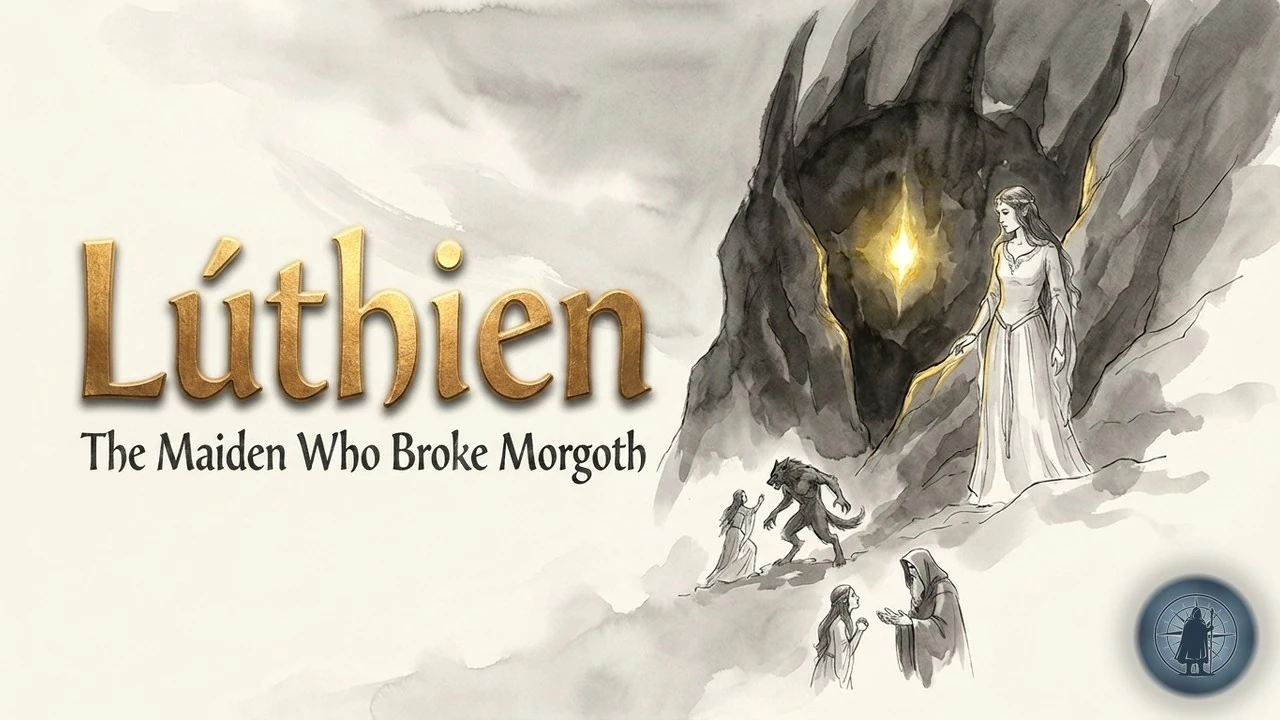 Watch the episode
Lúthien: The Maiden Who Broke Morgoth | Tolkien Explained
Watch the episode
Lúthien: The Maiden Who Broke Morgoth | Tolkien Explained
Main Narrative: Lúthien — Most Powerful Being in Middle-earth?
SECTION: The Maid Who Outranked Kings
The Silmarillion calls her a maid. A maiden. Sometimes, in the older drafts, just a girl who danced in the woods of Doriath. Lúthien Tinúviel — daughter of an Elf-king, fairest of all the Children of Ilúvatar — is introduced to us not as a warrior or a queen but as a beautiful young woman in a hidden forest. And then that same book has her do things no king, no army, and no champion in the entire history of Arda ever managed to do.
So here is the claim worth testing tonight, in full, without flinching from it. This goes well past her beauty and well past the tragic romance: this so-called maid may be the single most effective power ever to walk Middle-earth. More effective than Gandalf. More effective than Galadriel. Mightier, in the cold arithmetic of results, than the great Elf-lords who marched north with banners and broke against the gates of the enemy.
To weigh that fairly, the word "powerful" has to be defined, because the usual definition does her no favors. If power means raw strength — the ability to crush, to out-muscle, to win a contest of force — then Lúthien is not in the running. Morgoth could have unmade her with a gesture. She knows it. The text knows it. She never once lifts a sword.
But that is not what the word means in Tolkien's world, and pretending otherwise misses the whole architecture of the legendarium. Here, the mighty fail constantly. Fëanor, greatest of the Noldor, burns to ash in his own pride. The Union of Maedhros, the largest host the Elves ever raised, shatters against Angband in a single catastrophic day. King Finrod Felagund, wise and valiant, dies in a pit fighting a werewolf with his bare hands. Strength, in this universe, is not the thing that wins. The thing that wins is the capacity to change an outcome that the strong could not change.
By that measure, the picture inverts. Where Finrod died, she walked in and threw the tower down. Where whole armies broke, she got past the gate. Where death itself was final and absolute, she made it give a man back. There is a line that fan circles love, and it is sharper than it looks: Galadriel merely repelled Sauron's forces — she held Lothlórien, she resisted, she defended. Lúthien mastered Sauron in person. Held him, broke him, and dictated his surrender to his face.
One of them defended a border. The other took a Dark Lord's fortress away from him as a prize. That is the gap this episode is built to examine. So let's look at exactly what she did, one feat at a time, and see how high the case can actually be stacked.
SECTION: The Mastery of a Dark Lord
Begin where the legend turns from love-story into something far stranger. Beren, the mortal man Lúthien loves, has been thrown into the dungeons of Tol-in-Gaurhoth — the Isle of Werewolves — a fortress on the River Sirion held by Sauron himself. In this age, Sauron is not yet the lidless eye on the dark tower. He is Morgoth's chief lieutenant, the cruelest mind in the service of the first Dark Lord. And he has already won here once: Finrod Felagund, a king of the Noldor, died in this very stronghold trying to protect Beren.
A king came to this place and was killed. Then a maid came to it.
She arrives with one ally — Huan, the great hound of Valinor, a beast mightier than any wolf in the world. And she does something that has no precedent. Standing on the bridge that leads to the island, she begins to sing. Not a war-cry, not an incantation of fire. A melody. As The Silmarillion puts it, "standing upon the bridge that led to Sauron's isle she sang a song that no walls of stone could hinder." The dungeons hear it. Beren, half-dead in the dark, hears it and answers.
Sauron hears it too, and he is not a fool. He understands that a voice that can pass through stone is a threat unlike any sword. So he sends his wolves out onto the bridge, one after another, to silence her. Huan slays them in silence, each in turn, until none are left. Then Sauron does the thing that matters for the argument we are building: he takes the field himself. He clothes his spirit in the body of a werewolf — and not just any werewolf, but, in Tolkien's words, the mightiest that had yet walked the world. The Dark Lord comes in person to end her.
And here is the part people misremember, so it has to be said straight. Lúthien does not win the wrestling match. When the monstrous wolf-shape charges her, it is Huan who springs and pins him, Huan's jaws that hold the Dark Lord to the ground. The physical contest belongs to the hound. Keep that fact in your pocket — it comes back later, and it matters.
But what happens next belongs to her alone, and it is the most chilling moment in the whole tale. Pinned, beaten in body, Sauron is still a deathless spirit — kill the wolf-shape and he simply slips free, a houseless ghost, and flees back to his master to take a new form. Lúthien knows this. So she does not aim at his body. She aims at the thing underneath it. She tells him, to his face, that she will strip the flesh from his spirit and send his naked self quaking back to Morgoth — there to endure, everlastingly, the torment of his master's scorn. And then she offers him one way out: "unless thou yield to me the mastery of thy tower."
Sit with what that sentence actually is. It is not a duel. It is a hostage negotiation in which the hostage is Sauron's own soul, and she is the one holding the knife. She has found the one threat a deathless being can still fear — eternal humiliation before the lord he serves — and she has leveled it with total composure.
The text gives us the result in four words that ought to be more famous than they are. "Then Sauron yielded himself." He surrenders. He gives up his fortress, abandons his form, and flees in the shape of a vampire-bat into the dark. Lúthien takes the mastery of the isle and everything in it, throws down its towers, and frees every prisoner inside.
And everything that comes three ages later sits in the shadow of that moment. The being who will one day forge the One Ring, raise Barad-dûr, and bring the free peoples of Middle-earth to the brink of ruin — that being was once cornered on a bridge by a singing girl and a dog, and chose to abandon his own castle rather than face what she promised him. The future Lord of the Rings was mastered, in person, by a maid of Doriath. That is feat one.
SECTION: Walking Into the Iron Prison
Defeating Sauron was, it turns out, the warm-up. Because the bride-price Lúthien's father had set for her hand was deliberately impossible: a Silmaril, one of the three holy jewels, cut from the Iron Crown of Morgoth himself. Set on the head of the most powerful being ever to enter the world, deep inside the most impregnable fortress ever built.
Understand what Angband is, because the scale is the whole point. It is a vast subterranean kingdom beneath the triple peaks of Thangorodrim, in the frozen north. It is where Morgoth — a fallen Vala, a being of the same order as the gods who shaped the earth — sits enthroned with the light of the Silmarils blazing in his crown. Armies died trying to reach this place. The greatest coalition the Elves ever assembled marched on it and was annihilated. No force in the First Age breached those gates and came out again carrying something Morgoth wanted to keep.
Two people did. A mortal man and a maid. And the maid is the reason it worked.
They go in disguised — Beren wrapped in the pelt of a slain werewolf, Lúthien cloaked in the form of Thuringwethil, a bat-winged messenger of horror. They pass the outer guards. They get past Carcharoth, the monstrous wolf set to watch the gate. And then they stand in the throne-hall of the Dark Lord, beneath the crown they have come to rob.
Lúthien casts off her disguise. She names herself before Morgoth's face — an act of almost unimaginable boldness — and she begins to sing. The Silmarillion describes the voice as coming "dropping down like rain into pools, profound and dark." She offers herself as a singer for his court, and as she weaves the melody she draws a fold of her dark cloak across his eyes and lays upon him a dream as black as the outer Void.
And the impossible happens. Sleep takes Morgoth. The first Dark Lord, the mightiest being in all of Arda, the one whom no army could touch — his head sags under the suddenly unbearable weight of the Iron Crown, his eyes close, and he topples from his own throne onto the floor of his own hall. His entire court goes down with him into enchanted sleep. The Silmarils burn unguarded above a sleeping god.
Beren draws the knife Angrist and cuts a Silmaril free from the crown — a jewel of living light glowing in his hand. He reaches for a second. And here Tolkien plants the detail that tells you exactly how thin the margin was: "The knife Angrist snapped, and a shard of the blade flying smote the cheek of Morgoth. He groaned and stirred, and all the host of Angband moved in sleep." Even the recoil of a broken blade against the cheek of a Vala only made him stir. The enchantment held. They turned and ran with their prize.
No one else ever did this. Not before, not after. Beren cut the jewel, yes — but the only reason there was a sleeping crown to cut from is that Lúthien's melody put a fallen god on the floor of his own fortress. That is feat two. And it raises a question the honest version of this argument cannot dodge, so flag it now and we will return to it: was Morgoth beaten, or was he merely lulled? Did her voice overpower him, or did he let his guard down because vanity and curiosity made him want to listen? Keep that open. It is the crack in the crown.
SECTION: The Song That Moved Death
The jewel did not buy them peace. At the gate of Angband, Carcharoth woke, fell upon them, and bit off Beren's hand — the hand holding the Silmaril — swallowing the holy jewel whole. The light of it burned the great wolf to madness. And in the long aftermath, the hunting of that wolf, Beren took a mortal wound. He died, as men die, in Lúthien's arms.
For an Elf, this is the deepest grief the world can hold. Elves do not follow Men into death. When a mortal dies, his spirit leaves the world entirely, beyond the circles of Arda, to a fate not even the Valar fully know. Beren is simply gone, to a place no Elf can reach. Lúthien should, by every rule of her own nature, lose him forever.
So she does the third impossible thing, and it is the one that settles the whole argument — if anything can. She lets her own spirit fail from grief, and her soul goes to the Halls of Mandos, the great house of the dead where the Doomsman of the Valar keeps the spirits of the departed. And there, before Námo Mandos himself — the Vala who pronounces fate, the most pitiless and unbending of all the Powers — she kneels, and she sings.
The Silmarillion reaches for its highest language here, and it is worth giving in full, because the text itself tells you this is the summit of everything. Her singing before Mandos "was the song most fair that ever in words was woven, and the song most sorrowful that ever the world shall hear." She wove together two themes — the sorrow of the Elves and the grief of mortal Men, the joined laments of the Two Kindreds — into a single melody that had never existed before and could not exist again.
And then comes the line this entire episode has been climbing toward. "Mandos was moved to pity, who never before was so moved, nor has been since."
Turn that over slowly, because it is doing more work than any feat of arms in the legendarium. This is not the text saying Mandos was impressed, or touched. It is the text making a uniqueness claim about the entire history of the world. The Doomsman of the dead, who had received the spirits of every fallen Elf since the beginning, who would receive countless thousands more across all the ages to come, was bent from his nature exactly once. Before Lúthien: never. After Lúthien: never again. In the whole span of Arda's existence, one voice reached the unreachable, and it was hers.
Mandos cannot simply overrule death on his own authority — he takes the matter to Manwë, the King of the Valar, who consults the will of Ilúvatar, the One, the creator. And the exception is allowed. Beren is summoned back from beyond the world. The two of them are returned to mortal life together, to dwell in a green land for a second span of years. Death let go of someone it had taken. It is the only time in all of Tolkien's mythology that this happens.
There is a reason this story sits at the heart of the whole legendarium, and scholars have a name for the shape of it. The Greeks told of Orpheus, who went down to the land of the dead and sang to win back his lost love — and failed, losing her at the last step, because in that older, colder world even the most perfect art is finally helpless against death. Tolkien knew that tale intimately, and he deliberately turned it inside out. Where Orpheus's singing fails, Lúthien's wins. In a world that was itself sung into being by a loving creator, a voice raised against death can, just once, prevail. That is not an accident of plot. That is a theology. And it is feat three — the apex of the case. She did to the grave the one thing the rest of existence could never reproduce.
SECTION: Where the Power Came From
Three victories that should not have been possible: she mastered Sauron's will, she put a fallen god to sleep, she moved the grave to mercy. The natural objection is that this is just a pile of lucky miracles strung together by an author who loved his heroine. So the fair question is mechanical. Where does this capacity actually come from? Is there a reason, inside the rules of the world, that Lúthien specifically can do what no one else can?
There is, and it comes down to two words: heritage and voice.
Lúthien is unique in all of Arda. She is the only being ever born of the union of a Maia and an Elf. Her father, Thingol, is an Elf-king. Her mother, Melian, is a Maia — one of the angelic spirits who existed before the world was made, who took fleshly form and ruled beside him in Doriath. No one else in the legendarium has this lineage. She carries, quite literally, a strain of the divine in her blood — a thread of the same order of being as Gandalf, as Sauron, as the spirits who entered the world at its dawn. She is half mortal-adjacent Elf, half angel.
And the gift that flows down that divine half is music — which, in Tolkien's cosmology, is not decoration. It is the deepest force there is. The world was not built; it was sung. Before anything existed, the Ainur made a great Music in the presence of Ilúvatar, and from that Music all of creation was given shape. Reality, at its foundation, is a melody. To work true enchantment through voice, then, is not to cast a spell in the way a stage-magician palms a coin. It is to reach down to the level at which the world itself was composed and to add a few notes of your own.
Melian sang in that original Music. Her voice was so lovely that the Valar themselves would pause their labors to listen. And she passed that art to her daughter — a rare, matrilineal inheritance of enchantment, mother to daughter, of the art of bending the world through melody. This is why Lúthien's voice can do what swords cannot. A sword acts on bodies. Her singing acts on the substance underneath bodies — on will, on sleep, on the resolve of a god, on the verdict of the Doomsman — because it speaks the same language in which all those things were first made.
And there is a beautiful clue buried in her very name. In Tolkien's earliest workings, "Lúthien" was glossed from a root meaning magic and enchantment. Her name, in its oldest form, simply meant Enchantress. Later he softened it toward "daughter of flowers" — but the first meaning was the truer one for what she is. She was named for the gift before she ever wielded it. That is the mechanism: not luck, not authorial favoritism, but the deepest tier of force in the entire cosmos, inherited through her blood and voiced through her song.
SECTION: The Power That Refused to Rule
If all of that is true — if Lúthien can master Dark Lords and put gods to sleep and bend the verdict of death — then a hard question follows, and it is the one that usually undoes a claim this large. Why didn't she do more? Morgoth still sat on his throne after she left it. The wars of Beleriand ground on for another fifty years and ended in ruin. If she could bend any outcome she chose, why didn't she end the war herself? Why didn't she rule?
The answer is the most important thing about her, and it is what separates her from every other great power in the legend. She never wanted to.
Look at the company she keeps among the mighty. Morgoth wanted to possess and corrupt all of creation. Sauron wanted to order the whole world under his single will. Even Fëanor, the brightest of the Elves, was consumed by the need to own what he had made. Every great force in the legendarium is bent, in the end, toward dominion — the will to control, to hold, to rule. It is practically the definition of a Dark Lord. And it is precisely the thing Lúthien does not have. Not a trace of it.
Every one of those feats is aimed at exactly one thing: getting back to Beren, the man she loves. She breaks Sauron to free him from a dungeon. She robs Morgoth to win the right to marry him. She harrows the halls of the dead to undo his dying. There is no empire in any of it. No throne she reaches for. Her mother's great work, the enchanted Girdle that hid Doriath for an age, was once described as stronger than any power except unselfish love — and Lúthien is that exception made flesh. Her strength runs entirely on love, never on ambition.
And then she does the thing that proves it beyond any doubt. When the grave gives Beren back, the Valar offer her a choice. She can dwell in the blessed undying land of Valinor, in honor and immortality forever — but without Beren, who as a mortal must eventually pass beyond the world. Or she can return to Middle-earth as a mortal woman, accept the Gift and the Doom of Men, and one day die a second and final death — truly die, gone forever beyond the circles of the world, as no Elf ever does — but die beside him.
She chooses mortality. The most powerful being among the Children of Ilúvatar deliberately lays the whole of it down — her immortality, her place among the deathless, the divine strain in her blood — and chooses to become the most vulnerable thing there is. As the text says, "she alone of the Eldalië has died indeed, and left the world long ago." The one being who could bend death to her will, in the end, walked into it on purpose, for love. Might that refuses to rule, and then refuses even to keep itself. There is nothing else like it in all of Tolkien.
SECTION: Testing the Claim
So the case for Lúthien is, frankly, formidable. She has feats no one else can match, a mechanism that explains them, and a moral character that makes her the clean inverse of every tyrant. It would be easy to close the book here and call it settled. But a claim like that is only worth anything if it survives its own best objections — so it has to be tested honestly, and there are real cracks in it.
Take the cracks we flagged along the way. First, Sauron. She did not, physically, beat him — Huan did. The hound slew the wolves and pinned the Dark Lord to the ground; her ultimatum only worked because a beast of Valinor already had him by the throat. Take Huan out of that scene and it is far from clear Lúthien survives it at all. The mastery was hers, but the muscle was borrowed.
Second, Morgoth. Did her singing overpower a Vala — or did it only succeed because he let it? The text is honest about this: the enchantment took hold partly because Morgoth's own desire and curiosity drew him in. He wanted to look at her, wanted to listen, lowered his guard. That is not the same as defeating him in a contest of strength. A god who chooses to sleep is not a god who has been overthrown. His head bowed because, in some sense, he allowed it to.
And third — the deepest cut of all — the song before Mandos. She did not overrule death. She petitioned. Mandos was moved, yes, but Mandos had to carry the matter up to Manwë, and Manwë to Ilúvatar, and the exception was granted by the One. The most extraordinary feat in her whole legend was, finally, a request that a higher authority chose to honor. The Valar, and Eru above them, remain categorically above her. She moved them. She did not command them.
Notice what every one of those objections has in common. None of them denies that the outcomes happened. They only ask who or what made them happen — the hound, the enemy's vanity, the mercy of the One. And that is exactly the line that can never be cleanly drawn, because a force that works through the wills of others can never be fully separated from those others. Where does Lúthien end and Huan, or Morgoth's weakness, or Eru's grace, begin?
Which leaves the question honestly unsettled, and maybe it should stay that way. If "most powerful" means raw might, the answer is plainly no; a dozen Valar and the One stand plainly above her, and she would tell you so herself. But if it means the capacity to make the impossible actually happen — to alter the outcomes that defeated kings and armies and broke against the gates of the enemy — then no other Child of Ilúvatar comes close. The most effective power Middle-earth ever knew, even if not the most raw. That much the record will bear.
And here is where the question opens out into something larger. Her bloodline runs on — through her son Dior, through Elwing, through Eärendil who carries her stolen jewel into the sky as a star, down through the half-elven, down at last to Aragorn and to Arwen, who chose mortality exactly as her foremother did, for love, three ages later. Aragorn sings her tale on a cold hill the night the Black Riders come, because it is the oldest and deepest story he knows. The maid in the woods of Doriath became the legend underneath the whole War of the Ring. So perhaps the real measure of her was never about power at all. Perhaps it is what it means that the one who could do what no one else could was the one who wanted nothing, ruled nothing, and gave everything away — and whether, in Tolkien's world, that giving-away was the mightiest thing she ever did. That part is left for you to answer.