
Research & Sources
Lúthien
The Maiden Who Broke Morgoth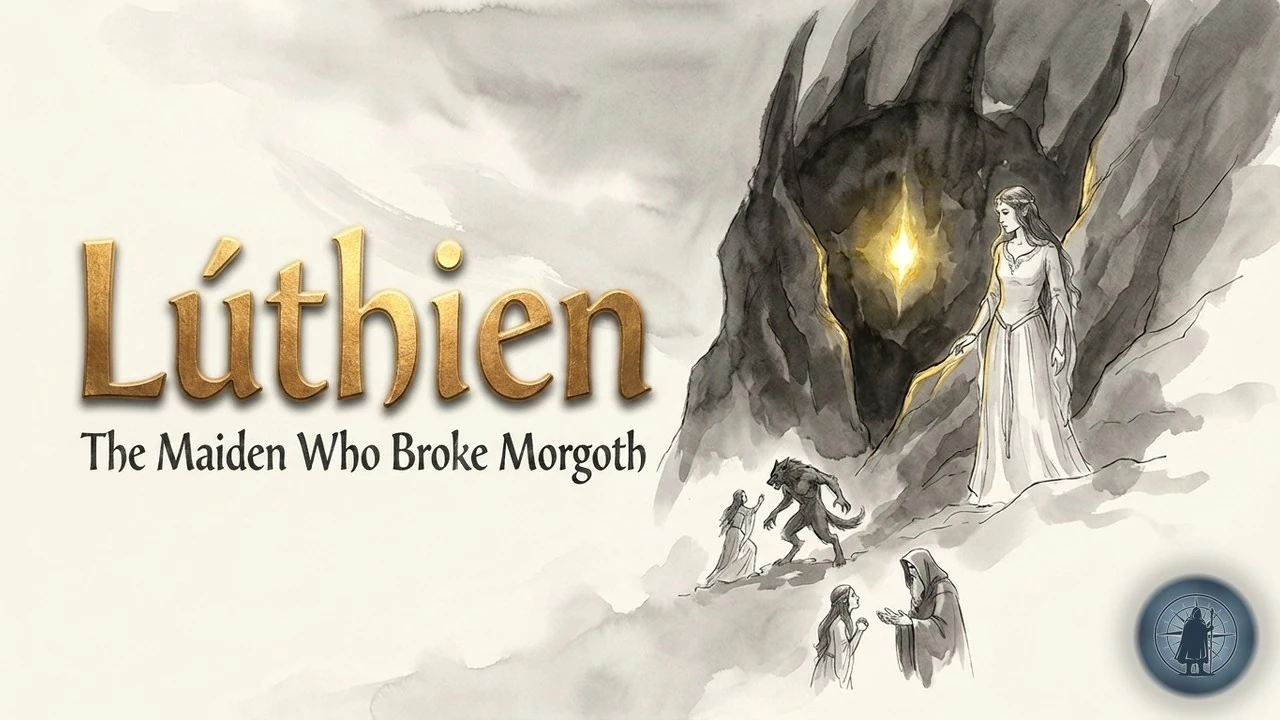 Watch the episode
Lúthien: The Maiden Who Broke Morgoth | Tolkien Explained
Watch the episode
Lúthien: The Maiden Who Broke Morgoth | Tolkien Explained
Research Notes: Lúthien — Most Powerful Being in Middle-earth?
Overview
This episode makes the case FOR a single, audacious thesis: that Lúthien Tinúviel — daughter of an Elven king and a divine Maia, dismissed in the text as a "mere maid" — may be the single most effective power in the history of Middle-earth. The argument rests on three feats no other being can claim in combination:
1. She broke Sauron in single contest at Tol-in-Gaurhoth, forcing the Dark Lord (the future Lord of the Rings) to flee his own fortress — the same fortress where the mighty King Finrod Felagund had just died. 2. She enchanted Morgoth himself — the first Dark Lord, a fallen Vala, the most powerful being to walk Arda — singing him and his entire court to sleep so that a Silmaril could be cut from his Iron Crown. No army of Elves, Men, or Dwarves ever breached Angband and returned; she walked in and out. 3. She moved Death to pity — singing before Mandos, Doomsman of the Valar, and bending the unbendable so that her dead love Beren was returned to life. The text states explicitly this never happened before and has never happened since.
The thesis is not that Lúthien could out-muscle Morgoth in raw strength (she could not, and the text knows it). It is that power in Tolkien is not muscle — it is the capacity to alter outcomes that the mighty cannot. By that measure, the case for Lúthien at #1 is genuinely strong. This is a ranked/debate-format episode: build the case, then test it honestly against the obvious objections (Valar, Eru, the role of Huan, the role of circumstance).
Note on format: This is distinct from a general "Top 10 Most Powerful Beings" ranking and from a Beren & Lúthien love-story episode. The lens here is narrow and argumentative — power, ranked, single-subject.
Primary Sources
The Silmarillion — "Of Beren and Lúthien" (Ch. 19) & "Of the Ruin of Doriath" (Ch. 22)
This is the central text. Key verified passages:
Her nature / the framing claim: - Lúthien is named "the most beautiful of all the Children of Ilúvatar" — described with "blue raiment like unclouded heaven... grey eyes like starlit evening... dark hair like twilight shadows." (Silmarillion, Ch. 19) — this is the channel's "fairest of the Children of Ilúvatar" hook. - She is the only being in the history of Arda born of both a Maia (Melian) and an Elf (Thingol). This dual heritage is the textual root of her power. (Silmarillion; cf. Wikipedia, "Melian")
Defeat of Sauron at Tol-in-Gaurhoth (F.A. 465): - "standing upon the bridge that led to Sauron's isle she sang a song that no walls of stone could hinder." (Silmarillion, Ch. 19) - Sauron sent wolves one by one; Huan slew each silently. Sauron then "took upon himself the form of a werewolf, and made himself the mightiest that had yet walked the world." (Ch. 19) - "even as he came, falling she cast a fold of her dark cloak before his eyes; and he stumbled, for a fleeting drowsiness came upon him." (Ch. 19) - THE ICONIC ULTIMATUM (verbatim): "Ere his foul spirit left its dark house, Lúthien came to him, and said that he should be stripped of his raiment of flesh, and his ghost be sent quaking back to Morgoth; and she said: 'There everlastingly thy naked self shall endure the torment of his scorn, pierced by his eyes, unless thou yield to me the mastery of thy tower.' Then Sauron yielded himself, and Lúthien took the mastery of the isle and all that was there." (Silmarillion, Ch. 19) - This is the single best quote for the episode. She does not merely beat Sauron physically (Huan does the biting) — she terrifies the spirit of Sauron with a worse fate than death and dictates terms. She is the one who masters him.
Enchanting Morgoth in Angband (F.A. 466): - Disguised (Lúthien as the vampire Thuringwethil, Beren as the werewolf Draugluin), they passed the gates and the great wolf Carcharoth. - Before the throne she cast off her disguise, named herself, and sang. "her voice came dropping down like rain into pools, profound and dark." She cast her cloak before Morgoth's eyes "and set upon him a dream, dark as the outer Void." - The spell of sleep fell on Morgoth and his entire court; the Iron Crown grew unbearably heavy, his head sagged, and he toppled from his throne. (Silmarillion, Ch. 19) - Beren cut a Silmaril from the Iron Crown with the knife Angrist; attempting a second, "The knife Angrist snapped, and a shard of the blade flying smote the cheek of Morgoth. He groaned and stirred, and all the host of Angband moved in sleep." (Ch. 19)
The song before Mandos (F.A. 466/467): - After Beren's death, Lúthien's spirit went to the Halls of Mandos and she sang before him. - "The song of Lúthien before Mandos was the song most fair that ever in words was woven, and the song most sorrowful that ever the world shall hear." (Silmarillion, Ch. 19) - The song wove "two themes of words, of the sorrow of the Eldar and the grief of Men, of the Two Kindreds." (Ch. 19) - THE KEY LINE (verbatim sense): "As she knelt before him her tears fell upon his feet like rain upon stones; and Mandos was moved to pity, who never before was so moved, nor has been since." (Silmarillion, Ch. 19) - This is the load-bearing quote for the #1 argument: she did something to Death that the entire rest of Arda's history could not reproduce.
The choice / the cost: - Mandos, with Manwë's and Ilúvatar's sanction, offered Lúthien a choice: dwell blessed in Valinor without Beren, OR return to Middle-earth as a mortal, doomed to die a second and final death, with Beren. She chose mortality. (Silmarillion, Ch. 19) - "she alone of the Eldalië has died indeed, and left the world long ago." Lúthien is the only Elf to truly die and pass beyond the circles of the world.
The Lord of the Rings
- The tale is sung by Aragorn to the hobbits on Weathertop ("The Lay of Lúthien" / "Tinúviel"), establishing Lúthien as the deep-time legend underlying the entire saga. (LOTR, Book I, "A Knife in the Dark") - Arwen is called "Evenstar of her people," explicitly framed as a returning likeness of Lúthien; the Aragorn–Arwen romance deliberately re-runs Beren–Lúthien. (LOTR, Appendix A) - Lineage: Lúthien → Dior → Elwing → Eärendil → Elrond/Elros → Aragorn and Arwen. Her bloodline produces the Half-elven, the Númenórean kings, and ultimately the restored King of Gondor.
Unfinished Tales / HoME
- The Lays of Beleriand (HoME Vol. 3) contains "The Lay of Leithian," the long verse version that is the source of much detail (the hair-lengthening spell "a magic song to Men unknown," her escape from the tree-prison in Doriath, the singing-down of Morgoth's court). - The Book of Lost Tales (HoME Vols. 1–2) preserves the earliest form, "The Tale of Tinúviel": here her name was simply Tinúviel, Beren was an Elf (a Noldo, originally a Gnome), and the antagonist was Tevildo, Prince of Cats rather than Sauron. (Useful "contradictions" material.) - Beren and Lúthien (2017, ed. Christopher Tolkien) compiles the versions in sequence, letting one trace the evolution.
The Letters of J.R.R. Tolkien
- Tolkien called the tale "the kernel of the mythology." (Letters) - Letter to Christopher Tolkien (July 1972) requesting "Lúthien" on Edith's gravestone: "she was (and knew she was) my Lúthien." Their joint Wolvercote gravestone reads Beren / Lúthien. The autobiographical weight is why this character matters more to Tolkien than perhaps any other.
Timeline (First Age, per the Tale of Years)
- F.A. 465 — Beren reaches Doriath; the bride-price (a Silmaril) is set by Thingol. Beren captured by Sauron at Tol-in-Gaurhoth; Finrod Felagund dies there defending him. Lúthien escapes Doriath, allies with Huan, and defeats Sauron at Tol-in-Gaurhoth, freeing Beren. (Tolkien Gateway, "First Age 465") - F.A. 466 — The journey to Angband; Lúthien sings Morgoth's court to sleep; Beren cuts the Silmaril; Carcharoth bites off Beren's hand with the jewel inside. The Hunting of the Wolf: Huan and Carcharoth slay each other; Beren dies of his wounds in Lúthien's arms. - F.A. 466/467 — Lúthien dies of grief; her song before Mandos; Beren and Lúthien are returned to mortal life in Ossiriand (Tol Galen, "Dor Firn-i-Guinar," the Land of the Dead that Live). Birth of Dior Eluchíl. - Later F.A. — Thingol sets the Silmaril in the Nauglamír; he is slain by Dwarves; the recovered jewel passes to Lúthien, who wears it until her final death. The Silmaril then descends to Elwing and Eärendil and becomes the Star.
(Exact years for the death/Mandos sequence vary slightly across editions; 465 for Tol-in-Gaurhoth is firm.)
Key Characters
- Lúthien Tinúviel — Elf-princess of Doriath; only child of Thingol and Melian; uniquely part-Maia. Powers manifest almost entirely through song/enchantment. Arc: sheltered princess → active rescuer who repeatedly out-performs every male hero in the tale (Finrod dies, Beren is captured twice, Huan dies; she is the one who finishes every task) → the only Elf to choose and accept true mortal death. - Melian — Maia of Lórien, Queen of Doriath; wove the Girdle of Melian (an enchantment shielding Doriath). Source of Lúthien's divine inheritance. "The Girdle of Melian proves to be stronger than any power except unselfish love" — a thematic preview of Lúthien's own arc. - Beren Erchamion ("One-hand") — mortal man, House of Bëor. The beloved; notably the passive partner in the power dynamic. His role reframes Lúthien's: he is what she fights for and saves, not the hero who saves her. - Huan — the great Hound of Valinor; slays the wolves and pins wolf-Sauron. CRITICAL for the honest debate: Lúthien did NOT defeat Sauron's body alone — Huan's jaws did the physical work. The case for Lúthien must distinguish physical defeat (Huan) from mastery/domination of the will (Lúthien's ultimatum). This is the strongest counter-argument the episode must address head-on. - Sauron — at this point Morgoth's chief lieutenant; the future Dark Lord of the Third Age. Being mastered by Lúthien is, in hindsight, an extraordinary humiliation of the eventual Ring-lord. - Morgoth (Melkor) — fallen Vala, most powerful being to enter Arda. The fact that he can be put to sleep by a song is the episode's "biggest fish" moment. - Mandos (Námo) — Vala, Doomsman, keeper of the Houses of the Dead. The one whose pity she uniquely won.
Geography
- Tol-in-Gaurhoth ("Isle of Werewolves") — formerly Tol Sirion / Minas Tirith, Finrod's watchtower on an island in the River Sirion, captured by Sauron. Site of the Sauron duel. After her victory, Lúthien threw down its towers and freed the captives. - Angband ("Iron-prison") — Morgoth's vast subterranean fortress beneath Thangorodrim in the far north. Effectively impregnable; the Union of Maedhros and the great Elf-Man coalitions broke against it. Lúthien and Beren are the only beings to enter, take from Morgoth directly, and escape. - Doriath — the Hidden Kingdom, shielded by the Girdle of Melian. Lúthien's home; her escape from it (singing her hair into a sleep-inducing cloak and rope) is an early proof of power. - Ossiriand / Tol Galen — "Dor Firn-i-Guinar," the Land of the Dead that Live, where the resurrected couple dwelt.
Themes & Symbolism
- Power as song, not sword. In Tolkien's cosmology, reality itself was sung into being in the Ainulindalë (the Music of the Ainur). Power that operates through song therefore reaches the deepest structural level of creation. Lúthien's enchantments are not "spells" in a D&D sense; they are participation in the same creative Music that made the world — inherited through Melian, who herself sang in the original Music. This is why her song can override the will of Morgoth and even Mandos: she is working at the level of reality's source code. - The "weak" overturning the "mighty." A recurring Tolkien moral inversion (later echoed by the Hobbits). The text repeatedly calls her a "maid" / "mere maid," then has her do what kings and armies cannot. - Love as the supreme force. "Stronger than any power except unselfish love" (of Melian's Girdle). Lúthien's victories are all powered by love for Beren; the resolution at Mandos is love literally rewriting fate. Connects to Tolkien's Catholic frame: caritas, self-sacrifice, and grace. - Death as gift and choice. Lúthien's choosing of mortality reframes death (the "Gift of Men") not as defeat but as the ultimate act of love and freedom. The most powerful being chooses to lay power down. - Eucatastrophe. The Mandos resolution is the archetypal Tolkien "sudden joyous turn" — grief turned to joy through a near-impossible mercy.
Scholarly Interpretations & Theories
- Orpheus inverted (Tom Shippey; valpo.edu Journal of Tolkien Research). The tale is a retelling of Orpheus and Eurydice — but Tolkien inverts it. Orpheus's song fails and he loses Eurydice; Lúthien's song succeeds and she wins Beren back. Where the Greek hero's art is ultimately impotent against death, Lúthien's art conquers it. Scholars argue this is a deliberate theological statement: in a world made by a benevolent Music, song against death can win. - Female-centred fairy-tale revisioning (John Garth). Garth notes the final version makes Lúthien "far more resourceful than her lover" — Beren is repeatedly the one in distress. The tale subverts the damsel structure: she is the rescuer. - The Harrowing of Hell (Robert Steed). The descent into Angband and the freeing of captives at Tol-in-Gaurhoth echo the medieval motif of Christ harrowing Hell — a liberator bringing light into darkness. Lúthien carries a Christ-typological resonance. - Power-ranking discourse (CBR, ScreenRant, fan communities). Popular analyses consistently place Lúthien at or near the top among non-Valar: "she went toe to toe with the Dark Lord—and utterly humiliated him," and is rated above Galadriel ("Galadriel merely repelled Sauron's forces; Lúthien mastered him in person"). The common caveat: her power is specialized (enchantment) rather than all-encompassing, "which places her just below the absolute apex" — useful as the steelman of the opposing view.
Contradictions & Different Versions
- The Tale of Tinúviel (Book of Lost Tales): earliest form. Antagonist is Tevildo, Prince of Cats (a giant demonic cat), not Sauron. Beren was originally an Elf (Gnome/Noldo), not a mortal Man — which removes the entire mortality-choice theme that the later version is built on. Great "the story used to be totally different" beat. - The Lay of Leithian (Lays of Beleriand): the unfinished long poem; richer detail than the Silmarillion prose, but incomplete — Christopher Tolkien had to bridge gaps when constructing the published Silmarillion. - Etymology evolution: "Lúthien" originally glossed as "Enchantress" (from root LUK, "magic, enchantment"; cf. Doriathrin Luthien, "enchantress," in The Etymologies). Tolkien later shifted the meaning toward "Daughter of Flowers" (lúth, "blossom" + -ien, "daughter"). The earlier meaning is the more on-theme one for a power episode — she was literally named "Enchantress." - The role of Huan vs. Lúthien in the Sauron fight is itself a textual nuance worth flagging: Huan does the killing of wolves and the physical pinning; Lúthien's contribution is the song that breaches the walls, the sleep-cloak that staggers Sauron, and the ultimatum that masters him. Honest framing matters for credibility.
Cultural & Linguistic Context
- Lúthien (Sindarin): later meaning "Daughter of Flowers" (lúth + -ien); original/older meaning "Enchantress" (root LUK). Both meanings are canonical at different stages. - Tinúviel (the name Beren gave her): "Nightingale," more literally "Daughter of Twilight" (from Primitive Quendian tindōmiselde). Ties her identity directly to song and to the hour between day and night. - Melian → musical lineage: Melian was renowned for "songs of enchantment" so beautiful the Valar paused to listen; the singing-power passes mother to daughter, a rare matrilineal magical inheritance in the legendarium. - Real-world parallel: Edith Tolkien dancing in a hemlock glade at Roos, Yorkshire (1917) — the literal origin of the image of Lúthien dancing. The character is, by Tolkien's own statement, a portrait of his wife.
Questions & Mysteries (for discussion / hooks)
- Could Lúthien have defeated Sauron without Huan? The text leaves it open — she staggered him with the cloak, but Huan did the pinning. Where does the credit fall? - Is "putting Morgoth to sleep" a defeat, or did it only work because he was overcome by desire/curiosity and let his guard down? (The Angband-skeptic position: it depended on his being lulled, not overpowered.) - Was the Mandos result her power, or the grace of Eru responding to her song? (Theological reading: she didn't override Death — she moved a Vala to petition, and Ilúvatar/Manwë granted the exception. If so, the "she defeated Death" framing softens.) - If she's #1, why didn't she end the war against Morgoth herself? (Answer the episode should give: she had no desire for dominion — power without will-to-power, the opposite of every Dark Lord.)
Compelling Quotes for Narration
1. "Ere his foul spirit left its dark house, Lúthien came to him, and said that he should be stripped of his raiment of flesh, and his ghost be sent quaking back to Morgoth... 'unless thou yield to me the mastery of thy tower.' Then Sauron yielded himself." — Silmarillion, Ch. 19 (the Sauron mastery) 2. "standing upon the bridge that led to Sauron's isle she sang a song that no walls of stone could hinder." — Silmarillion, Ch. 19 3. "The song of Lúthien before Mandos was the song most fair that ever in words was woven, and the song most sorrowful that ever the world shall hear." — Silmarillion, Ch. 19 4. "Mandos was moved to pity, who never before was so moved, nor has been since." — Silmarillion, Ch. 19 (THE thesis quote) 5. "the most beautiful of all the Children of Ilúvatar." — Silmarillion, Ch. 19 6. "she alone of the Eldalië has died indeed, and left the world long ago." — Silmarillion 7. "she was (and knew she was) my Lúthien." — Tolkien, Letters (on Edith)
Visual Elements to Highlight
1. Lúthien on the stone bridge of Tol-in-Gaurhoth, singing into the dark, walls of the isle behind her. 2. Wolf-Sauron pinned by Huan; Lúthien standing over the cornered Dark Lord delivering the ultimatum. 3. Lúthien before Morgoth's black throne, casting off her bat-form disguise, the Silmarils blazing in the Iron Crown above as the court slumps into sleep. 4. Beren's hand on Angrist, a Silmaril cut free and glowing through living flesh. 5. Lúthien kneeling before the shadowed Mandos, tears falling "like rain upon stones." 6. The Wolvercote gravestone: Beren / Lúthien (real-world close).