Transcript
Isildur
Hero or Failure?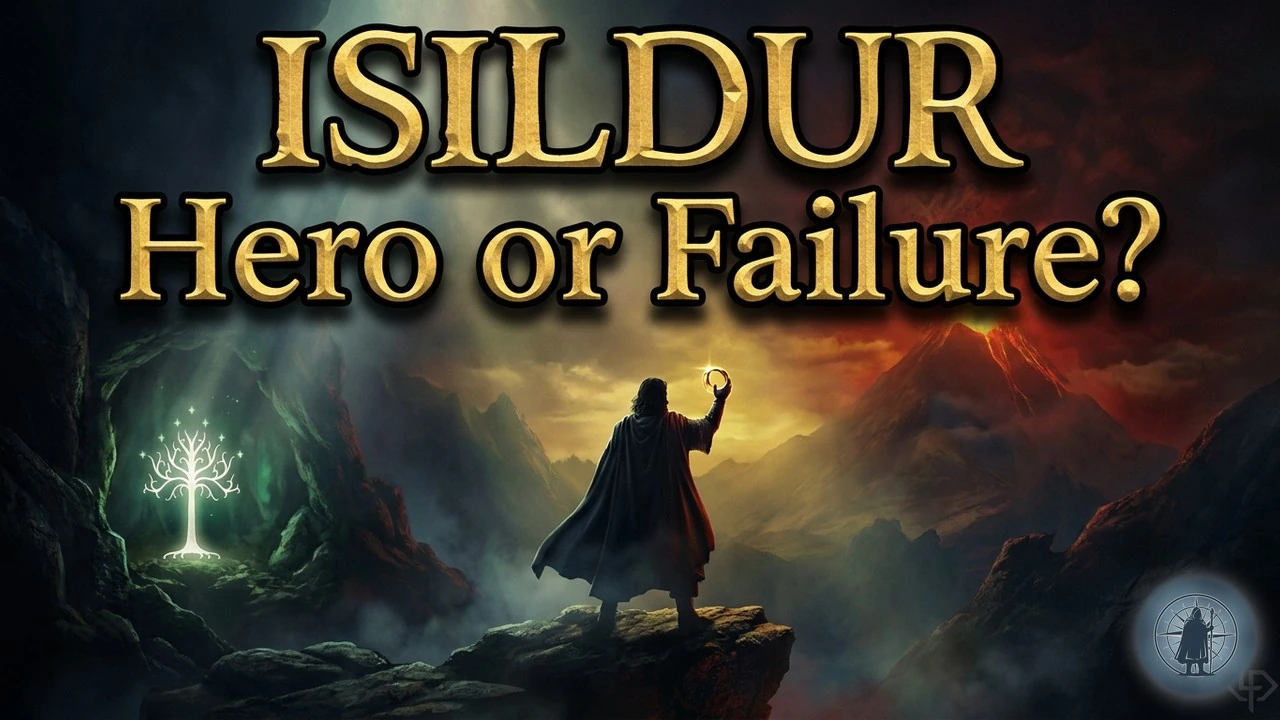 Watch the episode
Isildur: Hero or Failure? | Tolkien's Most Misjudged King Explained
Watch the episode
Isildur: Hero or Failure? | Tolkien's Most Misjudged King Explained
SECTION: The Theft of Nimloth's Fruit
Before he was the man who kept the Ring, Isildur was the man who saved the Tree.
It is a detail almost nobody remembers. In the popular memory there is one Isildur, and he stands on the slope of Mount Doom holding the hilt-shard of his father's broken sword, refusing the counsel of Elrond and Círdan. That image has eaten the rest of his life.
But Tolkien gives him another image first.
Late in the Second Age, on the island of Númenor, the king Ar-Pharazôn had taken Sauron prisoner. And Sauron, prisoner in body, had within a few years made himself the king's chief counsellor in spirit. He persuaded Ar-Pharazôn to fell Nimloth, the White Tree that grew in the king's court at Armenelos — a tree descended, line by sacred line, from the Tree of Tirion in Valinor, which was descended in turn from one of the Two Trees of the Light.
To kill Nimloth was to cut the last living thread of that light on Númenor. Sauron meant to burn it on a great altar in the temple of Morgoth he had built.
Isildur, in disguise, in the night, against orders that forbade any man to enter the Court, slipped past the guards and took a fruit from the Tree before it was felled.
He was discovered. He fought his way out. He took many wounds — spear-wounds, the heads venomed — and he came back to his father Amandil and laid the fruit in his hands and lay near death for a long time.
Then, says the Akallabêth, the leaf of the seedling opened on a sudden in the spring, and Isildur arose, and his pain left him.
That is his first appearance in the legendarium. Not on Mount Doom. In a king's garden, in the dark, bleeding from spear-wounds, holding a single fruit.
The seedling went with Elendil's nine ships when Númenor sank. It was planted at Minas Ithil. When Sauron took Minas Ithil, Isildur saved a fruit from the burning of that tree too. And from that one rescued fruit grew, in time, the White Tree of Gondor, which Aragorn's herald Faramir would honour three thousand years later.
Every white blossom on that tree, in every age that followed, traces back to a young Númenórean prince bleeding from venomed spears in the king's court at Armenelos.
This is the man we are about to watch fail.
SECTION: Two Towers, Moon and Sun
The brothers' names are a piece of prophecy hidden in plain Quenya.
Isildur: Isil, the moon, plus the suffix -(n)dur, "servant of, devoted to." Servant of the Moon.
Anárion: Anar, the sun, with the same suffix. Servant of the Sun.
Moon and Sun. The two great lights of Middle-earth, drawn last from the dying fruit and last flower of the Two Trees of Valinor. The brothers carried that cosmology in their names.
And the cities they built doubled the symbolism.
Isildur founded Minas Ithil — the Tower of the Rising Moon — on the western slopes of the Ephel Dúath, looking eastward toward Mordor. He planted the seedling of Nimloth there.
Anárion founded Minas Anor — the Tower of the Setting Sun — westward across the Anduin, on the spur of Mount Mindolluin. The brothers ruled jointly from Osgiliath, the Citadel of the Stars, between them.
In Second Age 3429, less than a century after the kingdoms were founded, Sauron came forth out of Mordor and took Minas Ithil. The seedling there burned. Isildur escaped north up the Anduin with his wife, his youngest son Valandil, and a fruit he had saved from the burning tree — exactly as he had once saved a fruit on Númenor.
Anárion's tower endured. Through three Ages of the world. The Tower of the Setting Sun became Minas Anor became Minas Tirith — the Tower of Guard — capital of Gondor, last bastion of the West.
The Tower of the Moon became Minas Morgul, the Tower of Sorcery, seat of the Lord of the Nazgûl.
The Moon-tower fell. The Sun-tower stood.
Tolkien is not in the habit of placing accidents in his etymologies. The brother who would lose everything was named, from infancy, for the lesser light — the light that does not burn of itself, the light that only reflects.
SECTION: The Slope of Orodruin
On the slopes of Mount Doom, at the end of the Second Age, three of the great powers of the West stood together over Sauron's broken body.
Gil-galad, last High King of the Noldor in Middle-earth, was already dead — his hand burned by contact with Sauron in the last grappling on the mountainside. Elendil the Tall, High King of Arnor and Gondor, was dead at Sauron's feet — and his sword Narsil, the white flame, was broken under him as he fell.
Sauron's spirit had not yet fled. The body lay there. The Ring lay on the body's hand.
Elrond Half-elven was there. Círdan the Shipwright was there. And Isildur, the only surviving prince of the line of Elendil, took up the broken hilt-shard of Narsil — the same blade his father had been carrying when Sauron struck him down — and with that shard he cut the Ring from Sauron's hand.
That was the moment Sauron's spirit fled and the Second Age ended.
It is one of the great hinges of the legendarium, and the men who saw it happen — Elrond, three thousand years later, at the Council in Rivendell — could still recall the silence on the mountainside afterwards.
What Elrond and Círdan said next has been quoted in nearly every account Tolkien gave of the event. They counselled Isildur to cast the Ring into the fire of Orodruin "nigh at hand, in which it had been forged, so that it should perish, and the power of Sauron be for ever diminished."
Isildur refused.
His words have come down to us in two slightly different forms, but the substance is the same in every version:
"This I will have as weregild for my father's death, and my brother's. Was it not I that dealt the Enemy his death-blow?"
That word — weregild — is doing more work than most listeners realize.
It is an Anglo-Saxon and Old Norse legal term. The man-price. The compensation owed in gold or treasure for a slain kinsman, by which a feud could be settled and revenge averted. It runs through Beowulf; it runs through the Volsunga Saga and the Heimskringla; it is one of the foundational concepts of the Northern moral imagination Tolkien spent his professional life teaching.
For Isildur to call the Ring weregild is not for him to invent an excuse. It is for him to reach, in the most exposed moment of his life, for the most respectable moral vocabulary his ancestors gave him. He has lost his father and his brother to this enemy. The Ring is the enemy's most precious possession. By the law of his fathers, the law that holds the Northern world together, this object is owed to him.
The trouble is that the Ring is the one object in creation that cannot be folded into the ordinary economy of compensation. It is its own thing. It does not pass into a man's keeping; the man passes into its.
And so the moral framework that worked for Hrothgar's hall and the swords of the Volsungs — the framework that prevents endless feud — encounters here, on the slope of an active volcano, the one object on which it has no jurisdiction. Isildur is not being unusually evil. He is being unusually Northern. He is doing what his entire culture would have told him was right.
Tolkien put the matter without softening, in a 1951 letter to his publisher: "Yet here at last comes a sort of catastrophe of folly: Isildur, son of Elendil, cut the ring from Sauron's hand, and his power departed; but the Ring itself was not unmade. Isildur claimed it as his own, as 'weregild for his father.'"
A catastrophe of folly. Not of malice. Not of greed. Of a folly so deep that the author of all this had to coin a phrase for it.
SECTION: The Scroll of Isildur
Three thousand years after the Last Alliance, in the records-room of Minas Tirith, Gandalf the Grey unrolled a parchment in Isildur's own hand.
This document — what later readers call the Scroll of Isildur — is the only first-person record of him that survives. He wrote it during the year he stayed in Gondor after the war, before he set out north. He wrote it because he understood, in some way, that the thing he had taken needed to be on the record.
The scroll begins formally enough. The Great Ring, he says, shall go now to be an heirloom of the North Kingdom; but records of it shall be left in Gondor, where also dwell the heirs of Elendil, lest a time come when the memory of these great matters should grow dim.
It is, on its face, an administrative note. A king ordering his archives.
Then the language changes.
"It was hot when I first took it," he writes, "hot as a glede, and my hand was scorched, so that I doubt if ever again I shall be free of the pain of it. Yet even as I write it is cooled, and it seemeth to shrink, though it loseth neither its beauty nor its shape."
The Ring, in his prose, has begun to behave less like an object and more like an animal that is settling into its master.
He notices that the inscription, which had been "as clear as red flame" when first he held it, has faded; he traces a copy of the letters before the writing disappears entirely. He observes that they are in an Elven-script of Eregion — the same script of Celebrimbor's people, the very smiths the Ring was made to enslave — but in a language he does not know. He guesses, correctly, that the language is the speech of Mordor.
And then, near the end of the scroll, he writes the line that thirteen hundred years later Bilbo Baggins's nephew will hear echoed by a small bog-creature in the depths of the Misty Mountains.
"The Ring misseth, maybe, the heat of Sauron's hand… But for my part I will risk no hurt to this thing: of all the works of Sauron the only fair. It is precious to me, though I buy it with great pain."
Precious.
That word, in Isildur's mouth, two years after Mount Doom — that word is the textual smoking gun. The scholar Tom Shippey has written about it more than anyone: Tolkien planted it there, in the scroll, knowing his readers would not encounter it for hundreds of pages, and would meet it again in Gollum's whispering catalogue of his own losses. By the time the careful reader arrives at the Council of Elrond and Gandalf reads from the scroll aloud, the fate of Isildur is already inscribed in a single adjective.
He is a year removed from refusing to destroy it. He is sitting in his brother's tower in Minas Anor, where he has just planted the second seedling of the White Tree in Anárion's memory. He has buried his father's bones, instructed his nephew Meneldil in the governance of Gondor, ordered his archives, and prepared his ride north.
And in his own first-person handwriting, he calls the thing precious.
The double inheritance is now visible. He has planted a sapling of the saved Tree in his brother's tower with one hand. He has slipped a Ring of Sauron's making onto a chain around his neck with the other. And before the next spring he will be on the road that runs up the eastern bank of the Anduin, carrying both.
SECTION: The Disaster of the Gladden Fields
Fifteen years after The Lord of the Rings was published, in the late 1960s, J.R.R. Tolkien sat down to write the story of Isildur's death.
He never finished it for publication. His son Christopher edited it after his father's death and gave it the title The Disaster of the Gladden Fields, and printed it in Unfinished Tales. It is the longest, latest, and most sympathetic portrait of Isildur in the entire legendarium, and it changes the meaning of everything that came before it.
Here is what the essay establishes.
In the autumn of the second year of the Third Age, Isildur left Gondor. He took with him his three eldest sons — Elendur, Aratan, and Ciryon — and a guard of two hundred Dúnedain knights, war-hardened veterans of the Last Alliance. His youngest son Valandil, a child of about eleven, was already safe in Rivendell with his mother. They rode north up the eastern bank of the Anduin, intending to pass between the river and the Misty Mountains and reach Thranduil's realm in Greenwood the Great in four days, and then go on to Arnor.
They were ambushed at the edge of the Gladden Fields by a host of Orcs out of the Misty Mountains. The Orcs may have outnumbered the Dúnedain ten to one. They had taken the high ground.
The essay is explicit on a detail every careful reader should notice: the Orcs did not know Isildur was carrying the Ring. They were a raiding band that had spotted a Dúnedain column and hoped for plunder. The malice that placed them on that ridge was not Sauron's — Sauron was bodiless, his spirit hidden in waste places. The malice was simply the war-pattern of his servants in the world he had shaped, operating by themselves.
The Ring's malice, however, was about to operate on its own.
Before the final stand, Isildur speaks aloud about the Ring. It is the only place in all the legendarium where Tolkien lets him reflect on what he carries, and it is the passage on which the entire late rehabilitation rests.
"It is precious to me, though I buy it with great pain. The writing was as a fire, and they are letters in the speech of Mordor. I cannot read them. I cannot use it. I dread the pain of touching it. And I have not yet found the strength to bend it to my will. It needeth one greater than I now know myself to be. My pride has fallen. It should go to the Keepers of the Three."
My pride has fallen.
The man who said weregild on the slope of Orodruin is dead. The man who wrote precious in Minas Anor has been broken in private, between the time of writing and the time of riding. He is on the road, with his three eldest sons, heading not north to enthrone himself in Annúminas with the Ring around his neck. He is heading toward Rivendell, toward Lórien, toward Círdan at the Grey Havens — toward the three Elven-rings and their bearers, the only powers in Middle-earth who could be entrusted with what he carries. He is going to give it up.
Tolkien wrote this in 1969. Fifteen years after publishing the version where Elrond's account is harsh and where Isildur dies under the simple shadow of his own greed. Tolkien returned to the man and said: that is not all of it. He had repented. He simply did not live long enough.
The orcs poured down off the ridge. The two hundred Dúnedain held the line in a hilltop ring, falling one by one. Ciryon, the third son, died first. Aratan, the second son, died trying to reach Elendur, the eldest. Elendur himself — the only son Isildur had told about the Ring, the son in whom the elder Elendil's nobility was said to live again — Elendur came to his father at the centre of the failing ring of shields and spoke the last words anyone heard Isildur answer.
"My King," said Elendur. "Ciryon is dead and Aratan is dying. Your last counsellor must advise, nay command you, as you commanded Ohtar. Go! Take your burden, and at all costs bring it to the Keepers: even at the cost of abandoning your men and me!"
And Isildur — and this is the line that breaks the popular caricature of him — Isildur said:
"King's son, I knew that I must do so; but I feared the pain. Nor could I go without your leave. Forgive me, and my pride that has brought you to this doom."
Forgive me.
Elendur kissed him. Go! Go now.
He went. He put on the Ring and slipped down to the Anduin and entered the water and began to swim across, invisible to the orcs on the bank.
And the Ring slipped from his finger.
In all of recorded Middle-earth, this is the first time the Ring acts on its own. Not at Sauron's command — Sauron's hand was bodiless. Not by any wielder's intent. The Ring slipped, of its own desire, from the finger of a man who was carrying it seven hundred miles to surrender it to the Wise. Elrond, three thousand years later, will name what happened: "soon he was betrayed by it to his death."
Isildur, suddenly visible, climbed from the water onto the western bank. The orc archers on the eastern bank saw him and shot. The arrows were poisoned. He fell back into the river, and the Anduin took him, and took also the Elendilmir from his brow — the white star of mithril and crystal that was the badge of the King of Arnor. The Ring lay in the river-mud and waited.
Of two hundred Dúnedain, three survived. Ohtar, his squire, whom he had sent ahead carrying the shards of Narsil to Rivendell. Ohtar's companion. And Estelmo, Elendur's esquire, knocked unconscious in the last stand and left for dead on the field — the only witness to the father–son dialogue that Unfinished Tales preserves.
A king. Three princes. One hundred and ninety-seven knights. One Ring slipping into a river to wait for the next bearer it could find.
And a man who had, in the last hour, broken to his eldest son and asked his forgiveness.
SECTION: Letter 246, and the Question of Failure
In September of 1963, Tolkien was answering a letter from a reader who had asked him whether Frodo failed at the Crack of Doom.
Frodo, you remember, did not throw the Ring in. He stood on the lip of Sammath Naur, claimed the Ring for himself, and put it on. Gollum's teeth were what destroyed it. Frodo's will did not.
Tolkien's answer is the most carefully argued sentence he ever wrote about moral failure:
"I do not think that Frodo's was a moral failure. At the last moment the pressure of the Ring would reach its maximum — impossible, I should have said, for any one to resist, certainly after long possession, months of increasing torment, and when starved and exhausted."
And then the criterion. The principle. The thing that ought to govern any judgment of any bearer of the Ring:
"Moral failure can only be asserted, I think, when a man's effort or endurance falls short of his limits, and the blame decreases as that limit is closer approached."
Tolkien is talking about Frodo. But the criterion does not stop at Frodo. It reaches backwards. It reaches to a man on the slope of an active volcano, with the Ring still hot from the hand of Sauron and his father's body still warm at his feet.
Was Isildur's effort short of his limits?
He was, by every account, the greatest warrior of his Age. He had just personally cut the Ring from a Maia who had walked the world for ages of the world. Three days earlier the Ring's master had slain his father in front of him. The object on his palm had been forged for the express purpose of dominating the will of every other being in Arda.
Frodo, exhausted and broken at the lip of the Crack, could not throw the Ring in. Isildur, fresh from the same fire, did no worse — and did, arguably, something better. He did not put the Ring on. He did not try to use it. For two years, the scroll says, he carried it in pain and did not bend it to any purpose. He could not bend himself to destroying it; but he never bent it to himself either. By the time Unfinished Tales picks him up, he has decided to surrender it.
By Tolkien's own criterion, late and considered and applied to Frodo: this is not the simple moral fall that the popular caricature has made of it.
That does not mean Isildur was not wrong on the slope of Orodruin. Of course he was wrong. Elrond and Círdan were right and he was wrong, and the entire Third Age unfolds from the wrongness. Tolkien never softens that.
What the late material adds is the thing the legendarium was always going to need if it was to be a Catholic work and not merely a Northern one: the recognition that the man who made the wrong choice did not choose it freely against perfect knowledge in a moment of leisure. He chose it on a battlefield, over the body of his father, with the most powerful corrupting object ever made warming his hand. He repented in private. He was on his way to do the act of restitution when the thing he was carrying killed him.
In the Catholic vocabulary that shaped Tolkien's imagination, the structure of repentance has three parts: contrition, the firm purpose of amendment, and the act of restitution. Isildur achieved the first two. The third was denied him by an arrow in his back as he came up out of the river. The blame, in Tolkien's own framework, is real — but it is not unmixed.
Isildur and Frodo, by the criterion of Letter 246, are kin.
SECTION: The Thirty-Ninth Heir
At the Council of Elrond, three thousand and seventeen years after the Gladden Fields, Frodo Baggins lays the One Ring on the table at the centre of the courtyard.
Aragorn son of Arathorn is in the room. A Ranger of the North in travel-stained green, with a broken sword across his knees — the same broken sword Isildur once cut a ring from a hand with. He is the thirty-ninth man in unbroken descent from Isildur's youngest son Valandil, the boy who survived Gladden Fields because he was already at Rivendell when his father and brothers rode north.
Frodo, at one point in the council, speaks the obvious thing — that Aragorn is Isildur's heir, and so the Ring must be his.
Aragorn refuses instantly. He says, in effect: it is not mine.
The scholar Paul Kocher framed the entire arc of Aragorn's story around that refusal. "It seemed fit," Kocher wrote, "that Isildur's heir should labour to repair Isildur's fault."
Notice Tolkien's choice of title. Aragorn is never, in The Lord of the Rings, called "the heir of Elendil" — though he is also that. He is called, again and again, "the heir of Isildur." Elendil fell heroically and broke his sword in the fall. Isildur is the failure; and Tolkien deliberately names the inheritance for the failure, not for the heroism.
This is the answer the legendarium gives to the Northern question of weregild. The blood-price for what was claimed on the slope of Orodruin could not be paid in gold or treasure. It could only be paid in a renunciation — and the renunciation had to be made by the same blood that had made the original claim. Thirty-eight generations waited.
And then in the final spring of the Third Age, on a single day, the line was settled.
The Ring went into the fire of Orodruin — not by Isildur's hand and not by Aragorn's hand, but by the working of a long pity that had begun, generations earlier, with Bilbo Baggins choosing not to kill a creature on a stone in the dark.
Aragorn was crowned in Minas Tirith, in the city Anárion had founded, where Isildur had once planted the second seedling of the saved Tree.
Gandalf led him up to the slopes of Mount Mindolluin, where the dead White Tree of the courtyard had stood barren for years, and there, in a quiet place high above the city, found a sapling of Nimloth alive in the snow.
And in the hoard of Saruman, recovered from the wreck of Orthanc the same year, was the Elendilmir of Isildur — the white star that had been on his brow when he fell into the Anduin three thousand and twenty-one years earlier, lost since that morning, found at last when the heir was crowned.
On one day, in one season, every thread of Isildur's broken life came back into the hand of his heir.
The blade he had used to cut the Ring, reforged as Andúril.
The Tree he had saved from two burnings, alive again on the mountain.
The white star he had worn into the river, recovered out of a wizard's plunder.
And the Ring, the only inheritance of his that his heir refused to claim, gone into the fire from which Isildur could not let it go.
The line of Isildur is the longest single thread in the legendarium — three thousand years of waiting — because the thing it was waiting for was a single act of letting go that the man at its head could not make. The line is named for him because the line is the answer to him.
When Aragorn says, at the council, It is not mine, the answer to the slope of Orodruin is finally spoken.
Nothing in the Northern tradition Tolkien loved teaches that. Beowulf does not teach that. The Volsunga Saga does not teach that. They teach courage, and the keeping of oaths, and the readiness to die for one's hall and one's gold. They do not teach the renunciation of the gold the hero himself has won.
That is the thing the heroic-Germanic frame could not contain — and the thing Isildur, on the slope of Orodruin, in the unrelieved blaze of his own people's moral language, could not yet say. It took thirty-eight generations of his blood for one of them to say it.
And when one of them at last did, the catastrophe of folly named in Tolkien's letter became, in the same breath, the thing the whole legendarium had been waiting to undo.