
Research & Sources
Isildur
Hero or Failure?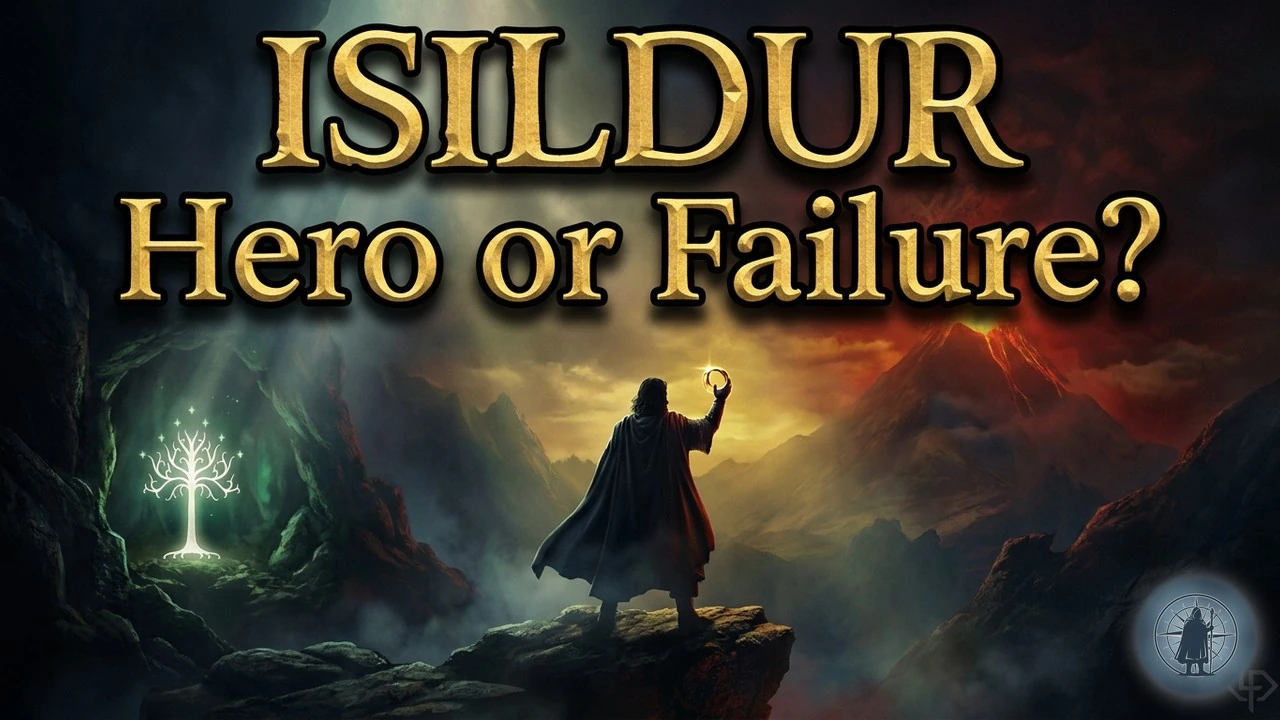 Watch the episode
Isildur: Hero or Failure? | Tolkien's Most Misjudged King Explained
Watch the episode
Isildur: Hero or Failure? | Tolkien's Most Misjudged King Explained
Research Notes: Isildur — Hero and Failure
Overview
Isildur Elendilion is one of Tolkien's great tragic figures: a Númenórean prince who as a youth risked his life to save the White Tree from Sauron's pyre, who as a man helped found two Dúnedain kingdoms in exile, who personally cut the One Ring from Sauron's hand at the end of the Second Age — and who in that single moment of triumph also sealed his own ruin and the long sorrow of the North Kingdom. He is the man who wins the war and loses the peace; the savior of his people's holiest relic and the keeper of their deadliest one. Tolkien returned to him repeatedly across his life — in The Lord of the Rings, in the "Akallabêth," in Of the Rings of Power and the Third Age, in Appendix A and B, and most fully in the late essay The Disaster of the Gladden Fields (in Unfinished Tales) — and the portrait that emerges is more complicated, and more sympathetic, than the simple "Isildur fell to greed" caricature that grew up around him. He is the hero whose failure becomes the shape of the next three thousand years of Middle-earth's history, until his thirty-ninth heir, Aragorn, finally redeems the line.
Primary Sources
The Silmarillion — "Akallabêth" (Númenórean youth)
"Isildur, daring the deadly peril of the king and of Sauron, came by night to the Court, which it was forbidden to any now to enter; and he passed through the guards and took a fruit from the Tree, and turned to go. But the guard was aroused, and he was assailed, and fought his way out, receiving many wounds; and he escaped, and being disguised was not pursued, but came at last back to Amandil. And the fruit he gave into his father's hands."
"Long Isildur lay near to death, and the venom of the wounds of the spears was upon him; but the fruit was tended in secret, and the leaf of the Tree opened on a sudden in the spring; then Isildur arose, and his pain left him."
(Silmarillion, "Akallabêth")
This is the heroic frame for everything that follows. Isildur's first appearance in the legendarium is an act of self-sacrifice for a sacred relic of his people, performed at near-fatal cost.
The Silmarillion — "Of the Rings of Power and the Third Age" (the moment at Mount Doom)
"Then Sauron was for that time vanquished, and he forsook his body, and his spirit fled far away and hid in waste places; and he took no visible shape again for many long years."
"Thus began the Third Age of the World, after the Eldest Days and the Black Years; and there was still hope in that time and the promise of good, and many things remained still fair in Middle-earth, though others were filled with fear and shadow. But Isildur was slain by orcs of the Misty Mountains, as is told in other places. He had been but two years King of Men…"
The crucial dialogue (recounted in this section, the source most quoted across the legendarium):
Isildur said: "This I will have as weregild for my father's death, and my brother's. Was it not I that dealt the Enemy his death-blow?"
But Elrond and Círdan "counselled him to cast it into the fire of Orodruin nigh at hand, in which it had been forged, so that it should perish, and the power of Sauron be for ever diminished, and he should remain only as a shadow of malice in the wilderness."
"But Isildur would not heed this counsel, saying: 'This I will have as weregild for my father and my brother.' …And the Ring he kept, and it was hidden from all save a few."
(Silmarillion, "Of the Rings of Power and the Third Age")
The Lord of the Rings — Council of Elrond ("The Shadow of the Past" / "The Council of Elrond")
Elrond's eyewitness testimony (LOTR Bk II, Ch. 2):
"I remember well the splendour of their banners… It recalled to me the glory of the Elder Days and the hosts of Beleriand, so many great princes and captains were assembled. And yet not so many, nor so fair, as when Thangorodrim was broken… With Gil-galad were Elendil, and Isildur and Anárion his sons; with Elrond was Círdan."
"I was the herald of Gil-galad and marched with his host. I was at the Battle of Dagorlad… I was at the last battle on the slopes of Orodruin, where Gil-galad died, and Elendil fell, and Narsil broke beneath him; but Sauron himself was overthrown, and Isildur cut the Ring from his hand with the hilt-shard of his father's sword, and took it for his own."
"Isildur took it, as should not have been. It should have been cast then into Orodruin's fire nigh at hand where it was made. But few marked what Isildur did. He alone stood by his father in that last mortal contest; and by Gil-galad only Círdan stood, and I. But Isildur would not listen to our counsel. 'This I will have as weregild for my father, and my brother,' he said; and therefore whether we would or no, he took it to treasure it. But soon he was betrayed by it to his death; and so it is named in the North Isildur's Bane."
The Scroll of Isildur (read by Gandalf in Minas Tirith, LOTR Bk II, Ch. 2)
The full extant text — the only surviving first-person record from Isildur:
"The Great Ring shall go now to be an heirloom of the North Kingdom; but records of it shall be left in Gondor, where also dwell the heirs of Elendil, lest a time come when the memory of these great matters shall grow dim."
"It was hot when I first took it, hot as a glede, and my hand was scorched, so that I doubt if ever again I shall be free of the pain of it. Yet even as I write it is cooled, and it seemeth to shrink, though it loseth neither its beauty nor its shape. Already the writing upon it, which at first was as clear as red flame, fadeth and is now only barely to be read."
"It is fashioned in an elven-script of Eregion, for they have no letters in Mordor for such subtle work; but the language is unknown to me. I deem it to be a tongue of the Black Land, since it is foul and uncouth. What evil it saith I do not know; but I trace here a copy of it, lest it fade beyond recall."
"The Ring misseth, maybe, the heat of Sauron's hand, which was black and yet burned like fire, and so Gil-galad was destroyed; and maybe were the gold made hot again, the writing would be refreshed. But for my part I will risk no hurt to this thing: of all the works of Sauron the only fair. It is precious to me, though I buy it with great pain."
This is the most damning single piece of evidence Tolkien ever wrote about Isildur — the word precious placed in his mouth, decades before Gollum echoes it. Gandalf says the scroll proved beyond doubt that Frodo's ring was the One.
Unfinished Tales — The Disaster of the Gladden Fields
Tolkien's late, fullest, and most sympathetic treatment. Composition c. 1969–70; published posthumously by Christopher Tolkien.
Key facts established by this essay: - Date: T.A. 2 (autumn). Isildur left Gondor after a year of administrative work, intending to ride north to Arnor with his three eldest sons and a guard of two hundred war-hardened Dúnedain. - Route: north up the eastern bank of the Anduin, past the Field of Celebrant and toward Greenwood the Great (where Thranduil reigned, four days' march ahead). - The ambush: a great host of Orcs of the Misty Mountains, possibly ten times the Dúnedain in number, fell on them at the edge of the Gladden Fields. The Orcs had been watching Isildur's force, hoping for booty — they did not know he carried the Ring; this was a "chance" attack that the narrative treats as providentially malignant. - Three sons fell in the battle: Ciryon killed first, Aratan mortally wounded trying to rescue his brother Elendur, who as eldest and most trusted was the only son Isildur had told about the Ring.
The decisive late dialogue, preserved (the framing tells us) by Estelmo, Elendur's esquire, who was knocked unconscious and survived:
"'My King,' said Elendur, 'Ciryon is dead and Aratan is dying. Your last counsellor must advise, nay command you, as you commanded Ohtar. Go! Take your burden, and at all costs bring it to the Keepers: even at the cost of abandoning your men and me!'"
"'King's son,' said Isildur, 'I knew that I must do so; but I feared the pain. Nor could I go without your leave. Forgive me, and my pride that has brought you to this doom.'"
"Elendur kissed him. 'Go! Go now!' he said."
(Unfinished Tales, "The Disaster of the Gladden Fields")
Earlier in the same essay Isildur speaks the most extraordinary passage about the Ring ever set down — the only place Tolkien lets him reflect aloud on what he carries:
"It is precious to me, though I buy it with great pain. The writing was as a fire, and they are letters in the speech of Mordor. I cannot read them. I cannot use it. I dread the pain of touching it. And I have not yet found the strength to bend it to my will. It needeth one greater than I now know myself to be. My pride has fallen. It should go to the Keepers of the Three."
(Unfinished Tales, p. 261)
This is the crucial revisionist passage. By T.A. 2, Tolkien shows, Isildur has already repented: he is on his way to give the Ring to Elrond and Galadriel and Círdan. His failure is not that he never recanted — it is that he died before he could.
The death itself:
Isildur put on the Ring to escape; the Ring was already "treacherous" and "betrayed" him by slipping from his finger as he swam the Anduin in the Gladden Fields. He was shot through with poisoned arrows by orc archers on the west bank as he climbed from the water. The Elendilmir, the white star of mithril and crystal that was the badge of the King of Arnor, was on his brow when he fell — and was lost with his body. Only three of his company survived: his squire Ohtar (whom he had sent ahead bearing the shards of Narsil), Ohtar's companion, and Estelmo.
Letters of J.R.R. Tolkien
Letter 131 (to Milton Waldman, c. 1951) — Tolkien's foundational summary:
"Sauron was indeed caught in the wreck of Númenor, so that the bodily form in which he long had walked perished; but he returned to Middle-earth, … and in the war he was bodily vanquished by Gil-galad and Elendil, who themselves perished in the act. Yet here at last comes a sort of catastrophe of folly: Isildur, son of Elendil, cut the ring from Sauron's hand, and his power departed; but the Ring itself was not unmade. Isildur claimed it as his own, as 'weregild for his father', and would not surrender it to be cast into the Fire even at the heart of the place where it was forged."
Tolkien's framing here is unambiguous: the entire shape of the Third Age is the consequence of one man's decision in one moment.
Letter 246 (to Eileen Elgar, Sept. 1963) — on Frodo's "failure," with implicit comparison to Isildur:
"I do not think that Frodo's was a moral failure. At the last moment the pressure of the Ring would reach its maximum — impossible, I should have said, for any one to resist, certainly after long possession, months of increasing torment, and when starved and exhausted."
"Moral failure can only be asserted, I think, when a man's effort or endurance falls short of his limits, and the blame decreases as that limit is closer approached."
The implicit corollary, central to any honest reading of Isildur: neither was Isildur's failure straightforwardly moral. Frodo, exhausted, broken, at the lip of the Crack, could not throw the Ring in. Isildur, fresh from victory, with the Ring still hot from Sauron's hand and his father's body still warm on the slope of Orodruin, did no worse — and arguably better, in that he did not even try to use it. Tolkien's late charity to Frodo extends, by the same logic, backward to Isildur.
Timeline
Second Age - S.A. 3209 – Isildur born in Númenor, son of Elendil son of Amandil, last Lord of Andúnië. - S.A. 3299 – Elendur, Isildur's eldest son, born in Númenor. - c. S.A. 3310–3319 – Isildur, of the Faithful, defies Ar-Pharazôn's regime. Sauron, advisor to the king, persuades him to fell Nimloth the White Tree. Isildur sneaks into the king's court at night, plucks a fruit, escapes wounded, lies near death; recovers when the seedling sprouts. - S.A. 3319 – Downfall of Númenor. Elendil and his sons escape with nine ships; the seedling of Nimloth is among the sacred cargo. - S.A. 3320 – Realms in Exile founded. Elendil High King in Arnor (capital Annúminas). Isildur and Anárion jointly rule Gondor in the south — Isildur from Minas Ithil, Anárion from Minas Anor; Osgiliath the joint capital. Isildur plants the seedling of the White Tree at Minas Ithil. - S.A. 3429 – Sauron attacks; Minas Ithil falls; Isildur flees north with his wife, Valandil, and a seedling of the White Tree (the original Minas Ithil tree was burned by Sauron; Isildur had taken a fruit). - S.A. 3430 – Last Alliance of Elves and Men forged: Gil-galad and Elendil. - S.A. 3434 – Battle of Dagorlad. The Alliance crosses into Mordor. - S.A. 3434–3441 – Seven-year siege of Barad-dûr. Anárion killed by a stone hurled from the tower. - S.A. 3441 – Sauron comes forth in person. On the slopes of Orodruin he kills Gil-galad and Elendil; Narsil breaks beneath Elendil. Isildur takes the hilt-shard and cuts the Ring from Sauron's hand. Sauron's spirit flees. Isildur refuses to destroy the Ring against the counsel of Elrond and Círdan: "weregild for my father and my brother." Second Age ends.
Third Age - T.A. 1 – Isildur remains in Gondor a year. Plants seedling of the White Tree in Minas Anor in memory of Anárion. Instructs his nephew Meneldil (Anárion's son) in the governance of Gondor. Writes the Scroll of Isildur documenting the Ring and its inscription. - T.A. 2 (autumn) – Isildur sets out north for Arnor with his three eldest sons (Elendur, Aratan, Ciryon) and 200 Dúnedain knights. Ambushed by Orcs at the Gladden Fields. All four are slain. Isildur, attempting to swim the Anduin invisible, is betrayed by the Ring (which slips from his finger), shot with poisoned arrows, and falls back into the river. The Elendilmir is lost with him. The One Ring is lost in the Anduin. The squire Ohtar brings the shards of Narsil safely to Rivendell, where Valandil (Isildur's fourth son) inherits the kingship of Arnor. - T.A. 2463 – Déagol finds the Ring in the Gladden Fields. Sméagol murders him. The 2,461-year obscurity begins. - T.A. 3017 – Gandalf reads the Scroll of Isildur in Minas Tirith and confirms Frodo's ring is the One. - T.A. 3019 – Saruman's hoard at Orthanc is recovered; the Elendilmir itself, lost since Isildur's death, is found there. Saruman, in his hunt for the Ring along the Anduin, had apparently found Isildur's bones and taken his regalia. - T.A. 3019 – Aragorn, the thirty-ninth heir of Isildur in unbroken line through Valandil, is crowned Elessar. The Reunited Kingdom is restored. Isildur's sword Narsil, reforged as Andúril, redeems the line.
Key Characters
Isildur (S.A. 3209 – T.A. 2). Quenya: Isil-dur, "Servant of the Moon" (or "devoted to the moon"; cf. Anárion, "of the Sun"). Eldest son of Elendil. Saved the White Tree's lineage; co-founded Gondor; founded the line of Arnor through his son Valandil; cut the One Ring from Sauron's hand; refused to destroy it; died at the Gladden Fields two years later.
Elendil the Tall — Isildur's father. Last Lord of Andúnië. High King of Arnor and Gondor in exile. Slain by Sauron at Orodruin.
Anárion — Isildur's younger brother. Co-founded Gondor; ruled from Minas Anor; killed by a stone hurled from Barad-dûr during the siege.
Sons of Isildur: - Elendur (b. S.A. 3299) — eldest; the only son trusted with knowledge of the Ring; described by Tolkien in Unfinished Tales as the most worthy heir Númenor never had ("such as he, in look and stature, was Elendil the High King in his youth"). Killed at Gladden Fields. - Aratan — second son. Stationed at Minas Ithil during the war. Killed trying to save Elendur. - Ciryon — third son. Also stationed at Minas Ithil. First of the brothers to fall. - Valandil — fourth and youngest, kept safe at Rivendell; inherited Arnor as a child of about 11 (regents until age 21). Direct ancestor of Aragorn.
Meneldil — Anárion's son; Isildur instructed him in T.A. 1 and left him as King of Gondor (the southern crown thus diverged from the northern at Isildur's death).
Ohtar — Isildur's esquire, sent away from the battle bearing the shards of Narsil to Rivendell. One of three survivors.
Estelmo — Elendur's esquire, knocked unconscious at the king's last stand; the source of the preserved father–son dialogue.
Geography
Númenor (the Court of the King, Armenelos) — site of the theft of Nimloth's fruit.
Minas Ithil ("Tower of the Rising Moon") — Isildur's seat in Gondor, on the western slopes of the Ephel Dúath. The first seedling of Nimloth grew here. Sauron captured it in S.A. 3429; it became Minas Morgul in T.A. 2002.
Minas Anor ("Tower of the Setting Sun"; later Minas Tirith) — Anárion's seat. Where Isildur planted the second seedling of the White Tree (in memory of Anárion) before riding north.
Osgiliath — joint royal city on the Anduin.
Dagorlad — "Plain of Battle," north of the Black Gate: site of the Last Alliance's first great victory.
Orodruin / Mount Doom — site of the Last Combat. Elendil and Gil-galad fell on its slopes; Isildur cut the Ring there and refused to destroy it within meters of where it had been forged.
The Gladden Fields — vast reedy marshland where the Gladden River (Sîr Ninglor, "river of golden water-flowers") flows into the Anduin south of the Carrock and Greenwood. The geography is the trap: the road from Lórien to Greenwood narrows to a strip between the Anduin marsh on the west and the steep slopes of the Misty Mountain foothills on the east. The Orcs took the high ground.
The Anduin — the river that carried the Ring away after it slipped from Isildur's finger; recovered there by Déagol some 2,461 years later.
Annúminas / Fornost / Rivendell — northern destinations Isildur never reached. Rivendell would shelter Valandil and the line of the North.
Themes and Symbolism
1. The double inheritance — relics of light and darkness
Isildur is uniquely the bearer of two ancestral relics in the same lifetime: the seedling of Nimloth, which he risked his life to save and which becomes the symbol of the Reunited Kingdom; and the One Ring, which he refused to destroy and which becomes the curse of his line. The man who saved the Tree is the same man who kept the Ring. Tolkien is precise about this symmetry: Isildur the savior of beauty is also Isildur the preserver of evil. Nothing in the legendarium argues more powerfully that goodness and pride coexist in the same heart.2. Weregild — the Germanic frame
Isildur invokes the legal-cultural language of the Anglo-Saxon and Norse world: weregild, the "man-price" owed in compensation for a slain kinsman. He is not making up an excuse; he is naming what he is doing in the moral vocabulary of his ancestors. The problem, Tolkien suggests, is that the Ring is the one object in creation that cannot be made into weregild — it is its own thing, and any attempt to claim it makes it claim you. The heroic-Germanic frame of compensation, which works for swords and gold, fails categorically before the Ring. This is the legendarium's quiet rebuke to the values of Beowulf: a sword can be inherited; this cannot.3. The fall of pride and the late repentance
The most important late revision in The Disaster of the Gladden Fields is that Tolkien shows Isildur repenting in life. "My pride has fallen. It should go to the Keepers of the Three." The man Elrond remembers — stiff-necked, refusing counsel on the slopes of Orodruin — has, two years later, broken. He is riding north not to enthrone himself with the Ring but to surrender it. The ambush kills him before his repentance can become an act. Tolkien thereby converts him from a figure of unrelieved tragic flaw to something closer to a Greek tragic hero: a man undone by the gap between recognition and time.4. Catholic shape: contrition, sacrament, time
The Catholic structure is unmistakable. Isildur recognizes his sin ("my pride has fallen"); he forms a firm purpose of amendment ("it should go to the Keepers of the Three"); but absolution requires the act of restitution, and the act is denied him by death. Compare Letter 246 on Frodo: at the lip of the Crack, no will could resist; Frodo's prior mercies are reckoned to him as righteousness. Isildur's prior heroism — the Tree, the Ring cut from Sauron's hand, two years of administration of Gondor — accumulates the same kind of credit; what he lacks is Frodo's grace of being borne by another's pity at the last moment.5. The Ring's first betrayal — agency and treachery
The Disaster of the Gladden Fields is the only place in the legendarium where the Ring "betrays" its bearer overtly and visibly: it slips from Isildur's finger in the Anduin. Tolkien is careful with the verb. The Ring "wished" to return to Sauron; it had been carried 700 miles from Sauron's hand by a man whose mind was now turning to give it to the Wise; it makes its first move. This is the foundational instance for everything Tolkien later writes about the Ring's quasi-volition. The Gladden Fields, in this reading, are not a random mishap but the Ring's first independent act in three thousand years of plot.6. The Tree and the Ring as parallel inheritance lines
The seedling of the White Tree and the One Ring travel parallel paths through Isildur's life: both rescued from a burning citadel of Sauron (Númenor / Barad-dûr's master), both planted/kept in Gondor, both inherited by his successors. The Tree dies and is replanted three times across the ages, each death marking a low point of the Dúnedain; the Ring is lost and stays lost until Aragorn, sapling-of-the-Tree-found-and-replanted-in-the-same-year, also undoes Isildur's other legacy. Aragorn closes both inheritances on the same day.7. Heroism redefined — the tale's moral arc
The Council of Elrond is the legendarium's restatement of what heroism is. Isildur was the greatest warrior of his age; he refused the Ring and was destroyed. Aragorn, at Frodo's words "it is not mine, it should go to you," renounces it instantly. Frodo, the least, takes it. Tolkien's hierarchy of heroism inverts the Northern one: humility, not prowess, is the only adequate weapon against the Ring. Isildur is the necessary negative example; without his failure, Aragorn's renunciation would mean nothing.Scholarly Perspectives
Tom Shippey (The Road to Middle-earth; J.R.R. Tolkien: Author of the Century): Notes that Isildur's word "precious" in the scroll is the textual smoking gun — a deliberate echo planted by Tolkien generations before Gollum first uses the word, telling the careful reader that the Ring's psychic colonization of Isildur was already advanced. Shippey reads Isildur as Tolkien's demonstration that even the greatest are corruptible, and that the optimistic Enlightenment hope that "evil could be destroyed forever" through one heroic act is precisely what Tolkien is denying.
Paul H. Kocher (Master of Middle-earth, 1972): The structural counterpoint between Isildur and Aragorn is Kocher's central argument about the Ring's politics. "Aragorn, on hearing Frodo's exclamation that since he is Isildur's direct descendant the Ring must be his, at once renounces all claim to it." Kocher reads Aragorn's whole story as the redemption of Isildur's failure: "It seemed fit that Isildur's heir should labour to repair Isildur's fault."
Christopher Tolkien (commentary in Unfinished Tales): Frames The Disaster of the Gladden Fields as his father's late attempt to humanize and exonerate Isildur. Notes the essay was written c. 1969–70, after LOTR had been in print fifteen years, and represents Tolkien's reconsideration of a character who had become flatter in popular memory than the legendarium warranted.
Verlyn Flieger (Splintered Light): Reads Isildur within the broader pattern of Númenórean self-deception: the Faithful are not immune to the corruption of the King's Men; they merely succumb to subtler versions of it. Isildur's "weregild" is a Faithful man speaking the moral language of the Faithful — and it is still wrong.
Jane Chance / Nitzsche (Tolkien's Art): Treats Isildur as the legendarium's most successful tragic hero in the Aristotelian sense — high station, recognizable virtue, a single intelligible flaw, a fall whose magnitude is exactly equal to his prior height.
Online and fan scholarship ("Sweating to Mordor," Henneth Annûn, Journal of Tolkien Research) consistently observes the retcon arc: the early "Of the Rings of Power" Isildur is essentially villainous-by-pride; the late Gladden Fields Isildur is a man already on his knees who simply does not live to make restitution. Tolkien's portrait got softer and more theological as he aged.
Contradictions and Variants
1. When did Isildur take the Ring's measure? In the Silmarillion version, he keeps it knowingly as a treasure ("an heirloom of my house"). In the Unfinished Tales version, he had decided within two years that he could not master it and was riding to surrender it. The accounts are reconcilable but emphasize different stages of his arc.
2. The role of Elrond and Círdan. Silmarillion says they "counselled" him to destroy it. Some readers (and the Jackson films) push this toward "Elrond should have shoved him in." Tolkien never says Elrond could have. The setting is post-battle, on the slope of an active volcano, with the Ring fresh from Sauron's hand and Isildur the senior surviving prince of the West. Coercion was not on the table.
3. The Elendilmir. Two of them existed: the original (lost with Isildur, recovered three thousand years later in Saruman's hoard) and a copy made by the Elven-smiths of Rivendell for Valandil. Aragorn inherited the copy and recovered the original in T.A. 3019.
4. Isildur's "scroll" vs. Isildur's quoted speech. The scroll text in LOTR ("It is precious to me…") and the dialogue in Unfinished Tales ("It is precious to me, though I buy it with great pain. … My pride has fallen.") use the same language but in different moods — the LOTR scroll is from his year in Gondor (T.A. 1, still possessing the Ring as treasure); the Unfinished Tales speech is from the road north (T.A. 2, after a year of growing fear). The same words shift meaning across twelve months.
5. Why the Orcs attacked. Unfinished Tales is explicit that the Orcs of the Misty Mountains did not know the Ring was there — they were, in their own minds, raiding a Dúnedain column for plunder. Sauron's malice operates impersonally through the war-pattern of his servants; the Ring's "betrayal" is its own act, not a coordinated plot.
6. Date of the scroll. Some early Tolkien drafts placed Isildur's writing later or in transit; the published version has him producing it during the year he spent in Gondor (T.A. 1).
7. Number of sons. Consistent across texts: four (Elendur, Aratan, Ciryon, Valandil), but only the Disaster essay individualizes the elder three. Earlier texts often refer simply to "his sons" being slain.
Linguistic Notes
- Isildur — Quenya Isil ("moon") + -(n)dur ("servant of, devoted to"). "Servant of the Moon." Paired with Anárion (Anar, "sun" + same suffix), "Servant of the Sun." The brothers are Moon and Sun, the two great Two-Trees-derived lights, and the symbolism is doubled: Isildur founds Minas Ithil ("Tower of the Moon"), Anárion founds Minas Anor ("Tower of the Sun"). The Moon-tower is the one Sauron captures; the Sun-tower becomes Minas Tirith and endures. - Elendur — Elen ("star") + -dur ("servant"); "Servant of the Star," fitting for the heir who would have worn the Elendilmir. - Aratan — Ara- (high, royal, noble). - Ciryon — círya (ship), recalling the Númenórean voyage. - Valandil — "Friend of the Valar / of the Powers"; the same name as Valandil of Andúnië, ancestor of the Faithful. - Elendilmir — "Star of Elendil." The mithril fillet bearing a single white gem. - Weregild — Old English / Germanic legal term Tolkien knew intimately as a philologist. In Beowulf and the Eddas, weregild settles feuds and prevents endless revenge. Isildur's invocation is therefore philologically exact and theologically doomed: the Ring cannot be folded into the ordinary moral economy of compensation.
Additional Context
- The seedling and the king. Aragorn's coronation in T.A. 3019 includes Gandalf finding a sapling of the White Tree on the slopes of Mindolluin — the lineage Isildur saved continuing past every collapse of his political work. The Tree and the Crown are together again only when Isildur's other failure is also undone. - Isildur and Boromir. Boromir's dream that opens The Council of Elrond speaks of "Isildur's Bane" — a phrase the Council interprets as the Ring (the thing that destroyed Isildur) but which is also a prophecy: Boromir, like Isildur, will reach for the Ring to defend his people, and will die for it. Tolkien plays the parallel deliberately. - The Disaster as inspiration for the geography of Lothlórien's later isolation. The fall of Isildur on the eastern bank of Anduin is one reason the river becomes a hostile no-go zone for the Dúnedain for the next age. - Modern reception (Rings of Power, Jackson films). The Jackson prologue compresses Isildur's story into a single moment of greed at Mount Doom — "Isildur kept the Ring," and that's all we see. The legendarium's actual portrait, especially the Unfinished Tales version, is far more sympathetic and tragic.
Questions for Further Research / Gaps
- Isildur's wife is unnamed in published material. Christopher Tolkien notes drafts where she is named but Tolkien never finalized. - The exact mechanism by which Saruman recovered Isildur's bones (what was left, where, how identified) is implied but not described. - The 2,461-year gap between the Ring's loss and Déagol's discovery — almost the entire Third Age — is one of the great unwritten stretches; the Ring waits patiently in the Anduin for the precise moment.
Discrete Analytical Themes
Theme 1: The Double Inheritance — Tree and Ring
Core idea: Isildur is the unique figure in the legendarium who personally rescues both the holiest and the deadliest object of the Second Age, and the symmetry defines his tragedy. Evidence: - Wounded near death stealing Nimloth's fruit ("Akallabêth"): "Long Isildur lay near to death… but the fruit was tended in secret, and the leaf of the Tree opened on a sudden in the spring." - Cuts the Ring from Sauron's hand with hilt-shard of Narsil; refuses to destroy it (Council of Elrond / Silmarillion). - Both seedling and Ring travel from Mordor's pyre / hand to Gondor under Isildur's care. - Aragorn closes both inheritances on the same day in T.A. 3019: Andúril/Tree restored, Ring destroyed. Distinction: This is about the structural symmetry of his career — every other theme is about a single decision; this is about the shape of his whole life.Theme 2: Weregild as Heroic-Germanic Misframe
Core idea: Isildur reaches for the moral vocabulary of his ancestors — compensation for slain kin — and that vocabulary categorically cannot apply to the Ring. Evidence: - "This I will have as weregild for my father's death, and my brother's. Was it not I that dealt the Enemy his death-blow?" (Silmarillion; quoted at Council of Elrond). - Tolkien's philological exactness: weregild is the legal pivot of Anglo-Saxon and Norse society, settled in Beowulf, the Volsunga Saga, the Heimskringla. - The Ring's nature: it is the one object that cannot be possessed without possessing its possessor. - Letter 131: "claimed it as his own, as 'weregild for his father.'" Distinction: This is about the legal-cultural failure mode — Isildur is invoking a real, valid, ancestral moral framework that simply doesn't have jurisdiction over the One Ring. Different from "pride" or "greed."Theme 3: The Late Repentance (Unfinished Tales Revision)
Core idea: Tolkien's most sympathetic late portrait shows Isildur as a man who had already broken in private and was riding to surrender the Ring when death overtook him. Evidence: - "I cannot use it. I dread the pain of touching it. And I have not yet found the strength to bend it to my will. It needeth one greater than I now know myself to be. My pride has fallen. It should go to the Keepers of the Three." (UT, p. 261) - "I knew that I must do so; but I feared the pain. Nor could I go without your leave. Forgive me, and my pride that has brought you to this doom." (to Elendur, before fleeing the battle) - He is on the road north — toward Rivendell, Lórien, the Three Keepers — not entrenching at Minas Ithil with the Ring. - Christopher Tolkien dates the essay to c. 1969–70, fifteen years after LOTR's publication: a deliberate rehabilitation. Distinction: This is the temporal-theological dimension — recognition of sin without time enough for restitution. Different from his initial refusal at Mount Doom (Theme 2).Theme 4: The Ring's First Betrayal
Core idea: The Gladden Fields are the moment the Ring first acts as an autonomous agent, slipping from a bearer's finger to seek its master. Evidence: - Unfinished Tales: as Isildur swims the Anduin invisible, the Ring slips off; "sudden despair came to him and he would have drowned himself, but the mood passed him as if a great burden had been taken away." - He climbs from the water and is shot dead by orc archers who could not see him until the Ring fell off. - Elrond at Council: "soon he was betrayed by it to his death; and so it is named in the North Isildur's Bane." - This is the foundational textual instance of the Ring as a quasi-volitional entity that "wants" to return to Sauron — established here, before any later instance. Distinction: This is about the Ring as agent, not Isildur as agent. The death scene reveals the antagonist's nature for the first time.Theme 5: Father, Brother, Sons — The Cost in Kin
Core idea: Isildur's life is bracketed and finally consumed by the deaths of his closest kin in the war against Sauron. Evidence: - Father Elendil killed by Sauron at Orodruin; brother Anárion killed by stone from Barad-dûr during the seven-year siege. - Three eldest sons (Elendur, Aratan, Ciryon) killed at Gladden Fields. - Elendur's last act: kissing his dying father, commanding him to flee with the Ring ("Go! Go now!"). - Only Valandil, kept safe in Rivendell, survives — and the entire line of the North Kingdom (and ultimately Aragorn) descends from this single boy. - The "weregild" of Theme 2 was for two deaths; by T.A. 2 the bill has tripled and the man invoking it is dead. Distinction: This is the familial-emotional dimension — the human cost behind the abstractions. Different from the political/cosmological themes; this is about a man losing everyone.Theme 6: The Two Towers — Moon and Sun, Captured and Free
Core idea: The brothers' parallel foundations encode the legendarium's symbolism of which lights endure and which fall. Evidence: - Isildur (Servant of the Moon) → Minas Ithil (Tower of the Moon) → captured by Sauron in S.A. 3429, becomes Minas Morgul. - Anárion (Servant of the Sun) → Minas Anor (Tower of the Sun) → endures, becomes Minas Tirith, capital of the Reunited Kingdom. - Isildur plants the second seedling of the White Tree in Anárion's tower in memory of Anárion (T.A. 1). - The Moon-line carries the Ring; the Sun-line endures the long centuries until Aragorn restores it. Distinction: This is the cosmological-symbolic dimension, encoded in language and geography. Different from the moral/personal themes.Theme 7: Heroism Redefined — The Negative Example Aragorn Redeems
Core idea: Isildur is the legendarium's necessary counter-example to Aragorn; without his failure, Aragorn's renunciation has no weight. Evidence: - Council of Elrond: when Frodo offers the Ring to Aragorn ("It is not mine. It should go to you"), Aragorn refuses instantly. Kocher: "It seemed fit that Isildur's heir should labour to repair Isildur's fault." - Aragorn carries the shards of Narsil — the same blade Isildur used at Orodruin — for 87 years before reforging it as Andúril. - Aragorn's title throughout LOTR: "heir of Isildur" — the inheritance is named for the man who failed, not the man (Elendil) who fell heroically. Tolkien wants the failure foregrounded. - Aragorn is the thirty-ninth heir of Isildur. The line waited 38 generations for redemption. - Letter 246's logic: failure under sufficient pressure is not moral failure. By that standard, Frodo and Isildur are kin; the inheritance is also of mercy. Distinction: This is the long-arc redemptive dimension — Isildur's meaning is not finished at Gladden Fields; it completes only when Aragorn renounces the Ring. Different from the closed tragedy of Themes 3 and 4.Word count: ~3,950
Sources Consulted: Isildur — Hero and Failure
Primary Tolkien Texts (Canon)
1. The Lord of the Rings - Book II, Ch. 2 "The Council of Elrond" — Elrond's eyewitness narration of the Last Alliance, Mount Doom, and Isildur's refusal; Boromir's dream of "Isildur's Bane"; Gandalf's reading of the Scroll of Isildur. - Appendix A, "Annals of the Kings and Rulers" — lineage of Arnor and Gondor through Valandil. - Appendix B, "The Tale of Years" — S.A. 3429–3441; T.A. 2; T.A. 3017; T.A. 3019.
2. The Silmarillion (ed. Christopher Tolkien, 1977) - "Akallabêth" — Isildur's youth in Númenor; the rescue of Nimloth's fruit; the wounding and recovery; the Downfall. - "Of the Rings of Power and the Third Age" — the founding of the Realms in Exile; the Last Alliance; "weregild for my father, and my brother."
3. Unfinished Tales of Númenor and Middle-earth (ed. Christopher Tolkien, 1980) - Part Three, I: "The Disaster of the Gladden Fields" — the single most important source for this episode. Isildur's late repentance speech ("My pride has fallen"); the Estelmo dialogue ("Go! Go now!"); the Elendilmir; the Ring's betrayal in the Anduin; the death by poisoned arrow. Composed c. 1969–70. - Appendices to Unfinished Tales — sources of Númenórean history.
4. The Letters of J.R.R. Tolkien (ed. Humphrey Carpenter & Christopher Tolkien, 1981) - Letter 131 (to Milton Waldman, c. 1951): "Yet here at last comes a sort of catastrophe of folly: Isildur, son of Elendil…" - Letter 246 (to Eileen Elgar, Sept. 1963): on Frodo's "failure" — the moral framework that retroactively softens Isildur.
5. The Peoples of Middle-earth (HoMe XII) — late Tolkien revisions of the Númenórean genealogies.
Web Sources Consulted
- Tolkien Gateway (tolkiengateway.net) — Isildur, Disaster of the Gladden Fields, Scroll of Isildur, Elendilmir, Elendur (son of Isildur), Aratan, War of the Last Alliance, Arnor, House of Isildur, Heir of Isildur, Reunited Kingdom, Letter 131, Letter 246. Most useful general reference. - Wikipedia — Isildur; Heroism in The Lord of the Rings; Aragorn; One Ring. Useful for scholarly framing (Shippey, Kocher) and editorial summaries. - The Tolkien Estate (tolkienestate.com) — primary letter texts where available; Letter 246 to Eileen Elgar. - Henneth Annûn Story Archive — events index entries (the Last Combat, Gandalf reads the Scroll), useful for cross-referencing dates. - The Encyclopedia of Arda (glyphweb.com) — Nimloth, Scroll of Isildur, Isildur biographical entries. - Sweating to Mordor (sweatingtomordor.wordpress.com) — two-part essay "How Isildur Went Out Like a Hero" — particularly useful on the Unfinished Tales late revision and Tolkien's softening of Isildur over time. - Wisdom from The Lord of the Rings (stephencwinter.com) — "This I Will Have as Weregild" essay on Elrond's Council narration. - Tea with Tolkien (teawithtolkien.com) — Letter 131 and Of the Rings of Power readers' guides. - The Tolkien Forum (thetolkien.forum) — discussion of Disaster of the Gladden Fields and Isildur's culpability; useful for fan-scholarly synthesis. - Master of Lore (masteroflore.wordpress.com) — Gladden Fields essay. - Silmarillion Writers' Guild (silmarillionwritersguild.org) — Akallabêth summary; Elendur "Character of the Month" feature. - Parf Edhellen / Elfdict (elfdict.com) — Quenya etymology of Isildur, Anárion, Elendur. - The Tolkien Road Podcast — episodes 0214 and 0215 on The Disaster of the Gladden Fields. - Tolkien Geek (tolkiengeek.blogspot.com) — close reading of the Disaster essay. - CBR.com — articles on Anárion and on Elrond's non-intervention at Mount Doom (mainstream framing). - Journal of Tolkien Research (Vol. 19 Issue 1) — peer-reviewed scholarship on heroism and failure.
Most Useful Sources (in order)
1. Unfinished Tales, "The Disaster of the Gladden Fields" — irreplaceable. Every sympathetic read of Isildur depends on this text. 2. The Council of Elrond chapter (LOTR II.2) — Elrond's eyewitness; the Scroll of Isildur in full. 3. Letter 131 — Tolkien's own framing of the "catastrophe of folly." 4. "Of the Rings of Power" — the canonical "weregild" passage. 5. Letter 246 — the moral framework that, applied consistently, also exonerates Isildur to some degree. 6. Tolkien Gateway / Wikipedia — for cross-referencing dates, lineages, and scholarly summary (Shippey, Kocher).
Notes on Source Quality and Gaps
- Unfinished Tales is the only place where Isildur speaks at length about the Ring in his own voice (other than the brief Scroll). It is therefore disproportionately weighted in this research, which is correct. - The "Akallabêth" Nimloth episode is short but vivid — about three paragraphs of text that establish the heroic frame. - Tolkien never finished a more detailed Isildur biography; gaps include his wife (unnamed), much of his year as administrator of Gondor (T.A. 1), and the precise mechanics of Saruman's later recovery of the Elendilmir. - Christopher Tolkien's editorial notes in Unfinished Tales are essential for understanding the late dating and revisionist intent of the Gladden Fields essay. - Modern adaptations (Jackson, Rings of Power) consistently flatten Isildur to a moment of greed at Mount Doom; the canonical portrait is more textured and should be foregrounded in the script.