Transcript
Grima Wormtongue
The Villain Who Needed No Sword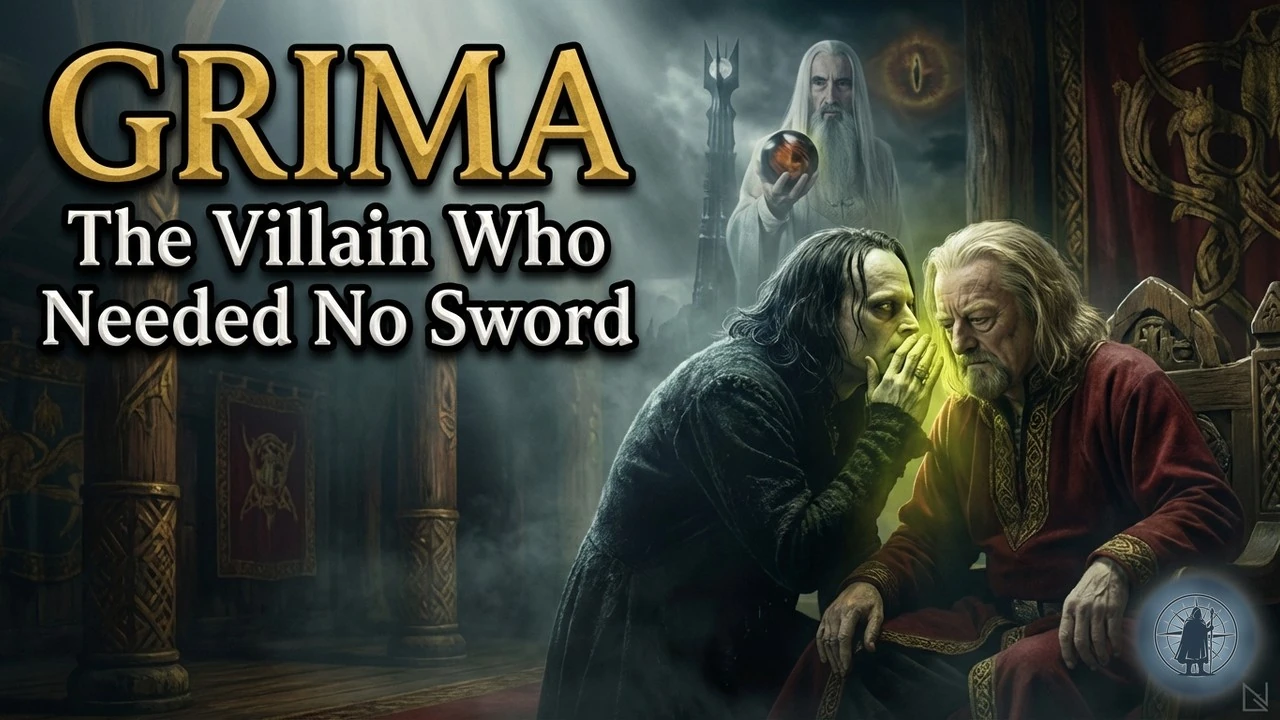 Watch the episode
Grima Wormtongue: The Villain Who Needed No Sword | Tolkien Lore Explained
Watch the episode
Grima Wormtongue: The Villain Who Needed No Sword | Tolkien Lore Explained
Main Narrative: Grima Wormtongue -- The Serpent in the Golden Hall
SECTION: The Mask and the Serpent -- What a Name Reveals
What kind of villain needs no sword, commands no army, and possesses no ring of power -- yet nearly brings an entire kingdom to its knees?
His name tells you everything. Tolkien was a philologist before he was a storyteller, and he packed a lifetime of meaning into two words. "Grima" comes from Old English and Old Norse, where it means "mask," "helmet," or "spectre." It's the hidden face, the thing that conceals what lies beneath. And "Wormtongue" -- wyrm, the Old English word for serpent, joined to tongue. The serpent who speaks. The masked face whispering poison.
Between those two words, Tolkien encoded an entire theology of deception. Grima is the concealed tempter, the voice that sounds like wisdom but serves destruction, the advisor whose every word is a weapon forged in secrecy. His father's name was Galmod -- Old English for "light-hearted" or possibly "frivolous" -- hinting at a family disposition toward moral carelessness, a bloodline where seriousness about virtue never quite took root.
And here's what makes him singular among Tolkien's villains. Sauron had the One Ring. Morgoth had the Silmarils and the strength of a fallen Vala. Saruman had the Voice, that terrible instrument of persuasion that could bend wills across a battlefield. Grima had nothing. No supernatural power. No enchanted artifact. No divine heritage. He was simply a man -- pale-faced, heavy-lidded, wizened -- who understood that the right words, whispered at the right moment into the right ear, could accomplish what armies could not.
This is Ranger of the Realms, and today we're tracing the arc of the most dangerous mortal counselor in Middle-earth. A man who sold his king for a promise, poisoned a throne with syllables, and died far from home with a knife in one hand and nothing in his heart but hatred.
SECTION: The Beowulf Blueprint -- Meduseld as Heorot
To understand Grima, you have to understand where he comes from -- not as a character in Rohan, but as a character in literature. Because Tolkien didn't invent him from nothing. He resurrected him.
In 1936, Tolkien delivered his famous British Academy lecture, "Beowulf: The Monsters and the Critics," which permanently transformed how scholars read the oldest surviving work of English literature. Tolkien didn't just study Beowulf. He internalized it. And when he came to write the chapters set in Rohan -- a culture deliberately modeled on Anglo-Saxon warrior society -- he rebuilt Heorot, Hrothgar's great mead-hall, stone by stone.
Meduseld is Heorot. The golden hall of the Rohirrim kings mirrors the hall of the Danish king in nearly every structural detail. And seated at the feet of each king is a figure the scholarship has long recognized as the same archetype: the hostile counselor.
In Beowulf, his name is Unferth. He lounges at Hrothgar's feet and challenges the visiting hero with hostile rhetoric -- mocking Beowulf's reputation, questioning his strength, trying to undermine him before the court. Beowulf answers with superior truth-telling and Unferth is silenced. In Meduseld, Grima crouches at Theoden's feet and challenges Gandalf with the same rhetorical hostility -- calling him "Lathspell," ill-news, "a carrion-fowl that grows fat on war." Gandalf answers with superior truth-telling and Grima is silenced.
And notice the word "Lathspell" itself. It's Old English -- lath, meaning "loathsome," and spell, meaning "news" or "tale." Grima coined it. He reached into the ancestral language of the Rohirrim and forged a rhetorical weapon from it. This is a man who understands the power of naming, who fights on linguistic terrain with native fluency. He's not just an advisor with bad intentions. He's a skilled rhetorician deploying the culture's own language against its defenders.
The parallels run deeper than character. When Gandalf's company arrives at Meduseld, they're asked to leave their weapons at the door -- precisely as Beowulf and his companions were asked at Heorot. Grima has arranged this, just as he's arranged every other barrier between Theoden and the outside world. Even the door-wardens serve his purposes. When his control slips, he panics: "Did I not counsel you, lord, to forbid his staff? That fool, Hama, has betrayed us!"
That word -- "us." Not "you, my lord." Us. In a single slip of the tongue, the mask cracks. The advisor reveals that he considers himself co-ruler, that he has confused service with partnership, that in his own mind he and Theoden are a joint enterprise. It's the kind of detail Tolkien plants like a seed, trusting the attentive reader to notice.
But the Beowulf connection does more than illuminate Grima's literary genealogy. It explains why he's so transgressive within his own culture. The Rohirrim are warriors. Their society is built on physical courage, on riding to meet the enemy in the open field, on the oath between lord and rider. Grima violates every one of these ideals. He fights with indirection. He works through suggestion. He avoids battle. When Theoden offers him the chance to ride to war and prove his loyalty, Grima spits at his feet and flees.
In an Anglo-Saxon warrior culture, that refusal isn't just cowardice. It's apostasy.
SECTION: The Whisperer's Method -- Words as Weapons
So how did one man, with nothing but language, nearly destroy the most powerful horse-kingdom in Middle-earth?
Gandalf gives us the diagnosis when he frees Theoden from Grima's influence: "Ever Wormtongue's whispering was in your ears, poisoning your thought, chilling your heart, weakening your limbs, while others watched and could do nothing, for your will was in his keeping."
Poisoning thought. Chilling the heart. Weakening the limbs. And most terrifyingly: capturing the will. Gandalf describes a four-stage assault on Theoden's entire being -- intellectual, emotional, physical, and volitional. This isn't metaphor. Or rather, it isn't only metaphor. Unfinished Tales makes the physical dimension explicit: Theoden's malady "may well have been induced or increased by subtle poisons, administered by Grima," possibly disguised as medicinal treatments. The man who poisoned the king's mind may have been poisoning his body too.
Modern readers recognize the pattern immediately. Grima is a gaslighter. He makes Theoden doubt his own perceptions, isolates him from people who might challenge the false reality, controls the flow of information, and fosters total dependence. Stephen Winter calls Grima "the master-hider from reality, both hating and fearing the real." When Theodred dies at the Fords of Isen, Grima doesn't conceal the news -- he weaponizes it. "You speak justly, lord. It is not yet five days since the bitter tidings came that Theodred your son was slain upon the West Marches." Real grief, real loss, deployed as instruments of paralysis.
He banished Eomer, the strongest military leader who might resist Saruman's plans. He incapacitated the king. He turned mourning into surrender. And he did it all while maintaining the posture of loyal service -- the mask never slipping until Gandalf tore it away.
And there's a dimension to his method that extends beyond Rohan's borders. In the version of events preserved in Unfinished Tales, Grima encountered the Nazgul -- the Witch-king himself -- while traveling between Edoras and Isengard around September of 3018. Struck by a terror beyond anything he'd experienced, Grima revealed what he knew of the Shire's location: "West through the Gap of Rohan yonder, and then north and a little west, until the next great river bars the way." The Witch-king spared him, recognizing that a terrified spy still embedded in Rohan's court was more useful than a dead one. Tolkien ultimately abandoned this version, but it survives in Christopher Tolkien's editorial work, and it reveals something important: Grima's cowardice didn't just damage Rohan. It may have helped the Nazgul find Frodo. The consequences of his treachery rippled far beyond any single kingdom.
And Gandalf's method of destruction is the precise opposite of Grima's method of construction. Where Grima worked through indirection, ambiguity, and suggestion, Gandalf works through direct declaration. He names the crimes openly. He states facts. He strips away the carefully maintained facade with nothing more elaborate than the truth. "You have been bought by Saruman," Gandalf says. Not hints. Not insinuation. A plain statement of reality.
"Keep your forked tongue behind your teeth." Gandalf silences the weapon. He doesn't argue with Grima's rhetoric, doesn't engage with his framing, doesn't debate the premises. He simply speaks what is true, and the whole edifice collapses. The serpent imagery -- "forked tongue," "witless worm" -- strips away the pretense of wisdom and names the thing for what it is. The mask cannot survive plain speech.
There's a profound point buried here. In Tolkien's moral universe, deception is always fragile. It depends on darkness, on isolation, on the absence of clarity. Truth doesn't need to be clever. It just needs to be spoken. Gandalf brings light into the darkened hall -- literally, as storm-light floods through the opened doors -- and the shadows flee.
SECTION: The Promised Reward -- Eowyn as Currency
The intellectual analysis of Grima's method risks making him sound abstract -- a case study in rhetoric and political strategy. But there's a dimension to his treachery that's viscerally personal, and Tolkien doesn't let us overlook it.
"You have been bought by Saruman," Gandalf tells Grima, "in part by a promise of Eowyn."
A promise of Eowyn. Not her hand. Not her affection. Her possession. Saruman offered Grima a human being as payment for services rendered. And Grima accepted. The transaction reveals something crucial about the moral economy of corruption in Tolkien: people become objects. Relationships become commerce. Love -- or what masquerades as love -- becomes acquisition.
Grima's pursuit of Eowyn wasn't passive desire. It was systematic predation. He removed her allies one by one with surgical precision. Theoden, incapacitated by Grima's own counsel, could no longer protect her. Theodred, killed at the Fords of Isen in a battle enabled by Rohan's weakened defenses, could no longer stand between her and danger. Eomer, banished on Grima's recommendation, could no longer watch over his sister. Grima "haunted her steps," addressing her with looks that made her recoil.
Richard Purtill, in his analysis of Tolkien's use of the seven deadly sins, identifies Grima as the embodiment of lechery -- desire degraded into predation, wanting reduced to taking. Eowyn herself gives us the most devastating image of what Grima's attention felt like. Her description of her cage -- "a bower closing in about you, a hutch to trammel some wild thing in" -- captures the experience of being the object of a possessor's gaze. She is the wild thing. Grima is the one building the hutch, bar by bar, removing each avenue of escape until the only exit is despair.
This connects to one of Tolkien's deepest convictions about the nature of corruption. In his moral framework, the desire to possess another being -- to own them, to control them, to reduce a person to an object of appetite -- is one of the primary signatures of corruption. It's what Morgoth did to the Silmarils. It's what Sauron did through the Rings of Power. And it's what Grima, at the lowest and most personal level, did to Eowyn. The scale differs enormously. The moral structure is identical.
SECTION: The Chain of Diminishing Evil
Step back from Grima's individual story and a larger pattern comes into focus.
Morgoth was a Vala, the mightiest of all the Ainur who entered the world. His rebellion shook the foundations of creation. He stole the Silmarils, destroyed the Two Trees, bred entire races of monsters, and warred against the combined armies of Elves and Valar for thousands of years. His evil was cosmic.
Sauron was a Maia, lesser than Morgoth but still an angelic being of immense power. He forged the Rings of Power, raised Barad-dur, commanded the Nazgul, and bent entire civilizations to his will. His evil was imperial.
Saruman was an Istari, a Maia sent in diminished form to aid the peoples of Middle-earth. He corrupted his mission, built a war machine at Isengard, bred the Uruk-hai, and aspired to rival Sauron. His evil was industrial.
And Grima was a man. A pale, wizened, heavy-lidded man who murmured in an old king's ear and wanted a woman who despised him. His evil was personal.
Each link in this chain -- Morgoth to Sauron to Saruman to Grima -- produces a more diminished version of the corruption above it. The pattern is deliberate. Tolkien is showing us what darkness looks like as it trickles down through layers of imitation, each servant a lesser copy of the one above. By the time the corruption reaches Grima, it has been stripped of every pretense of grandeur. No cosmic rebellion. No dark tower. No enchanted rings. Just a man crouching at a king's feet, lying for personal advantage.
The Romanian Tolkien Society put it precisely: Grima "embodies the true essence of the malice that Saruman, Sauron and Morgoth possess but stripped of all its pretense of grandiosity." He is what darkness looks like when it has nowhere left to hide -- petty, lecherous, cowardly, and ultimately self-consuming.
The analysis from the Council of Elrond offers one more layer. Perhaps Grima was not inherently wicked. Perhaps he was a man without noble birth or fortune, for whom advancement through conventional means in a warrior culture was impossible. Saruman's honeyed voice offered him what Rohan's social order never would -- significance, influence, the promise that his cleverness mattered more than his bloodline. If that reading is correct, then Grima's fall began not with malice but with desperation, and his corruption is all the more tragic for being comprehensible.
And his trajectory mirrors Saruman's in miniature. Saruman was once a wise Istari who counseled the free peoples; he became Sauron's imitator and ended as a petty criminal in the Shire. Grima was once a counselor to a king; he became Saruman's agent and ended as a starved, beaten creature called simply "Worm." Master and servant followed the same downward arc, each one proving the thesis that wickedness does not elevate its instruments. It devours them.
SECTION: Two Offers of Mercy
Grima is offered redemption twice. Both times he refuses. And those refusals carry the full weight of Tolkien's Catholic moral vision.
The first offer comes from Theoden at Edoras, after Gandalf has broken Grima's hold. The king gives his former counselor two options: "Ride with me to war, and let us see in battle whether you are true; or go now, whither you will." It's a genuine offer. Theoden adds a warning -- "if ever we meet again, I shall not be merciful" -- but the door is open. Grima could ride to Helm's Deep, fight alongside the Rohirrim, and begin the long work of proving that something remained in him worth saving.
He spits at Theoden's feet and flees to Isengard.
The second offer comes from Frodo at Bag End, more than half a year later. By now Grima has been imprisoned with Saruman in Orthanc, starved, beaten, degraded from servant to slave, his name shortened to "Worm." He stands outside Bag End, a broken figure in a broken man's service. And Frodo -- who has carried the Ring to Mount Doom, who has seen what corruption does to a soul, who has watched Gollum struggle and fail and struggle again -- looks at Grima and says: "You need not follow him. I know of no evil you have done to me."
Frodo is offering the same compassion he extended to Gollum. He sees the wretchedness and responds with grace rather than judgment. The door is open again.
Grima follows Saruman.
Tolkien described The Lord of the Rings as "a fundamentally religious and Catholic work." In Catholic theology, damnation is not imposed from outside -- it is chosen. God's grace is always available; the sinner must accept it. The courage to accept requires honesty about what you've become, and the willingness to endure the pain of change. Grima possesses neither. He cannot face what he is. He cannot imagine becoming something else. And so he follows the one who degrades him, because servitude to darkness, however miserable, is at least familiar.
His murder of Saruman -- cutting Saruman's throat after one final public humiliation -- is sometimes read as a moment of liberation. It isn't. There's no moral awakening in it, no act of conscience, no turning toward the light. It's the blind lashing-out of a creature pushed past its breaking point. A tormented animal snapping at its handler. Grima dies seconds later, cut down by hobbit arrows, and there is no indication that he experienced anything resembling clarity or peace. The worm turned. But it was still a worm.
SECTION: The Worm Turns -- Death at Bag End
The end was foreshadowed at Orthanc.
After Gandalf broke Saruman's staff, something came hurtling from a high window of the tower -- a heavy, dark sphere that crashed on the steps below. Gandalf suspected it was "Master Wormtongue, I fancy, but ill aimed." Aragorn offered the sharper insight: "The aim was poor, maybe, because he could not make up his mind which he hated more, you or Saruman."
That single observation captures Grima's entire psychological condition. He existed in a state of bifurcated loathing -- despising the handler who degraded him and the heroes who exposed him, unable to commit fully to rebellion or loyalty. The object he threw turned out to be the palantir of Orthanc, one of the most powerful artifacts in Middle-earth, and he threw it away in a tantrum of confused spite. A shrill shriek from above -- suddenly cut off -- suggests Saruman's violent reaction to losing it. Even Grima's acts of defiance serve his enemies.
What happened between the flooding of Isengard and the Scouring of the Shire is left mostly to imagination. Months of imprisonment in Orthanc with an increasingly desperate and diminished Saruman. The Ents standing guard outside, patient as trees. Two creatures who had once wielded real influence -- one over a wizard's order, one over a king's court -- reduced to gnawing at each other in a stone cage. When the Ents finally allowed them to leave in August of 3019, Saruman and Grima walked out together, master and servant still, bound not by loyalty but by the absence of anything else.
Months later, the final scene. Saruman -- now calling himself "Sharkey" -- has established a petty tyranny in the Shire, the most peaceful and domestic place in Middle-earth. And trailing behind him, starved and beaten, is Grima. When the hobbits confront Saruman at the door of Bag End, the fallen wizard delivers one last act of cruelty. He reveals that Grima murdered Lotho Sackville-Baggins, the hobbits' puppet boss. "Worm killed your Chief, poor little fellow, your nice little Boss. Didn't you, Worm? Stabbed him in his sleep, I believe. Buried him, I hope; though Worm has been very hungry lately."
That final phrase -- "Worm has been very hungry lately" -- carries an ambiguity Tolkien never resolves. Did Grima consume Lotho? Is Saruman accusing his servant of cannibalism, or simply tormenting him with grotesque mockery? The text refuses to answer. What it does tell us is that Saruman delivered this accusation publicly, before the very people Grima had wronged, stripping away his last shred of dignity.
And Grima snapped. The knife came out. Saruman's throat was cut. Gandalf's prophecy -- "They will gnaw one another with words. But the punishment is just" -- fulfilled itself not with words but with steel.
Grima died on the steps of Bag End, pierced by hobbit arrows. Far from the golden hall of Meduseld where he'd once held a kingdom in his whisper. Far from the plains of Rohan where his people rode. Among strangers, in a land he'd never cared about, having murdered the tyrant he served and the hobbit he'd been told to manage, possessing nothing, mourned by no one.
Gandalf had predicted mutual destruction, and mutual destruction is what came to pass. But notice where it happened. Not on some dark battlefield. Not in the ruins of Isengard. At Bag End. Bilbo's front door. The most innocent, most domestic, most ordinary place in Tolkien's entire mythology. Corruption penetrated even there -- and consumed itself there, because it cannot help consuming itself. That is Tolkien's final word on the matter. The serpent that enters the garden always ends up swallowing its own tail.
Grima Wormtongue. The masked face. The forked tongue. The man who sold a king for a promise and followed Saruman all the way to the end, not because he believed in anything Saruman offered, but because he had forgotten how to walk any other road. His tragedy isn't that he was beyond saving. It's that he was offered saving, twice, and could not bring himself to accept it.