
Research & Sources
Grima Wormtongue
The Villain Who Needed No Sword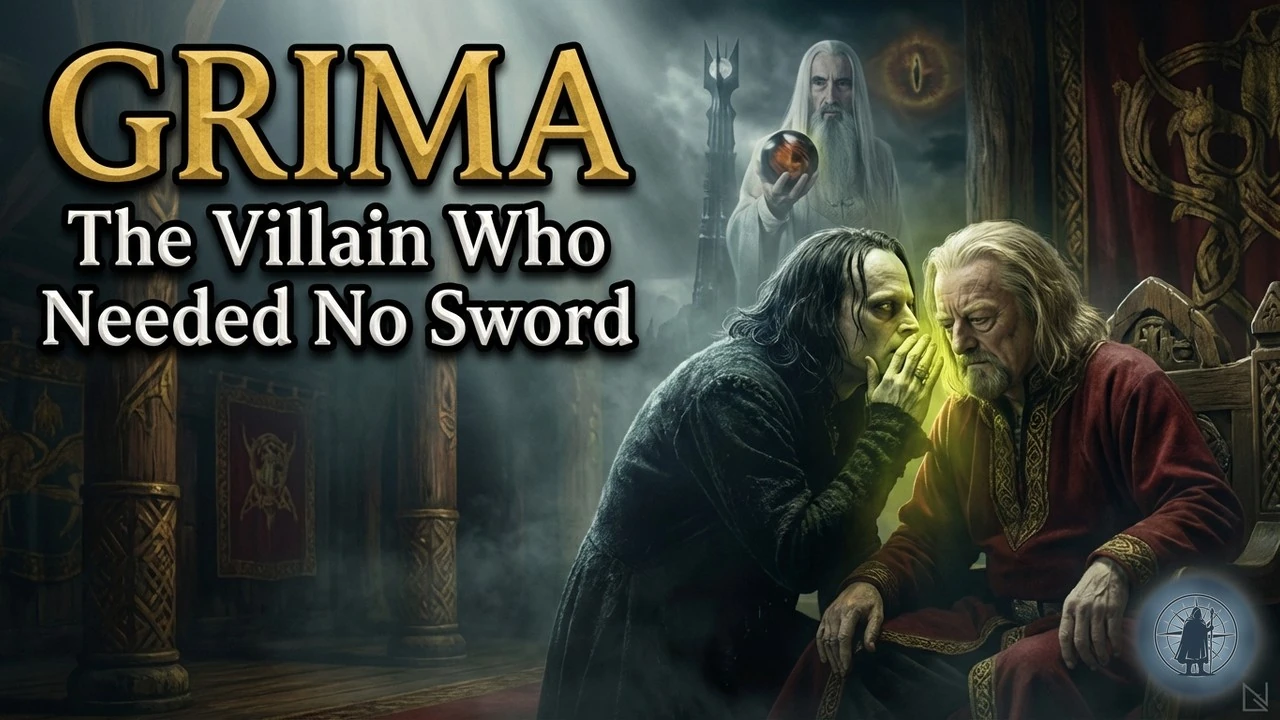 Watch the episode
Grima Wormtongue: The Villain Who Needed No Sword | Tolkien Lore Explained
Watch the episode
Grima Wormtongue: The Villain Who Needed No Sword | Tolkien Lore Explained
Research Notes: Grima Wormtongue
Overview
Grima Wormtongue, son of Galmod, is the chief counselor of King Theoden of Rohan and the secret agent of the wizard Saruman. He represents one of Tolkien's most psychologically complex minor villains -- a figure who wields no sword, commands no army, and possesses no magical artifact, yet nearly destroys the kingdom of Rohan through words alone. His story is a study in corruption through counsel, the degradation of servitude to evil, and the tragic refusal of redemption. Grima occupies a unique position in Tolkien's chain of evil: the lowest rung of a corruption hierarchy descending from Morgoth through Sauron through Saruman, embodying the thesis that evil, stripped of all pretense of grandeur, is ultimately pathetic and petty.
Primary Sources
The Lord of the Rings
#### "The King of the Golden Hall" (The Two Towers, Book III, Chapter 6)
This chapter contains Grima's most prominent appearance. Key textual details:
Physical description: "a wizened figure of a man, with a pale wise face and heavy-lidded eyes" -- a man who looks cunning rather than powerful, whose body reflects his serpentine nature.
Grima's challenge to Gandalf: "Why indeed should we welcome you, Master Stormcrow? Lathspell I name you, Ill-news; and ill news is an ill guest they say." The name "Lathspell" is Old English for "bad news," demonstrating Grima's own linguistic sophistication -- he fights with words, using the language of the Rohirrim against their allies.
Grima's attempt to keep the staff out: "Did I not counsel you, lord, to forbid his staff? That fool, Hama, has betrayed us!" -- revealing how thoroughly he has controlled access to Theoden, managing even the door-wardens.
Gandalf's rebuke: "The wise speak only of what they know, Grima son of Galmod. A witless worm have you become. Therefore be silent, and keep your forked tongue behind your teeth. I have not passed through fire and death to bandy crooked words with a witless worm." -- The serpent imagery is deliberate and devastating.
Gandalf's diagnosis of Grima's method: "Ever Wormtongue's whispering was in your ears, poisoning your thought, chilling your heart, weakening your limbs, while others watched and could do nothing, for your will was in his keeping." -- This reveals the dual nature of Grima's attack: psychological manipulation ("poisoning your thought") and possibly literal poison ("weakening your limbs").
Gandalf's accusation about Eowyn: "You have been bought by Saruman, in part by a promise of Eowyn." -- Saruman had promised Grima possession of Eowyn as payment for his treachery.
Grima on Theodred's death: "You speak justly, lord. It is not yet five days since the bitter tidings came that Theodred your son was slain upon the West Marches." -- Using real grief to reinforce despair and inaction.
Theoden's mercy and Grima's choice: Theoden offers Grima two options: "Ride with me to war, and let us see in battle whether you are true; or to go now, whither you will." But adds: "if ever we meet again, I shall not be merciful." Grima chose exile over proving himself in battle -- spitting at the feet of the king and fleeing the city. His refusal of combat reveals his fundamental cowardice: the man who fights only with words cannot face the consequences of those words.
Grima's description of others: He calls Gandalf's company "pickers of bones, meddlers in other men's sorrows, carrion-fowl that grow fat on war" -- projecting his own parasitic nature onto others.
#### "The Voice of Saruman" (The Two Towers, Book III, Chapter 10)
At Orthanc, Grima appears as Saruman's degraded servant:
Gandalf's command: "Go and fetch Saruman, since you have become his footman, Grima Wormtongue! And do not waste our time!" -- The descent from king's chief counselor to wizard's footman is complete.
Theoden recognizes the voice: "I know that voice, and I curse the day when I first listened to it." -- Theoden's recognition of how thoroughly he was deceived.
The palantir-throwing incident: After Gandalf breaks Saruman's staff, an object is hurled from a high window. Gandalf identifies it as coming from "a window far above" and suspects it was "Master Wormtongue, I fancy, but ill aimed." Aragorn offers the key psychological insight: "The aim was poor, maybe, because he could not make up his mind which he hated more, you or Saruman." The thrown object -- actually the palantir of Orthanc -- represents Grima's confused hatred: he despises both his master and those who exposed him, unable to commit fully to either rebellion or loyalty. A "shrill shriek; suddenly cut off" from above suggests Saruman's violent reaction to losing the palantir.
Gandalf's prophecy: "They will gnaw one another with words. But the punishment is just." -- Foreshadowing the mutual destruction of Saruman and Grima.
#### "The Scouring of the Shire" (The Return of the King, Book VI, Chapter 8)
Grima's final appearance and death:
Saruman's revelation about Lotho: "Worm killed your Chief, poor little fellow, your nice little Boss. Didn't you, Worm? Stabbed him in his sleep, I believe. Buried him, I hope; though Worm has been very hungry lately." -- The implication of cannibalism is deliberately ambiguous. Tolkien leaves it uncertain whether Grima actually consumed Lotho or whether Saruman is simply tormenting his servant with grotesque accusations. The reduction of his name from "Wormtongue" to simply "Worm" marks his complete degradation.
Frodo's mercy: "You need not follow him. I know of no evil you have done to me." -- Frodo extends the same compassion to Grima that was shown to Gollum, offering a path away from servitude.
Grima's murder of Saruman: Grima finally snaps under accumulated abuse and mockery, cutting Saruman's throat -- an act of violence born not from courage or moral awakening but from the breaking point of a tormented creature.
Grima's death: He is killed by hobbit arrows immediately after slaying Saruman. His death on the steps of Bag End, far from Rohan, encapsulates his complete displacement -- a man who betrayed his own people and died among strangers.
Unfinished Tales
#### "The Hunt for the Ring"
In this text, Tolkien explores an important episode that never made it into the published Lord of the Rings: Grima's encounter with the Nazgul.
The encounter: While traveling from Edoras to Isengard (around September 20, 3018 T.A.), Grima was intercepted by the Nazgul -- specifically the Witch-king -- in the fields of Rohan. Struck by terror, he revealed what he knew of Saruman's interest in the Shire and its approximate location: "West through the Gap of Rohan yonder, and then north and a little west, until the next great river bars the way."
Why the Nazgul spared him: The Witch-king "deemed that so great a terror was upon him that he would never dare to speak of their encounter" and recognized that Grima's continued service to Saruman would cause further harm.
Significance: This encounter explains how the Nazgul located the Shire without consulting Saruman directly, resolving a timeline problem in the narrative. It also reveals that Grima's treachery had consequences far beyond Rohan -- his cowardly disclosure under duress contributed to the Nazgul's pursuit of the Ring.
The poison question: Unfinished Tales also addresses Theoden's physical decline: his malady "may well have been induced or increased by subtle poisons, administered by Grima." These were possibly disguised as medicinal treatments, making the metaphor of "poisoned counsel" terrifyingly literal.
Note: Tolkien considered but ultimately abandoned this version of events. Christopher Tolkien's editorial work preserves it as a significant alternate narrative.
The History of Middle-earth
In the early drafts documented in HoME, Grima's role underwent significant evolution:
Original concept: In Tolkien's earliest drafts, Grima was planned to have a "far more important role in the story." He would have been the primary means by which the Nazgul discovered the Shire's location, making him responsible for the Black Riders finding Frodo so quickly.
Boromir connection: Elements of treachery initially attributed to Boromir -- who in early drafts sought lordship of Gondor under Saruman -- were eventually reassigned to Grima after Boromir's arc was recast as tragic but redeemable. Grima absorbed the "internal betrayer" function that Tolkien originally distributed more broadly.
Key Facts & Timeline
- c. 3014 T.A.: Grima begins influencing Theoden as Saruman's agent, gradually taking control of the king's counsel - September 19-20, 3018 T.A.: Gandalf arrives at Edoras and is poorly received (Grima's influence); around this time Grima encounters the Nazgul while traveling to Isengard (per Unfinished Tales) - February 25, 3019 T.A.: Theodred slain at the First Battle of the Fords of Isen -- a military disaster enabled by Grima's weakening of Rohan's defenses - March 2, 3019 T.A.: Gandalf exposes Grima's treachery at Meduseld; Grima is given the choice of war or exile; he flees to Isengard - March 3, 3019 T.A.: Battle of Helm's Deep -- Rohan survives the crisis Grima helped create - March 5, 3019 T.A.: The confrontation at Orthanc; Saruman's staff broken; Grima throws the palantir; imprisoned with Saruman in Orthanc by the Ents - August 15, 3019 T.A.: Released from Orthanc with Saruman after the Ents allow them to leave - c. September 22, 3019 T.A.: Arrives in the Shire with Saruman ("Sharkey") - November 3, 3019 T.A.: Murders Saruman at Bag End; killed by hobbit arrows
Significant Characters
Grima Wormtongue
- Father: Galmod (a Rohirric man; name means "light-hearted" or possibly "frivolous" in Old English) - Physical traits: Pale face, dark heavy-lidded eyes, wizened appearance - Role: Chief counselor to King Theoden; secret agent of Saruman - Motivation: Power, advancement, and possession of Eowyn - Death: November 3, 3019 T.A., at Bag End in the ShireKing Theoden
- Grima's primary victim. The king's physical and mental decline under Grima's influence was both psychological (despair, inaction, isolation) and possibly physical (subtle poisons). When freed by Gandalf, Theoden describes feeling as though waking from a nightmare.Saruman
- Grima's master. Their relationship is one of escalating abuse: Saruman corrupts Grima with promises (Eowyn, power), then degrades him into a servant, then a footman, and finally a starved, beaten creature called simply "Worm." Saruman's treatment of Grima mirrors how Morgoth treated Sauron and how Sauron treated Saruman -- evil devours its own servants.Eowyn
- The promised reward that Saruman dangled before Grima. Grima's pursuit of Eowyn involved isolation tactics: removing her allies (Theoden incapacitated, Theodred killed, Eomer banished), "haunting her steps," and addressing her with "leering" looks. Gandalf's accusation reveals the transactional nature: Eowyn was currency in the Saruman-Grima exchange.Gandalf
- Grima's nemesis. Gandalf dismantles Grima's influence through direct confrontation, naming his crimes openly. The serpent imagery Gandalf deploys ("forked tongue," "witless worm") strips away Grima's pretense of wisdom.Eomer
- The primary target of Grima's political machinations. Grima worked to discredit and ultimately banish Eomer, removing the strongest military leader who might resist Saruman's plans.Theodred
- Theoden's son, killed at the Fords of Isen. While the book attributes his death to Saruman's forces, some analyses suggest Grima's undermining of Rohan's military readiness contributed to the circumstances that led to Theodred's death.Geographic Locations
- Edoras / Meduseld: The golden hall of the Rohirrim kings, where Grima held court and whispered his poison. The hall itself -- modeled on Heorot from Beowulf -- serves as the symbolic battleground between honest counsel and corruption. - Orthanc / Isengard: Where Grima flees after exposure, becoming Saruman's prisoner-servant. The Ents' flooding of Isengard traps both master and servant. - The Shire / Bag End: Where Grima meets his end. His death at Bag End -- the most domestic, peaceful location in Middle-earth -- underscores how far evil can penetrate even into places of innocence. - The Gap of Rohan: Where Grima encountered the Nazgul (per Unfinished Tales), betraying the location of the Shire under duress. - The Fords of Isen: Where Theodred fell, partly due to the military weakness Grima had cultivated.
Themes & Symbolism
The Power of Words as Weapons
Grima's entire arsenal consists of language. He has "no supernatural strength, no magical artifacts, no armies under his command -- only words." Yet those words nearly destroyed Rohan from within. This parallels Saruman's own power of Voice and, at the highest level, Morgoth's corruption through music and speech in the Ainulindale.The Mask and the Serpent
Grima's name encodes his dual nature: "Grima" (Old English/Old Norse for "mask, helmet, spectre") and "Wormtongue" (from Old English "wyrm" = serpent + tongue). He is the hidden face behind counsel and the serpent whispering poison -- combining imagery of concealment with the Edenic tempter.The Chain of Corruption
Morgoth corrupted Sauron; Sauron corrupted Saruman; Saruman corrupted Grima. Each link in this chain produces a lesser imitation of the one above. Grima is what Sauron's evil looks like when it reaches the level of a single mortal man: petty, lecherous, cowardly, and ultimately self-destructive.Servitude and Degradation
Grima's trajectory traces a descent: from king's counselor to spy, from spy to footman, from footman to starved prisoner, from prisoner to "Worm." Evil does not reward its servants; it consumes them. Saruman's progressive abuse of Grima mirrors the broader Tolkienian principle that domination destroys both dominated and dominator.Failed Redemption
Grima is offered mercy at least twice: by Theoden (ride to war or go free) and by Frodo ("You need not follow him"). Both times he refuses. His murder of Saruman is not redemption but the final spasm of a broken creature. Tolkien's Catholic moral framework implies that redemption requires "honest self-reflection and the courage to take responsibility" -- qualities Grima never demonstrates.The Genesis Serpent
Multiple scholars connect Grima to Satan's role in Eden: the tempter who whispers doubt and despair into ears of authority. His "forked tongue" and serpentine associations make this parallel explicit. He represents corruption that works through intimacy and trust rather than open assault.Evil as Ultimately Pathetic
Grima embodies Tolkien's conviction that evil, stripped of all pretense, is small and pitiable. He ends his life far from home, starved, beaten, having murdered his master and been cut down in turn -- the most wretched possible end for what began as a position of influence and trust.Scholarly Interpretations & Theories
The Unferth Parallel (Beowulf)
Tolkien scholars widely recognize that Grima is modeled on Unferth from Beowulf. Both are court advisors who sit at the feet of their king (Grima at Theoden's feet in Meduseld, Unferth at Hrothgar's feet in Heorot). Both challenge visiting heroes with hostile words (Unferth taunts Beowulf about his swimming contest; Grima calls Gandalf "Lathspell"). Both are thoroughly discredited by the hero they challenge. Both exhibit cowardice that violates the warrior ethos of their culture. The entrance of Gandalf's company into Meduseld directly mirrors Beowulf's entrance into Heorot. (J. Allard; multiple Tolkien scholars)The Seven Deadly Sins
Richard Purtill argues that Tolkien intentionally embodied the seven deadly sins in his characters, with Grima representing lechery (his desire for Eowyn) and possibly envy (his resentment of those with genuine nobility). This interpretation aligns with Tolkien's self-described "fundamentally religious and Catholic" work.Gaslighting and Psychological Abuse
Modern scholars and commentators recognize Grima's techniques as what we would now call gaslighting: making Theoden doubt his own perceptions, isolating him from allies, controlling information flow, and fostering dependence. Stephen Winter describes Grima as "the master-hider from reality, both hating and fearing the real."The Complicated Villain
Analysis from the Council of Elrond suggests Grima may not have been inherently evil but was "tempted" by Saruman's "honeyed voice." His lack of noble birth or fortune made advancement through conventional means unlikely, suggesting corruption born from desperation rather than innate wickedness. He is described as "a desperate human being, who has chosen the wrong path far too many times."Machiavellian Political Theory
Stephen Winter draws parallels between Grima's tactics and Machiavellian political manipulation, contrasting fear-based governance (Grima's approach) with love-based leadership (Theoden's genuine kindness once restored).Contradictions & Different Versions
The Nazgul Encounter
The most significant textual variant involves Grima's encounter with the Nazgul in Unfinished Tales ("The Hunt for the Ring"). Tolkien wrote multiple versions of how the Nazgul learned of the Shire's location. In one version, Grima reveals this information under duress; in another version, this role is given to the "squint-eyed southerner" encountered at Bree. Tolkien ultimately abandoned the Grima-Nazgul encounter as "unsatisfactory" but Christopher Tolkien preserved it in Unfinished Tales.Poison: Literal or Metaphorical?
The published Lord of the Rings is ambiguous about whether Grima literally poisoned Theoden or merely "poisoned" his mind through words. Unfinished Tales makes the literal poison more explicit: Theoden's malady "may well have been induced or increased by subtle poisons, administered by Grima." The film adaptation takes this further, showing Theoden physically transformed by Saruman's influence.The Lotho Question
Whether Grima actually consumed Lotho Sackville-Baggins after murdering him is deliberately ambiguous. Saruman's taunt -- "Buried him, I hope; though Worm has been very hungry lately" -- could be literal accusation or simply cruel mockery designed to humiliate Grima before the hobbits.Grima's Early Draft Role
In Tolkien's earliest drafts, Grima was planned for a much larger role, potentially being the primary means by which the Nazgul discovered the Shire. Elements of internal betrayal initially attributed to Boromir were later reassigned to Grima as the character evolved.Cultural & Linguistic Context
Etymology of "Grima"
- Old English: grima = "mask, helmet, visor, spectre" -- reflecting his hidden nature as a spy - Old Norse: grima = "mask" or "concealing helmet" - Connection to English "grim": which in Old English means "ugly, fierce, cruel" - The name perfectly encodes his function: the masked face behind seemingly helpful counselEtymology of "Wormtongue"
- Old English: wyrm = "serpent, snake, dragon" + tunga = "tongue" - Gandalf's repeated serpent comparisons ("forked tongue," "witless worm") are linguistically grounded - "Worm" as used by Saruman is both the Old English meaning (serpent) and the modern diminutive (lowly creature), marking Grima's degradation"Lathspell"
- Old English: lath (loathsome) + spell (news, tale) = "ill news" - Grima's coinage demonstrates his own philological sophistication -- he fights with language native to Rohan's Anglo-Saxon-inspired culture"Galmod"
- Grima's father's name; Old English galmod = "light-hearted, frivolous, wanton" - Possibly suggests a family disposition toward moral laxityRohirric Language Context
Tolkien used Old English to represent the language of Rohan, just as he used Old English for the language of the Shire-hobbits' ancestors. Grima's names and epithets are thus "translations" into the closest real-world linguistic equivalent. The Rohirrim's culture, modeled on Anglo-Saxon warrior society, makes Grima's cowardice and serpentine cunning especially transgressive -- he violates every ideal his culture holds dear.Questions & Mysteries
- When exactly did Saruman recruit Grima? The text says Grima began influencing Theoden around 3014 T.A., but his initial corruption by Saruman may have begun earlier. - Was Grima always predisposed to corruption, or was he genuinely a good counselor before Saruman? The text provides no clear answer. His name ("mask") might suggest an inherently deceptive nature, or it might be a nickname applied after his treachery was known. - Did Grima actually consume Lotho? Tolkien deliberately leaves this ambiguous. - What was Grima's life like between the flooding of Isengard and the Scouring of the Shire? The months of imprisonment with an increasingly desperate Saruman are left to imagination. - Could Grima have been redeemed? Frodo believed so ("You need not follow him"), but Grima's refusal and subsequent murder suggest otherwise. Whether this represents moral failure or psychological impossibility is a matter of interpretation.
Compelling Quotes for Narration
1. "The wise speak only of what they know, Grima son of Galmod. A witless worm have you become. Therefore be silent, and keep your forked tongue behind your teeth." -- Gandalf (TTT, "The King of the Golden Hall")
2. "Ever Wormtongue's whispering was in your ears, poisoning your thought, chilling your heart, weakening your limbs, while others watched and could do nothing, for your will was in his keeping." -- Gandalf (TTT, "The King of the Golden Hall")
3. "Lathspell I name you, Ill-news; and ill news is an ill guest they say." -- Grima (TTT, "The King of the Golden Hall")
4. "The aim was poor, maybe, because he could not make up his mind which he hated more, you or Saruman." -- Aragorn (TTT, "The Voice of Saruman")
5. "They will gnaw one another with words. But the punishment is just." -- Gandalf (TTT, "The Voice of Saruman")
6. "Worm killed your Chief, poor little fellow, your nice little Boss. Didn't you, Worm? Stabbed him in his sleep, I believe. Buried him, I hope; though Worm has been very hungry lately." -- Saruman (ROTK, "The Scouring of the Shire")
7. "You need not follow him. I know of no evil you have done to me." -- Frodo to Grima (ROTK, "The Scouring of the Shire")
8. "I know that voice, and I curse the day when I first listened to it." -- Theoden (TTT, "The Voice of Saruman")
9. "Did I not counsel you, lord, to forbid his staff? That fool, Hama, has betrayed us!" -- Grima (TTT, "The King of the Golden Hall")
10. "His malady may well have been induced or increased by subtle poisons, administered by Grima." -- (Unfinished Tales, "The Hunt for the Ring")
Visual Elements to Highlight
1. Meduseld confrontation: Grima crouching at the feet of a bent, aged Theoden in the darkened golden hall -- the pale-faced advisor whispering to the diminished king 2. Gandalf's storm in the hall: Lightning illuminating the hall as Grima sprawls face-down, cowering from power he cannot match 3. The flight from Edoras: Grima spitting at Theoden's feet and fleeing down the hill, a lone figure against the vast landscape of Rohan 4. The palantir throw: A dark object hurled from a high window of Orthanc, crashing on the steps below -- Grima's confused hatred made physical 5. The Scouring: A starved, beaten Grima crouching beside Saruman at the door of Bag End -- the final degradation of the once-powerful counselor 6. The murder: Grima's knife at Saruman's throat -- the worm finally turning on his master, a moment both terrible and pathetically tragic 7. Eowyn and Grima: The contrast between Eowyn's golden dignity and Grima's pale, leering presence -- beauty and corruption in the same hall
Discrete Analytical Themes
Theme 1: The Weaponization of Language
Core idea: Grima demonstrates that words, wielded with calculated precision, can be more destructive than swords -- nearly toppling a kingdom without a single blow being struck. Evidence: - "Ever Wormtongue's whispering was in your ears, poisoning your thought, chilling your heart, weakening your limbs" (Gandalf, TTT) - "Lathspell I name you" -- Grima coins Old English terms as rhetorical weapons - He calls Gandalf's company "pickers of bones, meddlers in other men's sorrows, carrion-fowl that grow fat on war" - His weapon parallels Saruman's Voice and, at the cosmic level, Morgoth's corruption of the Ainulindale through music Distinction: This theme is specifically about Grima's METHOD -- the mechanics of how words function as instruments of destruction. Not about his psychology or his relationships, but about the technique itself and its place in Tolkien's hierarchy of linguistic power.Theme 2: The Chain of Diminishing Evil
Core idea: Grima is the lowest link in a corruption hierarchy (Morgoth > Sauron > Saruman > Grima), and each descending level produces a more pathetic imitation of the evil above it, proving Tolkien's thesis that evil is ultimately petty. Evidence: - Morgoth corrupted Sauron; Sauron corrupted Saruman; Saruman corrupted Grima - "Wormtongue embodies the true essence of the evil that Saruman, Sauron and Morgoth possess but stripped of all its pretense of grandiosity" (Romanian Tolkien Society) - Both Grima and Saruman were "once noble allies of a human kingdom but were corrupted by an evil wizard" - Grima's end (starved, beaten, far from home) mirrors what evil ultimately does to all its servants Distinction: This theme is about Grima's STRUCTURAL POSITION in Tolkien's cosmology of evil -- how he fits into the architecture of corruption. Not about his individual actions but about what he represents as a pattern.Theme 3: The Beowulf Template -- Meduseld as Heorot
Core idea: Tolkien deliberately modeled the Meduseld confrontation on Beowulf's entrance into Heorot, making Grima a direct literary descendant of Unferth and the scene a conscious reimagining of Anglo-Saxon heroic narrative. Evidence: - Grima lounges at Theoden's feet exactly as Unferth sits at Hrothgar's feet - Both challenge visiting heroes with hostile rhetoric and are thoroughly discredited - Both exhibit cowardice violating the warrior ethos of their culture - Gandalf's entrance into Meduseld mirrors Beowulf's entrance into Heorot, including the demand to leave weapons - Tolkien's professional expertise in Beowulf ("The Monsters and the Critics," 1936) makes this connection deliberate Distinction: This theme is about LITERARY GENEALOGY -- the specific source material Tolkien drew upon and how he transformed it. Not about Grima's moral character but about his artistic origins.Theme 4: Eowyn as Currency -- Possession, Isolation, and Desire
Core idea: Grima's pursuit of Eowyn reveals how evil reduces persons to objects; his systematic isolation of her parallels his broader strategy of severing all bonds of trust within Rohan's royal household. Evidence: - "You have been bought by Saruman, in part by a promise of Eowyn" -- Gandalf exposes the transaction - Grima removes Eowyn's allies systematically: Theoden incapacitated, Theodred killed, Eomer banished - He "haunted her steps" with "leering" looks; she had to "step aside from him" - Richard Purtill identifies Grima as embodying the deadly sin of lechery - The cage metaphor: Eowyn's "bower closing in about you, a hutch to trammel some wild thing in" Distinction: This theme is about the EOWYN DIMENSION specifically -- how Grima's corruption manifests as sexual predation and objectification, and how this connects to Tolkien's treatment of desire and possession as moral categories.Theme 5: The Refusal of Mercy
Core idea: Grima is offered redemption at least twice and refuses both times, making his tragedy one of choice rather than fate -- a specifically Catholic vision of damnation as self-chosen. Evidence: - Theoden's offer: "Ride with me to war... or go now, whither you will" -- Grima spits and flees - Frodo's offer: "You need not follow him. I know of no evil you have done to me" -- Grima follows Saruman - Tolkien called LOTR "a fundamentally religious and Catholic work" - Redemption in Tolkien's framework requires "honest self-reflection and the courage to take responsibility" -- qualities Grima never demonstrates - His murder of Saruman is not redemption but the spasm of a broken creature Distinction: This theme is about MORAL AGENCY and THEOLOGICAL IMPLICATIONS -- not Grima's psychology but the metaphysical stakes of his choices within Tolkien's Catholic moral universe.Theme 6: The Mask Falls -- Gandalf's Method of Exposure
Core idea: The Meduseld scene dramatizes how truth-telling defeats manipulation; Gandalf's method is to name evil plainly, stripping away Grima's carefully constructed facade. Evidence: - Gandalf names Grima's crimes openly: his sale to Saruman, his designs on Eowyn, his poisoning of counsel - The storm in the hall: "Wormtongue sprawled on his face" -- physical power reinforcing verbal truth - "Keep your forked tongue behind your teeth" -- silencing the weapon of words - Contrast with Grima's method: Grima works through indirection, suggestion, and ambiguity; Gandalf works through direct declaration - This mirrors how Beowulf defeated Unferth: through superior truth-telling Distinction: This theme is about the ANTIDOTE to Grima's poison -- the specific mechanism by which his influence is broken. Not about Grima himself but about what defeats him and why.Theme 7: The Worm Turns -- Saruman's Final Destruction from Within
Core idea: Grima's murder of Saruman at Bag End fulfills the pattern that evil destroys itself through the very instruments it creates -- the abused servant becomes the executioner. Evidence: - "They will gnaw one another with words. But the punishment is just." -- Gandalf's prophecy fulfilled - The palantir throw at Orthanc foreshadows the final violence: "he could not make up his mind which he hated more" - Saruman's escalating abuse (servant > footman > "Worm" > starved prisoner) creates the conditions for his own death - The murder follows Saruman's public humiliation of Grima regarding Lotho - Grima dies immediately after -- suggesting mutual destruction, not liberation - The location (Bag End) makes the self-consuming nature of evil explicit: it invades even the Shire but cannot survive there Distinction: This theme is about the ENDGAME -- the specific narrative mechanics of how the Grima-Saruman relationship resolves, and what this resolution means for Tolkien's vision of evil as inherently self-destructive.Additional Notes
Connection to Broader Themes in Tolkien
Grima's story connects to several major patterns in Tolkien's work: - The corruption of counsel mirrors the Rings of Power's corruption of the Nine Kings (both involve the promise of power leading to servitude) - Words as weapons connects to Saruman's Voice, Morgoth's lies to Hurin, and the broader theme that the most dangerous evil works through persuasion rather than force - The faithful counselor vs. the false counselor is a recurring motif (compare Grima with characters like Hurin's loyalty, or Denethor's tragic but honest despair)The Name "Galmod"
Grima's father Galmod (Old English "light-hearted, frivolous, wanton") may suggest a hereditary moral weakness, though Tolkien does not develop this further. It raises the question of whether corruption runs in families or is purely a matter of individual choice.Film vs. Book Differences
Peter Jackson relocated Saruman's death from the Scouring of the Shire to Orthanc (extended edition), eliminating the thematic significance of evil penetrating the Shire. In the film, Legolas kills Grima with an arrow at Orthanc rather than hobbit archers at Bag End. The film also adds scenes not in the book: Grima shedding a tear upon seeing the Uruk-hai army (suggesting buried conscience), and expanded interaction with Eowyn.Sources: Grima Wormtongue Research
Primary Tolkien Texts
The Lord of the Rings
- The Two Towers, Book III, Chapter 6: "The King of the Golden Hall" -- Primary source for Grima's characterization, the Meduseld confrontation, Gandalf's exposure of his treachery, and Theoden's mercy - The Two Towers, Book III, Chapter 10: "The Voice of Saruman" -- The Orthanc scene, palantir throwing, Gandalf's prophecy about Grima and Saruman - The Return of the King, Book VI, Chapter 8: "The Scouring of the Shire" -- Grima's death, murder of Saruman, the Lotho revelation, Frodo's mercyUnfinished Tales of Numenor and Middle-earth
- "The Hunt for the Ring" -- Grima's encounter with the Nazgul, revelation of the Shire's location, discussion of subtle poisons administered to TheodenThe History of Middle-earth
- The War of the Ring (HoME Vol. 8) -- Early drafts showing Grima's originally larger role, evolution of the character from early manuscriptsThe Letters of J.R.R. Tolkien
- Letter 131 -- Tolkien's description of LOTR as "a fundamentally religious and Catholic work" - Letter 192 (1956) -- Commentary on mercy and pity: "only truly present when contrary to prudence"Web Sources
Encyclopedic References
- Grima - Tolkien Gateway -- Comprehensive wiki entry with biography, etymology, and source references. Most useful for factual overview and timeline. - Grima Wormtongue - Wikipedia -- Good overview including literary analysis, Beowulf parallels, and adaptations summary. - Grima - LOTR Fandom Wiki -- Detailed biography and relationship information. - Grima Wormtongue - Thain's Book -- Very useful comprehensive character profile with detailed timeline, etymology, and psychological analysis.Scholarly and Analytical Sources
- Wormtongue - Wisdom from The Lord of the Rings (Stephen C. Winter) -- Highly useful scholarly blog analyzing Grima's psychological manipulation tactics, Machiavellian parallels, and the contrast between fear-based and love-based leadership. - Stephen C. Winter: Gandalf Overcomes Wormtongue in Meduseld -- Detailed analysis of the Meduseld confrontation scene. - Of Grima Wormtongue, the Snivelling Turncoat - Romanian Tolkien Society -- Very useful scholarly analysis of corruption hierarchy, Unferth parallels, and Grima's role as diminished embodiment of evil. - Pity and Mercy in The Lord of the Rings: Gollum, Grima, and Saruman (Nathan Paul) -- Useful theological analysis of mercy extended to Grima and its implications. - Grima Wormtongue: A Complicated Character - Council of Elrond -- Very useful analysis of moral complexity, motivations, and whether Grima was inherently evil or corrupted. - Wormtongue at the Listless Wheel - The Gospel Coalition -- Christian theological interpretation of Grima as spiritual tempter, Genesis serpent parallels.Chapter Analysis Sources
- LOTR Re-read: Two Towers III.6 "The King of the Golden Hall" - Reactor Magazine -- Detailed chapter analysis with direct text quotes. - 310 - The Voice of Saruman (Chapter-by-Chapter analysis) -- Analysis of the Orthanc scene and palantir incident. - The Hunt for the Ring - Tolkien Gateway -- Summary of the Unfinished Tales material about Grima and the Nazgul.Character Analysis and Discussion
- Why Wormtongue Kills Saruman - Game Rant -- Analysis of the murder's psychological motivations and thematic significance. - Was Grima Secretly Trying to Help by Throwing the Palantir? - Game Rant -- Discussion of the palantir-throwing scene's ambiguity. - Wormtongue Originally Played a Major Role - CBR -- Early draft information about Grima's expanded role. - Grima and the Nazgul - Sweating to Mordor -- Detailed timeline analysis of the Nazgul encounter from Unfinished Tales.Beowulf Parallels
- Wormtongue is Based on Unferth in Beowulf - Medium (Emily) -- Direct analysis of the Unferth-Grima connection. - The Influence of Beowulf on Tolkien's LOTR - DeniseOD -- Broader Beowulf influence including Meduseld/Heorot parallels.Linguistic Sources
- Grima Wormtongue: Behind the Name - Tolkien Enthusiast (Tumblr) -- Etymology analysis of the name components.Source Quality Assessment
Most valuable sources for script writing (in order): 1. The primary Tolkien texts (TTT chapters 6 and 10, ROTK chapter 8, Unfinished Tales) 2. Romanian Tolkien Society analysis (corruption chain, Unferth parallels) 3. Stephen C. Winter's blog (psychological manipulation analysis) 4. Council of Elrond character analysis (moral complexity) 5. Nathan Paul's mercy/pity analysis (theological framework) 6. Thain's Book profile (comprehensive factual reference)
Information gaps: - Limited access to HoME Vol. 8 (The War of the Ring) for specific Christopher Tolkien editorial notes on Grima's textual evolution - No direct access to Richard Purtill's scholarly work on Seven Deadly Sins in Tolkien - Tolkien Gateway was blocked (403 error) during research; relied on search result summaries - Wikipedia was also blocked (403 error); relied on search result summaries