Númenor
the star-island that drowned itself in pride
The Story
The Valar raised Númenor out of the sea after the War of Wrath as a gift to the Edain who had stood with the Eldar against Morgoth. For three thousand years the Dúnedain, the Men of the West, were the glory of mortals: long-lived, sea-kings whose ships ranged from Lindon to the southern coasts of Middle-earth.
Then Sauron came as a captive, and as a captive corrupted the last and proudest of the kings, Ar-Pharazôn the Golden. The white tree was burned. Sauron's temple rose. The fleet sailed against the Valar in defiance of the Ban that had stood since the world's making.
And Eru himself bent down and broke the world. The fleet was buried under mountains. Númenor sank in a single day. The round world was made so that no road would ever lead back. Only Elendil and his sons escaped, sailing east to make Arnor and Gondor in exile. The Akallabêth, the Downfallen, is the keenest grief in Tolkien's whole legendarium.
The Land
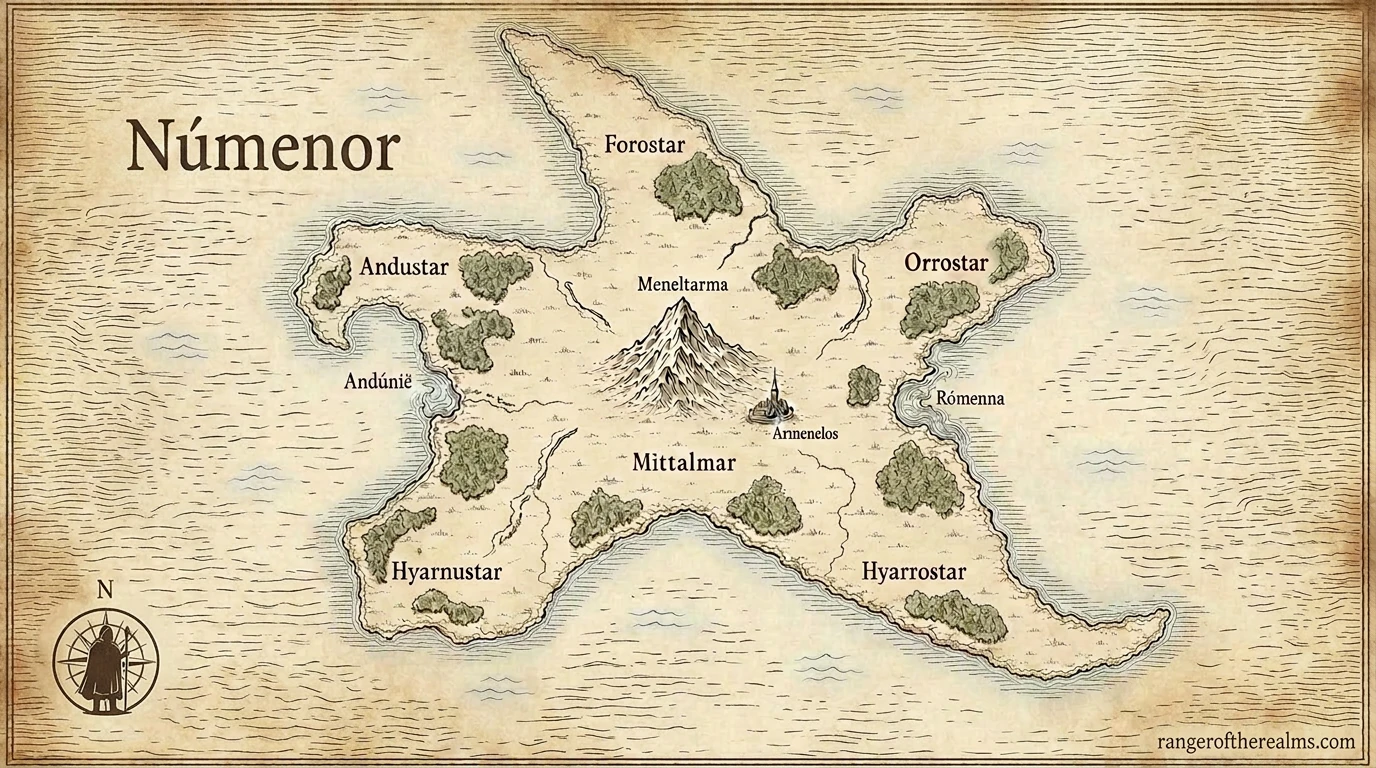
A five-pointed star at the centre of the Sundering Sea, a single great peak, the Meneltarma (the Pillar of Heaven), rising at its exact midpoint. The five capes give the island its shape and its harbours.
- Meneltarma, the holy mountain at the island's centre, sacred to Eru.
- Forostar, Andustar, Hyarnustar, Hyarrostar, Orrostar, the five capes radiating north, west, southwest, southeast, east.
- Armenelos, the king's city, near the eastern foot of the Meneltarma.
- Rómenna, the great deep harbour on the eastern coast.
- Andúnië, the western haven where the Faithful made their refuge before the end.
Sailors of later ages spoke of the Meneltarma sometimes seen alone above the waves.