
Why Would He Spend All That Money?
I was watching the new Avatar documentary with my son, Fire and Water: Making the Avatar Films, and he looked over at me and said, "Wait, Dad. Why would he spend all that money if you can just do it with AI?"
He's eleven.
That question landed differently than I expected.
I'd been listening to a James Cameron interview a few days earlier. He was talking about how audiences don't really understand what goes into a film like Avatar. Not the spectacle. People get that. The craft. The human effort beneath the CGI.
That's why he released the documentary on Disney+. He wanted people to see it.
So I sat down with my son to watch.
What they did is remarkable.
For Avatar: The Way of Water, Cameron built a 680,000-gallon water tank to simulate Pandora's oceans. The actors had to learn free diving under instructor Kirk Krack. Kate Winslet held her breath for over seven minutes. The whole cast trained to stay underwater for three, four, five minutes at a time. While performing.
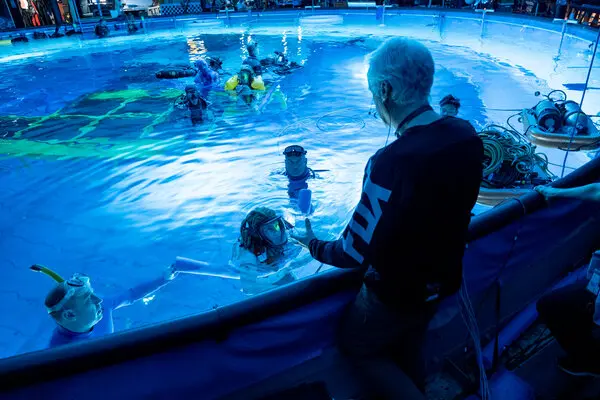
The motion capture technology had to be reinvented for water. Those little dots on the actors' faces, the ones that track every micro-expression? They don't work underwater. Traditional cameras don't work either. The team developed new infrared systems that could function submerged. They spent years figuring out how to capture authentic human emotion through the water.
Watching it, I kept thinking: the amount of problem-solving required to make this movie is staggering. Every scene is a small engineering breakthrough layered on top of a performance layered on top of a story.
And sitting there, a thought kept forming in my head:
You're going to be able to do all of this with AI. Relatively easily. Relatively soon.I didn't say it out loud. Something stopped me. Maybe it felt like puncturing the moment. Maybe it was something closer to sadness. Watching all this human ingenuity and knowing it might become unnecessary.
Then my son said it for me.
"Why would he spend all that money if you can just do it with AI?"
Cameron himself has been thinking about this. In a recent interview, he called the idea of AI-generated actors "horrifying." Not because he's anti-technology. He joined the board of Stability AI last year, and he's openly exploring ways to use AI to cut visual effects costs in half. But he draws a sharp line.
"For years," he said, "there was this sense that, 'Oh, they're doing something strange with computers and they're replacing actors,' when in fact, once you really drill down and you see what we're doing, it's a celebration of the actor-director moment."
He wants people to understand that what happens in the motion capture volume is more acting, not less. The technology amplifies the human, it doesn't replace it.
And he thinks something is coming. "The act of performance," he said, "the act of actually seeing an artist creating in real time will become sacred."
Will become. Future tense. He's already anticipating the shift.Yesterday, I listened to Matt Damon on Joe Rogan's podcast. He was talking about Dwayne Johnson's performance in The Smashing Machine, a film about the MMA fighter Mark Kerr, who struggled with addiction.
Damon described a scene that "really walloped" him. Johnson's character has overdosed and his friend comes to see him in the hospital. Johnson starts to cry and pulls the hospital sheet up over his head.
Damon asked him about it. Where did that moment come from?
Johnson said it came from his mother. When she was diagnosed with stage three lung cancer, the oncologist delivered the news, and she pulled the sheet up over her head. "She just looked like a little kid."
That's where the moment lived. In a real memory. In actual grief.
Damon's point was simple: no AI could do that. "That is a completely human thing. That is an artist. That's a piece of art. That comes out of a lived human experience."
I believe that. I really do. There's something in authentic human expression that can't be replicated by pattern-matching on training data. The specificity of grief. The weight of memory converted into performance.
But here's what I keep coming back to:
How many people in the audience know the difference?
There are people who deeply appreciate the craft of acting. Who understand what it means to access real emotion and channel it through a character. Who watch that hospital scene and feel the weight of lived experience behind it.
That audience exists. But I think it's smaller than we assume. And I think it's getting smaller.
James Cameron can raise $400 million because he's James Cameron. His name on a film means seats in theaters. The people who fund blockbusters will make that bet.
But if you're not James Cameron? If you're a filmmaker trying to tell a story without a track record of billion-dollar returns?
I can't imagine a world where investors keep funding human-craft productions at that scale when AI offers a cheaper path to something that's good enough for most audiences.
The economics are going to change. They're already changing.
I don't know how to feel about this. It's not doom. I'm not saying human craft will disappear. Cameron is probably right that live performance will become sacred. There will always be people who seek out the authentic thing.
But sacred things tend to be niche. Expensive craft becomes a luxury good. The mass market moves toward whatever's cheap and good enough.
My son's question wasn't cynical. It was practical. He saw the effort, he understood that AI might do it easier, and he asked the obvious thing.
Maybe the answer is that we'll value the story of how things were made as much as the things themselves. The documentary about Avatar might matter as much as Avatar itself. Proof that humans chose to do it the hard way. Chose to be in the water. Chose to hold their breath.
I'm still thinking about it.