Research & Sources
Middle-earth Maps Explained
How Tolkien's World Changed Across the Ages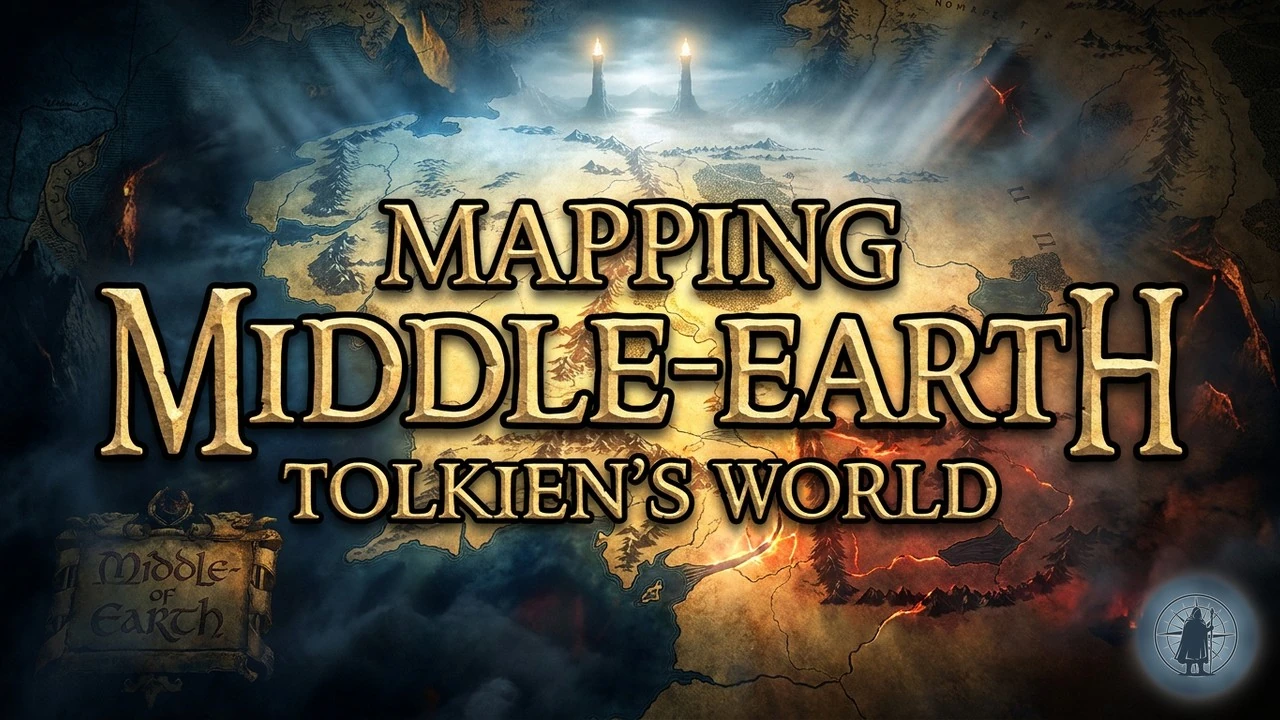 Watch the episode
Middle-earth Maps Explained: How Tolkien's World Changed Across the Ages
Watch the episode
Middle-earth Maps Explained: How Tolkien's World Changed Across the Ages
Research Notes: The Geography of Middle-earth — How the World Changed Across 5 Ages
Overview
Tolkien did not give Arda one map. He gave it five. Across the legendarium, the physical world is repeatedly broken, reshaped, drowned, and finally bent into a sphere. Each cataclysm corresponds to a moral event: an act of pride, rebellion, or mercy at cosmic scale. The geography of Middle-earth is therefore not a stable backdrop but a record of theological history written in coastlines and mountain ranges. The world the hobbits know in the Third Age is the wreckage of four prior worlds.
This episode tracks Arda through five distinct geographical states: 1. Years of the Lamps — symmetrical Arda, Almaren, the Two Lamps Illuin and Ormal. 2. Years of the Trees — post-cataclysm Arda; Aman raised in the West, Beleriand in the northwest, Middle-earth shoved east. 3. First Age — Beleriand at its most populous, ending in the War of Wrath that drowns the entire northwest. 4. Second Age — the Beleriand-less map appears, Númenor is raised as a star-shaped island, Sauron founds Mordor. 5. Third Age (post-Akallabêth) — the world is bent into a globe; Aman is removed from the circles of the world; only the Straight Road remains for the Elves.
Primary Sources
The Silmarillion — Ainulindalë
The cosmological frame. Eru Ilúvatar creates Arda through the Music of the Ainur, but Melkor introduces discord into the Music itself. The geography of Arda is therefore born marred: every later cataclysm is a working-out of that primordial dissonance.
- "The Music was over. And the Valar... beheld a new World made visible before them" (Ainulindalë). - The Ainur's themes of water, light, and stone become Arda's seas, lights, and mountains — but Melkor's discord becomes its violence: ice, fire, and fracture.
The Silmarillion — "Of the Beginning of Days"
Source for the Lamps era and the first cataclysm.
- Aulë forges the Two Lamps. Varda fills them with light. Manwë hallows them. They are set on great pillars: Illuin in the north on the pillar Helcar; Ormal in the south on the pillar Ringil. - "In the midst of the Earth... there was a great lake, and an island therein... and there the Valar dwelt; and that place is called Almaren." - Almaren sits where the lights of the two Lamps mingle — the literal center of a symmetrical world. - Melkor returns secretly, builds Utumno in the far north, and assails the Lamps. Both pillars are cast down. The world is filled "with flowing fire and surging water." The Spring of Arda is destroyed; the symmetry of the world is broken forever. - After the cataclysm: the Valar abandon Middle-earth and withdraw westward, raising the continent of Aman beyond Belegaer (the Great Sea). Within Aman they raise the Pelóri mountains as a fortification. East of Belegaer, Middle-earth is left to ruin under starlight.
The Silmarillion — "Of the Coming of the Elves" / Battle of the Powers
The second reshaping. The Sea of Helcar (the inland sea where Illuin fell) becomes the bay where the Elves awaken at Cuiviénen, under the Orocarni (Red Mountains) of the east.
- The Battle of the Powers (Y.T. 1090–1100): the Valar march east to capture Melkor. They level Angband, then breach Utumno and chain Melkor with the chain Angainor. - The fighting again reshapes Middle-earth: "The Great Sea [Belegaer] was widened... the Bay of Balar was carved out... the northern highlands of Hithlum and Dorthonion were raised up as new mountain ranges, and the river [Sirion] came into being." This is when the geography of Beleriand as we know it from the First Age is finalized.
The Silmarillion — Quenta Silmarillion
For Beleriand's First Age geography. Beleriand is the northwestern arm of Middle-earth, bounded by the Ered Luin (Blue Mountains, also called Ered Lindon) in the east, the Ered Wethrin in the north, Ered Gorgoroth above Doriath, and Belegaer to the west. Major regions: Hithlum, Dorthonion, Doriath, East Beleriand, Ossiriand, the Falas, the Isle of Balar.
- War of Wrath (F.A. 545–587): "And so great was the fury of those adversaries that the northern regions of the western world were rent asunder, and the sea roared in through many chasms, and there was confusion and great noise; and rivers perished or found new paths, and the valleys were upheaved and the hills trod down; and Sirion was no more" (Of the Voyage of Eärendil). - Result: nearly all of Beleriand sinks beneath Belegaer. Only Lindon (a remnant of Ossiriand west of the Ered Luin) and a few isolated peaks survive — Tol Morwen (graves of Túrin and Morwen), Tol Fuin (a remnant of Dorthonion), Tol Himling (the Hill of Himring). These are called the Western Isles.
The Silmarillion — Akallabêth
The pivotal cataclysm. The flat-to-round transformation.
- Númenor is raised by the Valar in the early Second Age as a reward for the Edain who fought against Morgoth. It is shaped like a five-pointed star with peninsulas Forostar, Andustar, Hyarnustar, Hyarrostar, Orrostar. At its center stands Meneltarma ("Pillar of Heaven"), a sacred mountain whose summit is a flat shrine to Eru, ascended by a spiraling road and flanked by five low ridges called Tarmasundar ("Roots of the Pillar") that point toward the five capes. - Sauron, taken prisoner by Ar-Pharazôn, corrupts Númenor. Ar-Pharazôn breaks the Ban of the Valar and sails his Great Armament against Aman. - Key quote: "Then Manwë upon the Mountain called upon Ilúvatar, and for that time the Valar laid down their government of Arda... but Ilúvatar showed forth his power, and he changed the fashion of the world; and a great chasm opened in the sea between Númenor and the Deathless Lands, and the waters flowed down into it, and the noise and smoke of the cataracts went up to heaven, and the world was shaken" (Akallabêth). - "The Blessed Realm and Eressëa were removed, and Númenor was swallowed into the sea." (Akallabêth) - "The world was diminished, for Valinor and Eressëa were taken from it into the realm of hidden things." (Akallabêth) - Elendil and the Faithful, in nine ships at Rómenna, are saved by a great wind and washed to Middle-earth. They found Arnor and Gondor (S.A. 3320). - The world is bent. Mortals who sail west now circle back. Only the Elves can take the Straight Road, leaving the curve of the Earth to find Aman in "the realm of hidden things."
The Lord of the Rings — Appendices and Prologue
For the Third Age map most readers know. Mordor's geography is detailed (the Ephel Dúath, Ered Lithui, Plateau of Gorgoroth, Orodruin/Mount Doom, Barad-dûr). Lindon is a coastal remnant. Ered Luin stands as the literal western edge of "Middle-earth proper," because everything beyond was once Beleriand and is now sea.
- Appendix B (Tale of Years): Sauron settles in Mordor c. S.A. 1000. Construction of Barad-dûr begins, takes ~600 years.
Unfinished Tales — "A Description of the Island of Númenor"
Detailed Númenórean geography. Climate, flora, the five regions, harbors of Rómenna and Andúnië, the city of Armenelos. Key emphasis: Meneltarma's summit is "wide and somewhat flattened, and could contain a great multitude" — a sanctuary, never roofed, where Eru is worshipped in silence.
History of Middle-earth, Volume IV — The Shaping of Middle-earth / The Ambarkanta
The Ambarkanta ("Shape of the World"), c. early 1930s, is Tolkien's only attempt at a formal cosmography. Includes Diagrams I–V: - Diagram I: Arda before the Changing — flat, with the Outer Sea (Ekkaia/Vaiya) surrounding all, the Walls of Night (Ilurambar) beyond, the Door of Night in the west. - Diagram III: Arda after the Changing — round, with the "Old Lands" of the flat world becoming one hemisphere and the "New Lands" forming the other. - Maps in the Ambarkanta are the only canonical depiction of Arda in its symmetrical Lamp-era state.
History of Middle-earth, Volume X — Morgoth's Ring
Crucial for the Round World version Tolkien attempted late in life. In this version, Arda is round from the beginning; the flat-world cosmology of the Silmarillion is reframed as a Mannish (Númenórean) misunderstanding of what the Elves told them. Tolkien never finished this revision; the published Silmarillion uses the flat-then-round version. Christopher Tolkien notes: his father felt the Two Trees (sun and moon as fruit and flower) and the Music made a flat world "indispensable" symbolically, even as he doubted it cosmologically.
Letters of J.R.R. Tolkien
- Letter 131 (to Milton Waldman, 1951): the canonical statement of intent. Tolkien describes the "Downfall of Númenor: a special variety of the Atlantis tradition" as "fundamental to mythical history." He explicitly identifies the cosmological pivot: the legendarium "contains a transition from a flat world... to a globe: an inevitable transition for a modern 'myth-maker' with a mind subjected to the same 'appearances' as ancient men, and partly fed on their myths, but taught that the Earth was round from the earliest years." - Letter 154 (to Naomi Mitchison, 1954): expands on the cosmology problem. Tolkien is uneasy that ancient Númenóreans would have thought the world flat; he begins to consider that Arda was always round and the flat-world stories are mythologized memory. - Letter 156 and the Athrabeth essays (HoME X): connect geography to theology. The marring of Arda is moral as much as physical; Arda Marred awaits Arda Healed (Arda Envinyanta) at the end of time.
Timeline
Years of the Lamps (timeless / pre-counted) - Aulë forges Illuin and Ormal. Almaren is the seat of the Valar. - Spring of Arda. Yavanna's first growth. - Melkor returns from the Void; secretly builds Utumno. - Melkor casts down the Lamps. Almaren is destroyed. The first map ends.
Years of the Trees (Y.T. 1–1500, approx.) - Valar withdraw to Aman. Yavanna sings into being Telperion and Laurelin, the Two Trees. - Y.T. 1050: Elves awaken at Cuiviénen by the Sea of Helcar. - Y.T. 1090–1100: Battle of the Powers. Utumno breached. Middle-earth's geography violently revised. Sirion forms. - Y.T. 1495: Melkor (now Morgoth) destroys the Two Trees with Ungoliant. Flees to Middle-earth with the Silmarils. - Y.T. 1500: First Age begins; Sun and Moon rise.
First Age (F.A. 1–587) - The Noldor return to Beleriand. Five major battles fought across Beleriand's geography. - Beleriand's regions: Hithlum, Mithrim, Nevrast, Dorthonion, Himring, Doriath, Ossiriand, Nargothrond, Gondolin. - F.A. 545–587: War of Wrath. Beleriand drowned. Only Lindon and a few peaks remain.
Second Age (S.A. 1–3441) - S.A. 32: Edain settle Númenor (raised by the Valar). - S.A. ~1000: Sauron settles in Mordor. Begins Barad-dûr. - S.A. 1600: One Ring forged in Orodruin. - S.A. 1693–1701: War of Sauron and the Elves. Eriador overrun, then liberated by Tar-Minastir's fleet. - S.A. 3262: Ar-Pharazôn captures Sauron; takes him to Númenor. - S.A. 3319: Akallabêth. Ar-Pharazôn's armament destroyed. Númenor swallowed. World made round. Aman removed. - S.A. 3320: Elendil founds Arnor and Gondor. - S.A. 3441: Last Alliance; Sauron defeated. Third Age begins.
Third Age (T.A. 1–3021) - The "familiar map." Lindon, Eriador, Rhovanion, Gondor, Mordor, Rohan. The shape of the world is now a globe; only the Elves can leave it.
Key Characters (Geographical Actors)
- Aulë: Smith of the Valar. Forged the Lamps and their pillars; raised Númenor from the seabed; later raised the Pelóri. - Yavanna: Gave growth to the Spring of Arda; sang the Two Trees into being after the Lamps fell. - Varda (Elbereth): Filled the Lamps with light; later kindled the stars (the second light source after the Lamps fall). - Manwë: Hallowed the Lamps; called upon Eru during the Akallabêth. - Melkor / Morgoth: Architect of every cataclysm before the Akallabêth. Cast down the Lamps; corrupted Arda's substance ("Morgoth's Ring" — the world itself becomes his ring of power, marred at the molecular level). - Sauron: Heir to Morgoth's ambition. Founder of Mordor as a geographical concept (he chooses it for its triple mountain wall). Indirect cause of the Akallabêth through the corruption of Ar-Pharazôn. - Ar-Pharazôn: Mortal who provokes Eru's intervention; his fleet's wreckage and Númenor's drowning literally reshape the planet. - Elendil: Carries the survival of Númenor — and the old world's politics — into the new round-Earth Third Age.
Geography (Era by Era)
Lamp-era Arda
- Single continent (or near-single), symmetrical north-south. - Two Lamps as opposing celestial poles. - Almaren island in the central great lake. - Melkor in the unlit fringes of the north (proto-Utumno).Trees-era Arda
- Aman in the far west, a continent fenced by the Pelóri. Within: Valinor, Valmar, Tirion, Alqualondë, Tol Eressëa offshore. - Belegaer (the Great Sea) widens between Aman and Middle-earth. - Helcaraxë in the far north — a grinding ice-bridge connecting Aman to Middle-earth. - Middle-earth thrust eastward; Ered Luin rises; Beleriand's rivers (Sirion principal) come into being. - Inland Sea of Helcar persists in the east; Cuiviénen on its bay.First Age Beleriand
- Northwestern Middle-earth, west of the Ered Luin. - Bounded north by the Iron Mountains (Ered Engrin) — Morgoth's reborn Angband. - Major rivers: Sirion, Gelion (with seven tributaries in Ossiriand). - Major realms: Hithlum (Fingolfin), Dorthonion, Nargothrond (Finrod), Doriath (Thingol/Melian), Gondolin (Turgon), Falas (Círdan), Ossiriand.Second Age Middle-earth
- Beleriand gone. Lindon (Forlindon, Harlindon) is now the western coast. - Eriador opens up — Lindon's hinterland becomes a vast region from Ered Luin to the Misty Mountains. - Eregion founded by Celebrimbor near Khazad-dûm. - Mordor chosen by Sauron c. S.A. 1000 — three mountain walls (Ephel Dúath west, Ered Lithui north, the southern range), fortress Barad-dûr, volcano Orodruin. - Númenor: star-shaped island in the middle of Belegaer, ~halfway between Middle-earth and Aman.Third Age Middle-earth
- The world is now a globe. Aman is unreachable except via the Straight Road. - Lindon is a sliver of the old First Age. Arnor (broken into Arthedain, Cardolan, Rhudaur) and Gondor are the Númenórean inheritance. - Mordor remains; Sauron returns to it. Mount Doom now contains the One Ring's fate.Themes and Symbolism
1. Geography as Moral Record
Every breaking of the world is the consequence of someone refusing their place. Melkor refuses subordination → Lamps fall. Morgoth refuses the verdict of the Valar → Beleriand drowns. Ar-Pharazôn refuses the Ban → the world bends. The Earth itself remembers sin.2. Arda Marred → Arda Healed
The Elvish concept (Athrabeth, HoME X): the world is currently in its "marred" state. Its asymmetries, its violent geography, its drowned places — all are wounds. At the end of time, Arda Envinyanta (Arda Renewed) will restore the original symmetry. Geography is therefore eschatological.3. The Loss of Symmetry
The Lamp-era world is the only state in which Arda is symmetrical. Every subsequent map is increasingly lopsided: Aman in the west, Mordor in the east, the empty center. Symmetry = paradise; asymmetry = history. When Tolkien draws the Third Age map, he is drawing a wound.4. The Atlantis Pattern
Letter 131 names it directly: Númenor is Tolkien's Atlantis. The drowning of a hubristic island civilization is, for Tolkien, "fundamental to mythical history." His own recurring "Atlantis dream" — a great wave rising over green lands — is the personal seed of the Akallabêth.5. Flat World as Theological Statement
A flat world with edges is a world that can be left — by the Valar going west, by the Elves sailing west, by the dead going to Mandos. A round world is a closed sphere. The Akallabêth therefore does not just punish Númenor; it closes the world to mortals permanently. The bending of the Earth is itself the seal on the Gift of Men: you can no longer reach the Deathless Lands by ship because there is no longer a "west" to sail toward.6. The Straight Road
The single residual asymmetry: Elves can still leave. The Straight Road is a metaphysical line tangent to the curved Earth — for those who built ships before the world was bent, the old route survives. This is geography as grace.Scholarly Perspectives
- Karen Wynn Fonstad (Atlas of Middle-earth, 1981; rev. 1991): the standard cartographic reconstruction. Her Years-of-the-Lamps map and Ambarkanta-derived diagrams remain the dominant visualization. - Verlyn Flieger (Splintered Light, 1983; A Question of Time, 1997): treats the cosmological transitions as light-history. Each cataclysm is also a lighting change: Lamps → Trees → Sun/Moon → mortal sky. - Tom Shippey (The Road to Middle-earth; J.R.R. Tolkien: Author of the Century): emphasizes the philological-mythological roots — Tolkien's Atlantis dream, the flat-earth myths of "ancient men," and the Christian pattern of fall and renewal. - Dimitra Fimi (Tolkien, Race and Cultural History): notes how the geographical reshapings parallel Tolkien's evolving thinking about race, peoples, and the relationship of the Elves to the West. - Christopher Tolkien (HoME, especially Vols. IV, V, X): the indispensable editor-scholar. His commentary in The Shaping of Middle-earth and Morgoth's Ring documents the flat-vs.-round dilemma in his father's late papers.
Contradictions and Variants
The Round World Problem
The single largest contradiction in the legendarium. The published Silmarillion (1977) uses the flat-then-round cosmology. But in the late 1950s and 1960s Tolkien repeatedly drafted a Round World version (collected in Morgoth's Ring, HoME X) in which Arda was always round, the Sun is older than the Trees, and the flat-world story is a Númenórean misremembering. Tolkien never resolved this. The flat-world version is canonical only by virtue of being the version Christopher Tolkien chose to publish in 1977.Sea of Helcar
Early writings (Book of Lost Tales) name Helkar a southern pillar. Later, Helcar is the inland sea formed by Illuin's fall. The Lamps' geography is one of the most volatile parts of the legendarium.Ambarkanta vs. Late Drafts
The Ambarkanta diagrams (early 1930s) are detailed but explicitly superseded by Tolkien's later thinking. They remain the only formal cosmography ever drawn but should be treated as a mid-period snapshot.Beleriand's Fate
Some texts suggest all of Beleriand sank; others (the Western Isles tradition) preserve scattered remnants. Tolkien left both versions.Linguistic Notes
- Arda: Quenya for "Realm." The Earth as a created place. - Almaren: Quenya, "the Blessed" — the first dwelling of the Valar, root sense related to alma "good fortune." - Illuin: Quenya, "sky-blue" — the northern lamp. - Ormal: Quenya, "high gold" — the southern lamp. - Helcar: Quenya, "icy-cold" — both the northern pillar (early) and the inland sea formed where Illuin fell. - Ringil: Quenya, "cold-star" — the southern pillar (also the name of Fingolfin's sword, a deliberate echo). - Beleriand: Sindarin, "the country of Balar" — named for the Bay of Balar. - Belegaer: Sindarin, "Great Sea" (beleg "great" + aer "sea"). - Númenor: Quenya, "Westernland" (númen "west" + nórë "land"). - Meneltarma: Quenya, "Pillar of Heaven" (menel "heaven" + tarma "pillar"). - Akallabêth: Adûnaic, "She That Hath Fallen" — Númenor itself is feminine, drowned. - Ekkaia / Vaiya: Quenya, "Outer Ocean" / "Enfolding Ocean." - Ilurambar: Quenya, "Walls of the World."
Additional Context
Tolkien's Atlantis Dream
Tolkien recorded a recurring nightmare from boyhood: a great wave rising over green fields and trees, drowning everything. He passed the dream to his son Michael, who reported the same dream. This is the experiential seed of the Akallabêth. (Letter 257; biographical material in Carpenter.)Catholic Cosmology
The flat-to-round transition has been read as a fall-of-Eden allegory: a primordial paradise (where the gods walked the earth) gives way to a closed, mortal world. The Straight Road preserves a single channel of grace. Tolkien (a devout Catholic) denied direct allegory but acknowledged the legendarium is "a fundamentally religious and Catholic work" (Letter 142).Five Maps as Storytelling Strategy
Most fantasy worlds have one map. Tolkien's gives him a structural device: each Age has its own geography because each Age has its own ethical character. The reader who notices that Beleriand is missing from the Third Age map is reading the consequences of the Silmarillion in negative space.Questions for Further Research
- Did Tolkien ever finalize the eastward extent of Middle-earth? (Most maps show only the western third.) - The fate of the Sea of Helcar between Y.T. 1100 and the Third Age is unclear; Fonstad shows it shrinking. - Did the Akallabêth bend the entire Earth or only the western reaches? Texts are ambiguous.
Discrete Analytical Themes
Theme 1: The Symmetrical World That Could Not Survive Evil
Core idea: Arda began with a deliberate, ordered symmetry — two lamps, one continent, one center — and this configuration was structurally incompatible with the existence of Melkor. Evidence: - "Illuin in the furthest north upon the pillar of Helcar, Ormal in the deepest south upon the pillar of Ringil" (Of the Beginning of Days). Two equal lamps, two equal pillars. - Almaren placed precisely "where the light of the Two Lamps mingled" — the geometric center of a balanced world. - "The fall of the great Lamps spoiled the symmetry of Arda's surface" (Of the Beginning of Days). Tolkien explicitly frames the loss as geometric, not just political. Distinction: This theme is about the initial design and what its destruction cost. Not about Melkor's psychology, not about the later remaking — about the unrecoverable original.Theme 2: Each Cataclysm Is a Refusal Made Geological
Core idea: Every reshaping of Arda is the physical consequence of a specific moral refusal — Melkor refuses subordination, Morgoth refuses defeat, Ar-Pharazôn refuses the Ban. Evidence: - Melkor casts down the Lamps because Almaren-as-center implies a hierarchy he rejects. Result: Arda asymmetrical. - War of Wrath: "the northern regions of the western world were rent asunder, and the sea roared in through many chasms" (Of the Voyage of Eärendil). The fight to extract Morgoth literally drowns Beleriand. - Akallabêth: Ar-Pharazôn's fleet provokes "a great chasm... between Númenor and the Deathless Lands" — a geographical wound carved by a single moral choice. Distinction: This theme is about causation — moral acts producing geological consequences. Not about the geography itself; about why it changes.Theme 3: Beleriand as the Lost Northwest
Core idea: The First Age happens in a region that no Third Age character can visit, because the entire stage of the Silmarillion is underwater. Evidence: - "Only a small section of Ossiriand remained, and was known as Lindon." - The Ered Luin — the Blue Mountains visible from the Shire — are the eastern edge of vanished Beleriand. - Surviving peaks (Tol Morwen, Tol Fuin, Tol Himling) are mountain summits left as islands. The world the Hobbits know is a coastline of grave-markers. Distinction: This theme is about what was lost and how the absence haunts the later map. Specifically about Beleriand, not about cataclysm in general.Theme 4: Númenor as a Designed Geography
Core idea: Unlike every other landmass in Arda, Númenor is engineered — a star-shaped island with a sacred mountain at its precise center, raised by the Valar as a reward. Evidence: - Five peninsulas (Forostar, Andustar, Hyarnustar, Hyarrostar, Orrostar) radiating from a center. - "Five long low grass-covered ridges, called Tarmasundar or 'Roots of the Pillar', extending in the direction of the five peninsulas" (UT, Description of the Island of Númenor). - Meneltarma's flat summit, "able to contain a great multitude," consecrated to Eru in silent worship. Distinction: This theme is about deliberate sacred geography — geography as architecture. Not about Númenor's politics or fall; about what it was designed to be.Theme 5: The Bending of the World
Core idea: The Akallabêth doesn't just destroy Númenor — it changes the topology of reality itself, converting a flat plane with edges into a closed sphere. Evidence: - "Ilúvatar showed forth his power, and he changed the fashion of the world" (Akallabêth). - "The world was diminished, for Valinor and Eressëa were taken from it into the realm of hidden things." - Letter 131: "transition from a flat world... to a globe... an inevitable transition for a modern 'myth-maker'." Distinction: This theme is about the cosmological pivot — flat to round — as a unique kind of catastrophe, distinct from any earlier reshaping. The earlier cataclysms moved continents; this one closed the universe.Theme 6: The Straight Road as the Only Surviving Asymmetry
Core idea: After the world is closed, one tangent remains — the Straight Road, accessible only to the Elves, by which the old flat-world geometry persists as a residual grace. Evidence: - "The Elves... can still sail into the Uttermost West, on what to Men is the Lost Road to Valinor" (Old Straight Road materials). - Círdan still builds ships at the Grey Havens throughout the Third Age. - The Straight Road is geometrically impossible in a round world — it's a line tangent to the sphere, surviving as a metaphysical loophole. Distinction: This theme is about what remains — the single thread of pre-Akallabêth cosmology preserved for the Firstborn. Specifically about the Elves' privilege, not about the Akallabêth itself.Theme 7: Arda Marred and the Theological Frame
Core idea: The geographical history of Arda is not just a sequence of disasters; it is the working-out of a primordial dissonance introduced into the Music of the Ainur, awaiting eventual healing. Evidence: - Arda Marred concept: the world is "tainted by the evil of Morgoth" at every level, including its physical shape. - Morgoth poured "his evil and rebellious will into [Arda's] very structure" (Morgoth's Ring). - The expectation of Arda Envinyanta — Arda Healed — at the end of time, when the original symmetry is restored. Distinction: This theme is about the theological meta-frame that gives the cataclysms meaning. Not any specific event; the philosophical container for all of them.Theme 8: Five Maps as a Storytelling Device
Core idea: Tolkien uses changing geography as a structural narrative tool — each Age has a different map because each Age has a different moral character, and the reader perceives the legendarium's stakes by tracking what is missing. Evidence: - The Ambarkanta provides the only formal cosmography but is superseded by later texts — Tolkien's geography evolved alongside his theology. - Karen Wynn Fonstad's Atlas of Middle-earth needed five separate sections because no one map could represent Arda. - Letter 131's framing: the legendarium requires the flat-to-round transition because mythical history requires an Atlantis. Distinction: This theme is about Tolkien's craft choice — multiple maps as deliberate narrative architecture. About the author, not the world.Sources Consulted
Primary Texts (Tolkien)
- The Silmarillion (1977, ed. Christopher Tolkien) - "Ainulindalë" — cosmological frame, Music of the Ainur, Melkor's discord - "Of the Beginning of Days" — Two Lamps, Almaren, first cataclysm, Aman raised - "Of the Coming of the Elves" — Cuiviénen, Sea of Helcar, Battle of the Powers - Quenta Silmarillion (multiple chapters) — Beleriand geography - "Of the Voyage of Eärendil" — War of Wrath, drowning of Beleriand - "Akallabêth" — Númenor's geography, Downfall, world made round - "Of the Rings of Power and the Third Age" — post-Akallabêth Middle-earth
- The Lord of the Rings — Appendix B (Tale of Years), Prologue, geography of the Third Age
- Unfinished Tales (1980) - "A Description of the Island of Númenor" — five peninsulas, Meneltarma, Tarmasundar - "The History of Galadriel and Celeborn" — Second Age Eriador, Eregion
- The History of Middle-earth (HoME) - Vol. IV, The Shaping of Middle-earth (1986) — the Ambarkanta ("Shape of the World"), Diagrams I–V, earliest cosmography - Vol. V, The Lost Road — drafts of the Númenor / flat-to-round transition - Vol. X, Morgoth's Ring (1993) — Athrabeth, Arda Marred / Arda Healed, the Round World version dilemma - Vol. XII, The Peoples of Middle-earth — late notes on cosmology
- The Letters of J.R.R. Tolkien (ed. Carpenter, 1981) - Letter 131 (to Milton Waldman, 1951) — Atlantis tradition, flat-to-round transition explicitly stated - Letter 142 — "fundamentally religious and Catholic work" - Letter 154 (to Naomi Mitchison, 1954) — cosmology hesitations - Letter 156 — Arda Marred theology - Letter 257 — the Atlantis dream
- The Fall of Númenor (2022, ed. Brian Sibley) — consolidated Second Age material
Secondary / Reference
- Karen Wynn Fonstad, The Atlas of Middle-earth (rev. 1991) — definitive cartographic reconstruction of all five eras - Verlyn Flieger, Splintered Light: Logos and Language in Tolkien's World — light-history and cosmological transitions - Tom Shippey, The Road to Middle-earth and J.R.R. Tolkien: Author of the Century — philological and mythological roots - Dimitra Fimi, Tolkien, Race and Cultural History — geographical evolution context - Humphrey Carpenter, J.R.R. Tolkien: A Biography — Atlantis dream
Web Sources Consulted
- Tolkien Gateway — comprehensive wiki entries: - https://tolkiengateway.net/wiki/Two_Lamps - https://tolkiengateway.net/wiki/Almaren - https://tolkiengateway.net/wiki/Years_of_the_Lamps - https://tolkiengateway.net/wiki/Years_of_the_Trees - https://tolkiengateway.net/wiki/Beleriand - https://tolkiengateway.net/wiki/War_of_Wrath - https://tolkiengateway.net/wiki/Akallab%C3%AAth - https://tolkiengateway.net/wiki/Downfall_of_N%C3%BAmenor - https://tolkiengateway.net/wiki/Changing_of_the_World - https://tolkiengateway.net/wiki/Bent_World - https://tolkiengateway.net/wiki/Straight_Road - https://tolkiengateway.net/wiki/Round_World_version_of_the_Silmarillion - https://tolkiengateway.net/wiki/Ambarkanta_maps - https://tolkiengateway.net/wiki/Arda_Marred - https://tolkiengateway.net/wiki/Battle_of_the_Powers - https://tolkiengateway.net/wiki/N%C3%BAmenor - https://tolkiengateway.net/wiki/A_Description_of_the_Island_of_N%C3%BAmenor - https://tolkiengateway.net/wiki/Helkar - https://tolkiengateway.net/wiki/Sea_of_Helcar - https://tolkiengateway.net/wiki/Ekkaia - https://tolkiengateway.net/wiki/Walls_of_the_Night - https://tolkiengateway.net/wiki/Belegaer - https://tolkiengateway.net/wiki/Mordor - https://tolkiengateway.net/wiki/Letter_131 - https://tolkiengateway.net/wiki/Letter_154
- Wikipedia: - https://en.wikipedia.org/wiki/Cosmology_of_Tolkien's_legendarium - https://en.wikipedia.org/wiki/Tolkien's_round_world_dilemma - https://en.wikipedia.org/wiki/Beleriand - https://en.wikipedia.org/wiki/N%C3%BAmenor - https://en.wikipedia.org/wiki/History_of_Arda - https://en.wikipedia.org/wiki/Ainulindal%C3%AB - https://en.wikipedia.org/wiki/Geography_of_Middle-earth - https://en.wikipedia.org/wiki/Old_Straight_Road - https://en.wikipedia.org/wiki/The_Shaping_of_Middle-earth
- The Encyclopedia of Arda (glyphweb.com): - https://www.glyphweb.com/arda/l/lampsofthevalar.php - https://www.glyphweb.com/arda/e/eredluin.php - https://www.glyphweb.com/arda/w/wallsofnight.php - https://www.glyphweb.com/arda/s/sunderingseas.php - https://www.glyphweb.com/arda/b/belegaer.php - https://arda.glyphweb.com/e/ekkaia.html
- Silmarillion Writers' Guild — "Mapping Arda" series: - https://www.silmarillionwritersguild.org/node/6824 (Part I: Terraforming) - https://www.silmarillionwritersguild.org/node/7933 (Part III: Second Age)
- Other: - https://www.teawithtolkien.com/blog/akallabeth - https://www.teawithtolkien.com/blog/Letter131 - https://middle-earth.xenite.org/where-did-the-undying-lands-go/ - https://middle-earth.xenite.org/how-was-beleriand-destroyed-in-the-war-of-wrath/ - https://middle-earth.xenite.org/do-any-maps-accurately-show-beleriand-and-eriador-together/ - https://reactormag.com/tolkiens-map-and-the-messed-up-mountains-of-middle-earth/ - https://afkimel.wordpress.com/2025/04/09/the-catastrophe-of-arda-marred-intimations-of-arda-envinyanta/ - https://drumsofatlantis.com/tolkien-and-his-atlantis-complex
Most Useful Sources
1. Tolkien Gateway entries on Akallabêth, Two Lamps, Beleriand, Ambarkanta — most comprehensive single-page references with citations to primary texts. 2. Wikipedia "Cosmology of Tolkien's legendarium" and "Tolkien's round world dilemma" — best summary of the flat/round controversy. 3. The Silmarillion itself — irreplaceable for direct quotes from Ainulindalë, Of the Beginning of Days, and Akallabêth. 4. Letter 131 — the single most important authorial statement about why the flat-to-round transition exists. 5. HoME Vol. X (Morgoth's Ring) — essential for the Round World variant and the Arda Marred theology.
Notes on Coverage
- Abundant: Lamps, Beleriand, Akallabêth, the round-world cosmology question — all richly documented in primary and secondary sources. - Moderate: Years of the Trees geography (Aman is sparsely mapped by Tolkien himself). - Scarce: Eastern Middle-earth in any age — Tolkien deliberately left it indistinct. - Contested: Whether the "true" cosmology is flat-then-round (published Silmarillion) or always-round (late drafts in HoME X). No clean resolution exists.