
Research & Sources
The Blue Wizards
Did They Defeat Sauron?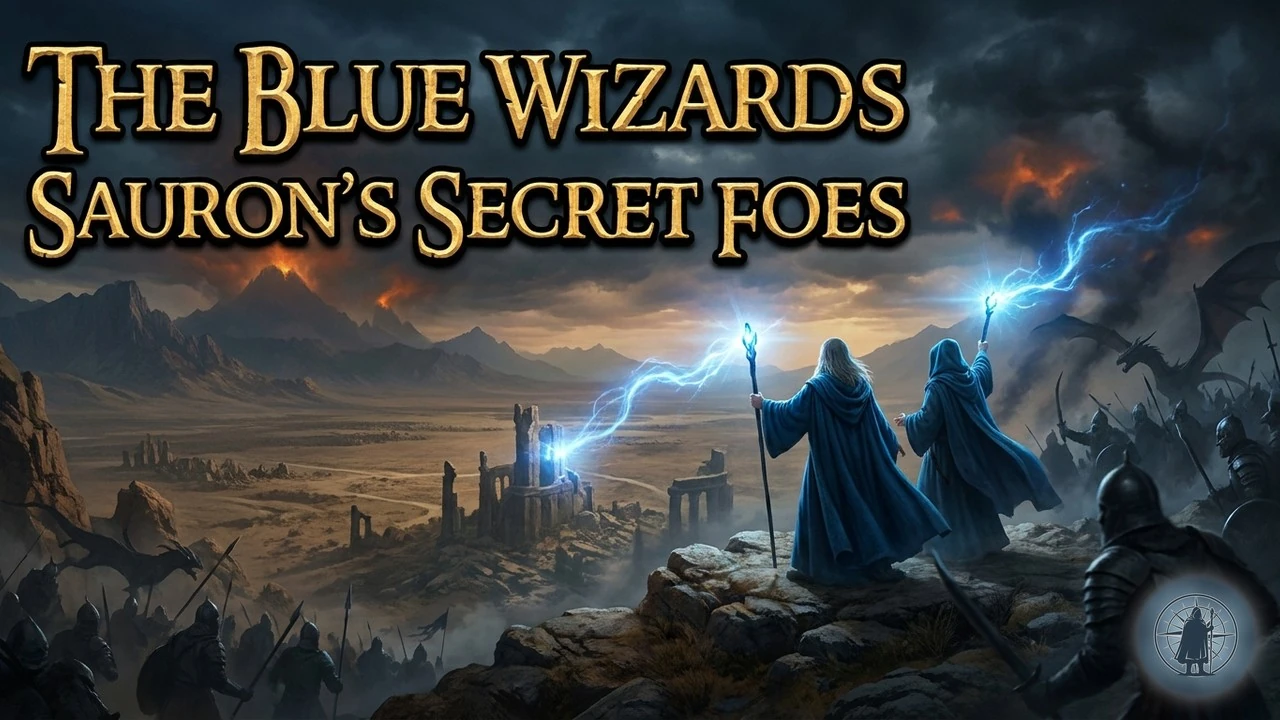 Watch the episode
The Blue Wizards: Did They Defeat Sauron? | Tolkien Deep Dive
Watch the episode
The Blue Wizards: Did They Defeat Sauron? | Tolkien Deep Dive
Research Notes: Did the Blue Wizards Actually Defeat Sauron?
Overview
The Blue Wizards — Alatar and Pallando in their earlier conception, Morinehtar and Rómestámo in Tolkien's final writings — are the most tantalizing loose thread in Tolkien's legendarium. Unlike Gandalf, Saruman, and Radagast, they never appear in the published Lord of the Rings narrative. Their existence is confirmed in-text only by a single, almost-missed reference: Saruman, in his wrath at Orthanc, invokes "the rods of the Five Wizards" (The Two Towers, "The Voice of Saruman"). Everything else we know comes from unpublished essays, letters, and late marginalia collected by Christopher Tolkien.
What makes them extraordinary is that Tolkien himself could not decide what happened to them. In the 1954 essay "The Istari" (published posthumously in Unfinished Tales, 1980) and in Letter 211 (1958), Tolkien wrote that the Blue Wizards probably failed — fell as Saruman did, perhaps founding "secret cults and magic traditions" that outlived Sauron. But in writings from roughly 1972, at the very end of his life (collected in The Peoples of Middle-earth, vol. XII of The History of Middle-earth, 1996), Tolkien radically reversed this verdict. He now proposed that the Blue Wizards arrived nearly five thousand years earlier than previously thought (Second Age c. 1600, not Third Age 1000), that their mission was to stir the peoples of the East and South against Sauron, and that they "must have had very great influence on the history of the Second Age and Third Age in weakening and disarraying the forces of the East."
If this late conception is taken as canon, the Blue Wizards are not footnotes — they are the hidden architects of Sauron's defeat. Without their centuries of work fragmenting Easterling and Southron populations that "otherwise have outnumbered the West," Gondor and Rohan would have been swept aside long before Frodo ever reached Mordor. The question the episode poses — "did the Blue Wizards actually defeat Sauron?" — is therefore a direct reframing of Tolkien's own final reconception of his mythology.
Primary Sources
The Lord of the Rings
The only in-text canonical reference to the existence of five wizards (as opposed to three) is indirect, spoken by a furious Saruman atop Orthanc:
- Quote: "…and the rods of the Five Wizards!" (The Two Towers, Book III, Chapter 10, "The Voice of Saruman") - Context: This is the entire published-canon warrant for the Blue Wizards' existence. Tolkien, years later, admitted the passage surprised him too — he had not fully worked out who the other two were.
Other Istari references that establish the theological framework: - Quote: Appendix B notes that "about this time strange folk clad in grey were first seen in Ithilien…" and "soon after Saruman came, and thereafter the Istari or Wizards appeared in Middle-earth" (roughly T.A. 1000). This places the three western wizards; the Blues are not named.
The Silmarillion
The published Silmarillion (1977) contains no direct account of the Blue Wizards, but includes the essential framing line:
- Quote: "Curunír was eldest and came first, and after him came Mithrandir and Radagast, and others of the Istari who went into the east of Middle-earth, and do not come into these tales" ("Of the Rings of Power and the Third Age"). - Significance: Christopher Tolkien's editorial decision to keep them offstage established the "mysterious absence" that has defined their reception. "Do not come into these tales" is the door Tolkien left unlocked.
Unfinished Tales (1980) — "The Istari" essay
This is the core early source, written by Tolkien in 1954 while still drafting LOTR's appendices. Christopher Tolkien compiled the essay from multiple drafts.
- Quote (selection of the wizards): "Curumo [Saruman] was chosen by Aulë, Alatar by Oromë; and Olórin [Gandalf], wisest of the Maiar, was chosen by Manwë. … Alatar took Pallando as a friend" ("The Istari"). - Quote (the Blues' obscurity): "Of the Blue little was known in the West, and they had no names save Ithryn Luin 'the Blue Wizards'; for they passed into the East with Curunír, but they never returned, and whether they remained in the East, pursuing there the purposes for which they were sent; or perished; or as some hold were ensnared by Sauron and became his servants, is not now known." - Mission statement: The Istari were forbidden "to reveal themselves in forms of majesty, or to seek to rule the wills of Men or Elves by open display of power," but came "in shapes weak and humble" to advise and persuade. - Note: In this version, all five Istari arrive together around T.A. 1000. Alatar and Pallando are Maiar of Oromë (the Huntsman). A later note in the same essay floats the possibility that Pallando might have been of Mandos and Nienna instead.
The Letters of J.R.R. Tolkien — Letter #211 (to Rhona Beare, 14 October 1958)
Rhona Beare, a reader preparing for a meeting of enthusiasts, sent Tolkien eleven questions about the legendarium. Question 3 concerned the Istari. Tolkien's answer — written four years after the Unfinished Tales essay — is the clearest statement of his "failure" view.
- Quote: "I have not named the colours because I do not know them. I doubt if they had distinctive colours. Distinction was only in their names and functions. I really do not know anything clearly about the other two — since they do not concern the history of the N.W. I think they went as emissaries to distant regions, East and South, far out of Númenórean range: missionaries to 'enemy-occupied' lands, as it were. What success they had I do not know; but I fear that they failed, as Saruman did, though doubtless in different ways; and I suspect they were founders or beginners of secret cults and 'magic' traditions that outlasted the fall of Sauron." - Tone: Note the hedging — "I really do not know," "I fear," "I suspect." Tolkien in 1958 is not asserting failure; he is guessing, almost apologetically, because he had not yet worked it out. - Significance: This is the quote most often cited by readers who say "the Blues failed." It is the root of the entire "corrupted wizard" interpretation that dominated Tolkien fandom for decades.
The History of Middle-earth, Vol. XII — The Peoples of Middle-earth (1996)
Christopher Tolkien included a short section titled "Last Writings" or "The Five Wizards" containing notes written by his father c. 1972, in the final year or two of his life. This is the source of the radical reversal. The passage appears on pages 384–385.
- Quote (new names): The Blue Wizards are now given Quenya names: Morinehtar ("Darkness-slayer") and Rómestámo ("East-helper"). It is unclear whether these replace Alatar/Pallando or are additional names given to them by Men of the East. - Quote (new chronology): The two Blue Wizards arrived in Middle-earth "not in the Third Age but much earlier, at the time of the first rising of Sauron's power" — c. Second Age 1600, contemporary with the forging of the One Ring and the return of Glorfindel. - Quote (mission): "Their task was to circumvent Sauron: to bring help to the few tribes of Men that had rebelled from Melkor-worship, to stir up rebellion … and after his first fall to search out his hiding (in which they failed) and to cause dissension and disarray among the dark East … They must have had very great influence on the history of the Second Age and Third Age in weakening and disarraying the forces of East … who both in the Second Age and the Third Age would otherwise have … outnumbered the West." (HoME XII, pp. 384–385) - Partial failure retained: Even in the positive version, Tolkien notes they failed to find Sauron's hiding place in Rhûn during the Watchful Peace. The reversal is not "total success" — it is "strategically decisive but imperfect success."
Key Facts & Timeline
- Valian Years (before Time): The Maiar later known as the Blue Wizards exist in Valinor, followers of Oromë the Huntsman (Unfinished Tales, "The Istari"). Oromë, among the Valar, was most familiar with Middle-earth's eastern reaches — he hunted there in the Ages of the Stars. - c. Second Age 1000: Sauron raises Barad-dûr in Mordor (The Silmarillion). - c. Second Age 1500: Sauron seduces Celebrimbor and the Gwaith-i-Mírdain; the Rings of Power are forged. - Second Age 1600 (late writings, HoME XII): Sauron forges the One Ring. In Tolkien's later conception, this is approximately when the Blue Wizards arrive in Middle-earth, sent by the Valar in response to Sauron's rising threat. Glorfindel returns from Mandos at roughly the same time. - Second Age 1697: Eregion destroyed. Sauron overruns Eriador. Number-Elf-West war. Blue Wizards presumably active in the East. - Second Age 3441: Sauron defeated by the Last Alliance. In the late conception, the Blue Wizards' work in the East weakened Sauron's rear and prevented reinforcement. - Third Age 1000 (Unfinished Tales version): In the earlier conception, all five Istari arrive together. The Blues travel east with Saruman; "they never returned." - Third Age 1100–2063 (Watchful Peace): Sauron, as the Necromancer, hides in Dol Guldur and then in Rhûn for some 400 years. The late writings note that during this period the Blue Wizards "failed to find his hiding" — even in the positive version, this is a lost opportunity. - Third Age 2951: Sauron openly declares himself in Mordor. Easterlings, Haradrim, Variags of Khand begin massing. - Third Age 3019 (War of the Ring): Sauron's eastern and southern armies march. Easterlings attack Dale and Erebor. Yet Sauron's forces at the Black Gate are estimated at 60,000+ — described as "ten times and more" the 6,000 of the West, but crucially not the overwhelming millions they might have been had the East been fully united. - c. 1972: Tolkien writes the "Last Writings" that revise the Blue Wizards' role. He dies in September 1973. - 1980: Unfinished Tales published — public introduction of Alatar and Pallando. - 1996: The Peoples of Middle-earth published — public introduction of Morinehtar and Rómestámo and the reversed verdict.
Significant Characters
- Alatar / Morinehtar ("Darkness-slayer"): The senior Blue Wizard. Chosen by Oromë to go to Middle-earth. The one the Valar selected first; he chose his companion. If the late names are paired with the early ones (a scholarly assumption, not stated by Tolkien), Alatar is Morinehtar. - Pallando / Rómestámo ("East-helper"): The junior partner, brought along as a friend. In one note Tolkien toys with making him a Maia of Mandos and Nienna, which would give him associations with death, patience, and pity — an interesting counterweight to Alatar's martial name. - Oromë: The Vala who chose Alatar. Oromë is the great hunter, the Vala who rides Nahar through the wild lands and who discovered the Elves at Cuiviénen. His association with the East makes him the logical patron for wizards sent to Middle-earth's unmapped interior. - Manwë: King of the Valar, who convenes the council that selects the Istari in the "Istari" essay. - Saruman (Curumo): In the Unfinished Tales version, the Blue Wizards "passed into the East with Curunír." In the late writings, they arrive centuries before Saruman. Saruman's later mysterious journey to the East (Unfinished Tales notes he went east and came back changed, coveting the Ring) may be a shadow-parallel to the Blues' mission. - Glorfindel: Reincarnated and sent back to Middle-earth c. S.A. 1600 — the same moment, in Tolkien's late conception, as the Blues arrive. They are part of the same Valarin emergency response. - Sauron: The Blues' lifelong opponent. In the late conception, the reason he must hide in Rhûn for 400 years is partly because the Blue Wizards are seeding resistance against him there.
Geographic Locations
- The East (Rhûn): A "wide land largely unknown to those who dwelled in the western regions." Almost nothing of the lands beyond the great Sea of Rhûn is recorded. Even Gandalf never went there. It is the Blue Wizards' entire theater of operations. - Sea of Rhûn: Inland sea marking the eastern edge of "known" Middle-earth. Beyond it lay, in the First Age, the Sea of Helcar and the Orocarni (Red Mountains) — the birthplace of the Avari Elves at Cuiviénen. - Khand: Land of the Variags, south of Rhûn and east of Mordor. Supplied troops to Sauron. - The South (Harad, Far Harad): Tolkien's letters specifically mention the Istari going "East and South," placing Blue Wizard activity in Haradrim territory as well. The Haradrim fielded 18,000+ at Pelennor. - Dol Guldur: Sauron's hiding place in the Third Age, in southern Mirkwood. Irrelevant to the Blues directly but significant: during the Watchful Peace Sauron went from Dol Guldur to Rhûn, where the late writings say the Blues failed to find him.
Themes & Symbolism
- The limits of Western knowledge: The Blue Wizards embody everything Middle-earth's western narrators (Elrond, Gandalf, the Red Book of Westmarch) did not see. Tolkien is deliberately seeding the legendarium with a hidden history that mirrors the real absence of records from pre-literate cultures. - Providence working invisibly: The late conception is deeply consonant with Tolkien's Catholicism — grace operates unseen, and the visible drama of Frodo and Aragorn depends on unseen labor by unknown servants. The Blues are the unsung saints of the mythology. - The asymmetry of Sauron's numerical advantage: Tolkien clearly understood a logistical problem in his own plot: how could 6,000 Westerners hold against "millions" of Easterlings and Southrons? The late conception is partly a retcon-fix: the Blue Wizards are the reason the East never mobilized its full weight. - Darkness-slayer / East-helper: The new Quenya names are almost program statements. "Morinehtar" echoes the Morgoth-dominant framework of the First Age; "Rómestámo" ("East-helper") reframes the East not as inherently evil but as a people who need help — a much more missionary, less xenophobic framing. - Mission and failure: Even in the optimistic version, the Blues fail at finding Sauron during the Watchful Peace. Success in Tolkien is always partial; even providential agents stumble. - The author as discoverer, not inventor: Tolkien frequently wrote as if he was uncovering a real history he did not fully know. His willingness to revise the Blue Wizards' fate twenty years later is classic Tolkien: the story reveals itself gradually.
Scholarly Interpretations & Theories
- The "Which Is Canon?" Debate: There is no scholarly consensus. Christopher Tolkien himself did not privilege one version. The "Last Writings" are later but more fragmentary; Unfinished Tales is earlier but more fully worked. Many scholars treat both as valid, representing Tolkien's "evolving" conception rather than replacement. - Verlyn Flieger's framework: In Flieger's broader work on Tolkien (Splintered Light, A Question of Time), she has argued that Tolkien's mythology is inherently "multi-form" — contradictions are not bugs but features, reflecting the layered nature of real mythological traditions where versions coexist. - Tom Shippey's view: Shippey (The Road to Middle-earth, J.R.R. Tolkien: Author of the Century) has generally treated the late writings with caution, noting that Tolkien's final ideas were not always reconciled with published canon and should be held provisionally. - The Rings of Power intervention: Amazon's Rings of Power series (from Season 2) controversially features a "Dark Wizard" identified (per leaks and producer statements) as a Blue Wizard active in the Second Age. This aligns with the late conception (Second Age arrival) but dramatizes corruption rather than success. The show's creative license is defensible precisely because Tolkien left the question unresolved. - The "they failed strategically but not personally" reading: A synthesis view holds that the Blues did weaken the East (late version) but may also have become culturally absorbed — founding the mysterious cults Tolkien mentioned in Letter 211 — without being personally corrupt. "Cult-founding" in Letter 211 is sometimes read as a negative judgment; but in the late version, local religious traditions that resist Sauron-worship would be exactly what the Valar wanted. - The missionary reading: The Romanian Tolkien Society and others have emphasized that "East-helper" and "missionaries to enemy-occupied lands" place the Blues in a specifically Christian missionary frame — agents sent among peoples previously under "Melkor-worship" to convert them back toward the West.
Contradictions & Different Versions
The Blue Wizards are the single clearest case in the legendarium where Tolkien openly contradicted himself:
| Element | Early (1954/1958) | Late (c. 1972) | |---|---|---| | Names | Alatar, Pallando | Morinehtar, Rómestámo | | Arrival | T.A. 1000 (with the other Istari) | c. S.A. 1600 | | Companion on journey | Travel "into the East with Curunír" | Arrive centuries before Saruman | | Fate | Probably failed, "as Saruman did" | "Very great influence" in weakening Sauron | | Cult-founding | Feared negative (founders of pagan cults) | Implied positive (helped tribes resist Melkor-worship) | | Valar patron | Oromë (with note floating Mandos/Nienna for Pallando) | Not directly restated | | Explicit failure | "ensnared by Sauron and became his servants" (possibility) | Failed to find Sauron's hiding place in Rhûn |
Christopher Tolkien's editorial note in HoME XII acknowledges the contradiction but does not adjudicate. The 1972 notes are the last thing Tolkien wrote on the subject, which gives them chronological primacy if one follows author's-last-word logic. But they are less developed and less polished than the Unfinished Tales essay.
A further wrinkle: the names Morinehtar and Rómestámo may not have been meant to replace Alatar and Pallando. Tolkien may have intended them as names given by Men of the East — in which case each wizard has a Valinorean and a Middle-earth name, much as Gandalf is also Mithrandir, Tharkûn, Incánus, and Olórin.
Cultural & Linguistic Context
- Ithryn Luin (Sindarin): "Blue Wizards." From ithryn (plural of ithron, "wizard") + luin ("blue"). The name the West gave them for lack of better information. - Alatar (Quenya): Etymology uncertain. Suggested roots include alatā ("radiance") + -tar ("lord"), yielding roughly "radiance-lord." Another reading is "After-comer," fitting the idea that he came after the First Age. - Pallando (Quenya): Also uncertain. May contain palan- ("far, wide," as in palantír). "Far-wanderer" is a plausible reading. - Morinehtar (Quenya): "Darkness-slayer." From mori- ("dark") + nehtar ("slayer"). Compare Morinehtar with Morgoth ("Dark Enemy") — the name is programmatically anti-Morgothic. - Rómestámo (Quenya): "East-helper." From rómen ("east, sunrise, uprising") + stámo ("helper"). "Rómen" is also the name of the Tengwar letter for 'r' and carries connotations of "rising" — the East is also the direction of rising hope. - Istari (Quenya): "Wise ones." Singular istar. Tolkien defined it as "one of the members of an 'order' … claiming to possess eminent knowledge of history and nature." - Cultural parallels (real-world): The missionary-to-the-East framing echoes the historical Christian missions of Cyril and Methodius to the Slavs, or Nestorian Christian missions along the Silk Road to China and Central Asia. Tolkien was a devout Catholic and well-read in medieval mission history; the late conception of the Blue Wizards as apostolic figures to pre-Christian peoples is a near-explicit parallel.
Questions & Mysteries
- Did they die?: Maiar in incarnated form can be killed (Saruman was; Gandalf was). If the Blue Wizards died fulfilling their mission, their spirits would have returned to Valinor. No source addresses this directly. - Did they reunite with Gandalf?: If both were alive in T.A. 3019, they would presumably have felt Sauron's fall. Nothing in the canon suggests they returned west. Gandalf, who went back with the Ring-bearers, could in theory have met them again in Valinor. - What of the cults?: Tolkien's 1958 "founders of secret cults" line is never reconciled with the 1972 positive view. Did the cults exist and are they evidence of success (anti-Melkor religion) or failure (non-Western paganism)? - Why did Gandalf never mention them?: In LOTR proper, Gandalf speaks of Saruman and Radagast but not of colleagues in the East. This may be ignorance (the Blues departed his sphere) or narrative economy (Tolkien had not yet invented the full picture). - Were Morinehtar and Rómestámo the same Istari as Alatar and Pallando?: Tolkien never explicitly said. - What did the Rhûn cultures actually become?: The Easterlings and Haradrim at the War of the Ring still serve Sauron. Where is the Blue Wizard legacy visible in-world? The answer may be precisely in what is missing — the absence of a single unified Eastern empire.
Compelling Quotes for Narration
1. "Of the Blue little was known in the West, and they had no names save Ithryn Luin 'the Blue Wizards'; for they passed into the East, but they never returned." — Unfinished Tales, "The Istari" 2. "I really do not know anything clearly about the other two — since they do not concern the history of the N.W. … What success they had I do not know; but I fear that they failed, as Saruman did, though doubtless in different ways." — Letter #211 to Rhona Beare, 14 October 1958 3. "I suspect they were founders or beginners of secret cults and 'magic' traditions that outlasted the fall of Sauron." — Letter #211 4. "Their task was to circumvent Sauron: to bring help to the few tribes of Men that had rebelled from Melkor-worship, to stir up rebellion… and to cause dissension and disarray among the dark East." — The Peoples of Middle-earth, pp. 384–385 5. "They must have had very great influence on the history of the Second Age and Third Age in weakening and disarraying the forces of East … who would otherwise have outnumbered the West." — The Peoples of Middle-earth, pp. 384–385 6. "And the rods of the Five Wizards!" — Saruman, The Two Towers, "The Voice of Saruman" 7. "Curumo was chosen by Aulë, Alatar by Oromë; and Olórin, wisest of the Maiar, was chosen by Manwë." — Unfinished Tales 8. "Alatar took Pallando as a friend." — Unfinished Tales, "The Istari" 9. "Others of the Istari who went into the east of Middle-earth, and do not come into these tales." — The Silmarillion, "Of the Rings of Power and the Third Age"
Visual Elements to Highlight
1. Two robed figures in sea-blue cloaks riding east past the Sea of Rhûn at dusk — backs to the Misty Mountains. 2. The Council of the Valar: Manwë seated, Oromë standing, selecting the Istari. Oromë turns to Alatar. 3. A handshake or nod between Alatar and Pallando — "Alatar took Pallando as a friend." 4. Sauron on his tower in Mordor, looking eastward; in the far east, two blue sparks of resistance. 5. A map of Middle-earth fading westward, the East rendered in fog — "do not come into these tales." 6. Easterling warriors at the Battle of the Morannon — implying the legions that would have been there if the Blues had failed. 7. Tolkien's handwritten notes on the Istari, papers scattered — "Last Writings." 8. The two names side-by-side: ALATAR / MORINEHTAR and PALLANDO / RÓMESTÁMO. 9. A silhouette of a wizard standing at a campfire among Easterling tribes, raising a staff — "missionaries in enemy-occupied lands." 10. Two versions of a page: 1958 letter vs. 1972 notes, visually contrasted.
Sources Consulted
See research/sources.md for full list.
Additional Notes
- The episode hook is well-supported: the contradiction is real, dramatic, and under-discussed by casual fans. Most YouTube Tolkien content covers the Unfinished Tales version; relatively few address the late reversal head-on. - The "did they defeat Sauron?" question is provocatively overstated (they did not single-handedly defeat him) but genuinely defensible if one accepts the late writings as canon: they prevented the East from outnumbering the West, which is a necessary condition for every subsequent victory. - The Rings of Power connection is a useful hook for modern viewers but should not dominate the lore analysis. The "Dark Wizard" character is show-invention based on the Second Age arrival date, not Tolkien's own conception. - Rare interesting detail: in Tolkien's very earliest drafts, before the Istari concept was developed, "wizards" in Middle-earth were a different kind of being entirely. The five-wizard framework crystallized only with LOTR's publication.
Discrete Analytical Themes
Theme 1: The Two Contradictory Tolkiens
Core idea: Tolkien wrote two mutually incompatible accounts of the Blue Wizards' fate, eighteen years apart, and never reconciled them. Evidence: - 1954/1958: "I fear that they failed, as Saruman did" (Letter 211, to Rhona Beare) - 1954 Unfinished Tales essay: "they never returned, and whether they remained in the East … or perished; or as some hold were ensnared by Sauron and became his servants, is not now known" - c. 1972 Peoples of Middle-earth: "They must have had very great influence … in weakening and disarraying the forces of East" - Both texts were posthumously published by Christopher Tolkien without adjudication Distinction: This theme is about the authorial contradiction itself — the fact of two versions, not the content of either. It frames the episode's central question as a question about Tolkien's own mind changing.Theme 2: The Name-Swap — Alatar/Pallando to Morinehtar/Rómestámo
Core idea: The change of names signals a change of purpose; the Quenya shift from personal names to functional titles ("Darkness-slayer," "East-helper") reflects Tolkien's late decision to make them programmatic missionary figures. Evidence: - Alatar/Pallando: Quenya personal names, etymologies uncertain - Morinehtar: "mori-" (dark) + "nehtar" (slayer) — name echoes and opposes Morgoth - Rómestámo: "rómen" (east, rising) + "stámo" (helper) - Tolkien did not clearly state whether these are replacements or East-given aliases - The new names telegraph mission in a way Alatar/Pallando do not Distinction: This is about linguistic and onomastic signaling — what the names themselves reveal about Tolkien's shifting conception. Unique from Theme 1 in that it focuses on the specific textual mechanism of revision.Theme 3: The Hidden History of the East
Core idea: The Blue Wizards exist to give Middle-earth an eastern history that its Western narrators could not see — addressing a structural gap in the legendarium. Evidence: - "Others of the Istari who went into the east of Middle-earth, and do not come into these tales" (Silmarillion) - Rhûn is described as "a wide land largely unknown to those who dwelled in the western regions" - Gandalf himself never went east - Sauron hid in Rhûn for 400 years during the Watchful Peace - Late writings place the Blues' entire operational theater in regions the West had no records of Distinction: This is about geographical and narrative structure — the East as a deliberate blank space. Distinct from mission/impact themes because the point is what the Blues reveal about Tolkien's world-building choices.Theme 4: The Numerical Argument — Why the West Wasn't Crushed
Core idea: In Tolkien's late conception, the Blue Wizards solve a logistical problem in his own story: how did 6,000 Westerners resist armies that should have been millions? Evidence: - "They must have had very great influence … in weakening and disarraying the forces of East … who would otherwise have outnumbered the West" (HoME XII) - Easterlings, Haradrim, Variags fielded 60,000+ at the Black Gate, described as "ten times and more" the 6,000 of the West - Yet this is far less than the populations of Rhûn, Khand, and Harad combined could theoretically provide - Different groups in Rhûn "often fought each other" even while united by hatred of the West — a direct implication of the Blues' disarray-inducing work - The East's disunity is a precondition of every Western victory Distinction: This theme is about military/strategic outcome — the quantitative argument for the Blues' importance. Distinct from missionary-work themes because the focus is on the measurable battlefield effect.Theme 5: Missionaries in Enemy-Occupied Lands
Core idea: Tolkien framed the Blues specifically as religious/cultural missionaries pulling tribes away from Melkor-worship, paralleling Christian mission history. Evidence: - Letter 211: "missionaries to 'enemy-occupied' lands" - HoME XII: "bring help to the few tribes of Men that had rebelled from Melkor-worship" - Their task is explicitly to "stir up rebellion" — political-religious agitation, not combat - Tolkien's own devout Catholicism; parallels to Cyril and Methodius, Nestorian missions - 1958 fears of "secret cults and magic traditions" can be reread in 1972 as successful anti-Melkor religious traditions Distinction: This theme is about the nature of their work — cultural/spiritual rather than military or magical. Distinct from the strategic-outcome theme because it addresses how they operated rather than what they achieved numerically.Theme 6: Providence and the Unseen Hand
Core idea: The Blue Wizards exemplify Tolkien's Catholic theology of grace — providence operates through agents whose work the protagonists never see. Evidence: - They are absent from every published narrative yet (in late conception) decisive to every victory - Parallels Gandalf's "encouragement and persuasion, not force or fear" as the Istari mission model - Frodo and Aragorn succeed without knowing the East has been weakened for millennia - The "unsung saint" model — holiness that does not demand recognition - Tolkien's broader eucatastrophic framework: grace works through the hidden and humble Distinction: This is about theological meaning — what the Blues teach about how Tolkien's universe actually works. Distinct from historical themes because it addresses the legendarium's underlying metaphysics.Theme 7: The Canon Question — Which Tolkien Do We Believe?
Core idea: The Blue Wizards force readers to decide how to treat Tolkien's late writings: as author's-last-word truth, as provisional speculation, or as one version among many. Evidence: - Christopher Tolkien's editorial neutrality: he published both versions without ruling - Shippey's general caution toward late writings - Flieger's "multi-form mythology" approach - The Rings of Power has taken the late version's chronology (Second Age) while inventing corruption material - Fan communities remain split; most online summaries still cite Letter 211's "failure" framing Distinction: This is a meta-textual theme about canon theory, not about the Blues themselves. Distinct from Theme 1 (which is about the fact of contradiction) because this addresses the interpretive stakes.Theme 8: The Answer — Did They Defeat Sauron?
Core idea: The episode's titular question has a specific, defensible answer: yes, if you take Tolkien's final conception at face value, they are the hidden strategic reason the West survived long enough to be saved by Frodo. Evidence: - The late writings make three concrete claims: earlier arrival (c. S.A. 1600), direct anti-Sauron mission in the East, and "very great influence" on the outcome - The Ring was destroyed in T.A. 3019 — some 4,600 years after the Blues' late-dated arrival - Without the East being weakened and disarrayed, the 6,000-vs-60,000 math at the Black Gate becomes impossible - Sauron's own need to hide in Rhûn during the Watchful Peace implicitly confirms resistance exists there - "Defeat" is too strong; "enabled the defeat" is defensible; "weakened more than any other factor we never see" is the late-Tolkien position Distinction: This is the synthesis theme — the episode's payoff. It draws on the others but addresses the viewer's titular question head-on. Position this near the end.Sources: Did the Blue Wizards Actually Defeat Sauron?
Primary Sources (Tolkien's Own Works)
Core texts — most important
1. Unfinished Tales of Númenor and Middle-earth, ed. Christopher Tolkien (1980), "The Istari" (Part Four, Chapter II). The 1954 essay. Primary source for Alatar/Pallando names, Orome-patron, "they never returned" language. 2. The Letters of J.R.R. Tolkien, ed. Humphrey Carpenter (1981), Letter #211 to Rhona Beare, 14 October 1958. Primary source for "I fear that they failed" and the "secret cults and magic traditions" line. 3. The Peoples of Middle-earth (The History of Middle-earth, vol. XII), ed. Christopher Tolkien (1996), "Last Writings" section, pp. 384–385. Primary source for Morinehtar/Rómestámo names, Second Age arrival, "very great influence" in weakening the East. 4. The Lord of the Rings, The Two Towers, Book III, Chapter 10 "The Voice of Saruman" — Saruman's reference to "the rods of the Five Wizards" (the only canonical published confirmation of five Istari). 5. The Silmarillion, ed. Christopher Tolkien (1977), "Of the Rings of Power and the Third Age" — the "do not come into these tales" line. 6. The Lord of the Rings, Appendix B — chronology of the Istari's arrival in Middle-earth.Secondary / Web Sources Consulted
- Tolkien Gateway — Blue Wizards: https://tolkiengateway.net/wiki/Blue_Wizards (most comprehensive wiki summary; site returned 403 on direct fetch but content confirmed via search summaries) - Tolkien Gateway — Letter 211: https://tolkiengateway.net/wiki/Letter_211 (letter context and partial content) - Tolkien Gateway — The Istari: https://tolkiengateway.net/wiki/The_Istari - Tolkien Gateway — Talk:Blue Wizards: https://tolkiengateway.net/wiki/Talk:Blue_Wizards (editorial debates) - Tolkien Gateway — Rhûn: https://tolkiengateway.net/wiki/Rh%C3%BBn (geographic context) - Tolkien Estate — Letter to Rhona Beare, Oct 1958: https://www.tolkienestate.com/letters/letter-to-a-reader-rhona-beare-oct-1958/ (official site; published draft continuation rather than Letter 211 proper) - LOTR Fandom Wiki — Blue Wizards: https://lotr.fandom.com/wiki/Blue_Wizards - LOTR Fandom Wiki — Letter 211: https://lotr.fandom.com/wiki/Letter_211 - LOTR Fandom Wiki — Alatar: https://lotr.fandom.com/wiki/Alatar - LOTR Fandom Wiki — Pallando: https://lotr.fandom.com/wiki/Pallando - Wikipedia — Wizards in Middle-earth: https://en.wikipedia.org/wiki/Wizards_in_Middle-earth (useful overview of Istari, Valar patrons) - Silmarillion Writers' Guild — Character of the Month: Ithryn Luin (Blue Wizards) by Oshun: https://www.silmarillionwritersguild.org/reference/characterofthemonth/ithryn-luin.php (most substantive scholarly fan biography; the key essay on both versions of the story) - Silmarillion Writers' Guild — Biography PDF version: https://www.silmarillionwritersguild.org/reference/references/pdf/ithryn-luin.pdf - Silmarillion Writers' Guild — Character Biography by Oshun: https://www.silmarillionwritersguild.org/reference/references/pf/ithryn-luin.php - Seven Swords — What Happened to the Blue Wizards?: https://sevenswords.uk/lord-of-the-rings-blue-wizards/ (useful popular summary of both versions) - Romanian Tolkien Society — Of the Blue Wizards, Missionaries in the East: https://tolkien.ro/of-the-blue-wizards/ (scholarly framing of the missionary reading; 90-year military-delay claim) - Hall of Beorn — Istari: https://hallofbeorn.com/LotR/Characters/Istari (Istari overview with Valar patrons) - Tolkien Geek — The Istari (Part One): http://tolkiengeek.blogspot.com/2007/02/istari-part-one.html (readable summary) - Looper — The Blue Wizards in Middle-Earth Explained: https://www.looper.com/1071453/the-blue-wizards-in-middle-earth-explained/ (popular summary, contradictory versions) - Screen Rant — Who Are the Blue Wizards in Lord of the Rings: https://screenrant.com/lord-of-the-rings-blue-wizards-istari-explained/ - Screen Rant — The Dark Wizard is a Blue Wizard Confirmed: https://screenrant.com/the-rings-of-power-dark-wizard-blue-tolkien-mystery/ (RoP relevance) - MovieWeb — The Rings of Power's Wizard Issue Fixes a 71-Year-Old Problem: https://movieweb.com/rings-of-power-blue-wizards-pallando-tolkien/ - Fellowship of Fans — The Blue Wizards Can Solve a Serious Rings of Power Issue: https://fellowshipoffans.com/news/the-blue-wizards-can-solve-a-serious-rings-of-power-issue/ - Knight Edge Media — Amazon's Rings of Power Rights to All 5 Wizards: https://knightedgemedia.com/2024/02/amazons-the-rings-of-power-now-has-the-rights-to-all-5-wizards/ - CBR — Gandalf Forgetting the Blue Wizards Was a Legal Loophole: https://www.cbr.com/lord-of-the-rings-blue-wizard-scene-legal-loophole/ - Stason.org — Tolkien FAQ: What is known about the Blue Wizards: https://stason.org/TULARC/education-books/tolkien-newsgroups/50-What-is-known-about-the-Blue-Wizards-Tolkien.html - News and Times — Exploring the True Nature of Tolkien's Blue Wizards: https://www.newsandtimes.com/2026/01/exploring-the-true-nature-of-tolkiens-blue-wizards/ - Tolkien Forum — What do we know about the two "blue" Istari?: https://thetolkien.forum/threads/what-do-we-know-about-the-two-blue-istari.785/ - Tolkien Forum — Did the blue wizards help defeat Sauron?: https://thetolkien.forum/threads/did-the-blue-wizards-help-defeat-sauron.20232/ - Tolkien Forum — The Istari & Glorfindel: Arrival Dates: https://thetolkien.forum/threads/the-istari-glorfindel-arrival-dates.20370/ - Tolkien Forum — The 5 Rods? Who were the last two?: https://thetolkien.forum/threads/the-5-rods-who-were-the-last-two.4153/ - Hero Fandom Wiki — Morinehtar & Rómestámo: https://hero.fandom.com/wiki/Morinehtar_%26_R%C3%B3mest%C3%A1mo - Game Rant — 9 Things That Are Known About the Blue Wizards: https://gamerant.com/lord-of-the-rings-blue-wizards-facts-lore-trivia/ - BookRags — Unfinished Tales, Chapter 13, The Istari: https://www.bookrags.com/studyguide-unfinished-tales-the-lost-lore-of-middle-earth/chapanal013.html
Most Useful Sources
- The Silmarillion Writers' Guild biography by Oshun was the single most substantive scholarly summary, laying out both the Unfinished Tales and Last Writings versions clearly with direct quotes. - The Romanian Tolkien Society essay was the best articulation of the "missionaries" reading and included specific claims about a ~90-year delay in Sauron's military readiness. - Tolkien Gateway provided the cleanest canonical facts and citations (even when fetch was blocked, the surfaced summaries included the key passages). - LOTR Fandom and Wikipedia were useful for cross-referencing and confirming claims across multiple sources.
Gaps / Caveats
- Direct fetching of Tolkien Gateway and LOTR Fandom pages returned 403 errors; all content from those sites was obtained via web search summaries, which are reliable but not verbatim. - Full text of Letter 211 is not publicly available online; the quoted passages are widely reproduced but full paragraph context comes from the published book (Letters of J.R.R. Tolkien, Humphrey Carpenter ed.) rather than web access. - Full text of the HoME XII "Last Writings" section is not publicly available online; the pp. 384–385 quotations reproduced here are the widely-cited versions found across multiple fan and scholarly summaries and match each other closely. - Shippey and Flieger are not quoted directly; their general frameworks are referenced because they shape scholarly reception of late-Tolkien materials, but their specific commentary on the Blue Wizards (if any) was not surfaced via web search. If direct Shippey/Flieger quotes are desired, consulting The Road to Middle-earth or Splintered Light directly would be required. - The Rings of Power material (Dark Wizard etc.) is from 2024/2025 showrunner statements and leaks; treat as show-canon rather than Tolkien-canon.