
Transcript
Barad-dûr
The Tower Built on Sauron's Soul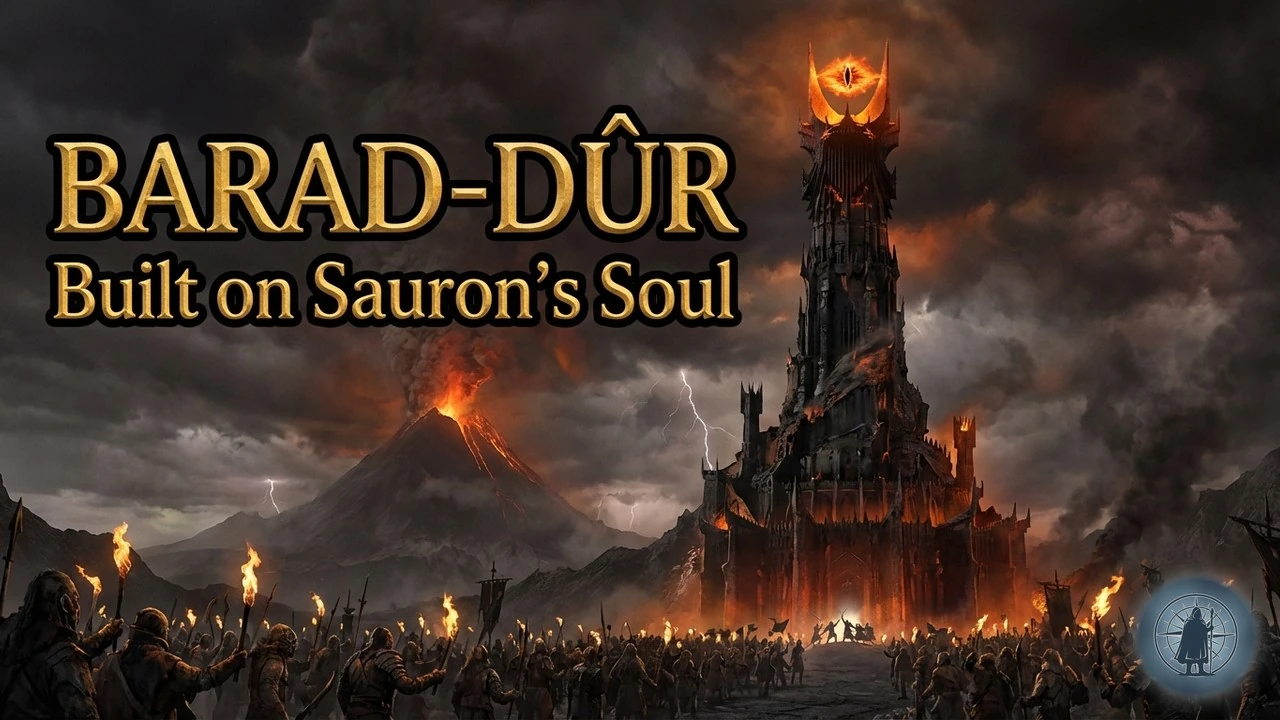 Watch the episode
Barad-dûr: The Tower Built on Sauron's Soul | Tolkien Lore Explained
Watch the episode
Barad-dûr: The Tower Built on Sauron's Soul | Tolkien Lore Explained
Main Narrative: Barad-dur -- The Dark Tower
SECTION: The Smith Who Built in Darkness
In the Valaquenta, Tolkien writes that Sauron "was of the Maiar of Aule, and he remained mighty in the lore of that people." Those words carry more weight than they first appear to. Because they tell you that the architect of Barad-dur -- the most terrible fortress in the history of Middle-earth -- was not, at his core, a warlord. He was a craftsman.
This is Ranger of the Realms, and today we're standing in the shadow of the Dark Tower itself. Not as a building. Not as a set piece from the films. But as a creation -- something made by a maker, across six hundred years of patient, deliberate, terrible labor, and then unmade in a single breath.
Sauron began his existence as Mairon, "the Admirable." He served Aule the Smith, the Vala who shaped the mountains and metals of the world, whose domain was the substance of physical reality itself. Tolkien tells us that Mairon's essential quality -- his virtue, the thing that made him great among the Maiar -- was his love of order and coordination. He hated waste. He despised confusion. He wanted things to work properly, to fit together, to serve their purpose with precision.
And when Morgoth, the great Enemy, drew Mairon away from Aule's service and into darkness, that virtue didn't disappear. It curdled. The love of order became a lust for control. The hatred of confusion became intolerance for freedom. The craftsman became a tyrant. But he never stopped building.
Around the year 1000 of the Second Age, Sauron chose his location with the strategic patience that defined him. He didn't just need a defensible position. He needed fire. Mount Doom -- Orodruin -- stood at the heart of the black land of Mordor, and its volcanic furnaces offered something no other place in Middle-earth could: the raw elemental power required for the kind of forging Sauron intended. The mountain's fires were not merely useful. They were essential. Tolkien tells us Sauron "used them in his sorceries and his forging," binding the natural energy of the earth itself to his purposes.
And there, on a spur of the Ash Mountains overlooking the desolate Plateau of Gorgoroth, he began the work that would consume six centuries. Not six years. Not six decades. Six hundred years of continuous construction, with armies of enslaved laborers hauling stone and iron under a sunless sky.
The sheer duration tells you something about the mind behind it. Morgoth was a destroyer. His instinct was ruin, corruption, the marring of what others had made. Sauron was something different, and in many ways more frightening. His evil was methodical. It planned. It built infrastructure. It laid bedrock and designed supply lines and connected its fortress to its forge by a maintained road -- Sauron's Road, a broad paved causeway running thirty miles across the Plateau of Gorgoroth from the tower's western gate to the slopes of Mount Doom. That road would be destroyed repeatedly by the mountain's eruptions and rebuilt each time by forced labor. The treadmill of tyranny, paved in broken stone and ash.
Where Morgoth hid beneath mountains in the subterranean pits of Angband, Sauron raised his tower above the landscape, visible for a hundred miles. A statement. A declaration.
This was not chaos. This was administration.
SECTION: The Ring-Stone Covenant -- Foundations Beyond Breaking
Around the year 1600 of the Second Age, something happened that transformed Barad-dur from a fortress into something unprecedented. Sauron descended into the Sammath Naur -- the Chambers of Fire within Mount Doom -- and forged the One Ring.
In that act, as Tolkien explains in Letter 131, Sauron "let a great part of his own inherent power pass into the One Ring." His native strength -- the spiritual energy that made him one of the mightiest of the Maiar -- was externalized, concentrated into a golden band. And with that same concentrated will, he completed and strengthened the underpinnings of his tower.
This is the fact that elevates Barad-dur beyond any ordinary stronghold. At the Council of Elrond, thousands of years later, Elrond delivers the critical insight that no one at the time of the Last Alliance fully understood: the tower's foundations "were made with the power of the Ring, and while it remains they will endure."
What does that mean, exactly? It means the stones beneath Barad-dur were not merely quarried and laid. They were infused with Sauron's own essence, channeled through the Ring. The bedrock beneath Barad-dur became an extension of the artifact. The structure became an extension of the maker. Ring, stone, and Dark Lord existed as a single metaphysical system -- each dependent on the others, each indestructible while the others survived.
Scholars have noted an intriguing problem here. Construction of Barad-dur began around SA 1000, but the Ring wasn't forged until SA 1600. How could the substructure be "made with the power of the Ring" if the tower predated it by six centuries? The most compelling explanation is that Sauron used his own native strength from the beginning -- the same strength that would later pass into the Ring. When the Ring was forged, that force retroactively bound what had already been built. The deep stones were completed or reinforced at the moment the Ring came into being, sealing the covenant between bedrock and gold.
There's a parallel here that Tolkien scholars have drawn with remarkable precision. In the History of Middle-earth, Volume 10 -- titled, not coincidentally, Morgoth's Ring -- Christopher Tolkien presents his father's concept of Morgoth's dispersal. Just as Morgoth poured his own strength into the very substance of Arda, marring the physical matter of the world itself, Sauron concentrated his will into a single artifact and the edifice it sustained. The master scattered. The apprentice focused. Both achieved a kind of immortality for their works -- and both created, in doing so, an inescapable vulnerability.
Morgoth could never be fully defeated because his malice permeated everything. Sauron could never be fully defeated while the Ring endured. But destroy the Ring, and everything it sustained -- including those supernaturally hardened stones -- would collapse in an instant.
SECTION: Wall Upon Wall -- What Tolkien Let Us See (and What He Didn't)
Here is something remarkable about the most important building in The Lord of the Rings: we never go inside it.
Not once. In a narrative that spans three volumes and over half a million words, no character crosses Barad-dur's threshold and describes what they find. We never walk its corridors. We never see its chambers. We never learn the layout of its prisons or the design of its halls. This is not an oversight. It is one of the most deliberate narrative choices Tolkien ever made.
Compare this to how Tolkien treats other fortresses. Minas Tirith receives lavish architectural description -- its seven circles, its White Tower, the Houses of Healing, the Court of the Fountain with its dead tree. Orthanc's obsidian-smooth walls, its astronomical carvings, its precisely described height are rendered with the loving attention of a man who thought deeply about stonework. Even Minas Morgul gets an exterior portrait vivid enough to haunt the imagination.
Barad-dur gets something else entirely. It gets impressions. It gets catalogues of horror that read almost like incantations. When Frodo perceives the tower from Amon Hen through the Ring's influence, the description is a cascade of nouns without rest: "wall upon wall, battlement upon battlement, black, immeasurably strong, mountain of iron, gate of steel, tower of adamant." This isn't architecture. It's the experience of being overwhelmed.
And when Sam witnesses the tower from the slopes of Mount Doom in its final moments, the language shifts to negation: "eyeless prisons sheer as cliffs," "immeasurable pits," "gaping gates." Notice the pattern. The words that define Barad-dur are words of absence. Eyeless. Immeasurable. Gaping. The tower is described by what it lacks -- light, proportion, warmth, openness -- rather than what it possesses.
One scholarly analysis identifies this as Tolkien's deliberate embodiment of his theological understanding of evil. In the Catholic tradition that shaped Tolkien's deepest thinking, evil is not a substance. It is a privation -- an absence of good, a hole where something should be. Barad-dur, then, is not merely a dark fortress. It is a fortress of negation. A structure defined by voids. This is why we never see its interior: there is, in a philosophical sense, nothing to see. Evil has no positive content to display.
Yet the tower dominates the entire narrative. Characters who never see it feel its weight. The Eye's searching gaze reaches across hundreds of miles. Barad-dur commands the story through what one scholar called "functional invisibility" -- despite never serving as a concrete setting for events, it shapes every decision, every fear, every movement of the plot. The greatest building in Tolkien's work is the one he refuses to let us enter.
SECTION: Seven Years Before the Gate -- The Siege That Won Everything and Nothing
In the year 3434 of the Second Age, the largest military force Middle-earth had ever assembled marched across the plain of Dagorlad and arrayed itself before the walls of Barad-dur.
The Last Alliance of Elves and Men. Gil-galad, High King of the Noldor, bearing the spear Aeglos. Elendil the Tall, High King of the Dunedain, carrying the sword Narsil. Behind them, the combined armies of Lindon, Rivendell, Lothlorien, Greenwood, Arnor, and Gondor. It was the final great union of the Free Peoples -- Elves and Men fighting side by side against the full strength of Mordor.
They had already won the field at Dagorlad. Now they faced the tower itself.
The siege lasted seven years.
Let that duration settle. Seven years of encampment on the ashen plains of Gorgoroth, within sight of that dark crown of iron. Seven years of supply lines stretched across Mordor's outer defenses, of provisions hauled through the Black Gate or over the passes of the Ephel Duath. Seven years of attrition, of sallies and counter-strikes, of stones hurled from the battlements and arrows loosed from the walls. The longest and most terrible siege in the history of Middle-earth until that time.
During those years, the tower killed. In SA 3440, a projectile cast from the battlements found Anarion, son of Elendil and co-ruler of Gondor. The prince who had defended Osgiliath against Sauron's initial assault, who had held the line when Minas Ithil fell -- killed by a stone thrown from the walls he was trying to breach. Elendil, already aged beyond counting by the standards of lesser Men, lost his son a year before the siege's end and fought on regardless.
In 3441, Sauron did something unexpected. He came out.
Rather than endure further siege, the Dark Lord issued forth from his tower to fight in person. And in the combat that followed, the alliance paid the highest imaginable price for its victory. Gil-galad was slain. Elendil was slain. Narsil, the great sword, shattered beneath the High King as he fell. The two mightiest leaders of the Free Peoples died at the foot of the tower they had spent seven years besieging.
But Sauron fell too. And Isildur, kneeling beside his father's body, took up the hilt-shard of Narsil and cut the One Ring from Sauron's hand.
The tower was leveled. The walls were thrown down. The iron crown was toppled. The alliance celebrated what appeared to be total victory. But the foundations -- those supernaturally hardened stones, fused with the Ring's potency six hundred years before the siege began -- remained. Dark and immovable, sunk into the bedrock of the Ash Mountains.
Elrond would later call it a fruitless victory. "Not wholly so," he qualified, "yet it did not achieve its end. Sauron was diminished, but not destroyed. His Ring was lost but not unmade."
Three thousand years of consequence would follow from that single failure. The most expensive military victory in the history of Middle-earth -- the lives of two High Kings, a prince of Gondor, and countless soldiers of both kindreds -- had purchased nothing permanent. The tower would rise again. It was only a matter of time. And time was something those unyielding stones had in abundance.
SECTION: The Long Silence and the Return
Imagine the ruins. The great walls thrown down, the iron crown toppled, the battlements shattered across the slopes of the Ash Mountains. Dust and silence where armies had marched. Ash drifting over broken stone. And beneath it all, untouched, unyielding, the deep roots of the tower. Still there. Still waiting. Still bound to a golden ring that was even now being carried north by Isildur toward the Gladden Fields, where he would lose it -- and his life -- within two years of the victory.
For a thousand years after the Last Alliance, those ruins stood empty. Sauron himself, shorn of the Ring and reduced to a formless shadow, drifted eastward and hid. He could not die while the Ring endured, just as the buried stones could not crumble. Master and edifice existed in the same state of diminished persistence -- not alive, not dead, not defeated, not victorious. Waiting.
Around TA 1000, a darkness began to gather in southern Mirkwood. A fortress appeared on a hill called Amon Lanc -- a place that would come to be known as Dol Guldur, the Hill of Sorcery. The Necromancer, as the locals called him, was in truth Sauron himself, slowly regathering his strength. But Dol Guldur was a shadow of what he had lost. A minor outpost. A hiding place for a being who had once commanded the greatest stronghold east of the sea.
For nearly two thousand years, Sauron lingered there -- growing in strength, probing the defenses of the Free Peoples, searching desperately for the Ring he had lost. In 2941, the White Council drove him from Dol Guldur. He withdrew. Not in defeat, but in readiness.
He went home.
In TA 2951, Sauron declared himself openly in Mordor. The Nazgul -- his nine Ringwraiths, who had been quietly preparing the black land for decades -- had done their work. Mordor was garrisoned. The passes were held. And now the reconstruction began.
Rising from that indestructible groundwork -- the same stones that had survived three millennia of abandonment because the Ring still existed somewhere in the world, lying at the bottom of the Anduin, then hidden in a cave beneath the Misty Mountains -- the Dark Tower climbed once more into the sky above Gorgoroth. Sauron's Road was repaved, running from the tower's great western gate, over a vast iron bridge spanning a deep chasm, across the ashen plain, and up a long causeway to the chambers of Mount Doom where the Ring had first been forged.
And now the tower served a new function alongside the old. In the years that followed, Barad-dur became not only a military command center and a projection of Sauron's authority but also an interrogation facility. Between TA 3009 and 3017, a wretched creature named Gollum was held in the Black Pits beneath the tower. The dungeons beneath Barad-dur are described as places of torment where prisoners were brought before "the Questioner."
What Sauron extracted from Gollum in those years of captivity -- two words, "Shire" and "Baggins" -- set the entire plot of The Lord of the Rings in motion. Those two words, wrung from a broken creature in the pits beneath the mightiest tower in Middle-earth, sent the Black Riders galloping toward a land Sauron had barely heard of, in search of a halfling he had never imagined.
Yet the torture also revealed a limitation. Sauron could break Gollum's body but never fully penetrate what Tolkien described as the "locked doors and closed windows" of his mind. The edifice that projected fear across a continent could not extract the full truth from a single wretched prisoner. Even the supreme instrument of coercion had its blind spots.
The tower had risen again, taller and darker than before. Its master sat within it, directing the movements of nine Ringwraiths and vast armies, gazing through the palantir of Minas Ithil, casting his will across the breadth of Middle-earth. The road between Barad-dur and Mount Doom was rebuilt and maintained by orc labor gangs, constantly repaired after the mountain's eruptions destroyed it, constantly restored -- a treadmill of forced labor that would continue until the very end.
SECTION: The Lidless Eye -- Sauron's Gaze from the Iron Crown
At the summit of the rebuilt tower, above the iron crown and its cruel pinnacles, there burned a light that was not a light. Tolkien describes it with surgical precision: "From some great window immeasurably high there stabbed northward a flame of red, the flicker of a piercing Eye."
This is the detail that defines Barad-dur in most imaginations, and it is also the detail most frequently misunderstood.
Peter Jackson's films rendered the Eye of Sauron as a literal, physical phenomenon -- a slit-pupiled iris of flame hovering between the tower's prongs like a searchlight. It is a powerful cinematic image. It is also, as scholars have noted, a simplification of something Tolkien kept deliberately ambiguous.
In the books, Sauron possessed a physical body during the War of the Ring. In a draft letter, Tolkien describes him as having a form -- diminished, yes, but corporeal. The Eye, then, was not a disembodied organ mounted on architecture. It was something more unsettling: a metaphor made almost literal, a description of the intensity of Sauron's focused will as perceived by those who came under its attention. The Window of the Eye was the vantage from which Sauron looked out -- and when he looked, the world felt it.
The most revealing moment comes at Amon Hen, when Frodo sits on the Seat of Seeing wearing the Ring. He perceives Barad-dur in full and terrible clarity. And then: "He knew that it had become aware of his gaze." Not that the Eye saw him. That it became aware. This is mutual detection -- two instruments of power (Ring and tower, the gold and the stone, both vessels of the same externalized will) recognizing each other across four hundred miles.
What makes this exchange genuinely terrifying is its psychological dimension. Barad-dur's primary function was never military in the conventional sense. The tower's purpose was to be seen, to be feared, to project the possibility of surveillance across the entire landscape of Middle-earth. Characters respond to the Eye's presence even when they cannot perceive it directly. Frodo feels its searching attention as a constant pressure throughout the journey. Pippin, after touching the palantir of Orthanc, is nearly broken by a momentary brush with Sauron's direct focus.
The palantir connection extended the surveillance further still. Sauron possessed the seeing-stone of Minas Ithil, captured when the Nazgul took that city, and through it he could dominate any other palantir in the network. The stones -- originally instruments of Numenorean governance, tools for legitimate communication -- became extensions of the Dark Tower's gaze. Denethor's secret use of his own palantir was not a window into knowledge. It was a window into Sauron's controlled narrative, filtered through the will that emanated from the Window of the Eye.
The Lidless Eye. It never closes. It never rests. And even when it cannot see you, you believe it can.
SECTION: The Proud and Bitter Crown -- Babel, Pride, and the Moment Everything Passed
There is a reason Tolkien describes the apex of Barad-dur as a "proud and bitter crown." Those adjectives are not decorative. They are diagnostic.
Pride is the foundational sin in Tolkien's Catholic theology -- the exaltation of self above the created order, the assertion that one's own will should supersede the authority of the Creator. Every fall in the legendarium begins with pride. Morgoth's discord in the Ainulindale. Feanor's defiance of the Valar. Ar-Pharazon's assault on Valinor. And Sauron, standing in the workshops of Aule, deciding that he could order the world better than the one who made it.
Barad-dur is that pride made architectural.
The parallel with the Tower of Babel -- which the artist John Howe explored in his essay connecting the two structures -- runs deeper than visual resemblance. Both towers represent the sin of reaching upward, of building as an act of defiance rather than devotion. The biblical builders said, "Let us build a tower whose top may reach unto heaven, and let us make a name for ourselves." Sauron built a tower whose iron crown rose above the Ash Mountains, and stamped it with the symbol of his unblinking Eye. Both fell. Both fell because the act of building, when motivated by the desire to dominate rather than to serve, carries its own destruction within it.
Tolkien understood this at the deepest level, because he was himself a maker. His entire theory of sub-creation -- the idea that the highest calling of a creative being is to reflect and honor the Creator's work through one's own -- stands in direct opposition to what Barad-dur represents. Sauron was once a sub-creator in the truest sense, a spirit of craft working within the divine order. The Dark Tower is what sub-creation becomes when it forgets its source. When the craftsman declares himself the purpose of the craft. When order becomes indistinguishable from oppression.
And so we arrive at the final scene, and it begins with the same fire that started everything.
On March 25 of the year 3019 in the Third Age, the One Ring fell into the Cracks of Doom. The same volcanic furnace that had forged the Ring, that had powered the laying of Barad-dur's deep stones six thousand years of narrative earlier, now unmade both artifact and edifice in a single cataclysmic moment.
Sam Gamgee, clinging to the slopes of Orodruin with Frodo in his arms, witnessed what followed. Tolkien gives Sam -- the gardener, the most humble character in the story -- the privilege of seeing the proudest creation in Middle-earth come apart.
"Towers and battlements, tall as hills, founded upon a mighty mountain-throne above immeasurable pits; great courts and dungeons, eyeless prisons sheer as cliffs, and gaping gates of steel and adamant: and then all passed."
Those last four words. And then all passed.
The foundations gave way. For the first time in over six thousand years, the stones that Sauron had reinforced with his own soul crumbled. Walls melted. Spires collapsed. Vast columns of smoke and steam erupted skyward. In the Silmarillion's account of the same moment, "the Tower trembled from its foundations to its proud and bitter crown" -- and then it was gone.
No excavation. No ruin to explore. No bones of Barad-dur left for archaeologists of the Fourth Age to catalog. The unmaking was total because the will that sustained the structure was total. When the Ring dissolved, so did every stone it had ever touched with its maker's will.
What took six hundred years to build, and three thousand more to rebuild, vanished in less time than it takes to draw a breath.
This is the final statement Tolkien makes about the kind of creation that Barad-dur represents. Craft in service of mastery. Order imposed rather than cultivated. Architecture as an assertion of the self rather than an offering to the world. It endures for ages. It seems indestructible. It laughs at flattery, secure in its pride and its immeasurable strength. And it passes -- utterly, irrecoverably -- the moment the lie at its foundation is exposed.
The Elven towers still stood when the story ended. Orthanc still stood. The Numenorean walls of Minas Tirith still stood. The things built with humility, built in service, built to preserve rather than to possess -- those endured.
The proud and bitter crown did not.