
Research & Sources
Barad-dûr
The Tower Built on Sauron's Soul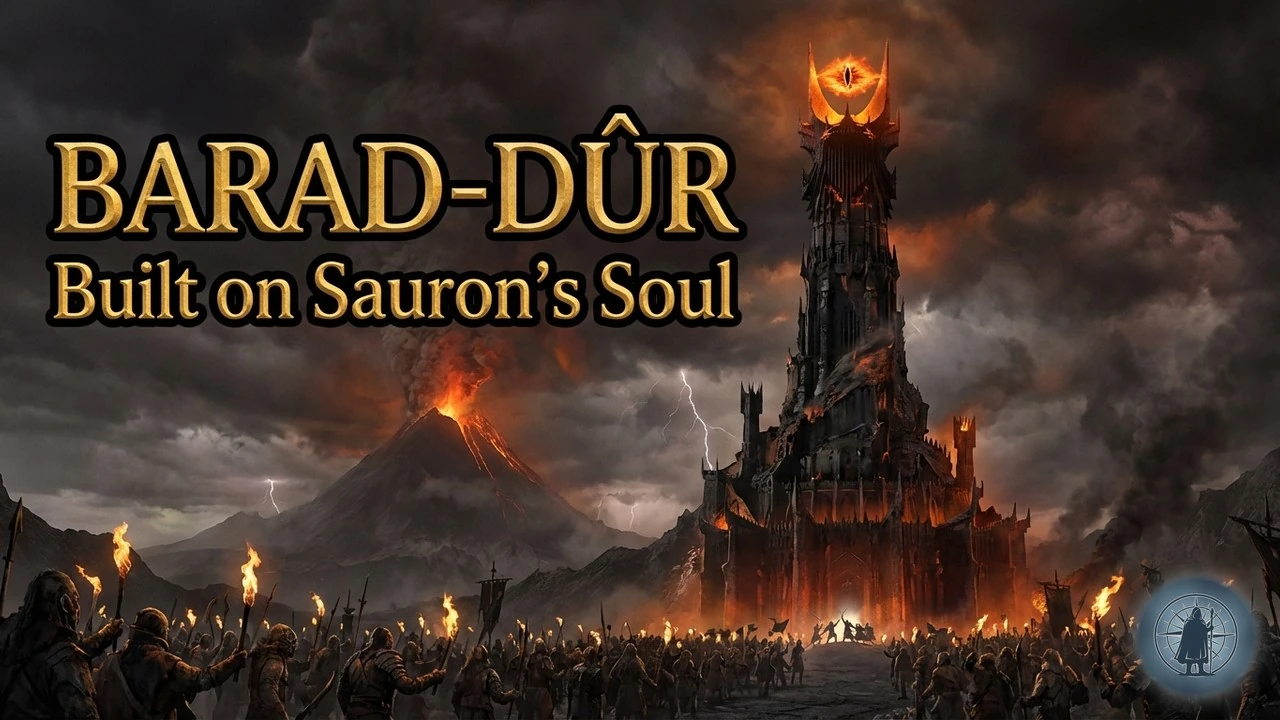 Watch the episode
Barad-dûr: The Tower Built on Sauron's Soul | Tolkien Lore Explained
Watch the episode
Barad-dûr: The Tower Built on Sauron's Soul | Tolkien Lore Explained
Research Notes: Barad-dur -- The Dark Tower
Overview
Barad-dur, the Dark Tower of Mordor, stands as Sauron's greatest physical creation and the supreme embodiment of his will to dominate Middle-earth. More than a fortress, it is an artifact -- its very foundations forged with the power of the One Ring, binding the tower's fate irrevocably to the Ring's existence. Constructed over six centuries during the Second Age, besieged for seven years by the Last Alliance, leveled yet never fully destroyed while the Ring endured, and finally annihilated in a single cataclysmic moment when the Ring entered the fire of Orodruin -- Barad-dur's story spans thousands of years and encapsulates Tolkien's deepest themes about power, pride, and the fragility of dominion built on domination.
Primary Sources
The Silmarillion -- "Of the Rings of Power and the Third Age"
This chapter provides the foundational account of Barad-dur's construction and its connection to the One Ring. The key passage establishes the timeline: Sauron chose Mordor as his land in the Second Age, and "there he began the building of Barad-dur" (Silmarillion, "Of the Rings of Power and the Third Age"). The chapter describes the forging of the Ring and the completion of the fortress as interconnected events.
The destruction passage from this source describes the moment of the Ring's claiming at Mount Doom: when Frodo claimed the Ring, "the Power in Barad-dur was shaken, and the Tower trembled from its foundations to its proud and bitter crown" (Silmarillion, "Of the Rings of Power and the Third Age"). This passage notably gives us one of the few physical descriptors of the tower's apex -- its "proud and bitter crown."
The Lord of the Rings -- The Fellowship of the Ring
Council of Elrond: Elrond delivers the critical statement linking Barad-dur to the Ring: "The Dark Tower was broken, but its foundations were not removed; for they were made with the power of the Ring, and while it remains they will endure" (FOTR, "The Council of Elrond"). This passage is essential -- it establishes both the Ring-Tower bond and explains why the Last Alliance's victory was ultimately incomplete.
Amon Hen Vision: When Frodo sits on the Seat of Seeing wearing the Ring, he perceives Barad-dur directly: "wall upon wall, battlement upon battlement, black, immeasurably strong, mountain of iron, gate of steel, tower of adamant, he saw it: Barad-dur, Fortress of Sauron" (FOTR, "The Breaking of the Fellowship"). At this moment, both Frodo and the Ring respond -- Frodo cries "Never, never!" while the Ring declares "Verily I come, I come to you." This scene dramatizes the psychic link between Ring and Tower.
The Lord of the Rings -- The Two Towers
The description of Barad-dur includes: "that vast fortress, armoury, prison, furnace of great power, Barad-dur, the Dark Tower, which suffered no rival, and laughed at flattery, biding its time, secure in its pride and its immeasurable strength" (TT). This personification of the tower -- it "laughed," it was "secure in its pride" -- suggests Barad-dur possesses a quasi-sentient quality, an extension of Sauron's own will and personality.
The Lord of the Rings -- The Return of the King
The Destruction Scene: Sam Gamgee witnesses the final collapse: "towers and battlements, tall as hills, founded upon a mighty mountain-throne above immeasurable pits; great courts and dungeons, eyeless prisons sheer as cliffs, and gaping gates of steel and adamant: and then all passed" (ROTK, "Mount Doom"). The description continues with the physical destruction: "Towers fell and mountains slid; walls crumbled and melted, crashing down; vast spires of smoke and spouting steams went billowing up."
The Window of the Eye: From the highest point of the tower, "from some great window immeasurably high there stabbed northward a flame of red, the flicker of a piercing Eye" (ROTK). This Window of the Eye is where Sauron's gaze emanated, looking westward toward Mount Doom.
The Iron Crown: The tower's highest pinnacle is described as bearing "cruel pinnacles and iron crown" (ROTK). This "iron crown" at the summit is one of the few specific architectural details Tolkien provides.
Tolkien's Letters
Letter 131: Tolkien explains that Sauron "had let a great part of his own inherent power pass into the One Ring." While this refers primarily to the Ring, it directly explains why Barad-dur's foundations were indestructible while the Ring survived -- the power that built those foundations was Sauron's own native power, externalized through the Ring and embedded in stone and iron. Tolkien further states that if the Ring "was actually unmade, annihilated, then its power would be dissolved, Sauron's own being would be diminished to vanishing point, and he would be reduced to a shadow, a mere memory of malicious will."
Letter 131 (continued): Tolkien describes Sauron as representing "as near an approach to the wholly evil will as is possible" and going "further than human tyrants in pride and the lust for domination, being in origin an immortal (angelic) spirit."
Unfinished Tales
Contains information about Gollum's captivity in Barad-dur. The Black Pits beneath the tower are described as "dungeons of torment" where Gollum was held between TA 3009 and 3017. Through torture, Sauron extracted the words "Shire" and "Baggins" from Gollum, though he could never fully penetrate the "locked doors and closed windows" of Gollum's mind.
Timeline
- SA c. 1000: Sauron chooses Mordor as his dwelling-place, attracted by the fires of Orodruin, and begins the construction of Barad-dur - SA c. 1500: Sauron begins instructing Elven-smiths in ring-lore (concurrent with tower construction) - SA c. 1600: Sauron completes the One Ring in the fires of Mount Doom; completes and strengthens the foundations of Barad-dur with the Ring's power. Construction has taken approximately 600 years - SA 3429: Sauron attacks Gondor; Anarion defends Minas Ithil and Osgiliath - SA 3434: Battle of Dagorlad; the Last Alliance of Elves and Men defeats Sauron's forces on the plain before the Morannon. The siege of Barad-dur begins - SA 3440: Anarion, son of Elendil, killed by a stone cast from Barad-dur during the siege - SA 3441: Sauron issues forth from Barad-dur for the final combat. Gil-galad and Elendil are slain defeating him. Isildur cuts the Ring from Sauron's hand. Barad-dur is "levelled" but its foundations endure because the Ring survives. End of the Second Age - TA c. 1000: A shadow falls on Greenwood (later Mirkwood); Sauron takes shape again and establishes Dol Guldur as his stronghold while gathering strength - TA 2941: The White Council drives Sauron from Dol Guldur; he withdraws to Mordor, which the Nazgul have been preparing for his return - TA 2951: Sauron declares himself openly and begins rebuilding Barad-dur. Three Ringwraiths led by Khamul are sent to re-occupy Dol Guldur - TA 3009-3017: Gollum held captive and tortured in the Black Pits beneath Barad-dur; reveals "Shire" and "Baggins" to Sauron - TA 3019, February 26: Frodo sees Barad-dur from the Seat of Seeing on Amon Hen; detected by Sauron's Eye - TA 3019, March 25: The One Ring is destroyed in the fires of Orodruin. Barad-dur collapses entirely and permanently; its foundations, made with the Ring's power, are finally unmade. Sauron is diminished to nothingness
Key Characters
- Sauron (Mairon): Builder and lord of Barad-dur. Originally a Maia of Aule, corrupted by Morgoth. His decision to pour his native power into the One Ring created an existential vulnerability -- when the Ring was destroyed, both he and his greatest creation were annihilated. He chose Mordor specifically for the fires of Orodruin, which he used "in his sorceries and his forging" - Elrond: Participant in the Last Alliance and the seven-year siege of Barad-dur; later articulates the critical insight about the Ring-Tower connection at his Council - Gil-galad: High King of the Noldor, slain by Sauron in the final battle before Barad-dur at the end of the Second Age - Elendil: High King of Arnor and Gondor, slain alongside Gil-galad fighting Sauron. His sword Narsil broke beneath him - Isildur: Cut the Ring from Sauron's hand with the hilt-shard of Narsil; oversaw the leveling of Barad-dur but failed to destroy the Ring, ensuring the foundations would endure - Anarion: Son of Elendil, killed during the siege of Barad-dur in SA 3440 by a projectile thrown from the tower - The Mouth of Sauron: Lieutenant of the Tower of Barad-dur; a Black Numenorean who served as Sauron's emissary and ambassador - The Nazgul: The nine Ringwraiths prepared Mordor for Sauron's return before TA 2951; served as his chief servants operating from Barad-dur - Gollum: Imprisoned and tortured in the Black Pits beneath Barad-dur for years; his interrogation revealed the location of the Ring-bearer's homeland - Frodo Baggins: Perceived Barad-dur through the Ring's power from Amon Hen; ultimately destroyed the Ring (through Gollum's intervention) and thereby destroyed the tower - Samwise Gamgee: Witnessed the destruction of Barad-dur from the slopes of Mount Doom; his account provides the most vivid description of the tower's collapse
Geography
- Barad-dur's Location: Built upon a spur of the Ered Lithui (Ash Mountains) on the northern edge of the Plateau of Gorgoroth, in northwestern Mordor. The tower rose from a rocky peak and dominated the surrounding landscape - Plateau of Gorgoroth: The high desolate plain in northwestern Mordor enclosed by the Morgai and Ephel Duath to the west and south, and the Ered Lithui to the north. Covered in volcanic ash from Mount Doom; no plant growth - Mount Doom (Orodruin): Located approximately 30 miles (some sources say 40) west of Barad-dur on the Gorgoroth plateau. Connected to Barad-dur by Sauron's Road - Sauron's Road: A broad paved road of beaten ash and broken rubble running from Barad-dur's great western gate, over a vast iron bridge spanning a deep abyss, across the plain of Gorgoroth between two smoking chasms, up a long sloping causeway to Mount Doom, encircling the mountain to reach the Sammath Naur. Maintained by orc labor crews - The Sammath Naur (Chambers of Fire): The forge-chamber within Mount Doom where the Ring was made and unmade; connected to Barad-dur by Sauron's Road. The deep fissure (Crack of Doom) where the Ring was forged and destroyed - Mordor's Defenses: Three mountain ranges protected Mordor -- the Ered Lithui (north), Ephel Duath (west and south) -- creating a naturally fortified realm - Dol Guldur: Sauron's earlier stronghold in southern Mirkwood (meaning "Hill of Sorcery"), occupied before his return to Barad-dur. A decidedly minor outpost compared to the Dark Tower
Themes and Symbolism
Power Externalized and Its Consequences
The central theme of Barad-dur is the paradox of externalized power. By pouring his native strength into the One Ring to dominate others, Sauron simultaneously created his greatest instrument and his greatest vulnerability. Barad-dur, built with that same externalized power, became the physical proof of this paradox -- indestructible while the Ring existed, but instantly obliterated when it was destroyed. This mirrors the broader theological concept from HoME Volume 10 (Morgoth's Ring): just as Morgoth dispersed his power into the very matter of Arda (making all of Middle-earth "Morgoth's Ring"), Sauron concentrated his into a single artifact and the fortress it sustained.The Tower as Anti-Creation
Tolkien, a devout Catholic, was deeply concerned with the distinction between true creation (sub-creation, in his terminology) and domination. Barad-dur represents the ultimate perversion of craft. Sauron was originally Mairon, a Maia of Aule the Smith, whose virtue was "love for order, planning and coordination." The Dark Tower is order perverted into tyranny, craftsmanship corrupted into an engine of fear. Where Elven towers like Minas Tirith (Tower of the Guard) were built to preserve and protect, Barad-dur exists solely to dominate and surveil.Babel Parallel
John Howe's essay "From Babel to Barad-dur" draws an explicit artistic parallel between the Biblical Tower of Babel and Sauron's fortress. Both represent prideful attempts to assert dominion -- Babel against heaven, Barad-dur against the free peoples. Both fall catastrophically. The tower "biding its time, secure in its pride and its immeasurable strength" echoes the sin of pride that precedes a fall.The Fortress of Absence
One of the most striking aspects of Barad-dur is what Tolkien does NOT describe. We never enter its halls; we never see its interior through any character's eyes. Scholars have noted that Barad-dur functions as "a paragon of evil in Middle-earth" rather than a concrete setting. This deliberate opacity serves a narrative purpose: evil in Tolkien's world is ultimately a negation, an absence of good. Barad-dur is a fortress of absence -- windowless prisons, eyeless dungeons, immeasurable pits. It is defined by what it lacks (light, freedom, beauty) rather than what it possesses.Surveillance and the Panopticon
The Window of the Eye atop the iron crown transforms Barad-dur into a surveillance apparatus. Sauron's gaze -- the "lidless Eye" -- reaches across hundreds of miles. The tower functions as the center of a panoptic regime where the mere possibility of being watched by the Eye constrains behavior across Middle-earth. Characters respond to the Eye's presence even when they cannot see it; Frodo feels its searching gaze constantly. The tower's primary function is not military but psychological.The Descendant of Angband
Barad-dur stands in direct lineage to Morgoth's fortress of Angband in the First Age. As Sauron was Morgoth's greatest lieutenant, so his fortress is the spiritual descendant of his master's stronghold. Yet the comparison reveals important differences: Angband was primarily subterranean, hidden beneath the mountains of Thangorodrim; Barad-dur rises above the landscape, visible and terrifying. Morgoth hid from the Valar; Sauron displays his power openly. This reflects Sauron's distinct philosophy -- not nihilistic destruction but totalitarian order.Scholarly Perspectives
The Tower as Narrative Absence (Eruditorum Press / Kelley)
A scholarly analysis argues that Barad-dur functions less as a setting for events than as an "absence" that dominates the narrative through psychological and spiritual terror. Characters constantly respond to Mordor's presence without entering Barad-dur itself. Kelley identifies the paradox: despite "functional invisibility in concrete plot sequences," the tower commands the entire story. The analysis further proposes that "the Ring is Sauron's body" -- his primary physical manifestation -- making Barad-dur an extension of this externalized selfhood.The Timeline Paradox
Scholars have debated the apparent contradiction between Barad-dur's construction (beginning SA 1000) and the One Ring's forging (SA 1600). If the foundations were "made with the power of the Ring," how could construction begin 600 years before the Ring existed? Proposed explanations include: (1) Sauron used his own native power initially, and this same power later "passed into" the Ring, retroactively binding the foundations; (2) the foundations were completed or strengthened around SA 1600, not begun then; (3) Tolkien's timeline represents a slight inconsistency that was never fully resolved.Corrupted Craft
In Tolkien's broader mythology, scholars note that Barad-dur represents the corruption of craft and skill, mirroring the fall of its master from Aule's greatest servant to Middle-earth's darkest tyrant. The fortress is a perversion of noble Elven and Numenorean architecture, reflecting Sauron's transformation of the impulse to create into the impulse to dominate.Film Adaptation Critique
Peter Jackson's literal rendering of the Eye of Sauron as a physical fiery eye atop Barad-dur has been described as "clangingly blunt" literalism. While Jackson's version finds some textual foundation in Tolkien's descriptions of the Eye's searching gaze, scholars note that Tolkien maintained deliberate ambiguity about whether the Eye was a literal physical phenomenon or a more metaphorical representation of Sauron's surveillance and spiritual power. In the books, Sauron had a physical body during the War of the Ring.Contradictions and Variants
The Foundation Timeline
The most significant textual tension involves the dating of Barad-dur's construction (c. SA 1000) versus the forging of the One Ring (c. SA 1600). Elrond's statement that the foundations "were made with the power of the Ring" appears to conflict with a 600-year gap. Christopher Tolkien's editorial work does not fully resolve this, and the most common scholarly reading is that the foundations were strengthened or completed with the Ring's power rather than initially built with it.The Physical Nature of the Eye
Tolkien's texts leave ambiguous whether Sauron manifested as a literal Eye atop Barad-dur or maintained a physical humanoid form with an intense gaze described metaphorically as "the Eye." Evidence exists for both readings. In a draft letter, Tolkien describes Sauron as having a physical form during the War of the Ring, which would contradict the literal eye-on-a-tower interpretation popularized by the films.Which "Two Towers"
Tolkien himself expressed uncertainty about which towers the title "The Two Towers" referred to. He considered various pairings: Orthanc and Barad-dur, Orthanc and Minas Morgul, Minas Tirith and Barad-dur. His final cover design depicted Orthanc and Minas Morgul, but the Jackson films presented Orthanc and Barad-dur, which has become the popular understanding.Height and Dimensions
Tolkien never specified exact dimensions for Barad-dur. The figure of approximately 1,400 meters (4,593 feet) that appears in various sources derives from film production design and game adaptations rather than the primary texts. Tolkien's descriptions emphasize subjective impressions of terrifying scale rather than measurable dimensions.Linguistic Notes
Sindarin
- Barad-dur: Composed of barad ("fortress, tower, great towering building") + dur ("dark," carrying implications of evil). The circumflex over the u indicates a long vowel - Barad: Related to Sindarin words for height and fortification; appears in other fortress names (e.g., Barad Eithel, "Tower of the Well") - The Sindarin name is the standard designation used by the Free PeoplesBlack Speech
- Lugburz: The Orcish/Black Speech name for Barad-dur, composed of lug ("fortress, lock-up, prison") + burz ("dark"). Used by Orcs in dialogue throughout LOTRQuenya
- Taras Luna: "Dark Tower" -- a Quenya rendering never used in the narrative itself - Lunaturco: "Dark Stronghold" -- an alternative Quenya form, also unused in the narrativeOther Names and Titles
- The Dark Tower (Common Speech equivalent) - The Great Tower - The Fortress of Sauron - The Nameless Tower (occasionally used)Additional Context
Sauron's Pattern of Tower-Building
Sauron has a recurring association with towers and fortresses throughout his history: the tower of Tol-in-Gaurhoth (formerly Minas Tirith of Finrod) in the First Age, Barad-dur in the Second and Third Ages, and Dol Guldur as an interim stronghold. This pattern reflects his fundamental character as a being obsessed with order, control, and dominion -- towers as instruments of surveillance and projections of authority.The Temple of Armenelos
Before Barad-dur's reconstruction in the Third Age, Sauron's other great architectural project was the Temple he designed in Armenelos, Numenor, for the worship of Morgoth. This massive circular structure (500 feet in diameter, 500 feet high, with a silver dome) was built at Sauron's direction during his captivity-turned-corruption of Numenor. Both the Temple and Barad-dur represent Sauron's use of architecture as an instrument of spiritual domination.Mount Doom as Co-Dependent Infrastructure
Barad-dur and Orodruin form an inseparable pair connected by Sauron's Road. Sauron chose Mordor specifically for the volcanic fires, which he used "in his sorceries and his forging." The fires that forged the Ring also helped build the fortress, and the same fires that unmade the Ring unmade the fortress. The road between them -- constantly destroyed by eruptions, constantly rebuilt by orc labor -- symbolizes the precarious infrastructure of tyranny.Gollum's Captivity as Window into the Tower
Gollum's imprisonment in the Black Pits (TA 3009-3017) provides the only "interior" perspective we get of Barad-dur, and even this is limited. The dungeons are described as places of torment where prisoners are taken out for interrogation by "the Questioner." Gollum endured years of torture yet managed to withhold key information (the Ring-bearer's identity) while giving up just enough ("Shire" and "Baggins") to set Sauron's hunt in motion.Questions for Further Research
1. How does the physical destruction of Barad-dur compare to the Downfall of Numenor in terms of literary treatment and symbolic weight? 2. What role does the Mouth of Sauron play in establishing Barad-dur's administrative (rather than purely military) function? 3. How does the seven-year siege of Barad-dur by the Last Alliance compare to historical sieges that Tolkien, as a medievalist, would have known? 4. What is the significance of the "iron crown" atop Barad-dur in relation to Morgoth's Iron Crown in the First Age? 5. How does Tolkien's treatment of Barad-dur's interior (or rather, his deliberate avoidance of describing it) compare to his treatment of other evil strongholds like Angband or Minas Morgul?
Compelling Quotes for Narration
1. "The Dark Tower was broken, but its foundations were not removed; for they were made with the power of the Ring, and while it remains they will endure." -- Elrond, FOTR, "The Council of Elrond" 2. "Wall upon wall, battlement upon battlement, black, immeasurably strong, mountain of iron, gate of steel, tower of adamant." -- Frodo's vision, FOTR, "The Breaking of the Fellowship" 3. "That vast fortress, armoury, prison, furnace of great power, Barad-dur, the Dark Tower, which suffered no rival, and laughed at flattery, biding its time, secure in its pride and its immeasurable strength." -- TT 4. "Towers and battlements, tall as hills, founded upon a mighty mountain-throne above immeasurable pits; great courts and dungeons, eyeless prisons sheer as cliffs, and gaping gates of steel and adamant: and then all passed." -- Sam's vision, ROTK, "Mount Doom" 5. "The Power in Barad-dur was shaken, and the Tower trembled from its foundations to its proud and bitter crown." -- Silmarillion, "Of the Rings of Power" 6. "From some great window immeasurably high there stabbed northward a flame of red, the flicker of a piercing Eye." -- ROTK
Visual Elements to Highlight
1. The construction of Barad-dur across centuries -- orc laborers, fires of Orodruin, Sauron directing the work 2. Sauron forging the One Ring in Mount Doom, with Barad-dur rising in the background, connected by the Road 3. The seven-year siege by the Last Alliance -- armies camped before the dark walls 4. The tower leveled after the Last Alliance, but its foundations remaining, dark and immovable 5. The Nazgul preparing Mordor for Sauron's return -- the ruins of Barad-dur in shadow 6. The tower being rebuilt in TA 2951, rising again from its enduring foundations 7. Frodo's vision from Amon Hen -- the full terrifying scope of the tower revealed through the Ring 8. The Window of the Eye -- the flame of red stabbing northward from immeasurable height 9. The Black Pits beneath the tower -- Gollum in torment 10. The final destruction -- walls crumbling, towers falling, vast spires of smoke, the foundations themselves finally giving way as the Ring is unmade
Discrete Analytical Themes
Theme 1: The Ring-Stone Covenant -- Architecture as Horcrux
Core idea: Barad-dur's foundations are a physical manifestation of Sauron's externalized power, making the tower not merely a building but a kind of architectural extension of the Ring itself. Evidence: - "The Dark Tower was broken, but its foundations were not removed; for they were made with the power of the Ring, and while it remains they will endure" (Elrond, FOTR, "The Council of Elrond") - Sauron "had let a great part of his own inherent power pass into the One Ring" (Letter 131) -- the same power that was embedded in stone - The tower "trembled from its foundations to its proud and bitter crown" at the moment Frodo claimed the Ring (Silmarillion) - The parallel with Morgoth dispersing his power into the matter of Arda itself (HoME Vol. 10, "Morgoth's Ring") Distinction: This theme is specifically about the METAPHYSICAL MECHANISM linking Ring, power, and stone -- the how and why of the tower's indestructibility, not its history or symbolism.Theme 2: Six Hundred Years of Darkness -- The Construction and Engineering of Evil
Core idea: The sheer scale and duration of Barad-dur's construction (600 years) reveals Sauron's character as a patient, methodical tyrant whose evil manifests through meticulous planning rather than chaotic destruction. Evidence: - Construction began SA 1000, completed SA 1600 -- six centuries of continuous labor - Sauron originally served Aule, whose domain was craftsmanship; his "virtue was love for order, planning and coordination" - He chose Mordor specifically for Orodruin's fires, which he "used in his sorceries and his forging" -- strategic location selection - Sauron's Road connecting Barad-dur to Mount Doom -- maintained by constant orc labor, "often blocked or destroyed by tumults of the Mountain, always repaired" - The contrast with Morgoth's fortresses: Angband was primarily subterranean and hidden; Barad-dur rises above the landscape as a deliberate display of power Distinction: This theme covers the PRACTICAL HISTORY of the tower's creation and what the building process itself reveals about Sauron's nature. It is about the construction, not the metaphysical bond with the Ring (Theme 1) or the tower's symbolic meaning (Theme 4).Theme 3: The Siege and the Flaw -- Barad-dur at the End of the Second Age
Core idea: The seven-year siege of Barad-dur by the Last Alliance represents the high-water mark of the Free Peoples' military power, yet their failure to destroy the Ring ensured that their victory was ultimately "fruitless." Evidence: - Seven-year siege from SA 3434 to 3441 -- one of the longest in Middle-earth's history - Anarion killed in 3440 by a projectile cast from the tower -- the siege's terrible cost - Gil-galad and Elendil both slain defeating Sauron in personal combat before the tower - Isildur cuts the Ring from Sauron's hand; Barad-dur is leveled but foundations endure - "Fruitless did I call the victory of the Last Alliance? Not wholly so, yet it did not achieve its end. Sauron was diminished, but not destroyed. His Ring was lost but not unmade" (Elrond, FOTR) Distinction: This theme covers the HISTORICAL NARRATIVE of Barad-dur's first fall -- the military campaign, the tragic victory, and the flaw (failing to destroy the Ring) that ensured the tower would rise again. It is about events and consequences, not the metaphysical bond (Theme 1) or the symbolism (Theme 4).Theme 4: The Fortress of Absence -- Architecture of Negation
Core idea: Tolkien deliberately avoids describing Barad-dur's interior, making it a literary embodiment of evil as negation -- defined by what it lacks (light, beauty, freedom) rather than what it contains. Evidence: - Tolkien provides no interior description; no character enters and describes the tower from within - Physical descriptions emphasize absence: "eyeless prisons," "immeasurable pits," "windowless" dungeons - The tower is described as "a paragon of evil in Middle-earth" rather than a concrete narrative setting (Eruditorum Press analysis) - The personification: the tower "suffered no rival, and laughed at flattery" -- it possesses negative qualities (intolerance, pride) rather than positive ones - The contrast with other fortresses like Minas Tirith, which Tolkien describes in loving architectural detail Distinction: This theme is about TOLKIEN'S LITERARY TECHNIQUE -- his deliberate choices as a writer regarding what to describe and what to leave as void. It addresses narrative craft, not historical events (Theme 3) or metaphysical connections (Theme 1).Theme 5: The Lidless Eye -- Surveillance and Spiritual Terror
Core idea: The Window of the Eye transforms Barad-dur from a military fortress into a surveillance apparatus, projecting fear and control across hundreds of miles through the mere possibility of being watched. Evidence: - "From some great window immeasurably high there stabbed northward a flame of red, the flicker of a piercing Eye" (ROTK) - The Eye is called "the Lidless Eye" -- it never closes, never stops watching - Frodo at Amon Hen: "He knew that it had become aware of his gaze" -- mutual detection across vast distance - Characters respond to the Eye's psychological presence even when they cannot see it; Frodo feels its searching gaze constantly - The Palantir connection: Sauron uses the Seeing-stone of Minas Ithil as an extension of his surveillance, augmenting the Eye's reach - The Eye functions as an emblem: the "Red Eye" or "Evil Eye" appears as Sauron's heraldic symbol on his armies' equipment Distinction: This theme is about FUNCTION AND PSYCHOLOGY -- how the tower operates as an instrument of control through surveillance and fear, not its construction (Theme 2), its metaphysical nature (Theme 1), or its literary treatment (Theme 4).Theme 6: Rise, Fall, Rise, Fall -- The Tower Through the Ages
Core idea: Barad-dur's cycle of construction, destruction, reconstruction, and final annihilation mirrors Sauron's own cycle of rising and falling, making the tower's biography inseparable from its master's. Evidence: - First construction: SA 1000-1600 (Sauron at the height of his power) - First destruction: SA 3441 (foundations endure because the Ring survives, as does Sauron in diminished form) - Interim: Sauron operates from Dol Guldur in Mirkwood, a "decidedly minor outpost" -- reduced power, reduced fortress - Reconstruction: TA 2951, after the Nazgul prepare Mordor (Sauron re-establishes himself) - Final destruction: TA 3019, simultaneous with Ring's destruction and Sauron's permanent diminishment to "a shadow, a mere memory of malicious will" - The tower's foundations parallel Sauron's inability to be fully destroyed while the Ring endures Distinction: This theme provides the CHRONOLOGICAL THROUGH-LINE of the tower's existence across thousands of years. It is a biographical treatment of the tower as a character in its own right, distinct from the metaphysical bond (Theme 1), the literary technique (Theme 4), or any single historical episode (Theme 3).Theme 7: The Anti-Babel -- Pride, Sub-Creation, and Catastrophe
Core idea: Barad-dur represents the ultimate perversion of Tolkien's concept of sub-creation -- the legitimate creative impulse corrupted into domination -- and echoes the Biblical Tower of Babel as a monument to pride that is destined to fall. Evidence: - John Howe's essay "From Babel to Barad-dur" draws direct artistic parallel between the two towers - Tolkien describes Numenor's downfall (explicitly his "Atlantis legend") as hubris, and Sauron builds a temple-tower there too (the Temple of Armenelos, 500 feet) - Sauron was Mairon, servant of Aule the Smith -- his creative gifts perverted into instruments of tyranny - The tower is described with language of pride: "secure in its pride," its "proud and bitter crown" - The destruction is total and instantaneous -- a eucatastrophe in reverse, where accumulated pride collapses in a single moment - Tolkien's Catholic theology: Sauron's tower-building mirrors the sin of pride, attempting to exalt oneself through one's own works Distinction: This theme is about MORAL AND THEOLOGICAL MEANING -- what Barad-dur represents in Tolkien's Catholic moral framework and mythological pattern. It addresses the deeper "why" of the tower's significance, distinct from its practical history (Theme 2), its narrative function (Theme 4), or its mechanics (Theme 1).Sources: Barad-dur -- The Dark Tower
Primary Sources (Tolkien's Works)
The Silmarillion
- "Of the Rings of Power and the Third Age" -- primary account of Barad-dur's construction, the Ring's forging, and the tower's fate across the ages - Key passage: the tower trembling "from its foundations to its proud and bitter crown" - Usefulness: Essential. Provides the macro-historical framework and the most important descriptive passage of the tower's destruction momentThe Lord of the Rings
- The Fellowship of the Ring: "The Council of Elrond" (Elrond's statement about the Ring-foundation bond); "The Breaking of the Fellowship" (Frodo's vision of Barad-dur from Amon Hen) - The Two Towers: Personification of the tower as prideful entity - The Return of the King: "Mount Doom" chapter (Sam's vision of the tower's destruction); the Window of the Eye descriptions; the iron crown detail - Usefulness: Critical. Provides nearly all physical descriptions and the key dramatic moments involving the towerThe Letters of J.R.R. Tolkien
- Letter 131 -- Sauron passing his power into the Ring; Sauron's nature as "near an approach to the wholly evil will as is possible" - Usefulness: Important for understanding the metaphysical relationship between Sauron, Ring, and towerUnfinished Tales
- Gollum's captivity in the Black Pits beneath Barad-dur - Usefulness: Provides the only "interior" glimpse of the tower's dungeonsMorgoth's Ring (HoME Vol. 10)
- The concept of Morgoth dispersing his power into the matter of Arda (paralleling Sauron's investment in the Ring/tower) - Usefulness: Essential for the thematic analysis of power externalizationSecondary Sources (Web)
Tolkien Gateway
- https://tolkiengateway.net/wiki/Barad-d%C3%BBr -- Comprehensive wiki entry - https://tolkiengateway.net/wiki/Siege_of_Barad-d%C3%BBr -- Siege details - https://tolkiengateway.net/wiki/Downfall_of_Barad-d%C3%BBr -- Destruction details - https://tolkiengateway.net/wiki/Eye_of_Sauron -- Eye analysis - https://tolkiengateway.net/wiki/Sauron's_Road -- Road infrastructure - https://tolkiengateway.net/wiki/Sauron -- Sauron's full history - Usefulness: Excellent for cross-referencing timeline details and gathering comprehensive factual information. 403 errors prevented direct page fetching but search results drew heavily from this sourceEruditorum Press
- https://www.eruditorumpress.com/blog/nowhere-and-back-again-part-2-barad-dur -- "Nowhere and Back Again Part 2: Barad-dur" by Kelley - Usefulness: Most valuable scholarly source found. Provided the "paragon of evil" analysis, the concept of Sauron's corporeal ambiguity, and the observation that the tower functions through absence rather than presenceThain's Book / Minas Tirith
- https://thainsbook.minastirith.cz/fortress.html -- Fortresses and Towers of Middle-earth - Usefulness: Good comprehensive reference with specific details about the iron crown, the Window of the Eye, and the 30-mile distance to Mount DoomMiddle-earth Xenite Blog
- https://middle-earth.xenite.org/what-was-barad-dur-like-on-the-inside/ -- Analysis of Barad-dur's interior - https://middle-earth.xenite.org/how-did-isildur-tear-down-barad-dur/ -- Post-Last Alliance destruction - https://middle-earth.xenite.org/why-did-sauron-need-a-road-from-barad-dur-to-sammath-naur/ -- Sauron's Road analysis - Usefulness: Good for speculative analysis filling gaps in Tolkien's descriptionsThe Tolkien Forum
- https://thetolkien.forum/threads/on-the-foundations-of-barad-dur-and-ainur-magic.31456/ -- Foundations and Ainur magic - https://thetolkien.forum/threads/was-the-foundation-of-barad-dur-made-with-the-power-of-the-ring.30778/ -- Ring-foundation debate - https://thetolkien.forum/wiki/Barad-d%C3%BBr -- Wiki entry - Usefulness: Valuable for scholarly community debate on the timeline paradox and the nature of the Ring-foundation connectionA Tolkienist's Perspective
- https://atolkienistperspective.wordpress.com/2014/04/10/which-two-towers/ -- Which Two Towers analysis - https://atolkienistperspective.wordpress.com/2016/02/21/the-tale-of-the-last-alliance/ -- Last Alliance account - Usefulness: Good for contextual analysisJohn Howe (Illustrator)
- https://www.john-howe.com/blog/from-babel-to-barad-dur/ -- "From Babel to Barad-dur" essay - Usefulness: Important for the Babel-Barad-dur symbolic parallel and artistic interpretationCBR
- https://www.cbr.com/lord-of-the-rings-saurons-tower-of-barad-dur-danger-explained/ -- Tower analysis - Usefulness: General overview, useful for popular interpretationLOTR Fandom Wiki
- https://lotr.fandom.com/wiki/Barad-d%C3%BBr -- Comprehensive wiki entry - https://lotr.fandom.com/wiki/Eye_of_Sauron -- Eye analysis - https://lotr.fandom.com/wiki/Black_Pits -- Dungeon details - https://lotr.fandom.com/wiki/Downfall_of_Barad-d%C3%BBr -- Destruction details - Usefulness: Good secondary reference; 403 errors prevented direct fetching but search results provided relevant contentWikipedia
- https://en.wikipedia.org/wiki/Barad-d%C3%BBr (redirects from Mordor) -- General encyclopedia entry - https://en.wikipedia.org/wiki/Morgoth%27s_Ring -- HoME Vol. 10 overview - Usefulness: Useful for cross-referencing and general contextParf Edhellen (Elvish Dictionary)
- https://www.elfdict.com/w/barad-duuur -- Etymology details - https://www.elfdict.com/w/BARAD -- Root word analysis - Usefulness: Essential for linguistic etymology of Sindarin termsQuora / Tolkien Legendarium
- https://tolkienlegendarium.quora.com/If-Barad-dur-began-its-construction-at-SA-1000-how-could-its-foundation-be-made-with-the-help-of-One-Ring-SA1600 -- Timeline paradox discussion - Usefulness: Good for understanding fan-scholarly debate on the construction timelineSparkNotes
- https://www.sparknotes.com/lit/twotowers/symbols/ -- Two Towers symbolism - Usefulness: Basic but useful framing of tower symbolism in literary analysis contextSource Quality Assessment
Most Valuable Sources: 1. Tolkien's primary texts (Silmarillion, LOTR, Letters) -- irreplaceable 2. Eruditorum Press analysis -- strongest scholarly perspective found 3. Tolkien Gateway -- most comprehensive factual reference 4. Thain's Book -- reliable detailed reference 5. John Howe's "Babel to Barad-dur" -- unique artistic-symbolic analysis
Research Gaps: - Direct access to HoME volumes beyond Morgoth's Ring was limited - No access to recent academic journal articles (e.g., Tolkien Studies) - Christopher Tolkien's specific editorial notes on Barad-dur descriptions across drafts were not found - The question of whether Tolkien's earliest drafts contained different conceptions of the Dark Tower remains unexplored
Note on Source Accessibility: Several key sources (Tolkien Gateway, LOTR Fandom Wiki, Wikipedia Barad-dur page) returned 403 errors when attempting direct page fetches, but their content was partially accessible through web search result summaries. The Eruditorum Press analysis was the most substantial scholarly source successfully retrieved in full.